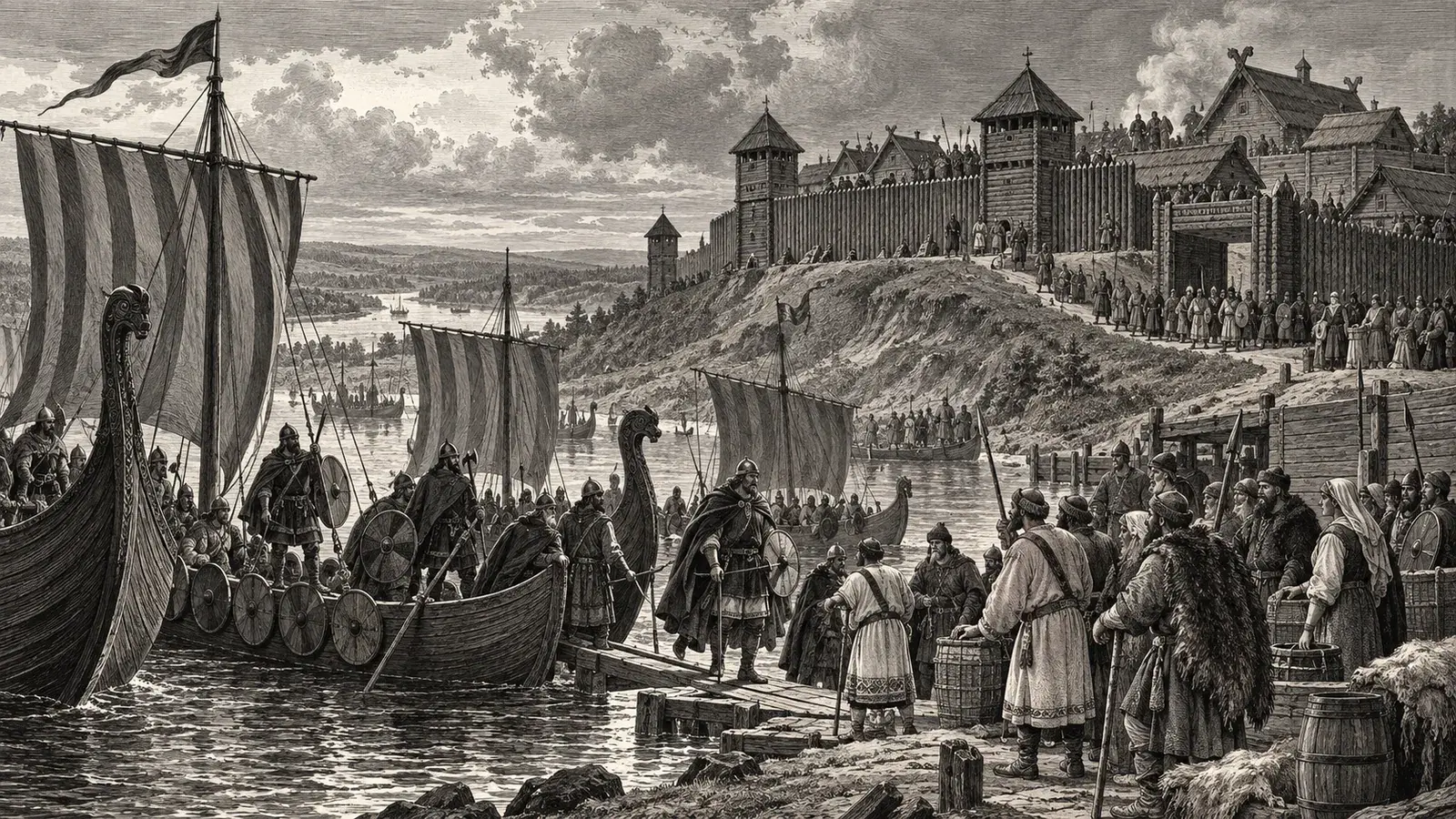
Europe wasn't the only place caught in the Viking flood. Across the sea in Britain, where the Angles and Saxons had been building a peaceful life for four hundred years, the fierce Northmen came in their black dragon ships. Britain had been invaded before — by Romans, Picts, Scots, and Saxons. But this was different, because it never seemed to end. Winning one battle was useless; the enemy would just attack somewhere else with a bigger fleet. It felt like all the barbarians in the world were landing on their shores.
Alfred came to the throne of the West Saxons at twenty-two, after the Danes killed his brother the king in battle.
A Scout Around Every Corner
One old writer painted a vivid picture of how impossible the situation was. A king would be racing east to meet the Danes when a breathless scout would arrive: "Sir King, where are you marching? The heathen have landed in the South, a countless fleet. Towns are in flames." The very same day, another scout: "Sir King, why do you turn? A fearsome host has come ashore in the West." The next morning, a third: "In the North the Danes have raided. They're burning your homes right now." It's no wonder kings and people lost heart. Into this chaos came young Alfred, made king of the West Saxons at twenty-two because the Danes had killed his brother in battle. He cared more about learning and peace than any king before him, but he had no choice except to fight.
The Lowest Point
Alfred fought nine battles in his first year alone. But over time, the Danes weren't just raiding — they were bringing their families and settling in. They conquered more and more, until they held over two-thirds of England. Then, in midwinter of the year 878, Danish kings swept across the land of the West Saxons "covering the face of the earth like locusts." Almost everyone was driven out or forced to submit — everyone except King Alfred. With a small band, he escaped into the woods and then into the salt marshes, to a tiny island called Athelney, the "Isle of Nobles." It was surrounded by swamp on all sides, reachable only by boat, with a patch of open ground barely two acres wide. Here the king of England came to hide, with just a few loyal followers.
The Burnt Cakes and the Disguised Minstrel
Many famous stories come from these three desperate months. They may not be exactly true, but they show how people imagined their hero. In one, Alfred took shelter in a goatherd's hut. The man's wife, not knowing he was the king, left him to watch some cakes baking on the hearth. Lost in his worries, Alfred let them burn — and the woman scolded him soundly. The king of England took the scolding meekly, because he knew he deserved it. In another tale, Alfred disguised himself as a traveling minstrel and slipped into the Danish camp. He played and sang so well that they brought him to the tent of the Danish king, Guthrum, who was charmed and wanted him to stay. Little did Guthrum know he'd soon face this same "minstrel" on the battlefield. Alfred learned everything he needed about the Danes' strength and returned to his people.
Legend says Alfred sneaked into the Danish camp disguised as a minstrel, charming the enemy while secretly learning their plans.
The Comeback and the Victory
Alfred wasn't deserted for long. Word came that the Danes had been beaten in Devon and had lost their prized Raven banner. So Alfred rode out to a meeting place called Egbert's Stone, and the people of the surrounding counties — those who hadn't fled overseas in fear — gathered to him. When they saw their king, they were filled with joy, hailing him "as one alive again from the dead." Three days later, Alfred met a mighty Danish force at a place called Ethandune (Edington). The two nations fought all day long, and in the end, Alfred won. The defeated Danes begged for mercy — for peace, for relief from hunger and cold. And in the kindness of his heart, Alfred gave it to them.
The Wise Peace of Wedmore
Alfred's true greatness showed in what he did next. He made the famous Treaty of Wedmore. As part of it, the Danish king Guthrum agreed to become a Christian. Seven weeks after the battle, Guthrum and thirty of his best nobles came to be baptized, and Alfred himself stood as godfather to his former enemy, giving him a new English name. The peace set boundaries between Alfred's land and Guthrum's, and made laws so the Danes and the English could trade and live together. Best of all, neither side was to treat the other as a conquered people — both were to be equal before the law. Alfred understood something important: the Danes were never going to be fully driven out, so the English had to accept them as neighbors and treat them fairly. Peace didn't come all at once, and Alfred had to fight again over the years. But in this treaty lies the beginning of a united England. Remember him not just as a warrior, but as the wise king who turned invaders into neighbors.
Through the Treaty of Wedmore, Alfred made peace with the Danes and stood as godfather to their king Guthrum — laying the foundation for a united England.