Legend tells of a palace built inside a cave in the heart of Spain, back in the old days of magic. Inside this palace, the story goes, was hidden the fate of the Gothic kingdom — and a king named Roderick lost everything because he unlocked its secret. An ancient prophecy had warned that one day, invaders would cross from Africa and conquer Spain. Long ago, a wise old king used his magic to delay that terrible day. He built a maze-like palace inside the cave and placed a secret charm in the innermost room. As long as the charm stayed hidden and undisturbed, Spain would be safe from invasion.
According to legend, every king of Spain added a new lock to the sealed palace door rather than open it — until thirty-two padlocks hung from the gate.
Thirty-Two Locks
A strong iron gate with a huge lock guarded the palace. And tradition held that every new king of Spain, on the day he took the throne, would add one more lock to the gate instead of opening it. By the time Roderick became king, thirty-two padlocks — most of them rusty — hung from that door. By then the Goths had lost much of their old strength. Two hundred years after Theodoric, only in Spain did they still rule, and even there, the comfortable southern life of vineyards and palaces had made them soft. Roderick had seized the throne by force, but with the people's support, because they saw him as brave and bold.
"It Is No Charm, But a Treasure House"
When Roderick's turn came to add a lock, he shocked everyone by announcing he'd open the gate instead. He didn't believe the old story. "It's no magic charm, it's a treasure house," he told his worried advisers. "The old king was a miser who made up a spooky tale to hide his gold. My treasury is empty — I'd be a fool to let some rusty locks keep me from it." His counselors were so afraid that they offered to raise all the money he needed if he'd just leave the palace alone. But that only made Roderick more stubborn. "Now I'll surely go," he said. "It will never be said that the king of the Goths was stopped by fear."
What Was Inside
The locks were filed off, the hinges forced open, and Roderick walked in with a torch, his nervous followers behind him. Room after dusty room held no gold at all. Then he reached the final chamber. Inside was a marble urn holding a scroll, and on the wall, a brightly painted picture of strange horsemen on small Arabian horses. Some wore turbans; others had black hair hanging over their foreheads. All were dressed for war. Roderick read the scroll aloud: "Unfortunate king, it is an evil hour in which you have come. Whenever this room is entered and this scroll is read, the people in this picture shall invade the land and overturn the throne of its kings." As his voice echoed down the silent halls, his terrified courtiers heard it too. Roderick suddenly understood the painting — the turban-wearers and dark-haired warriors were the Arabs and Moors who had already conquered Africa and were eyeing Spain across the narrow strait. He had broken the spell. That night, an earthquake destroyed the cave palace.
In the palace's innermost room, Roderick found a painting of foreign horsemen and a scroll warning that they would soon invade and end Gothic rule.
The Battle of Guadalete
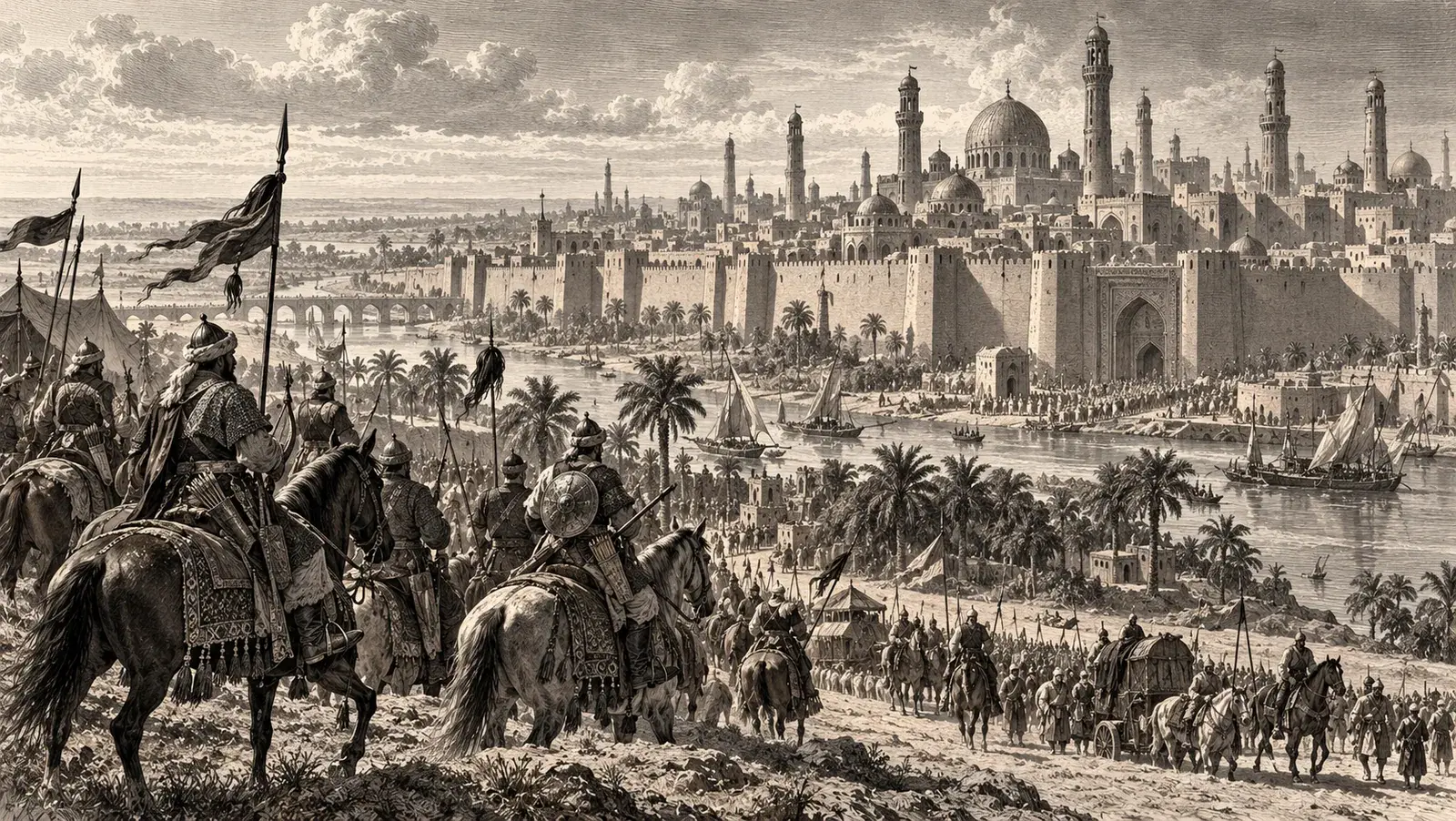
Within a year, the Arabs and Moors — whom Europeans called Saracens — crossed into Spain. A traitor Goth had given them their chance while Roderick was busy in the north. By the time he reached the south, they'd already landed in great numbers. Roderick rode to battle in true Spanish royal splendor, in a chariot of ivory drawn by white mules, wearing a robe sewn with pearls and a crown of gold. When the fighting began at Guadalete, he set aside his crown, put on a helmet, mounted his white war horse Orelia, and led from the front. Seeing the enemy, he reportedly gasped, "By the faith of the Messiah, those are the very men I saw painted on the palace walls."
The Vanishing King
The battle raged for three days. At first the Christians seemed to be winning. Then the tide turned, and the Goths were pushed back, back, back toward the mountains. Roderick was thrown from his horse and wandered the field, eventually casting off his royal mantle and jeweled sandals so the enemy wouldn't recognize him as king, before fleeing with the survivors. No one — Goth or Saracen — ever learned for sure what happened to him. One legend says he found his way to a monastery and lived out his days doing penance, and that two hundred years later a tomb was found with the words, "Here lies Roderick, last king of the Goths." His defeat at Guadalete ended three centuries of Gothic rule in Spain. Years earlier, the Goths had crushed the Huns in a single generation. But against the Saracens, the wise old saying went, the Teutons would have to fight for five hundred years.