The story of the Austronesian peoples is much bigger than one island or one community. It stretches across thousands of years and many parts of the world, from Taiwan to the islands of Polynesia and even to Madagascar near Africa. The ocean played the biggest role in their history. Instead of fighting for land, their story is about traveling, exploring, and learning to live with the sea. Their close relationship with the ocean helped them discover and settle some of the most distant places on Earth.
Ancient Austronesian navigators traveled across thousands of kilometers of open ocean using only the stars, waves, and wind.
Origins
When scholars talk about Austronesian peoples, they mean groups that are connected mainly by the languages they speak. These languages are used in places like Taiwan, the Philippines, Indonesia, Malaysia, Micronesia, Melanesia, Polynesia, coastal New Guinea, and Madagascar. Even though these places are far apart, millions of people still speak languages from this family. The huge spread of these languages shows how amazing their migration was. Long before modern tools existed, early Austronesian sailors learned how to read the stars, winds, waves, and clouds. They planned their trips carefully instead of drifting around. Their strong knowledge of the ocean helped them travel far and create connections between islands that were separated by great distances.
Taiwanese Homeland and the First Waves of Expansion
Most researchers widely agree on what is called the "Out of Taiwan" model. Around 3000 to 1500 BCE, early farming communities in Taiwan began to expand southward. They carried with them not only their languages but also agriculture, rituals, building traditions, and boat-making skills. Their first major stop was the northern Philippines, where new settlements took root. Over many generations, families moved further south and west into island Southeast Asia while others pushed eastward into the open Pacific. These migrations were not isolated waves of movement. They happened gradually, with different groups branching off, settling new places, and developing new cultures along the way. As they traveled, they encountered communities who had been living in these regions for tens of thousands of years. Rather than a single culture replacing another, histories intertwined. Marriages, shared knowledge, and blended traditions shaped the ancestry of many modern Austronesian-speaking peoples, especially in areas where they merged with Papuan and Negrito groups.
Austronesian migrations are believed to have begun in Taiwan as early farming communities expanded outward.
Navigating and Settling the Most Remote Corners of the World
The distances traveled by Austronesian navigators are truly amazing. To the east, they reached Easter Island, one of the most far-away places people have ever lived. To the south, they arrived in New Zealand, a land where no humans had lived before. To the west, they crossed the Indian Ocean and settled in Madagascar. Even though Madagascar is close to Africa, the main language spoken there is similar to languages in Southeast Asia, which shows just how far the Austronesian people traveled. These long journeys are even more impressive because they happened long before metal ships or modern navigation tools existed. The Austronesian people understood the ocean very well and built strong boats that could handle long trips. Their skills helped them explore distances that most ancient civilizations could not match.
Maritime Technology and the Evolution of Ocean‑Going Vessels
Austronesian societies created many different kinds of boats for fishing, trading, traveling, and long-distance journeys. At first, they may have used simple rafts made from logs. Over time, they experimented with new designs and shapes, which led to double-hulled canoes and the well-known outrigger canoes. These designs helped the boats stay steady even in rough waves. Most of these boats were made without any metal nails. Instead, builders carefully shaped wooden planks and tied them together with strong plant fibers. This made the boats flexible enough to bend with the waves without breaking. Their sails were often woven from plant leaves, which held up well in the salty sea air. In some places, people used catamarans—boats with two hulls connected together—for even longer trips. Many island communities still pass down this boat-building tradition today, keeping the ancient skills and knowledge alive.
Architecture, Daily Life, and Spiritual Spaces
The sea influenced almost every part of daily life for Austronesian peoples. Many of their villages were built near the ocean or along rivers because fishing and trading were important for survival. Their homes were usually built on stilts to protect them from floods, bugs, and animals. Raising the houses off the ground also helped keep them cool in hot weather. Some houses were even shaped like the boats people used. The roofs were curved like the bottom of a canoe, and many parts of the house had names related to sailing. In some places, the way villages were arranged came from boat designs, which shows how closely their lives were connected to the sea. These homes were not only for living in—they also had special meaning. People believed that certain parts of the house were sacred. Important family treasures or items linked to their ancestors were kept in high areas of the house. These spots were only visited during special ceremonies. Because the houses were made from wood, bamboo, and palm leaves, they needed to be repaired often. Today, archaeologists usually find only the holes where the posts once stood. But by studying old stories, carvings, and language, experts can still understand how these homes looked in the past.
Stilt houses protected families from flooding and reflected the maritime roots of Austronesian culture.
Trade Networks, Shifting Beliefs, and Developing Societies
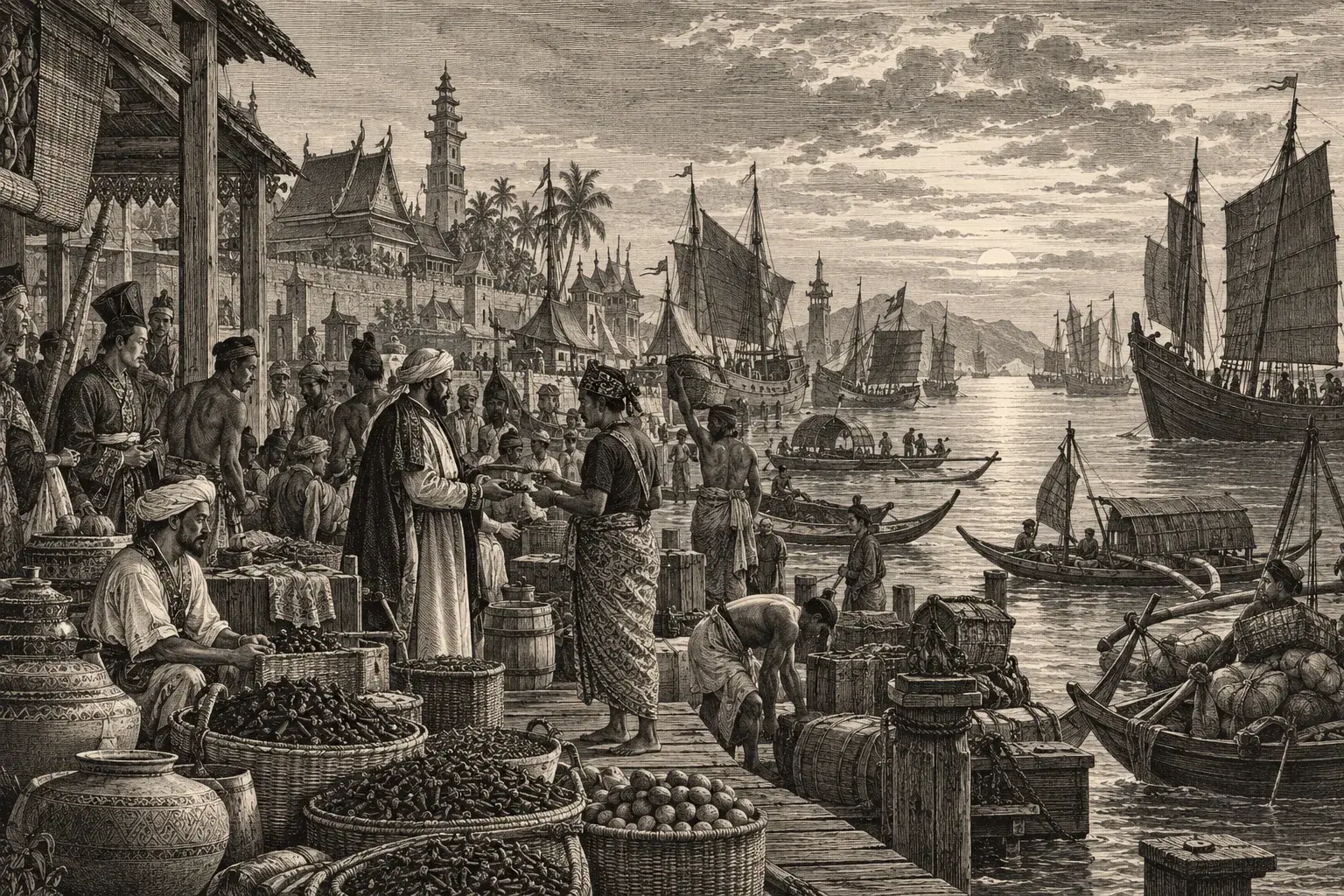
As centuries passed, Austronesian societies grew more complex. In Southeast Asia, coastal communities transformed into major trading powers, connecting India, China, and the Islamic world. With trade came the exchange of ideas, religion, and technology. Hinduism and Buddhism entered the region first, followed by Islam through merchant networks. In the Pacific, many communities maintained traditional belief systems, preserving rituals, navigation lore, and practices unique to each island. While some areas developed large political structures, others remained organized through clan networks led by elders and navigators. European arrival brought dramatic change. Driven by trade routes, spices, and territorial expansion, colonizing nations disrupted long-standing ways of life. Many communities faced hardship, conflict, and displacement. Yet despite these challenges, Austronesian cultures endured, adapting while preserving core traditions.