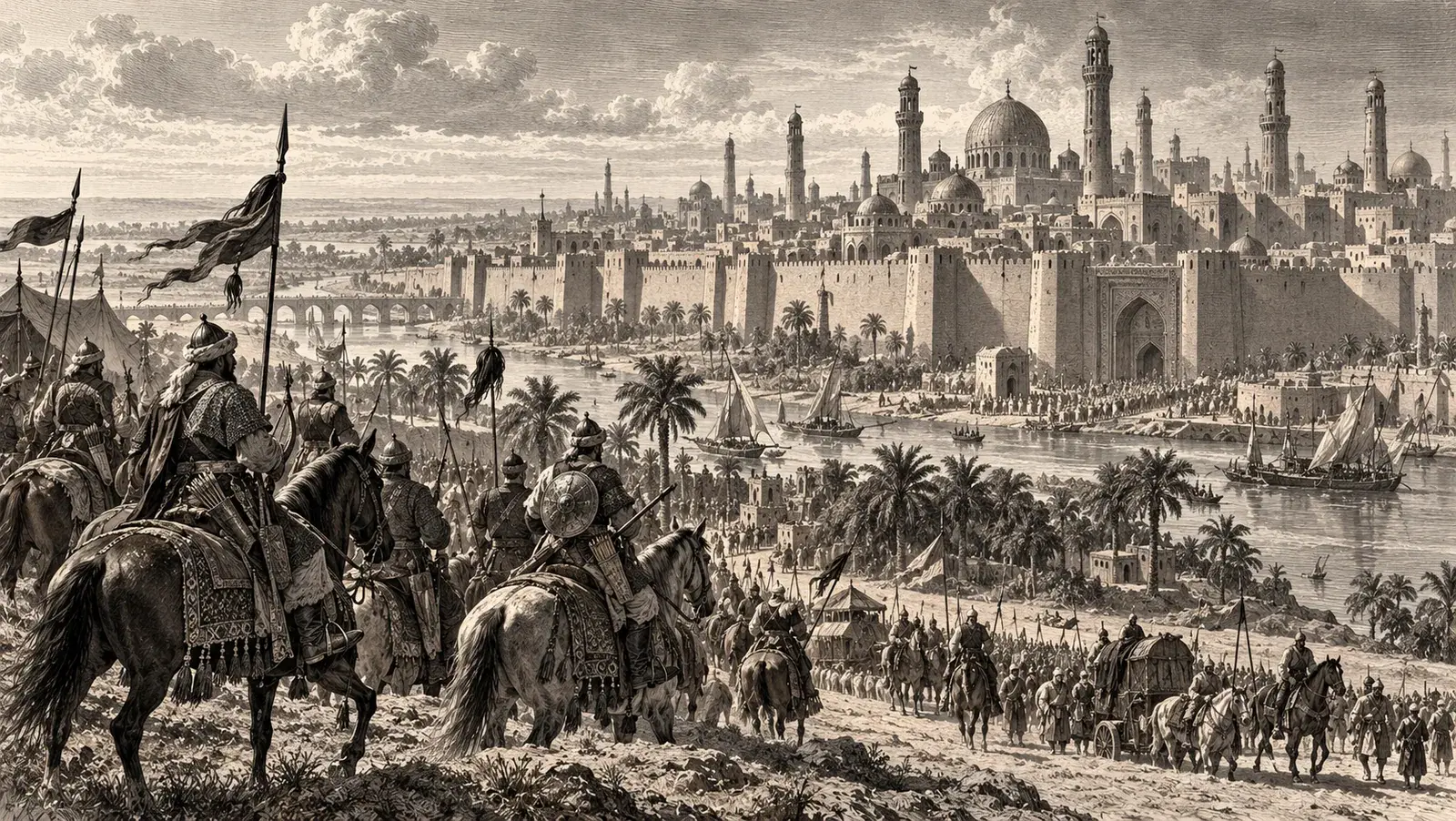
In the opening centuries of the Common Era, Rome stood as the undisputed master of the known world. From the Atlantic coast of Spain to the sands of Mesopotamia, from the deserts of North Africa to the misty forests beyond the Rhine, the Roman Empire stretched across continents. The Mediterranean was effectively a Roman lake, its trade routes safeguarded by Roman fleets, its ports linked together in a network of power, commerce, and culture. Rome itself, settled on its seven hills, was more than just a city—it was the beating heart of this vast empire. For centuries, no rival dared challenge its supremacy. It was, quite literally, the center of the world. That perception of invincibility, however, would not last forever. In 330 CE, the emperor Constantine made a bold decision that signaled change. He shifted the center of imperial power eastward, founding a new capital on the shores of the Bosphorus. Known first as “New Rome,” it soon became famous as Constantinople, the city of Constantine. Strongly fortified and strategically located between Europe and Asia, Constantinople would later survive as a bastion of Christianity even after Rome itself fell into ruin.
Barbarians and the Fall of Rome
Weakness at the Heart of Empire
Rome’s power seemed unshakable, but cracks in the mighty structure soon began to appear. Tyranny and corruption had eaten into the empire from within. Greedy officials and tax collectors burdened ordinary citizens with crushing taxes. The once-thriving middle classes—the very backbone of Roman society—were slowly destroyed under the weight of this oppression. Without a stable middle class, the empire’s strength weakened from the inside. At the same time, external threats loomed on the horizon. Beyond Rome’s borders lived tribes that the Romans dismissed as “barbarians.” To Roman eyes, these outsiders lacked refinement, discipline, and culture. They were thought unworthy of being considered equals. Yet, in the centuries that followed, these same “barbarians” would bring Rome to its knees.
Division of the Empire
After the death of Emperor Theodosius in 395 CE, the empire was divided between his two young sons. Arcadius ruled the Eastern Empire from Constantinople, while his eleven-year-old brother Honorius governed the Western Empire with Rome as his capital. This division would prove fateful. While the Eastern Empire grew wealthier and more resilient, the Western Empire became increasingly vulnerable. It was upon Rome and the western provinces that the great waves of barbarian invasions would fall most heavily.
Goths and the March of Alaric
The first great blow came from the Goths, a Germanic people divided into two main branches: the Visigoths (western Goths) and the Ostrogoths (eastern Goths). Tall, fair-haired, and formidable in battle, the Goths had originally fled westward, seeking refuge from an even more fearsome enemy—the Huns of Central Asia. Rome initially granted them protection, but uneasy coexistence soon turned to hostility. Under the leadership of their ambitious young king Alaric, the Visigoths launched repeated assaults on the Roman heartlands. Twice Alaric marched on Rome and twice he spared the city. But in 410 CE, on his third attempt, he unleashed his fury. The Visigoths stormed into Rome, plundering its treasures and humiliating the once-proud capital. It was the first time in eight centuries that the Eternal City had fallen to an enemy. Alaric’s triumph was short-lived. He died soon after, leaving his followers without their charismatic leader. His successor, Ataulf, abandoned plans to conquer Africa and instead led the Goths into southern Gaul and Spain, where they eventually settled. Yet the psychological blow had been dealt—the city that had once ruled the world was no longer untouchable.
Goths and the March of Alaric
New Invaders: Franks, Vandals, and Saxons
Rome’s weakened defenses opened the way for other tribes to pour across its frontiers. With legions recalled from distant provinces to defend Italy itself, the empire’s borders were left vulnerable. Across Hadrian’s Wall stormed the Picts and Scots, while along the Rhine and Danube came the Franks, Burgundians, Vandals, Lombards, and Allemanni. Each of these groups left their mark on the map of Europe. The Franks settled in Gaul, laying the foundations of what would become France. The Burgundians carved out a homeland that still echoes in the name “Burgundy.” The Vandals pushed into Spain, giving their name to modern Andalusia (once Vandalusia), before crossing into North Africa where they built a maritime empire. The Lombards swept into northern Italy, their name still preserved in the region of Lombardy. Across the sea, the Angles and Saxons crossed into Britain, reshaping its language, culture, and even its name—England, the land of the Angles. From the ruins of Rome, a new Europe of Germanic kingdoms began to emerge. But even more terrifying than the Germanic tribes was a new enemy rising out of the East.
New Invaders: Franks, Vandals, and Saxons
The Scourge of God: Attila and the Huns
The Huns were unlike any foe Rome had faced before. Nomadic warriors from the steppes of Asia, they lived almost entirely on horseback. Small in stature but fierce in appearance, with scarred faces and piercing eyes, they struck terror into all who encountered them. They plundered rather than farmed, feasting on raw meat and clothing themselves in animal skins. To settled peoples, the Huns seemed less than human, more like forces of nature than men. Their most feared leader was Attila, remembered by history as “the Scourge of God.” Though not physically imposing, Attila possessed immense authority and a ruthless will. He boasted that where his horse had trod, grass would never grow again. His campaigns left swathes of Europe in ashes, and no city felt safe from his wrath. In 451 CE, Attila invaded Gaul. There, an unlikely alliance formed: Romans, Visigoths, Franks, and Burgundians put aside their rivalries to face the common threat. On the plains near Chalons, one of the bloodiest battles of the ancient world was fought. Though Attila’s forces were not utterly crushed, they were driven back. The battle showed that Europe’s destiny would belong not to the Huns, but to the Christian Romans and their Germanic allies.
The Meeting with Pope Leo
Not long after, Attila turned his fury on Italy. City after city fell, and the path to Rome lay open. But in 452 CE, something remarkable occurred. As Attila approached, Pope Leo I went out to meet him near the River Mincio. Armed only with words and faith, Leo confronted the conqueror who had terrified all Europe. What passed between them remains a mystery. Some say it was Leo’s eloquence that moved Attila. Others whisper that the pope carried with him gold to secure peace. Later Christian writers claimed that Attila saw a vision of saints and angels beside Leo, warning him not to touch the holy city. Whatever the truth, the result was astonishing—Attila turned back, sparing Rome. “I can conquer men,” Attila reportedly said, “but the Lion (Leo) knows how to conquer me.” Soon after, famine and disease ravaged the Hun armies. Within a year Attila was dead, and his empire disintegrated almost overnight. The Huns faded from Europe’s stage as quickly as they had appeared.
Legacy
The fall of the Western Roman Empire was not a single event but a long and painful unraveling. Corruption and weakness at the heart of Rome combined with relentless pressure from outside to bring down what once seemed eternal. By the end of the 5th century, Rome was no longer the mistress of the world but a broken remnant of her former glory.