Empires don't end on the day they lose their last battle. They end in the years before it — in the deserting officials and disloyal governors, the exhausted treasury, the army built from farmers rather than soldiers, the emperor fleeing east toward people who won't receive him. By the time the Sasanian army met the Rashidun forces at Nahavand in 642 CE, the Persian Empire had already been bleeding out for years. The battle itself was the point where everyone could see it clearly. The Arab commander Nu'man ibn Muqarrin brought roughly 30,000 warriors into the mountain country of western Iran. The Sasanians, under a general named Firūzān, fielded somewhere between 50,000 and 150,000 men — the ancient sources disagree significantly on the number, but everyone agrees the Persians outnumbered the Arabs substantially. By the end of the fighting, that numerical advantage had meant nothing. The Sasanian force was destroyed. Firūzān was dead. Nu'man was dead. And the organized military capacity of one of the ancient world's most durable empires was gone. What the Arabs called the Conquest of Conquests, later historians would recognize as one of the decisive turning points of the medieval world.
The Battle of Nahavand in 642 CE brought the Rashidun Caliphate's forces under Nu'man ibn Muqarrin into a decisive confrontation with the last substantial Sasanian army — fought in mountain passes in western Iran, the battle ended in a catastrophic Persian defeat that effectively closed four centuries of Sasanian imperial rule.
How the Arab Armies Got This Far This Fast
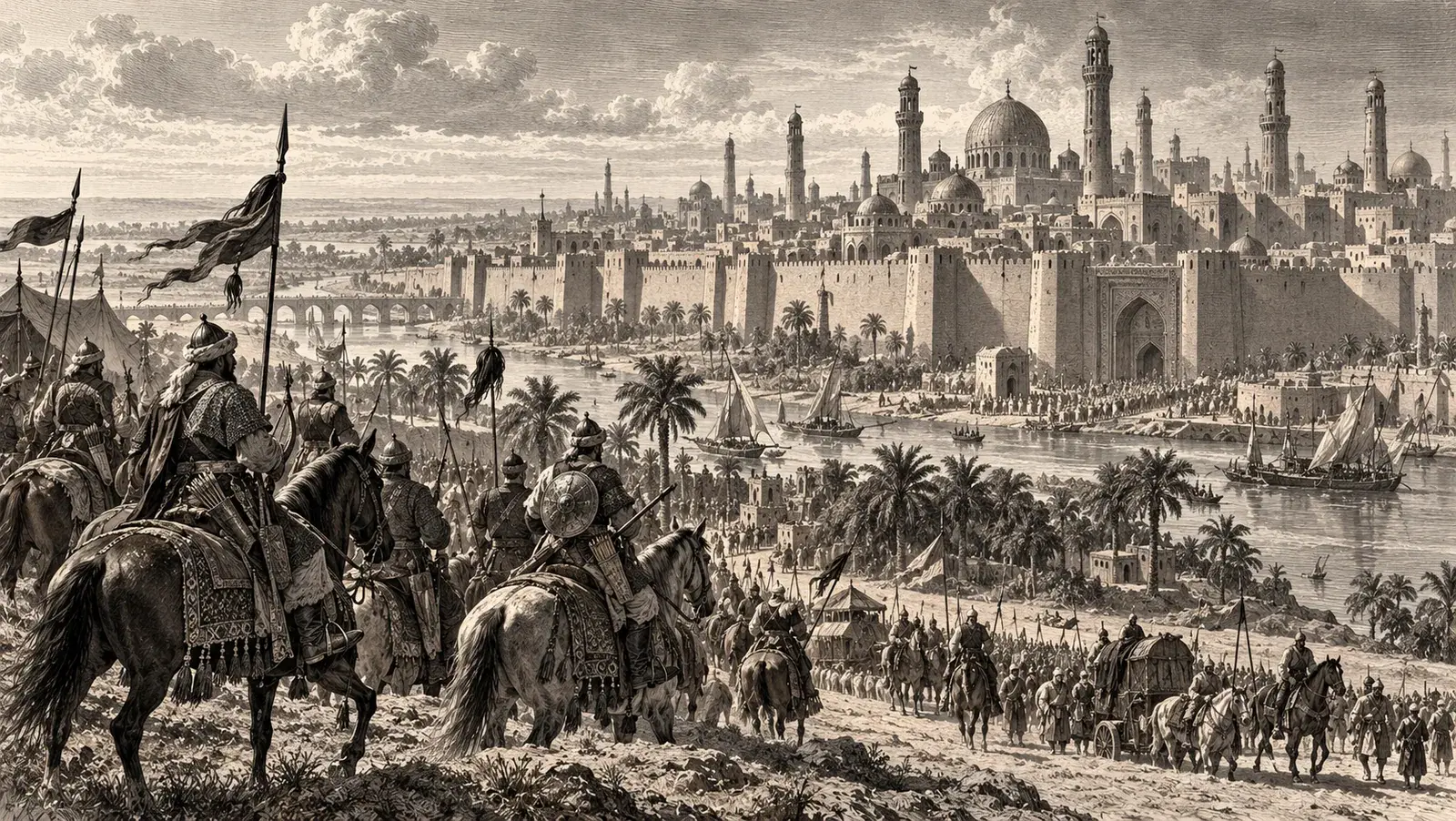
When the Prophet Muhammad died in 632, Islam was dominant in the Hejaz — western Arabia — and little else. A decade later, Arab Muslim armies were fighting on the borders of two of the ancient world's surviving superpowers simultaneously. The speed of expansion under the first two caliphs, Abu Bakr and Umar, was built on a particular combination of circumstances. Both the Byzantine and Sasanian empires had spent the previous decades grinding against each other in a series of wars that left both exhausted, financially strained, and dealing with internal problems they hadn't fully resolved. When the Arab armies moved against them, they were hitting opponents who were already weakened in ways that didn't show on the surface. The East Romans fell first in the west — their army was decisively defeated at the Battle of Yarmouk in 636, which freed the Arab forces to push east. In November of the same year, a Sasanian army was beaten at the Battle of Qadisiya, and Iraq — the wealthy agricultural heartland of the Persian empire — passed to Muslim control. Yazdegerd III, the last Sasanian king, was forced to abandon Ctesiphon, his capital on the Tigris that had been one of the ancient world's great cities. He withdrew south and east onto the Iranian plateau, pulling together what he could from the remains of an empire that was losing coherence around him.
The Rashidun Caliphate's expansion in the decade after 632 CE moved against two exhausted superpowers simultaneously — the Byzantines defeated at Yarmouk in 636, the Sasanians at Qadisiya the same year — opening the path that eventually led Arab forces into the Iranian heartland at Nahavand in 642.
The Army Yazdegerd Put Together — and What It Was Made Of
By 642 Yazdegerd had managed to assemble a new army — a replacement for the force lost at Qadisiya six years earlier. The numbers in the sources vary wildly, from 50,000 on the lower end to 150,000 at the high end, and historians have spent considerable time arguing about what the real figure was. What is agreed on is that this army was significantly larger than the Arab force it would face. The problem was quality. The men who filled out the Sasanian ranks at Nahavand were described by contemporaries as mostly farmers and villagers rather than veteran soldiers. The professional military class of the Sasanian Empire — the heavily armed cavalry, the trained infantry, the experienced officers — had taken serious losses at Qadisiya and in the years of fighting before it. What Yazdegerd scraped together was a large force built on numbers rather than experience. Command was given to Firūzān, but the structural problems of the Sasanian military didn't disappear because a capable general was in charge. The army was drawn from decentralized sources, led by an alliance of feudal nobles who had their own interests and loyalties, and held together by obligation rather than the kind of institutional cohesion that produces disciplined battlefield behavior under pressure. An ominous sign for what was coming: many Sasanian nobles were reportedly deserting Yazdegerd's cause even before the battle began. Military and civilian officials had already walked away from the emperor. The empire was contracting around him while he tried to fight.
The Battle — How the Arabs Won Against Superior Numbers
The accounts of what happened at Nahavand vary between sources, but the core tactical story that emerges from the more detailed versions is consistent enough to work with. Firūzān had positioned his larger army in a strong defensive location. Holding the high ground with a numerically superior force is normally a significant advantage — it forces the attacker to come uphill, channels their advance, and gives the defender the ability to dictate the early terms of the engagement. For a well-disciplined army, a strong defensive position with these numbers behind it should have been difficult to dislodge. But Nu'man understood the structural weakness of the force he was facing. A feudal coalition of nobles and their levies, drawn from across a disintegrating empire, was not going to hold a passive defensive position indefinitely. The motivation to stay put and absorb punishment simply wasn't there in the way it would be for a professional standing army with institutional loyalty. He drew them out. The Arab forces made skirmishing advances — enough pressure to provoke a response — and then conducted a disciplined withdrawal. The Persians, either reading this as a genuine retreat or simply unable to resist the momentum of pursuit, came down from their position and followed. Firūzān found his cavalry spread out across rough terrain, moving through narrow mountain passes, in extended order — exactly the conditions in which cavalry loses its cohesion and becomes difficult to coordinate. At that point the Arabs turned around and counterattacked. The fighting was serious — the Sasanians were caught in difficult ground but they were numerous, and the battle ran for two days and three nights with heavy losses on both sides. In the end the Persian force broke. Both Nu'man and Firūzān died in the final engagement. The Sasanian defeat was total.
Nu'man ibn Muqarrin's tactical approach at Nahavand — drawing the numerically superior Sasanian force down from its defensive position through controlled skirmishing and retreat, then counterattacking when the Persians were spread across rough mountain terrain — produced a complete destruction of the last major Sasanian field army.
What Came Apart After — Yazdegerd's Last Years
Nahavand marked something beyond a military defeat. The last of the grand marshals of the Sasanian army died in the battle, and with them the institutional command structure that had given the empire its military coherence. What followed was warlordism — regional strongmen operating on their own terms rather than under any unified imperial direction. Yazdegerd fled east. He tried everything. He sent appeals to the princes of Tukharistan and Sogdia. He dispatched his son Peroz III to the court of Tang Dynasty China, asking for help. None of these efforts produced results. China was far away and Tang foreign policy had limits. The eastern princes had their own problems and their own calculations. Back in Persia, the reception the fleeing emperor received from his own officials told the story of how completely the Sasanian imperial system had collapsed. Provincial governors who should have been loyal subjects treated him with open hostility. The governor of Merv — a man named Mahoye — made no effort to hide his contempt. Non-Muslim sources of the period recorded that in eastern Persia, the Sasanian dynasty had never been particularly popular with local populations, and Yazdegerd arriving as a fugitive without an army was not going to change that. The province of Khorasan had already shown it was willing to revolt against Sasanian rule — it had done so years earlier by siding with Khosrau II's uncle against him. When Yazdegerd had been crowned, Persia already had three kings ruling different regions simultaneously. The empire had been fragmenting long before Nahavand. The battle just made the fragmentation irreversible. In 651, nine years after Nahavand, Yazdegerd III was assassinated by a local miller at Merv. The last Sasanian emperor died violently at the hands of an ordinary man, in a province that didn't want him, far from the capital his ancestors had built. His son Peroz eventually died in China, having accomplished nothing in his attempts to restore the dynasty. The Sasanian imperial line ended without a restoration, without a successor state, without even a dignified final act.
After Nahavand, Yazdegerd III spent nine years as a fugitive in his own former empire — rejected by provincial governors, unable to raise another army, sending his son on fruitless missions to Tang China — before being assassinated by a local miller at Merv in 651, ending the Sasanian dynasty without a restoration.
What Survived — Persian Identity Under Arab Rule
The political collapse of the Sasanian Empire after Nahavand was real and rapid. The religious and cultural transformation of Persia that followed took considerably longer, and it never fully erased what had been there before. In the region south of the Caspian Sea, former Sasanian provincial structures — in alliance with Parthian and White Hun nobles — continued resisting Arab rule for roughly a century. The Rashidun Caliphate that won at Nahavand gave way to the Umayyad Caliphate, and still this resistance continued, preserving Sasanian court traditions, Zoroastrian religious practice, and the Persian language through the transition. Persia converted to Islam gradually, under pressure, and with significant regional variation in how that conversion happened and how quickly. But the Persian language survived. Persian literary and administrative culture survived. The architectural and artistic traditions of the Sasanian period fed directly into the Abbasid caliphate that eventually replaced the Umayyads, and Persian scholars and administrators became central figures in the intellectual life of Islamic civilization. The empire that Nahavand ended was gone. The civilization it had shaped was not. That distinction matters when thinking about what the battle actually meant — not just as a military event, but as the hinge point between two eras in the long history of a place and a people that neither conquest nor conversion could simply erase.
Despite the military collapse that followed Nahavand, former Sasanian nobles and regional powers resisted Arab rule in the Caspian region for nearly a century — preserving Zoroastrian religious practice, Sasanian court culture, and the Persian language through a political transition that changed who ruled Persia but could not erase what Persia had been.