The Suez Canal does not look like much on a map. A thin blue line cutting through the northeastern corner of Africa, roughly a hundred miles long, connecting the Mediterranean to the Red Sea. You could drive its length in under two hours. And yet for the better part of a century, that blue line was arguably the single most contested piece of real estate on earth — the reason Britain went to war in 1882, the reason it stayed in Egypt for decades after promising to leave, and ultimately the reason its postwar government collapsed in disgrace in 1956. This is a story about a ditch. But it is also a story about what happens when a country mistakes a trade route for an identity.
The Suez Canal cuts roughly a hundred miles through the Egyptian isthmus, eliminating the long voyage around the Cape of Good Hope and saving ships thousands of miles of travel between Europe and Asia.
The Long Way Round — Why the Canal Mattered
Before the canal existed, a ship sailing from London to Bombay had one option: down the Atlantic, around the Cape of Good Hope at the southern tip of Africa, back up through the Indian Ocean. It was not just slow. It was punishing — thousands of extra miles through notoriously rough water, with the additional problem that sailing ships performed poorly in the light and unpredictable winds of the Red Sea. The idea of cutting a waterway through the isthmus of Suez to link the two seas is genuinely ancient — there are records of earlier rulers attempting versions of it going back to antiquity. What changed in the nineteenth century was the combination of industrial machinery, organised labour on a large scale, and the will to actually finance it. Before the canal was built, a partial workaround existed. From the 1840s, travellers could cross the isthmus overland — ship to Alexandria on the Mediterranean coast, then by river boat and camel transport down to Suez on the Red Sea coast, then aboard another vessel for the onward journey. A British officer, Lieutenant Waghorn, developed this route. It was cumbersome, unsuitable for heavy cargo, and nobody's idea of comfortable travel. But it still saved roughly four weeks compared to the Cape route. In the 1850s, George Stephenson — the same man who built the world's first steam passenger railway — constructed a railway line from Alexandria to Cairo, which improved things somewhat. A proper canal would obviously do what none of that patchwork could: let the same ship carry any cargo at all from one end of the route to the other, cutting around 3,000 sea miles off the journey between London and Bombay alone.
The French Built It. The British Didn't Want Them To.
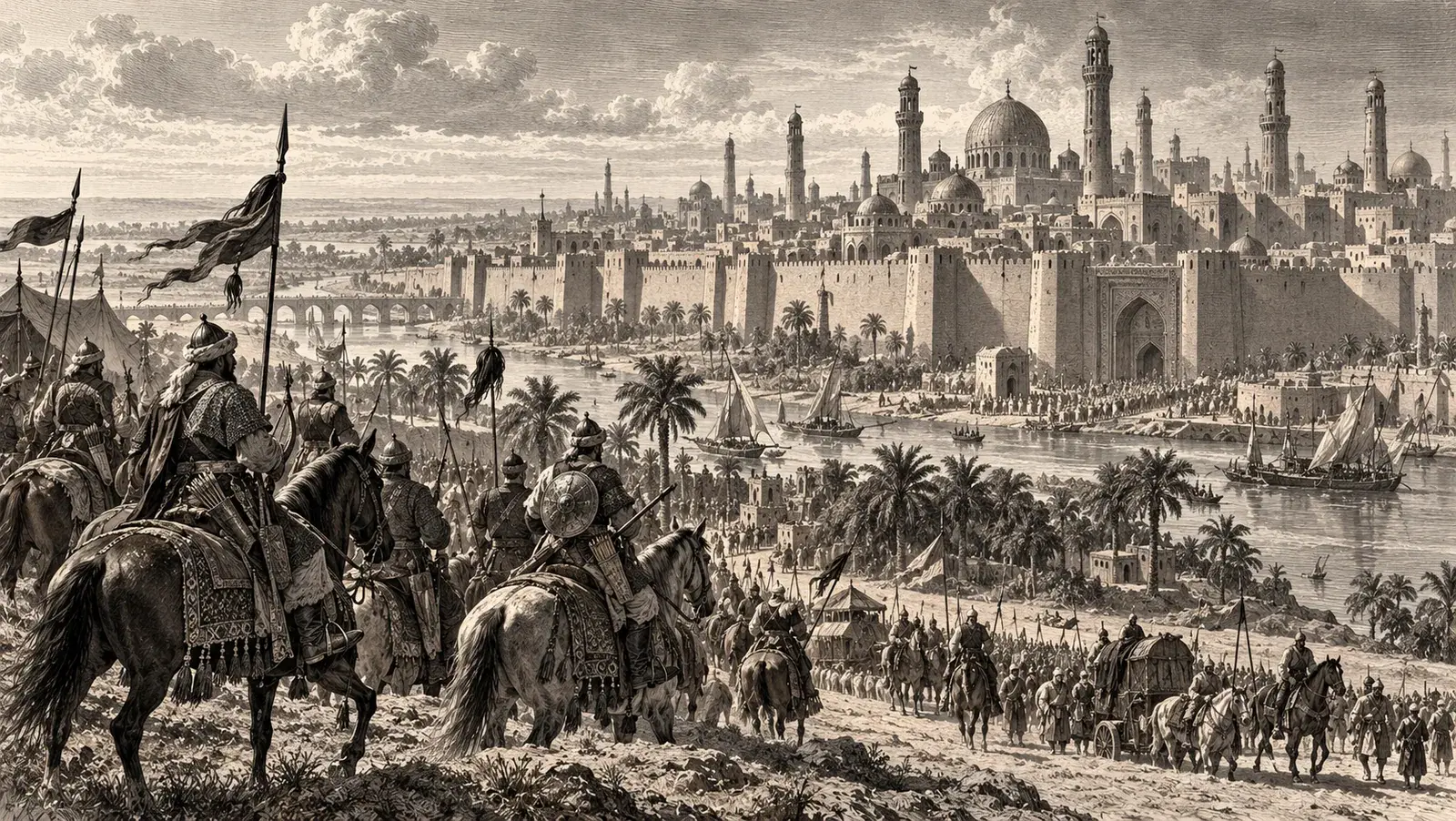
The Suez Canal was built by a private French company — the Compagnie Universelle du Canal Maritime de Suez — starting in 1859. The Egyptian government leased the land for 99 years and held roughly 45% of the company's shares. The British, oddly enough, opposed the whole project. Their reasoning was not principled — it was paranoid. They worried that a rival European power could seize control of the canal and either block British shipping or use it to threaten British colonial possessions elsewhere. They also doubted it could be done. Both concerns turned out to be wrong. The project was driven by the French engineer Ferdinand de Lesseps, who had the technical imagination and the administrative persistence to actually see it through. The terrain was mostly flat sand — no locks required, unlike the Panama Canal that would be built decades later. Egyptian labour did the physical work. The canal opened in November 1869, with a ceremony elaborate enough to suggest its builders understood they had just changed the world. They had. The timing proved lucky in a way nobody had planned: steamships were becoming commercially dominant at precisely the moment the canal opened, and steamships were far better suited to the canal than sailing vessels. Sail ships still made up 90% of the British merchant fleet when the canal opened, so the Cape route remained viable for years. But as steam steadily replaced sail through the 1870s and 1880s, the canal's traffic grew at a rate that made its importance impossible to dispute. In the canal's first full year of operation, roughly 436,000 tons of shipping passed through. A decade later, that figure was above five million tons.
Ferdinand de Lesseps drove the Suez Canal project from conception through completion, overseeing a decade of excavation through Egyptian desert before the canal opened in 1869 — Britain had opposed the project throughout.
The Takeover — Britain Bombs Its Way In
By 1875, cash was running short for the Egyptian ruler, the khedive, who sold his 177,000 shares in the canal company — nearly half of them — to the British government for £4 million. Britain now had a major financial stake in the waterway it had previously tried to prevent from being built. Seven years later, it had the whole thing. The justification Britain offered for seizing the canal in 1882 was, on its face, a security concern. Egypt, nominally part of the crumbling Ottoman Empire, had run itself into financial ruin through expensive colonial expeditions in Sudan. A nationalist movement — led by Ahmed Urabi — had risen against the Egyptian government and its foreign creditors. Britain argued that order needed to be restored and the canal protected. What actually happened was a bombardment. A British naval force shelled Alexandria for ten hours on 11 July, firing roughly 3,000 shells. A land force of 40,000 men, under the command of General Garnet Wolseley, then captured the canal itself. On 13 September, at the Battle of Tel-el-Kebir, Wolseley crushed the nationalist revolt. Urabi was shipped off to Ceylon. A garrison of 5,000 British troops settled in. The French, who had long viewed Egypt as their own sphere of influence, had also wanted to intervene militarily. Their National Assembly declined to authorise it. So the British went in alone and got what they wanted. The argument Britain made to legitimise all of this — beyond the brute fact of the shells — was partly financial. It owned a large block of canal shares. It could point out that 82% of the shipping passing through the canal was British-owned, and that 13% of all Britain's global trade moved through that waterway. These numbers were real. They did not change what the bombardment of a city was.
Occupation Without the Name
The British government had not gone into Egypt intending to stay. The original plan was a short, stabilising intervention after which they would leave. But stabilisation is easier to declare than to achieve, and the underlying financial and political problems — Egypt's debts, the fragility of its government, European rivalry over influence in the region — did not resolve themselves just because Britain had troops on the ground. So the temporary became permanent, dressed up in what the historian P. Curtin called 'a variety of legal fictions.' Britain did not declare Egypt a colony. It kept the khedive in place. It maintained the formal structures of Egyptian governance. But the British Agent and Consul-General in Cairo held more actual power than any Egyptian official. He could appoint and dismiss government ministers, including the prime minister. His advice was not really advice — it was instruction. The exception to British non-interference was commercial matters, which is to say the things Britain actually cared about. Local government, the legal system, the police — these were mostly left to Egyptian administration. The canal and the finances were not. France was furious, and not quietly so. The diplomatic fallout contributed to the Berlin Conference of 1884-5, where European powers attempted to set rules for colonising Africa — a gathering that effectively launched or dramatically accelerated what became the Scramble for Africa. The ongoing friction between Britain and France over Egypt flared up again in 1898 at Fashoda, in southern Sudan, where French explorers had planted their flag and British forces arrived shortly after. France backed down. But the bad feeling between the two countries persisted until the Entente Cordiale of 1904 patched things over. By 1888, Britain had quietly concluded it would stay in Egypt indefinitely. To avoid alarming other European powers, it signed the Suez Canal Convention that year, which committed the canal to international neutrality — a promise that would be convenient to cite when others threatened it, and equally convenient to ignore when Britain chose to.
Britain entered Egypt in 1882 promising a short stabilising presence. What followed was decades of occupation maintained through legal fictions that kept the khedive nominally in charge while British officials held real power.
War, Oil, and the Reluctance to Let Go
Britain declared Egypt a formal protectorate in 1914, when the First World War made the diplomatic niceties of the previous arrangement impractical to maintain. The Ottoman Empire — of which Egypt had nominally been part — entered the war on the opposing side, which simplified things considerably from Britain's point of view. After the war, the arrangement unwound slowly. Egypt gained independence in 1922, though Britain kept control over foreign policy and defence. British military occupation officially ended in 1936 under the Anglo-Egyptian Treaty. Except for the canal. The Suez Canal Zone kept a British garrison of around 38,000 military personnel. That is a large number of soldiers for a country that has technically left. The canal's strategic importance had not diminished with independence. If anything, the 1930s made it more urgent — Italy was pursuing imperial ambitions in East Africa, Japan was expanding across Asia, and the canal remained the fastest route for moving British troops between those theatres. Through that decade, two-thirds of the ships passing through were British. The Second World War settled this question temporarily by making Egypt Britain's main military base in the Middle East and eastern Mediterranean. The most consequential battle of the North African campaign, at El Alamein in the autumn of 1942, was fought partly to ensure the canal stayed in British hands. General Bernard Montgomery's Eighth Army stopped Rommel's Afrika Korps there, and with it any serious Axis threat to the canal. After the war, India gained independence in 1947. The empire was evidently contracting. But the canal retained its importance for a different reason now — oil. Middle Eastern crude was the fuel keeping postwar Britain and Europe running, and the Suez Canal was the pipe through which most of that oil moved. Losing it was not an abstract strategic concern. It was an economic one.
Nasser and the Nationalisation That Changed Everything
Gamal Abdel Nasser took power in Egypt through a military coup in 1952 and pushed out King Farouk, who had reigned since 1936 and become deeply unpopular, not least for his accommodation of British interests. Nasser was a nationalist in the most direct sense — he thought Egypt should be run by Egyptians, for Egyptian purposes, without foreign hands on its most important assets. The immediate trigger for what followed was money. Nasser had plans for the Aswan High Dam, a major infrastructure project that would transform Egyptian agriculture by controlling the Nile's flooding. He needed outside financing. The United States and Britain agreed to provide it — then cancelled the offer in 1956 when it emerged that Nasser had been buying arms from the Soviet Union and other Eastern Bloc countries. From a Cold War perspective, Washington and London had decided he was not a sufficiently reliable client. Nasser's response came on 26 July 1956. In a speech in Alexandria, he announced the nationalisation of the Suez Canal Company. The canal's revenues would finance the Aswan Dam instead. The British prime minister Anthony Eden described Nasser as having his hand on British windpipes. It was not a measured response, but it was an honest one — it captured what the British government actually felt rather than what it could say in public. Eden believed that if Nasser was not removed, his brand of pan-Arab nationalism would spread through the Middle East and eventually push out every Western interest in the region, leaving the field open for Soviet expansion. He wrote to US President Eisenhower making exactly this argument. Eisenhower was not persuaded. He thought his own public would not support military action, and he believed the United Nations should handle the dispute. There was also a more self-interested calculation: the United States was not sorry to see British influence in the Middle East weakening, since the two countries were competing for influence in the growing oil business there.
Nasser's announcement of the Suez Canal's nationalisation in July 1956 was partly retaliation for the US and Britain withdrawing funding for the Aswan Dam — and it set in motion the diplomatic and military crisis that would end Anthony Eden's career.
The Secret Plan and the Public Disaster
Without American backing, Britain, France, and Israel worked out their own arrangement — and they did so secretly. The plan, agreed at Sèvres in France in late October 1956 and given the operational name Musketeer, was constructed as a piece of theatre. Israel would attack Egypt. Britain and France would then issue a demand that both sides withdraw from the canal area, positioning themselves as neutral peacekeepers protecting an international waterway. Egypt would reject the ultimatum — the British and French were counting on that — and the two European powers would then intervene militarily, ostensibly to separate the combatants but in practice to seize the canal and, they hoped, bring down Nasser. Israel invaded Egypt on 29 October. The ultimatum went out. Egypt rejected it. British and French aircraft began bombing Egypt on 31 October. On 5 November, British and French troops landed near Port Said on the Mediterranean coast and pushed into the Canal Zone. Egypt's response to the ground assault was practical and effective: it sank ships in its section of the canal to block passage, which immediately defeated the ostensible purpose of the intervention. What nobody in London had adequately calculated was the reaction in Washington. Eisenhower was furious — genuinely, not diplomatically. The invasion happened during a US presidential election week and directly undercut the American position at the United Nations, where the US had been advocating for peaceful resolution. The United States and the Soviet Union both condemned the attack. A UN motion called for an immediate ceasefire. Then came the economic pressure. The pound came under serious attack on currency markets. The US refused to provide relief through the International Monetary Fund unless Britain agreed to withdraw. Britain's foreign exchange reserves were draining fast, and Washington was making clear it had no interest in saving them while British troops were still in Egypt. Britain declared a ceasefire after just two weeks. The withdrawal was complete by December 1956. The canal was cleared and reopened by the following April.
British and French paratroopers and ground forces landed near Port Said in November 1956 — but faced with US economic pressure and a UN ceasefire demand, the intervention collapsed within two weeks, forcing a humiliating withdrawal.
What Was Left When It Was Over
Anthony Eden resigned as prime minister in January 1957, citing health problems, though the real cause was not hard to identify. His reputation never recovered. The criticisms ranged from the practical — the military planning had been poor, the diplomatic groundwork worse — to the political, with serious questions raised about whether he had misled Parliament over the nature of Britain's involvement. The broader damage took longer to assess. Anglo-American relations were repaired over the following year, patched up by Harold Macmillan, who succeeded Eden and made rebuilding ties with Washington his first priority. But the damage to British credibility in the Arab world lasted much longer. Persian Gulf states that had watched Britain conspire militarily with Israel against an Arab country were not quick to forget it. The Suez Crisis did not cause the end of the British Empire — that process was already underway, and a wave of independence in British colonies continued through the late 1950s and 1960s largely along the trajectory it had been following. But the crisis made something explicit that had previously been possible to avoid saying plainly: Britain could not take significant military action in the world without American approval. The room to act independently, to project force, to defend what it called interests — all of that was gone, dependent now on a relationship with Washington rather than on its own capacity. For an empire that had built its identity partly on the ability to send a naval force anywhere on earth and do as it pleased, that was not a small thing to admit. The Suez Canal had been the artery of that empire. When Britain was finally pushed out of it, the empire it had sustained was, in every meaningful sense, already over.