Here is a fact that takes a moment to sit with: children playing in Thebes fifteen hundred years before the birth of Christ were playing with toys that worked on a string. Pull it, and a little man rolls dough back and forth on a board. There were also crocodiles — wooden ones — whose jaws opened and snapped shut. The children who owned these things had names. Tahuti. Sen-senb. They wore almost nothing because the Egyptian heat made clothing impractical. They got sick, and when they did, a doctor came and prescribed things that would make any modern parent go pale. They went to school at four years old and got beaten regularly by a teacher who believed, with complete sincerity, that a boy's ears were located somewhere on his back. And when school was finished for the day, they ran out shouting — which is something that has not changed in three thousand years, and probably never will.
Children in ancient Egypt played with jointed wooden toys, dolls, and ball games — and spent their afternoons on papyrus skiffs in the marshes when school was done. Daily life in pharaonic Thebes had more in common with the modern world than most people expect.
The First Years — Babies, Godmothers, and Three Years of Nursing
When a child was born in ancient Egypt, the occasion came with ceremony. There were figures known as the Hathors — divine beings who attended the birth and foretold what the child's life would hold. Think of them as the Egyptian version of fairy godmothers, which is not so far off: the idea of powerful figures presiding over a cradle and speaking the child's fate into being is old enough that nobody can say where it started. What came after the birth was a long stretch of physical closeness between mother and child that would look unusual today. Egyptian mothers nursed their babies for three full years — carrying them everywhere, either up on the shoulder or balanced across the hip. The bond was considered sacred. An old Egyptian text written as advice from father to son puts it plainly: the mother bore you, nursed you for three years, brought you to your teacher daily with bread and beer. If you forget her, she might lift her hands to God, and he would hear her complaint. That passage was not written as sentiment. It was practical instruction. In a society without the social infrastructure most modern people take for granted, the mother's investment in a child's survival was total and unambiguous — and the expectation of gratitude in return was equally total.
When the Doctor Came — Ancient Egyptian Medicine for Children
Egyptian doctors were not without knowledge. They understood quite a bit about wounds, fractures, and basic anatomy — enough that some of their surgical practices remained in use for centuries. But when it came to childhood illness, the gap between what they knew and what they prescribed could be alarming. Medicines for sick children sometimes included moisture scraped from pig's ears, lizard's blood, rotting meat, and decaying fat. These were not fringe remedies from back-country healers — they were the considered prescriptions of trained physicians. When a doctor looked at a feverish child and concluded that the problem was not physical illness but bewitchment, his prescription shifted accordingly. One recorded remedy for bewitchment: take a large beetle, remove the head and wings, boil the body in oil, then separately cook the head and wings in snake fat, combine everything, and have the patient drink the result. The alternative — a physician who skipped medicine entirely and simply wrote a few words on a scrap of papyrus, then tied it around the painful area — was probably no worse in effect and considerably more comfortable to receive. More interesting, perhaps, is what happened at night. Egyptian mothers believed that ghosts sometimes came to harm sleeping children — entering the room unseen and causing the crying that woke the household. When a child's distress seemed to have no physical cause, a mother would stand up and recite a verse she had memorised for exactly this purpose, addressed directly to whatever presence she believed was in the room: "Comest thou to kiss this child? I suffer thee not to kiss him. Comest thou to quiet him? I suffer thee not to quiet him. Comest thou to harm him? I suffer thee not to harm him. Comest thou to take him away? I suffer thee not to take him away." Whether or not it worked against ghosts, the practical effect of a calm, determined adult voice in a dark room is not nothing.
Ancient Egyptian medical knowledge was genuinely sophisticated in some areas — but childhood remedies often mixed practical ingredients with magical components, and diagnosis frequently involved determining whether a child was ill or bewitched.
Clothes, or the Lack of Them — Dressing in the Egyptian Heat
Egyptian children in their early years wore very little. In a climate where shade and water were the real luxuries, heavy clothing made no practical sense. Young children typically went about with nothing more than a narrow belt or a single thread tied around the waist — a token acknowledgment of covering rather than an actual garment. What they were careful about was washing. The Egyptians were genuinely particular about personal cleanliness in ways that distinguished them from many contemporary cultures. Bathing was regular and taken seriously. The absence of clothing was not the absence of hygiene. Tahuti's hair, in these early years, followed a specific style that Egyptian art recorded so consistently it became almost a symbol of childhood itself: a shaved head with one long thick lock left uncut, plaited and hanging down over the right ear. This sidelock — sometimes called the sidelock of youth — appears on countless carvings and paintings as shorthand for a child, recognisable across thousands of years of Egyptian imagery.
Toys and Games — What Egyptian Children Actually Played With
The toys that have survived from ancient Egypt are one of those places where the gap between past and present narrows almost to nothing. Tahuti had a jointed wooden figure of a man — pull the string and the figure moves, working a small roller back and forth across a board like a baker kneading dough. He also had a wooden crocodile with a moving jaw, its mouth opening and snapping shut when operated. These were not crude objects. They were designed with the specific understanding of what makes a child pay attention: movement, surprise, the pleasure of making something happen by pulling a string or pressing a lever. Sen-senb had dolls. One was a fine Egyptian lady. The other was a Nubian girl with frizzy hair and a dark face. Both were made with the kind of specificity that suggests children then, as now, wanted their toys to look like actual people — not abstract shapes. Brother and sister played ninepins together, rolling a ball through a small gate to knock the pins down. Ball games of various kinds appear throughout Egyptian imagery of children at play. So do wrestling, swimming, and what look remarkably like leapfrog and tug-of-war. The continuity is almost unsettling when you stop to think about it. The gap between a child in Thebes in 1400 BCE pulling a string to make a wooden man move, and a child anywhere today doing the same thing with a different material, is mostly a matter of manufacturing process.
Surviving Egyptian toys — jointed wooden figures operated by strings, snapping crocodiles, and detailed dolls representing Egyptian and Nubian women — show a sophisticated understanding of what holds a child's attention across three thousand years.
School at Four — Becoming a Writer in the House of Books
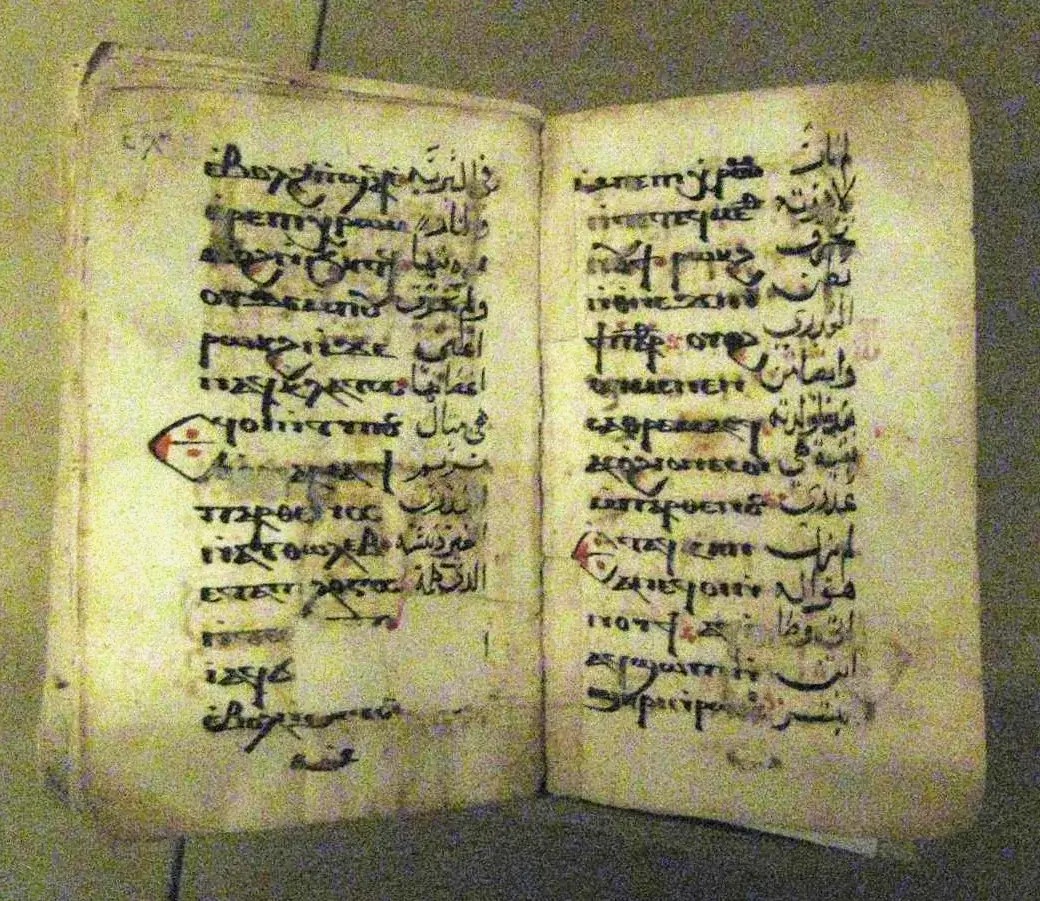
At four years old, Tahuti became what the Egyptians called a writer in the house of books. In plain terms: a schoolboy. He would have walked to school still wearing very little — the thread at the waist, the sidelock over the right ear — and what waited for him there was an education that mixed genuine intellectual content with a disciplinary approach that makes any modern school look gentle by comparison. The first years were spent on reading and writing. Egyptian script was not simple. There were two distinct styles that a boy intending to become a man of learning had to master — hieroglyphic for formal and religious use, hieratic for everyday scribal work. Both required sustained practice and a good memory. The bulk of early schooling was copying: passages from religious texts, poems, fairy tales, and most commonly, collections of wise sayings from respected men of earlier generations. Those copy-books have survived in remarkable numbers. Among all the written material recovered from ancient Egypt, schoolboy exercises outnumber almost every other category. Teachers wrote corrections in the margins. Students scratched rough drawings between the lines. Reading them, you can feel the boredom and the effort — the same quality that lives in the margins of exercise books from any era. But what those copy-books cannot capture is the sound of a schoolroom in Thebes. For that, you need the letters that former students sometimes wrote back to their old teachers — letters that are either the most grateful things ever written or the most carefully diplomatic, depending on how you read them. One former student wrote: I was with thee since I was brought up as a child. Thou didst beat my back, and thine instructions went into my ear. The beating was not metaphor. The schoolmaster's philosophy was stated plainly enough: a boy's ears are on his back, and he hears when he is beaten. Flogging was the standard response to inattention, poor work, and stubbornness. One student recalled being sentenced to three months in a kind of lock-up and bound in the temple for persistent misbehaviour. Whatever the Egyptian equivalent of detention was, it was considerably less comfortable than sitting in a quiet room.
More ancient Egyptian schoolboy copybooks have survived than almost any other category of written material — complete with teachers' margin corrections and students' doodles, they tell us more about daily education in pharaonic Egypt than any formal record.
What They Learned — Reading, Writing, and Just Enough Arithmetic
Half the school day was lesson time. The other half was free. And importantly, there was no homework — which may have made the beatings during lessons easier to endure in retrospect. As Tahuti got older and had the basics of writing under control, his teacher moved him on to dictation exercises: passages from the great Egyptian books, sections of royal wisdom literature, practice letters written as if to a friend in a distant city. Tahuti's practice letters would have been full of correct sentiments and careful phrasing. Whether he meant any of it was beside the point. Arithmetic was taught to a practical level and no further. Addition. Subtraction. A multiplication method that worked but was slow. Division was not taught — apparently because a full understanding of it was beyond what many teachers could confidently demonstrate. What was taught was enough mensuration to calculate the size of a field or work out how much grain a granary of a given size could hold. For most of what an Egyptian scribe actually needed to do, this was sufficient. When that foundation was in place, the path forward depended entirely on what profession the boy was heading toward. A common scribe needed nothing more than what he already had. A boy headed for the army entered a military school attached to the royal stables. A future priest joined one of the temple colleges, where the curriculum included theology, ritual, cosmology, and everything the Egyptians understood — or believed — about what happened to a person after death.
Manners Above Everything — Respect for Parents and Elders
Whatever path a boy's education took, one thing was taught with absolute consistency: respect for those older than himself. You did not sit while an elder was standing in the room. Your manners in public were careful and deliberate. You acknowledged the people above you in the household hierarchy without being told to. The person highest in that hierarchy was the mother. The Egyptians held their mothers in a reverence that went beyond sentiment. It was written into the practical instruction literature — the texts that Egyptian fathers left for their sons as guides to living correctly — in direct and specific terms. The passage quoted earlier, about the mother who nursed you for three years and brought bread and beer to your schoolmaster daily, was not poetry. It was a reminder of a debt that was real and was expected to be acknowledged in behaviour, not just in feeling. The father occupied a position of authority, obviously. But the mother occupied something closer to a sacred one. In a world where a child's survival through infancy owed everything to one person's sustained physical care and attention, that reverence had a material basis that most modern readers have to work a little to remember.
On the Marshes — Fishing, Fowling, and the Cat That Caught the Birds
When school was out and the holidays came, the family headed for the water. Fishing meant a papyrus skiff — a small, light boat made from the reeds that grew thick along the Nile — and long two-pronged spears. The technique was straightforward: drift over shallow marshy water, watch for fish moving below the surface, and throw. A clean hit through both prongs was the best outcome. It required patience, a good eye, and a reasonably steady hand on a moving boat. Fowling was more involved, and had an unusual participant. When Egyptians went after waterfowl in the marshes, they did not take dogs as retrieval animals the way most hunting cultures did. They took cats. Trained cats, apparently comfortable in boats and willing to wade into reeds after a bird that had been knocked down by a throw-stick. The throw-stick itself was curved, similar in shape to an Australian boomerang, and thrown at birds rising from the reeds. When a bird came down, the cat went in after it. This image — a cat sitting quietly in the bow of a papyrus skiff, watching the reeds, then launching itself forward when a bird fell — appears in Egyptian wall paintings and tomb art with enough frequency to confirm it was genuinely common practice rather than an artistic invention. Sen-senb sat in the boat and held the papyrus stalks aside to make room for the skiff to move through, or reached over to pick lotus flowers from the water. Tahuti threw with his father. The cat did its job. On the whole, it sounds like a good afternoon.
Egyptian tomb paintings and wall art repeatedly show families hunting waterfowl from papyrus skiffs in the Nile marshes — using curved throw-sticks and, distinctively, trained cats to retrieve downed birds from the reeds.
Three Thousand Years Is Not as Long as It Sounds
The things that separate childhood in ancient Egypt from childhood now are real and worth knowing — the medicine was frightening, the schoolmasters were brutal, the social structures were rigid in ways that left very little room for individual preference. These were not trivial differences. But the things that connect them are just as real. A child running out of school shouting when the lesson period ended. A boy pulling a string to make a wooden figure move. A girl with two dolls — one like herself, one different from her. A family in a boat on a quiet afternoon, doing something together that had nothing to do with work or obligation. The copybooks with their careful handwriting and their margins full of doodles are sitting in museums. The toys are in glass cases. The wall paintings show the cat in the bow of the skiff, alert, watching the reeds. Three thousand years is a long time. It is also, in certain moments, almost no time at all.