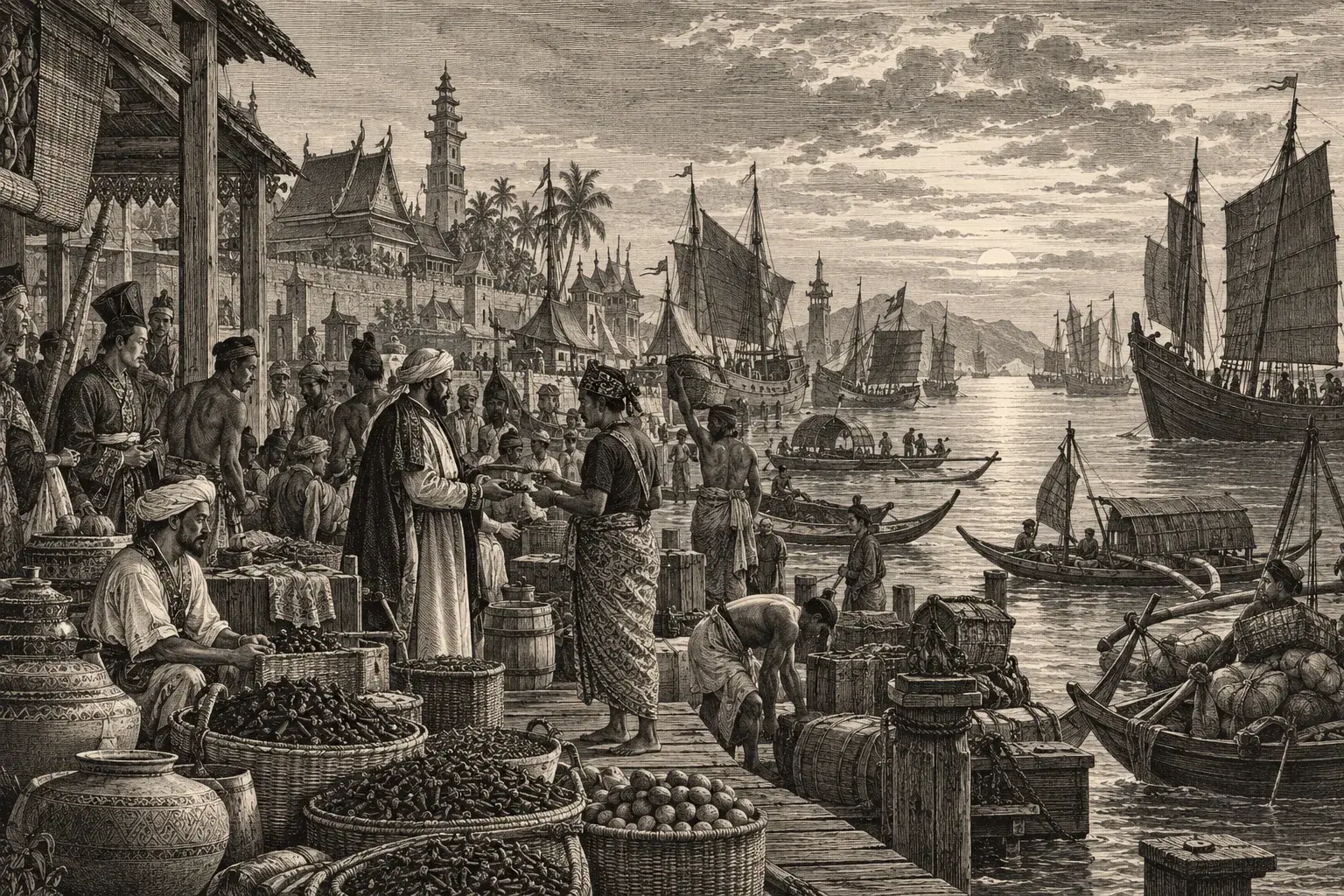
In 1295, Marco Polo returned to Venice from twenty-four years of travel through Asia and told Europe something it had not known: somewhere in the seas east of China lay an island called Chipangue, whose people were white, civilised, well-favoured, and answerable to nobody. Gold, he said, was endless there — the islanders found it in their own soil. He had never been. The description came from Chinese sources, the name was a Chinese rendering of the Japanese, and the gold detail was inflated in the way that distant wealth tends to be inflated by people who have not personally seen it. But Chipangue — Japan — entered European awareness for the first time through Marco Polo's account, and the country he described so loosely had already been building its own history for the better part of a thousand years before he heard of it. That history, in its earliest centuries, is mostly legend. The first written records were made by order of the Emperor Temmu toward the end of the seventh century CE, and they reached back through a thousand years of oral tradition to collect what the culture had preserved about its own beginnings. What those records contain is not what most people expect from historical documentation. It is stranger, and in some ways more honest.
Marco Polo's description of Chipangue — his phonetic rendering of the Chinese name for Japan — was Europe's first knowledge of the island empire, written in 1298 from secondhand Chinese accounts by a man who had never actually been there.
Before Japan Was Japan — The People Who Were There First
Scholars believe there were two major migrations into Japan from the Asian mainland, both arriving across the Korean peninsula. The people who came found the islands already occupied. The older inhabitants included a people the Japanese called pit-dwellers — small in stature, living in holes dug into the ground and covered with branches rather than in built structures. Japanese legend called them earth-spiders. The Ainu, who were already present, called them Hole-Men. They disappear from the historical record fairly early, pushed out or absorbed by the incoming population. The Ainu themselves were not absorbed. They were driven north — from the fertile plains of the main island to the wilder northern territories, where communities of Ainu people were still identifiable and still living by hunting and fishing centuries later. They are a distinct people: remarkable for the amount of hair that grows on the faces and bodies of the men, giving an appearance that struck every outside observer as notably different from their Japanese neighbours. They had no written language. They traded skins and fish with the Japanese for manufactured goods. Their religion centred on the worship of rivers, rocks, and springs, with the bear occupying a special and complicated position in their ritual life. The bear festival was the great event of the Ainu year. In spring, hunters went into the mountains and brought back a live bear cub. A woman of the village nursed and raised it. When it outgrew that arrangement it was caged, kept until the following autumn, and then — at the festival — deliberately starved and goaded into fury before the cage was opened. What followed was a full confrontation between the enraged bear and the assembled hunters, weapons drawn. The bear was killed, butchered, and shared among the village families. Ask an Ainu what the ritual meant and, according to the oldest accounts, they could not tell you. It was older than explanation. It simply was.
The Ainu — the indigenous people of Japan pushed northward by successive waves of mainland migration — maintained their own distinct culture, language, and religious practices for centuries, centred on hunting, fishing, and the annual bear festival whose original meaning had been forgotten even by those who performed it.
Jimmu — The First Emperor and the Feast That Was a Massacre
The legendary first emperor, Jimmu, is said to have begun his reign around 660 BCE. Whether he was a historical individual or a composite figure standing in for the whole period of early tribal conquest, the stories attached to him describe a world of genuine violence between incoming settlers and the people who were already there. One story about Jimmu and the pit-dwellers is particularly stark. He invited eighty warriors of the earth-spider people to a feast in one of their own underground dwellings, assigning one of his own soldiers to each guest as a personal attendant. Every soldier came armed with a sword. Jimmu positioned himself outside. He began to sing. The soldiers waited for a specific line of the song — a prearranged signal. When Jimmu reached it, every man drew his sword and killed the earth-spider beside him. The story is told in the old records without particular horror. It was the kind of thing a successful conqueror did.
The Custom That Buried the Living — and the Emperor Who Stopped It
For centuries, the death of a great man in ancient Japan meant the death of those who had served him. When a lord died, his retainers and the horses that had carried him were buried alongside him — not already dead, but alive and placed upright in the earth with their heads above ground, left to die of hunger and exposure. This was not a fringe practice. It was standard. The records preserved it without comment as ordinary procedure. The eleventh emperor, Suinin, brought it to an end — or tried to. His brother died in 2 BCE, and the retainers were buried around the body as custom required. Suinin heard them. The sound of people starving to death within earshot of the palace was apparently something he could not ignore, and he determined that it should not happen again. An adviser offered a practical solution: replace the living retainers with clay figures. The substitution was made. The clay burial figures — found now in archaeological sites across Japan — were the direct result of one emperor's decision to stop a practice that had been normal for as long as anyone could remember. The practice did not end immediately. An imperial decree issued in 646 CE still found it necessary to prohibit the burial of living retainers, which tells you how long the custom persisted despite official opposition.
The Conspiracy Against Emperor Suinin — and the Empress Who Prepared Her Escape
Suinin's reign also produced one of the more detailed political stories in early Japanese legend. His wife's brother wanted the throne. He came to the Empress with a direct question: which do you value more, your brother or your husband? She said her brother was dearer. He gave her a dagger and told her to kill the Emperor while he slept. She took the dagger. She went to Suinin as he lay sleeping with his head in her lap. She raised the blade. At the last moment she could not do it, and began to cry. The tears fell on the sleeping Emperor's face. He woke suddenly and told her of a vivid dream: a storm-cloud had covered the sky, rain had soaked his face, and a small red snake had curled around his neck. What did it mean? She told him everything. Suinin moved against his brother-in-law, who had fortified himself behind a stockade. The Empress fled to her brother. When the Emperor's troops arrived, she came to the stockade wall holding her newborn son, offering the child to Suinin while declaring she would stay with her brother. Suinin sent his best soldiers to bring both the child and the mother. The Empress was ready for them. She had cut off her hair and fastened it back on loosely. Her jewel-strings had been left to rot. Her garments had been soaked in wine until the fabric was weak. The soldiers grabbed her hair: it came away in their hands. They seized her jewels: the strings snapped. They clutched her clothing: it tore and she pulled free. She escaped into the stockade. The soldiers returned with the child but not the mother. Suinin was furious — and directed his fury not at his wife or his own soldiers but at the jewellers who had made the strings that broke. He ordered them punished. The stockade was set on fire. Suinin called through the flames and asked his wife what name she wished to give their son. She answered. He asked how the child should be raised. She gave instructions. A conversation conducted through the fire of a burning fortress wall, negotiating the details of a child's upbringing between two people on opposite sides of a rebellion. The brother was killed in the fire. The Empress died with him.
Yamato-dake — The Prince Who Answered 'I Killed Him'
The most vivid figure in all of early Japanese legend is Prince Yamato-dake, son of the Emperor Keiko. His introduction to the historical record comes through an exchange with his father. The Emperor had been complaining that his elder son was failing to attend the palace banquets. He asked Yamato-dake to speak with the brother and teach him his duty. A few days passed. The Emperor asked again whether the message had been delivered. "I have given him a warning." "In what manner?" "I slew him and flung his body away." This was the answer of a person who had heard the word warning and understood it differently from how it was meant. The Emperor was alarmed enough by this son that he immediately dispatched him on a dangerous mission far from court — to deal with two bandit brothers in a distant province who had been robbing and killing the Emperor's subjects. Yamato-dake went to his aunt first and borrowed a woman's dress. He hid a sword in the bosom of it. He traveled to the province, found the bandits celebrating the completion of a new cave-house with a feast, and walked in wearing the dress with his long hair loose about his shoulders. The bandits were delighted by this beautiful young woman and gave him the place of honour between the two brothers. When the drinking was at its highest and the brothers were off-guard, he drew the sword and cut down the elder with one stroke. The younger leapt for the door. Yamato-dake caught him at the threshold, seized him with one hand, and drove the sword through him with the other. The dying bandit asked him to hold the sword still for a moment. Yamato-dake waited. The man asked who he was. The prince told him. The bandit, bleeding out in the doorway of his own cave, acknowledged that he had met someone braver. Those were his last words. The prince, the old text records, then ripped him up like a ripe melon.
Yamato-dake — the prince who disposed of his disobedient brother without being asked and then infiltrated a bandit feast in women's clothing — is the most vivid character in early Japanese legend, his exploits spanning wars against the Ainu and encounters with the divine.
Fire on the Moor and a Wife Who Walked Into the Sea
Yamato-dake's last expedition was against wild tribes in the north. Before he left, he visited the temple of the Sun Goddess — his great ancestress, by the divine lineage the imperial family claimed — and his aunt, who served as priestess there, gave him a magic sword and a bag he was not to open unless he was in great danger. A local chief lured him onto a wide moorland covered in dry grass, then set fire to it. Yamato-dake, surrounded by burning grass, opened the bag. Inside was the means of making fire. He cut a clearing with the magic sword, heaped the cut grass, lit it, and let his own fire eat outward through the surrounding flames. Fire fought fire, and he walked out of the space his own burning had made. He killed the chief and conquered the region. On the crossing of a wide sea channel, a storm hit. The boat was in danger of going under. His wife rose and cast woven mats onto the water, then announced she would go into the sea in his place — the prince's task was unfinished and he had to complete it. She stepped from the boat and sat on the mats. The storm subsided. She sank. The boat sailed on across a quiet sea. Her comb was later washed ashore. The people built a temple over it. Yamato-dake completed his campaign and turned for home. On the journey back he fell ill and died at thirty-two. His followers buried him where he fell and raised a great tomb over him. The whole country mourned.
The Korean Invasion and the Open Door to Chinese Learning
In 202 CE, an empress whose husband had just died led an invasion of Korea. She concealed his death, assembled her forces with the help of a loyal prime minister, and crossed the strait before the Koreans had any awareness that something was coming. The element of surprise, combined with the strength of her forces, made the conquest relatively swift. The conquest mattered less for the tribute it produced than for what came with the tribute-bearers. Korea at this period was thoroughly integrated into Chinese civilisation — its scholars read and wrote Chinese, its administrative culture was Chinese in form, its arts and technologies drew from the Chinese mainland. When Korean ambassadors arrived in Japan carrying tribute, they brought Chinese knowledge with them as part of the cultural freight. In 284 CE, one such ambassador was a Chinese scholar of considerable reputation. He became tutor to the young prince who would later reign as Emperor Nintoku. He taught him Chinese language and literature. Writing and printing — technologies the Chinese had possessed for centuries before Europe had any idea they existed — entered Japan through this channel. Nintoku came to the throne in 313 CE, and what he did with it became the standard against which later Japanese emperors were measured.
Emperor Nintoku — The Roof Rotted and He Let It
Nintoku looked at the condition of his kingdom and found that the tax burden on the farming population was crushing them. He issued an order: no taxes for a fixed term of years. The order was obeyed completely, because the Japanese had always obeyed imperial commands as divine. The consequence was immediate. With no tax revenue, the imperial court had nothing to live on. The palace fell into disrepair. The roof developed holes and rain came through. The Emperor wore rough, plain clothing because he could not afford better. His courtiers noticed. His subjects noticed. They came to him and begged to be allowed to pay at least enough tax to keep the palace in order and the Emperor properly dressed. Nintoku refused. He had set a term of years and the term had not run. The poverty his people had been ground down into would take that long to recover from, and he would not cut it short for the sake of a dry roof. When the years were up he climbed to a high place and looked across the land. He saw houses with smoke rising from the hearth-fires inside. He saw cultivated fields. He saw, in other words, a population that had recovered enough to be visibly comfortable. Then he issued the command to resume taxation. His people paid it willingly. The Japanese called him Nintoku the Sage Emperor and placed him in their history where the English place Alfred the Great — the ruler who was good as well as powerful, who understood governing as a responsibility to the governed rather than an entitlement over them. He also sent scribes into the provinces with instructions to write down important events and send the accounts back to court. History, in the modern sense of a documented record rather than an oral tradition, began in Japan with Nintoku. The legends and the myths recede after his reign. What replaces them are dates and names that bear what one old account calls the sober guise of truth.
Emperor Nintoku abolished taxes for years while his palace roof rotted and he wore plain clothing — refusing to reverse the decision until the term had run and his people had recovered. The Japanese compare him to Alfred the Great, and for similar reasons.