When Tokugawa Ieyasu won the Battle of Sekigahara in October 1600, he had already been one of the most powerful men in Japan for years. What he built over the following decade — and what his descendants maintained for two and a half centuries — was something that had never quite existed in Japan before: a stable, centralized, bureaucratic government that kept the country at peace while simultaneously making sure nobody got powerful enough to threaten it. The Edo period, named for the city that became the Tokugawa capital and is now called Tokyo, ran from 1603 to 1868. It ended with the Meiji Restoration, which dismantled the shogunate and restored formal power to the emperor. But the 265 years between those two events were not simply a quiet interlude. Japan during the Edo period developed an urban merchant culture, a vibrant popular arts scene, sophisticated financial markets, and literacy rates that compared favorably with contemporary European societies — all under a government ideologically committed to keeping things exactly as they were. That tension between a conservative political system and a constantly changing society is what makes the Edo period worth understanding in depth. The shogunate tried for two and a half centuries to hold the country still. It could not.
By the mid-eighteenth century, Edo had a population of more than one million — likely the largest city in the world at the time. The city's growth was partly engineered by the sankin-kōtai system, which required daimyo and their large retinues to spend alternate years in the capital.
How Ieyasu Built the Shogunate — and Made Sure It Would Last
Tokugawa Ieyasu had been building toward Sekigahara for decades. He had survived the turbulent wars of the Sengoku period by being patient when others were reckless, and by positioning himself in the rich Kantō region, where he controlled two million koku of land — koku being the unit of rice production used to measure domain wealth — plus another 2.7 million koku through vassals. When Toyotomi Hideyoshi died in 1598, Ieyasu moved fast. The victory at Sekigahara was decisive but not total. Ieyasu defeated the western daimyo coalition, redistributed their lands to his own family and allies, and in 1603 received from Emperor Go-Yōzei the title of shōgun — a title that by convention implied legitimacy to rule in the emperor's name. Two years later he stepped down in favor of his son Hidetada, making the point unmistakably clear that the Tokugawa would hold the shogunate across generations, not just for one man's lifetime. The Toyotomi clan remained a genuine threat for another decade. Ieyasu finished them at the Siege of Osaka in 1615, destroying their stronghold and eliminating the primary rival to Tokugawa authority. He died the following year. By then the system was in place. The political structure he left behind was what historians call bakuhan — a combination of bakufu, the shogunate's central administration, and han, the domains governed by individual daimyo. The shōgun had national authority. The daimyo had regional authority. The system was centralized enough to maintain peace and decentralized enough to function across a country of 30 million people without a unified national tax code, national treasury, or national judiciary. Historians call it 'parcellized sovereignty,' which is a more precise description of how it actually worked than 'feudalism.'
Controlling the Daimyo: The Sankin-Kōtai System
The Tokugawa shogunate's single most effective tool for controlling the daimyo was not military force. It was logistics. The sankin-kōtai system — alternate attendance — required every daimyo to spend alternating years in Edo and in their home domain. Their families were required to live in Edo permanently. The effect was threefold: the families served as hostages without anyone having to say so explicitly; the daimyo spent enormous sums on the processions and establishments required to maintain appropriate status in the capital; and their attention was permanently divided between their home province and the city. The processions themselves were spectacular. A major daimyo traveling to or from Edo might move with hundreds or thousands of retainers, and the roads were built and maintained partly to accommodate this constant traffic. The inns, post towns, and road networks that developed along the main travel routes became economic arteries, pumping commerce between regions and creating exactly the kind of integrated national market that the shogunate's ideology was not supposed to encourage. The Buke shohatto — the code of laws for warrior households — added further controls. It specified what kinds of weapons daimyo could maintain, how many troops, the size of their castles (one per domain), whom they could marry, and what they could build. Daimyo were also regularly assessed for contributions to public works projects — castles, roads, bridges — which drained their resources further. None of this was technically taxation. All of it had the effect of taxation. The daimyo were sorted into three groups based on their relationship to the Tokugawa. The shinpan were directly related to the Tokugawa house. The fudai were loyal allies who had supported Ieyasu before Sekigahara. The tozama — outside lords — were former opponents or neutral parties who had submitted afterward. The tozama controlled the most land collectively, nearly ten million koku, but were excluded from central government positions and watched most carefully. The domains that eventually brought down the shogunate — Satsuma and Chōshū — were tozama.
The sankin-kōtai system required daimyo to travel to Edo every other year with large retinues. The processions were expensive by design — draining daimyo resources and making rebellion financially difficult while simultaneously building Japan's road and inn networks.
Sakoku: The Closed Country Policy and What It Actually Did
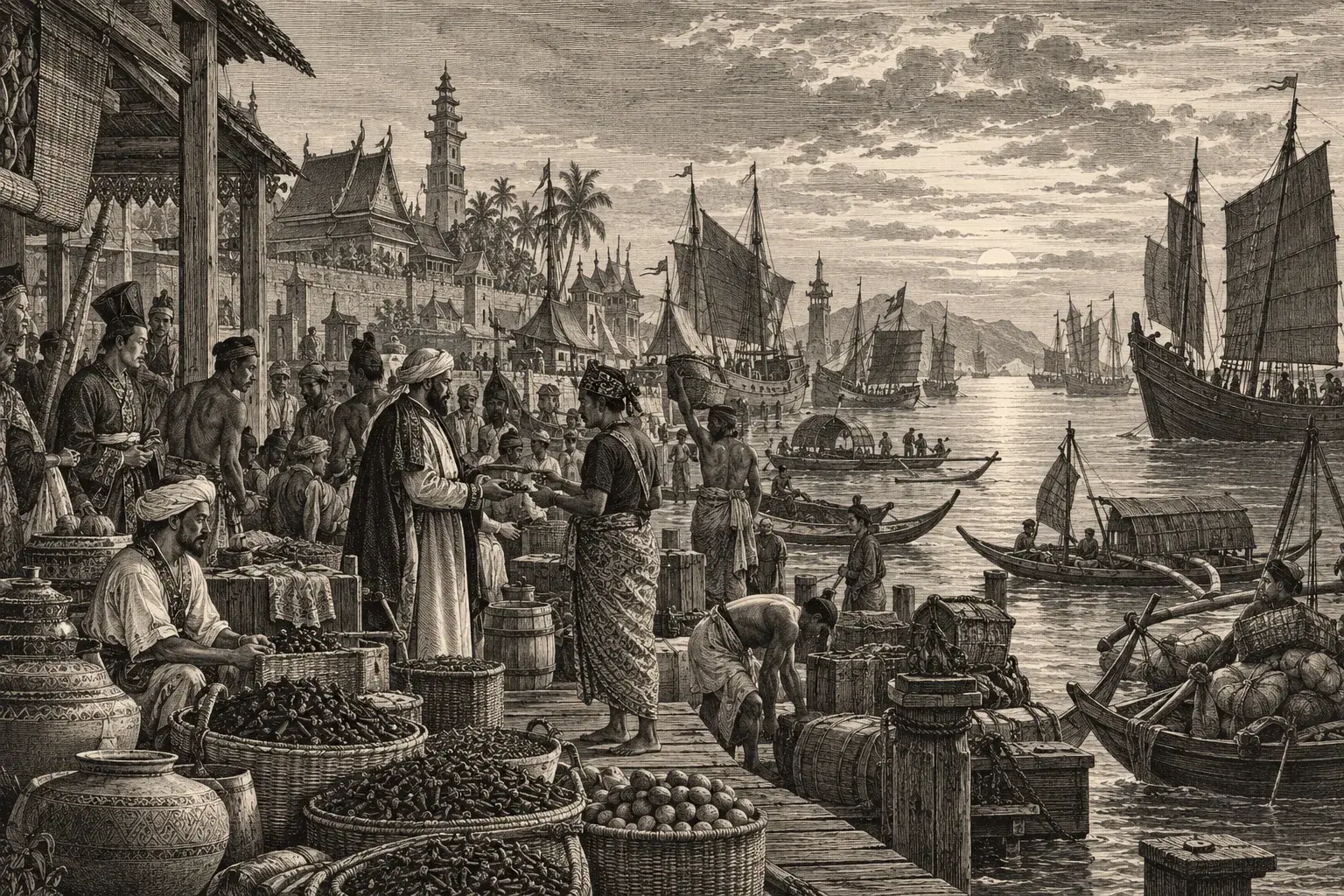
Japan under the early Tokugawa was not immediately an isolated country. The opposite was true. Ieyasu granted trading rights to the Dutch in 1609 and the English in 1613, employed an English navigator named William Adams as an adviser, and oversaw a period in which Japanese trading ships reached Taiwan, Macao, Manila, and the Thai capital of Ayuthia. The bakufu commissioned around 720 Red Seal Ships — armed, three-masted trade vessels — for intra-Asian commerce. Japanese adventurers operated throughout the region. The closure came gradually. By 1631, maritime permits were restricted to families close to the Tokugawa. In 1633, Japanese vessels were banned from traveling abroad without special certification. The Closed Country Edict of 1635 went further, prohibiting any Japanese from leaving and making it a capital offense to return if someone had. In 1636 the Dutch were confined to Dejima, a small artificial island in Nagasaki harbor — not Japanese soil, technically. The final trigger was the Shimabara Rebellion of 1637, a revolt by Christian samurai and peasants that the shogunate blamed on foreign religious influence. In 1639 the Portuguese were expelled entirely. By 1641, all foreign contact was restricted to three channels: the Dutch at Dejima in Nagasaki, Chinese merchants in a walled enclave also in Nagasaki, and carefully controlled relations with Korea and the Ryukyu Islands handled by vassal domains. Here is a detail that usually gets lost in the standard account: the word sakoku — closed country — was not a Tokugawa term. It was coined in 1801 by a Nagasaki interpreter translating a German physician's work. The shogunate called its own policies kaikin, maritime prohibitions. And despite the apparent severity of those prohibitions, the volume of trade did not collapse. The bakufu ordered the Dutch and the Tsushima and Satsuma domains to increase their trade to compensate for the loss of the Portuguese. In the early years of the policy, Dutch and Chinese trade at Nagasaki actually increased sharply. The motivations were strategic, not simply xenophobic. Christianity was perceived as genuinely destabilizing — the shogunate viewed it as a doctrine that undermined the Neo-Confucian social order they had built. Controlling foreign trade also prevented regional daimyo from acquiring independent wealth, firearms, or foreign alliances. And the reduction in outside competition forced domestic development of industries like silk production, which had previously been dominated by Chinese imports.
Dejima — a small artificial island in Nagasaki harbor — was the only point of contact between Japan and Europe for most of the Edo period. Dutch traders lived there under close surveillance, required to submit reports on world events to the shogunate and to conceal their religious practices.
The Social Order: Four Classes, Hidden Complexities, and People Outside the System
The Edo period social hierarchy is usually described as four tiers: samurai, peasants, craftsmen, merchants — in that order. That ordering is not quite accurate, and Japanese history textbooks have actually removed the old hierarchy chart since around 1995 after research showed the lower three classes were social categories, not a pecking order. Peasants, craftsmen, and merchants were classified differently but were not ranked against each other. What is accurate is that the samurai sat firmly above everyone else. About 6 percent of the population, they were a hereditary ruling and administrative class. And here is the thing about them in the Edo period: after roughly 1615, there was almost nothing for them to fight. Two and a half centuries of enforced peace made professional warriors into civil servants. They became administrators, bureaucrats, record keepers, and court officials. Their code of ethics — bushido — was formalized and written down during this period partly because the code's original function, governing men who fought, had become largely theoretical. Samurai law allowed them to kill a commoner for an insufficiently respectful gesture — the right of kirisute gomen, roughly 'cut and discard.' This was not frequently exercised but was a constant social reality. Most samurai, however, lived modestly, many accumulating serious debt as their stipends failed to keep pace with inflation and the cost of maintaining their social status. Peasants were 80 percent of the population and the primary tax base. Taxes ran at 40 to 50 percent of the rice harvest. Despite their official prestige in the Confucian hierarchy — producers of food were theoretically ranked above merchants who merely traded it — peasants bore the largest burden and had the least legal protection as individuals. The family was the smallest legal unit; individuals had no separate legal standing. Below the formal class structure were two groups: the eta and hinin. The eta worked in professions considered ritually impure under Buddhist tradition — butchering, tanning, undertaking. The hinin included executioners, street cleaners, and guards. Their names were direct: eta translates to 'filthy,' hinin to 'non-human.' Some eta villages did not appear on official maps. Hinin faced restrictions on clothing length and could not enter certain city districts. In practice, some eta and hinin accumulated significant wealth and even held formal authority within their own communities through the Danzaemon hierarchy. The entire classification was officially abolished in 1871, though its social legacy persisted considerably longer.
The Economy: Merchants Who Got Rich Under a System That Despised Them
The Tokugawa ideological position on merchants was clear: commerce was parasitic. It produced nothing. Neo-Confucian doctrine held agriculture as the foundation of civilization and viewed merchants as people who profited from the labor of real producers without contributing anything themselves. The shogunate taxed peasants. It did not systematically tax merchants, partly because doing so would raise merchants' prestige by acknowledging their economic significance. Merchants got rich anyway. And the shogunate, the daimyo, and eventually the samurai class all became dependent on them. The mechanics of this dependency are worth spelling out. Daimyo collected taxes in rice, then needed to convert rice into cash to operate in a monetized urban economy. This required selling rice at markets in Edo and Osaka. Those markets were controlled by merchant guilds. Daimyo sent agents to sell rice, often using forward contracts — selling rice before it was harvested, in arrangements that worked similarly to modern futures trading — and received paper credit redeemable elsewhere. When daimyo ran short, they borrowed from merchants. When the shogunate ran short, it also borrowed from merchants or debased the currency, causing inflation. By the mid-Edo period, wealthy merchants were routinely forced to make 'loans' to daimyo and the shogunate that were understood by both parties to be unlikely to be repaid. Some merchants responded by hiding their wealth. Others tried to marry into the samurai class. As the economy grew and commerce spread, the theoretical hierarchy between samurai and merchants increasingly diverged from the practical reality on the ground. Rice paddies grew from 1.6 million chō in 1600 to 3 million by 1720. Domestic production of silk, previously imported from China, expanded significantly. Roads built for sankin-kōtai processions became trade routes. Banking services, credit instruments, and merchant associations developed. By the mid-eighteenth century, Japan had one of the most sophisticated commercial economies in the world — in a country officially committed to the idea that agriculture, not commerce, was the proper basis of civilization.
Despite holding the lowest theoretical status in the Confucian hierarchy, merchants became the most economically powerful class in the Edo period. Large rice markets in Edo and Osaka, sophisticated credit systems, and the constant consumer demands of the daimyo processions made commerce the engine of Tokugawa Japan.
Culture in the Floating World: Kabuki, Ukiyo-e, and Mass Entertainment
The urban commoner culture that developed during the Edo period — particularly from the mid-seventeenth century onward — went by the name ukiyo, the floating world. It was a concept built around the idea that transient pleasures, popular entertainment, and the refinement of everyday aesthetics were worth pursuing seriously. The term had originally carried Buddhist overtones of life's impermanence; urban merchants and craftsmen of the Edo period adopted it in a much more secular, hedonistic direction. Kabuki theater emerged from this milieu. It started in the early seventeenth century, became associated with prostitution (female performers were banned by the shogunate in 1629), shifted to male actors playing all roles, and developed into an elaborate, stylized theatrical form with its own stars, conventions, and fan culture. Fashion trends, satirical commentary on current events, and even advertisements made their way into kabuki performances. The genre shibaraku was performed only at specific times of year. Some companies performed only for noble audiences. The form was popular enough across social classes that it supported a substantial publishing industry in actor-specific ukiyo-e prints. Ukiyo-e — woodblock prints — began as records of the pleasure districts, depicting courtesans and kabuki actors for a mass market. Harunobu produced the first full-color prints in 1765. By the end of the period, artists like Hokusai and Hiroshige had expanded the genre to include landscapes — The Great Wave off Kanagawa dates to around 1829 to 1832 — and ukiyo-e was spreading to Europe, where it would shape Impressionism and beyond. Literacy supported all of this. Estimates vary, but by the end of the Edo period, somewhere between 40 and 60 percent of men and 10 percent of women could read — exceptionally high for a pre-industrial society. Edo had between 600 and 800 rental bookstores. Bestselling novels were reprinted many times. Cookbooks, gardening guides, travel guides, satirical fiction, and romance novels all circulated in woodblock-printed editions borrowed and bought by ordinary people. Food culture also developed rapidly with urbanization. Soba, sushi, tempura, and unagi were sold from street stalls. Restaurant rating books, organized like sumo rankings, were published for people who wanted to know where to eat. Gardening became a popular hobby. Cherry blossom viewing was a major annual event. Pilgrimage tourism to Ise Grand Shrine drew 3.62 million visitors over fifty days in 1625 alone.
Ukiyo-e woodblock prints were the mass media of the Edo period — affordable, widely circulated, and covering everything from kabuki stars to landscapes to erotic art. Hokusai's Great Wave, produced around 1829–1832, later became one of the most recognized artworks in the world.
What the Dutch Traders Witnessed — and Had to Perform
The Dutch on Dejima occupied a specific and peculiar position in the Tokugawa system. They were tolerated — carefully, under surveillance, on artificial ground technically not part of Japan — because they were useful. The shogunate wanted their trade goods. More specifically, the shogunate wanted their information. Every Dutch captain arriving at Nagasaki was required to submit a fūsetsugaki — a report on world events. Through this system, the shogunate tracked the Napoleonic Wars, the movements of other European powers in Asia, and the general state of Western geopolitics, all while keeping Japan's population insulated from direct contact with that world. Periodically the Dutch chief factor, the head of the trading post, was required to travel to Edo and pay homage to the shōgun. These visits produced some striking accounts. Engelbert Kaempfer, a German physician who was stationed at Dejima in 1690 and accompanied the chief factor to Edo in 1691 and 1692, left a detailed record of what the audience with Shōgun Tokugawa Tsunayoshi actually looked like. The Dutch visitors were made to remove their hats, walk around the room, remove their wigs, jump, dance, play games, sing, kiss each other as man and wife — to the apparent amusement of those watching — and demonstrate European greetings appropriate to different social ranks. Kaempfer noted that by the late seventeenth century, Europeans had become, in his assessment, little more than exotic and amusing creatures to the Japanese elite. The observation says something honest about the power dynamic. The Dutch complied with these performances because the trading rights they gained in return were worth it.
The Beginning of the End: Perry, the Black Ships, and the Collapse of the Bakufu
The structural problems inside the Tokugawa system were accumulating long before Commodore Matthew Perry's four ships appeared in Edo Bay in July 1853. Twenty great famines between 1675 and 1837. A total of 154 famines across the period, 21 of them widespread and serious. Samurai living on fixed stipends while inflation eroded their purchasing power. Daimyo deep in debt to merchants they officially despised. A government bureaucracy that had grown enormous and was increasingly at odds with a society that had moved well beyond the assumptions the system was built on. But Perry's arrival — the 'black ships,' steam-powered vessels the Japanese had no equivalent of — demonstrated that the gap between Japan and the industrializing West had reached a point that could not be managed by the old tools. The shogunate had no good options. It lacked the military capacity to expel the Americans by force. It lacked the political consensus to make any decision without generating opposition. When senior councilor Abe Masahiro tried to consult broadly — asking shinpan and tozama daimyo for their views, which was unprecedented — he undermined the shogunate's authority by revealing that it did not know what to do. The Treaty of Kanagawa in 1854 opened two ports to American ships. The Harris Treaty of 1858 went further, setting low tariffs favorable to American merchants, granting extraterritoriality to American citizens in Japan, and establishing residence rights in designated areas. The immediate economic effects were disruptive — gold flowed out of Japan because the price differential between Japanese and world markets allowed foreign traders to buy Japanese gold cheaply and resell it at large profit, and cheap imported goods undercut Japanese manufacturers. The internal political crisis accelerated. The sonnō jōi movement — revere the emperor, expel the barbarians — gained momentum among those who blamed the bakufu for dishonoring Japan by accepting Western demands. Violence against foreigners and bakufu officials increased. The domains of Satsuma and Chōshū, both tozama, moved toward outright opposition. When the last shōgun, Tokugawa Yoshinobu, resigned in late 1867 and announced an imperial restoration, the Satsuma and Chōshū forces seized the imperial palace and announced their own version of the restoration on January 3, 1868. The Boshin War followed, the bakufu was abolished, and the Meiji era began.
Perry's arrival in July 1853 exposed the gap between Japan's military capacity and the industrialized West. The shogunate's failure to expel the Americans without negotiation damaged its authority irreparably, accelerating the political crisis that ended the Edo period fifteen years later.
What the Edo Period Left Behind
Japan entered the Meiji period in 1868 not as an undeveloped society suddenly confronting modernity, but as one of the most commercially sophisticated, literate, and urbanized countries in the world. Some historians have argued directly that the Edo period's relatively high literacy rates — 80 percent in Edo by some estimates, 40 to 60 percent nationally by the end of the period — were a significant factor in the speed of Japan's subsequent industrialization. A population that could read instructions, contracts, and technical manuals adapts faster to industrial organization than one that cannot. The merchant families that developed financial instruments, credit markets, and large-scale commercial operations in the Edo period became the foundations of the zaibatsu — the industrial conglomerates that drove Japan's twentieth-century economy. The road networks, post towns, and commercial infrastructure built partly to service sankin-kōtai processions formed the physical backbone of the Meiji-era economy. Ukiyo-e went to Europe and shaped Western art. Kabuki and bunraku survived and are performed today. Sumo remained Japan's most popular sport across the transition. The tea ceremony, the appreciation of seasonal aesthetics, the culture of craft that the Kaga domain and others had cultivated — all of it continued into modern Japan in recognizable form. The samurai as a class were formally abolished with the class system in 1871. Bushido values were not. They survived in modified form through Japan's militarization in the late nineteenth and early twentieth centuries, and echoes persist in modern Japanese corporate and martial arts culture in ways that are sometimes more substantial than symbolic. Akira Kurosawa's samurai films drew on the Edo period's aesthetics and social conflicts; those films in turn influenced Spaghetti Westerns and George Lucas's Star Wars. The Kakure Kirishitan — hidden Christians who practiced underground for more than two centuries — revealed themselves in 1865 when Japan was forced to end its seclusion. Tanaka Hisashige, who built mechanical puppets and clockworks during the Edo period that are still difficult to reverse-engineer today, later founded the company that became Toshiba. The Edo period tried to stop time. It produced one of the more dynamic societies in the premodern world instead.