Long before Europeans ever set foot in southern Africa, there was already a powerful kingdom called Mapungubwe. This early state rose during the Iron Age, between the 11th and 13th centuries, and it stood just south of the Limpopo River, in what is today northern South Africa. Historians now recognize Mapungubwe as the very first state in southern Africa. Its story is filled with lessons about trade, leadership, society, and decline, and it remains one of the most important chapters in African history.
The sandstone hill of Mapungubwe with stone walls and ruins, showing the historic heart of the kingdom.
The Mystery of the Name
The word Mapungubwe is still debated among historians. Some believe it means "stone monuments," a name that makes sense because large stone walls and buildings can still be found at the site today. Others say it means "hill of the jackal." Both ideas highlight that the place was significant and respected. Whatever the true meaning, Mapungubwe became a symbol of strength and culture in southern Africa.
Power from Cattle and Land
For the people of Mapungubwe, cattle were more than food. They were a measure of wealth, influence, and respect. Families with large herds were seen as powerful, and the rulers of Mapungubwe owned enormous numbers of cattle, which gave them control over their society. At the same time, the land provided other resources, such as ivory and copper, which were valuable for trade. As Mapungubwe grew, it became part of long-distance trade networks. Traders from faraway places brought gold, glass beads, and luxury goods into the kingdom. The rulers used these items to show their power and to impress both their people and neighboring communities. Yet, by the late 1200s, trouble was rising. The growing population placed pressure on the land, droughts made farming harder, and trade shifted north to Great Zimbabwe. These changes weakened Mapungubwe, and the kingdom eventually declined. Still, its legacy remained strong, and in 2003 the site was recognized as a UNESCO World Heritage Site.
What Archaeology Reveals
Unlike places such as Egypt or Mesopotamia, Mapungubwe left behind no written records. The only way we know about its past is through archaeology. Archaeologists have uncovered pottery, beads, tools, bones, stone walls, and burial sites. These discoveries tell us about the lives of the people who lived there. At the center of Mapungubwe was a giant sandstone hill. This hill was not just a natural landmark but a political and spiritual one. The king and his family lived at the top, while ordinary people lived below. This physical separation showed the difference in status and power. Daily life revolved around farming and herding. People grew crops such as sorghum and cowpeas, which provided food for families and trade surpluses that supported the kingdom.
Archaeologists excavating at Mapungubwe, uncovering artifacts that reveal details of the ancient kingdom.
Society and Daily Life
Cattle were at the heart of Mapungubwe society. Archaeological evidence shows that herds were very large and had been important in the area for centuries before the kingdom rose. Cotton was also grown, spun, and woven into textiles. Archaeologists have found spindle whorls—small tools used to spin thread—that prove weaving was a common skill. Society in Mapungubwe was carefully structured. At the top was the king, who was the wealthiest and most powerful person. His role was not only political but also religious. He was seen as connected to rainmaking, which was vital in a land where farming depended heavily on rainfall. The king and his family lived on the hilltop, in separate homes, surrounded by wooden fences that marked their elite status. Below, common people lived in smaller mud-and-thatch houses, forming a larger settlement known as K2 or Babandyanalo. At its peak, Mapungubwe had about 5,000 residents, which was considered large for that time. Burial customs also revealed the social structure. Kings and high-status individuals were buried at the top of the hill, while ordinary people were buried in the valleys below. This separation reinforced the idea that rulers were set apart, even in death.
Trade Across the World
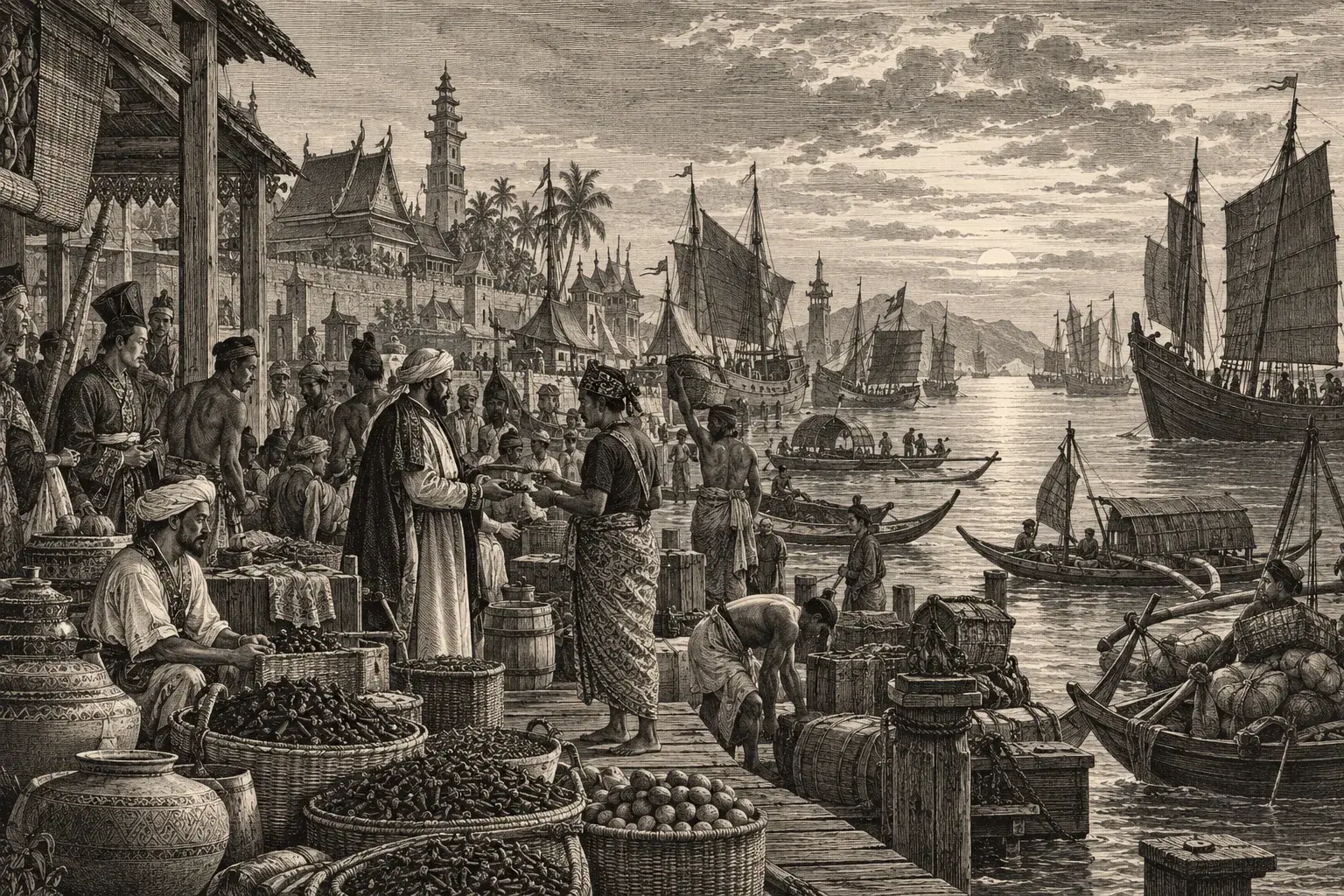
One of the most impressive aspects of Mapungubwe was its involvement in international trade. Archaeologists have discovered foreign items such as Chinese porcelain and Indian glass beads, showing that the kingdom was connected to faraway lands. These goods reached Mapungubwe through Indian Ocean trade routes, which linked Africa to Arabia, India, and even China. In exchange, Mapungubwe offered animal hides, ivory, gold, and other resources. These exports brought wealth to the kingdom and made its rulers even more powerful. Trade also linked Mapungubwe to the rise of Great Zimbabwe, another important kingdom in the region. Some historians even believe that Great Zimbabwe was influenced by or connected to Mapungubwe before it became powerful in its own right.
Art and Craftsmanship
The people of Mapungubwe were skilled artists and craftsmen. They created pottery decorated with carved or stamped designs. They also made figurines of animals like giraffes, cattle, and goats, as well as simple human figures. These figurines may have been used in religious ceremonies or to honor ancestors. Ivory and copper were crafted into jewelry and tools. But the most famous artifacts from Mapungubwe are made of gold. Thin sheets of hammered gold were shaped into beads, bracelets, and ornaments. The most celebrated discovery is the golden rhinoceros, a small but carefully crafted figurine made from gold. It has become a symbol of the kingdom’s greatness. These golden items were discovered in royal graves, showing how much gold represented wealth and authority.
The golden rhinoceros figurine from Mapungubwe, made from hammered gold sheets and discovered in a royal grave.
Decline of the Kingdom
Despite its success, Mapungubwe’s power did not last forever. By the late 13th century, the population had grown too large for the land to support. Droughts made farming more difficult, and trade routes shifted north to Great Zimbabwe. As a result, Mapungubwe’s influence faded, and by the 15th century, newer kingdoms like Mutapa had risen to power. When Europeans first discovered the ruins in the 1800s, they refused to believe that Africans had built such an advanced kingdom. They made up false stories, claiming that Egyptians or Phoenicians must have been responsible. These ideas came from racism and disbelief in African achievements. Archaeology has since proven the truth: Mapungubwe was built by Africans, using their own creativity, organization, and skill.
Mapungubwe Today
Today, the treasures of Mapungubwe are preserved in the University of Pretoria Museums. The site itself is part of Mapungubwe National Park, where visitors can see the remains of this once-great kingdom. It is protected as a UNESCO World Heritage Site and serves as proof of Africa’s rich and complex history. Walking through the ruins today, you can imagine the sounds of cattle lowing in the fields, traders arriving with goods from distant lands, and families farming in the fertile soil. Mapungubwe was not isolated—it was part of a global network of trade and culture long before Europeans arrived.