When Marco Polo was dying in Venice in 1324, a priest and several friends gathered at his bedside and urged him to retract the more extravagant claims in his book. People were saying it was all lies. It would be better for his soul, they suggested, if he admitted that he had exaggerated. Marco Polo replied that he had not told the half of what he had actually seen. That was probably true. The book — which he had dictated in a Genoese prison to a fellow captive who happened to be a professional writer — is remarkable not for its tall tales but for its specificity. Distances. Trade goods. Languages. Administrative systems. Agricultural practices. The book reads like someone who was actually there and had an excellent memory.
Marco Polo spent seventeen years in service to Kublai Khan — the Mongol emperor who ruled China and the largest land empire in history — traveling throughout his domains on official business and recording what he saw.
The Father Who Left Before Marco Was Born
Marco's father Niccolo and uncle Maffeo were Venetian merchants who had been trading in the eastern Mediterranean when, in 1260, a shift in the political situation around the Black Sea forced them further east than they had intended to go. They kept moving and eventually found themselves at the court of Kublai Khan, the Mongol emperor who ruled China and most of Asia. Kublai Khan received them warmly. He had been curious about Christianity for some time — not for religious reasons, but because he governed a huge mixed population and was interested in every major belief system that operated within his territory. He asked them extensive questions about Europe, about the Pope, about Christian practices and doctrine. When they left, he sent a letter with them to the Pope requesting a hundred learned scholars who could debate with his own priests and demonstrate the intellectual merits of Christianity. They reached Venice in 1269. Niccolo discovered that his wife had died during his absence and that she had left him a son — Marco, now fifteen years old, who had never met his father. The hundred scholars the Khan had requested were never assembled — the Pope who received the request died and his successor was not elected for three years. By the time a replacement could be arranged, Niccolo and Maffeo were ready to go back east. They took two friars. The friars, finding the road dangerous, turned back after a short distance. They also took Marco. He was seventeen when they left Venice in 1271.
The Road to Kublai Khan
The journey took three and a half years. They went through what is now Turkey, Iran, and Afghanistan, over the Pamir mountains — the Roof of the World, Marco calls them, and notes that the air was so thin that fires burned without giving much warmth — and across the Gobi Desert. Marco was ill for a year in one of the mountain regions and had to stay while he recovered before the journey could continue. The Gobi Desert Marco describes as very long to cross, so that it takes about a year to go from end to end. Its character is such that no food or drink is to be found in it, and he notes that the traveler hears what sounds like the footsteps of a great multitude of people and sometimes voices and musical instruments — the sounds of moving sand that play on the nerves of anyone alone in those spaces. They reached the Khan's court in 1275, after traveling roughly 7,000 miles. Kublai Khan received them, held a great banquet in their honor, and then began questioning the young Venetian at length. Marco had picked up languages along the way with the facility of the young and was already learning the several languages used at the Khan's court. The Khan was impressed enough to put him to work.
Seventeen Years in the Khan's Service
Kublai Khan's government was an administrative structure of remarkable complexity, managing territory from China to Persia. He needed capable, educated men who could investigate conditions in distant provinces and report accurately. He sent Marco on several official missions, each of which took the young Venetian through parts of China and the surrounding regions that no European had ever seen. Marco served as governor of the city of Yangchow for three years. He traveled to Burma, Vietnam, and India on various official commissions. He worked as a revenue inspector in one province. He saw the postal relay system — horses stationed at twenty-five-mile intervals throughout the empire so that official communications could travel at extraordinary speed — and described it with detailed accuracy. He saw paper money being used as currency, which China had had for centuries and Europe would not develop for hundreds of years. He described coal — black stones that burn like wood — which was mined in large quantities and used for heating throughout northern China. He described asbestos — a mineral fiber that doesn't burn — and was shown a cloth made from it as proof. All of these things would be regarded, in Venice, as fabrications.
The Polo family's route from Venice to Kublai Khan's court took them through Turkey, Persia, Afghanistan, over the Pamir mountains, and across the Gobi Desert — a journey of roughly 7,000 miles that took three and a half years.
The Journey Home — and Prison
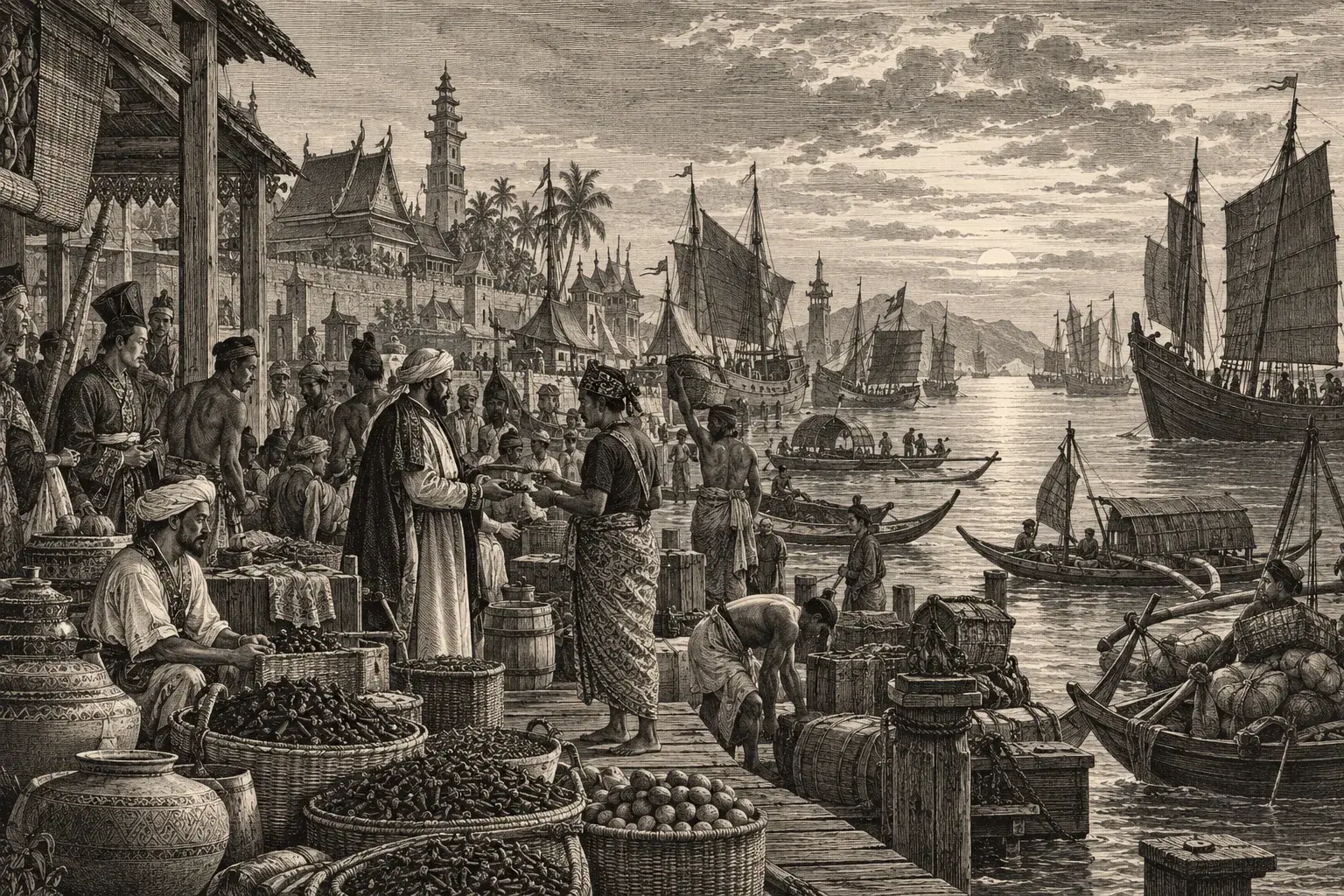
The Polos had wanted to return to Venice for years but could not get the Khan's permission. He valued them too much and was reluctant to lose them. The opportunity came in 1292, when a Mongol princess needed to be escorted to Persia to marry a Persian ruler. The sea route was safer than the overland route. The Polos were chosen to accompany the expedition, and the Khan finally permitted them to return home. They sailed through the South China Sea, touched Vietnam, Sumatra, Sri Lanka, and the western coast of India before rounding the Arabian Peninsula and reaching Persia. The princess was delivered. They continued to Trebizond on the Black Sea, then to Constantinople, then to Venice. They arrived in 1295, twenty-four years after leaving. Ancient accounts say that when they arrived at their family home, the relatives who answered the door did not recognize them — they were tanned like leather from years in Asian sun, and their clothes were in the Mongol fashion. Only when they cut open the seams of their traveling garments, which they had sewn full of jewels before leaving China, did the family begin to believe who they were. Three years after returning, Marco was captured in a sea battle between Venice and Genoa and imprisoned in Genoa. His cellmate was a professional writer named Rustichello of Pisa. Marco dictated. Rustichello wrote. The result was The Travels of Marco Polo — known in its original French as Le Devisement du Monde, The Description of the World. People called it Il Milione — the Million Lies. They said the numbers were impossible, the distances wrong, the things described fantastic. Paper money. Coal. A postal system crossing a continent. A city — Khanbaliq, which we now call Beijing — so large that no European had ever seen anything comparable.
The Book Columbus Carried
Columbus owned a copy of Marco Polo's book. It survives. His handwritten annotations are still in the margins. He read it repeatedly on the voyage across the Atlantic in 1492 and afterward, and he believed — incorrectly — that he had reached the eastern edge of the world Marco had described. The islands he encountered he interpreted through Marco's account of Japan and the Chinese coastal islands. This is why the indigenous people of the Americas were called Indians. Columbus thought he was in the Indies — the Asian territories Marco had described. The mistake was not corrected until Vespucci's voyages a few years later established that this was an entirely separate continent that Marco had never mentioned because nobody had ever been there. The book that nobody believed turned out to be accurate in its essential claims, inspirational to the explorer who changed the map of the world, and foundational to the entire European expansion into Asia that followed — the spice trade, the Portuguese route around Africa, the Dutch East India Company, all of it was partly driven by Europeans wanting to reach the places Marco Polo had described. He had not told the half of what he had seen. What he had told was enough to redirect history.