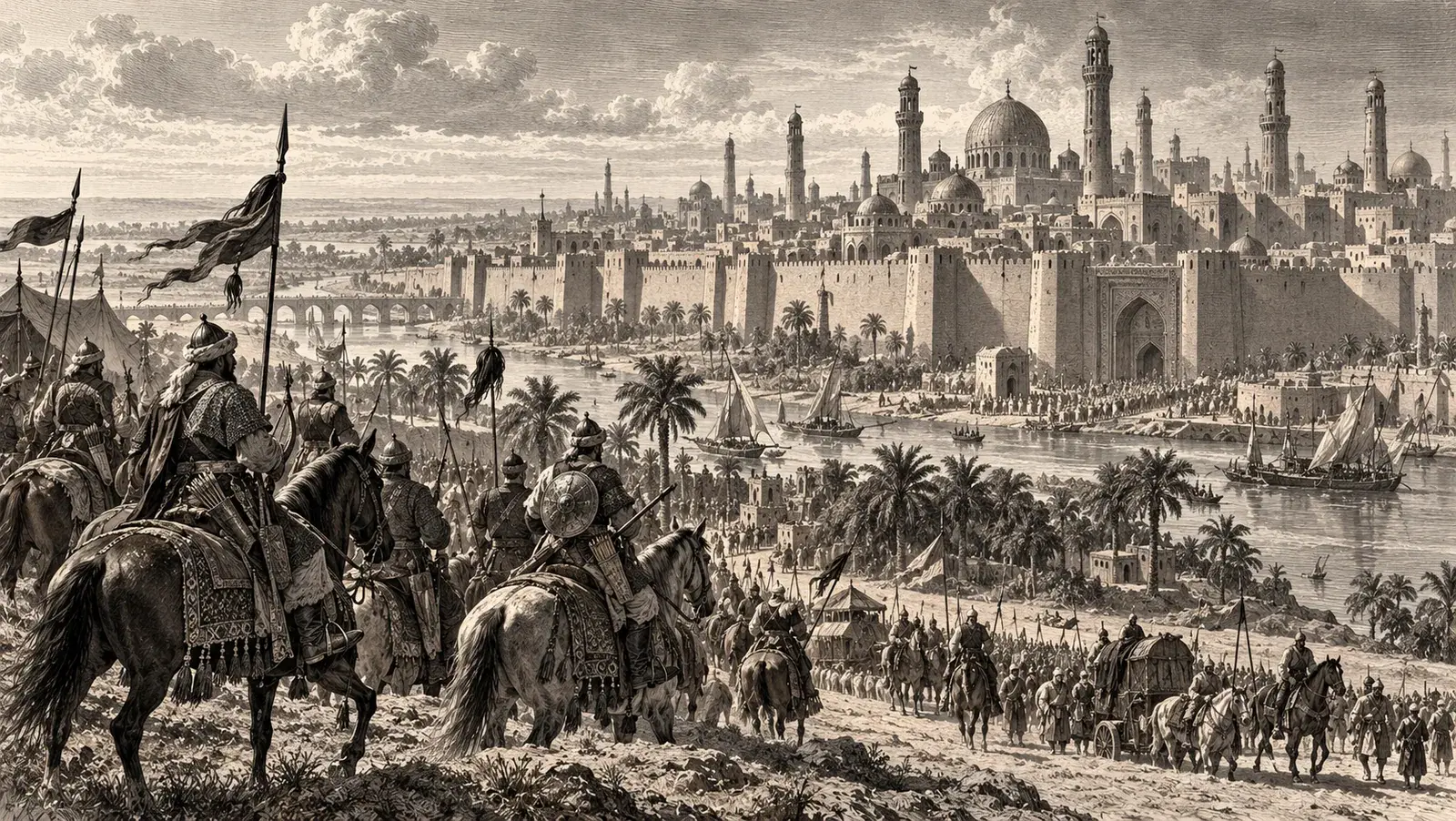
Peter the Hermit had been to Jerusalem and come back changed. He had made the pilgrimage sometime before 1095 — a difficult, dangerous journey from France through the Byzantine Empire and into the Holy Land, which had recently passed from relatively tolerant Arab rule to the Seljuk Turks, who had much less patience for Christian visitors wandering around their conquered territory. He had seen Christian pilgrims mistreated. He had seen churches neglected and holy sites in the hands of people who did not consider them holy. He had prayed in the Church of the Holy Sepulchre where Christ was said to have been buried, and he came home unable to stop thinking about what he had seen. When Pope Urban II called for a crusade at the Council of Clermont in November 1095 — a formal campaign to recapture Jerusalem from the Turks — Peter's private conviction and the Church's public call found each other at exactly the right moment.
Peter the Hermit's preaching tour through France and Germany in 1095-96 generated a spontaneous popular movement — the People's Crusade — that preceded the organized military campaign. Most of his followers never reached Jerusalem.
The Sermon That Moved a Continent
Peter was physically unimpressive. He was small, thin, and barefoot. He rode a donkey. He wore a rough hermit's robe. He was not a theologian or a bishop or a man of formal ecclesiastical standing. What he had was conviction of the kind that people can hear in someone's voice from fifty yards away. He began preaching in Berry in central France. People came to hear him and wept. Some kissed his donkey. He preached in Champagne, in Lorraine, in Germany. Everywhere he went the crowds gathered and many of them immediately decided to go with him to Jerusalem. Nobody had organized this. There were no logistics, no supplies planned, no military structure. People left their farms in the middle of the plowing season. Women with children attached themselves to the column. Elderly monks who had no business on a military expedition joined. A small number of actual knights came too, but the overwhelming majority of the gathering army were ordinary people who had heard Peter preach and decided that going to Jerusalem was what God wanted them to do. By the spring of 1096 he had somewhere between 100,000 and 200,000 people — ancient sources give wildly different numbers — marching east. It was the largest unplanned human movement in medieval European history.
The People's Crusade: What Happened When Enthusiasm Met Reality
The march through Germany produced atrocities. Groups within Peter's following attacked Jewish communities in the Rhineland, killing thousands on the reasoning that the enemies of God were present at home as well as in Jerusalem. Peter himself reportedly tried to stop some of these massacres and failed. The killing happened anyway. Through Hungary and into the Byzantine Empire, the column struggled. Food ran short. Some groups took what they needed from local populations. The Byzantine emperor Alexius, who had originally asked the Pope for help against the Turks, found himself managing a quarter-million hungry and increasingly desperate pilgrims tramping through his territory. He provided food, kept them moving, and got them across the Bosphorus into Asia Minor as quickly as possible. In Asia Minor, the Seljuk Turks were waiting. The People's Crusade was destroyed almost immediately. The Turks were professional cavalry soldiers. Peter's followers were mostly untrained farmers. A force that marched into Turkish territory was ambushed and cut to pieces. Another force met the main Turkish army and was annihilated. Of the hundreds of thousands who had followed Peter out of France and Germany, the vast majority were killed, enslaved, or simply lost somewhere along the roads of the eastern Mediterranean. Peter himself survived. He had remained at Constantinople during the final disasters and was not among the dead.
Godfrey of Bouillon and the Actual Army
Behind Peter's spontaneous mass movement came the real First Crusade: an organized military force of roughly 150,000, including a substantial cavalry arm, led by some of the most accomplished knights in Europe. The most notable was Godfrey of Bouillon, Duke of Lower Lorraine — tall, blond, powerfully built, an exceptional soldier who was known throughout the Christian world for personal piety that seemed genuine rather than performative. He sold his duchy to fund the campaign and marched east with his two brothers. The crusading army fought its way south through Asia Minor, defeating Turkish forces at Dorylaeum and pressing on through brutal heat and terrain that killed horses and men in large numbers. They captured Antioch after a siege of eight months, then held it against a massive Turkish counterattack in circumstances that ancient accounts describe as nearly miraculous. Then they marched on Jerusalem.
Godfrey of Bouillon commanded the assault on Jerusalem's walls in July 1099. When the city fell, he declined the title of king, saying he would not wear a golden crown in the city where Christ had worn a crown of thorns.
Jerusalem, 1099
The crusaders reached Jerusalem on June 7, 1099, three years after Peter had begun preaching. They had marched roughly 3,000 miles. The city's walls were high and the garrison determined. For five weeks the besieging army built siege towers and assault equipment while disease, heat, and thirst reduced their numbers daily. On July 15, 1099, the assault went in. Godfrey's men reached the walls first. His siege tower made contact, the drawbridge came down, and the first crusaders stepped onto Jerusalem's ramparts. The fighting inside the city was fierce and the killing was extensive — the accounts of the aftermath are some of the more disturbing pages in medieval history, describing massacres of the city's Muslim and Jewish population. The crusade's religious purpose did not make its soldiers gentle. When the fighting was done, the crusaders offered Godfrey the crown of Jerusalem. He refused to be called king. He would be called Defender of the Holy Sepulchre instead — he would not wear a crown of gold in the city where Christ had worn a crown of thorns. Peter the Hermit was in the city he had described in sermons to half of Europe. He lived until 1115, founding a monastery in Belgium, having outlasted most of the people he had inspired. The crusading kingdoms they established in Palestine lasted nearly two centuries before the last of them fell to Saladin's successors.