When modern explorers come home from somewhere remarkable, they write books. They give lectures. They publish maps. If they are particularly thorough, their records end up in an archive somewhere and survive a few centuries. Queen Hatshepsut of Egypt took a different approach. When her fleet returned from the land of Punt around 1470 BCE — from a voyage down the Red Sea to a country so distant that Egyptians called it the Divine Land — she had the entire story carved into the walls of her temple at Deir el-Bahri. Every ship. Every sailor. The meeting with the local chief and his wife. The trading tent with the guard of soldiers drawn around it. The incense trees with their roots balled in earth. The apes sitting on top of the cargo bales as the ships were loaded. The giraffe. All of it, in stone, in colour. Those carvings are still there. The books most explorers wrote have long since crumbled.
The temple of Hatshepsut at Deir el-Bahri rises in three terraced levels against the limestone cliffs behind Thebes — its walls carved with the full story of the voyage to Punt, making it the oldest surviving detailed record of a naval expedition in history.
A Queen in a World That Rarely Had Them
Egypt had great respect for women. The rank of a king's mother carried real weight in the court hierarchy — in some periods, nearly as much weight as the king's father. Women could own property, conduct business, and take legal disputes to court on equal terms with men. By the standards of the ancient world, Egyptian society gave women considerably more formal standing than most of its contemporaries. But the throne was another matter. Pharaoh was a male institution, bound up with male gods and male ritual roles and the expectations of a male military aristocracy. Women ruled, in the full sense, almost never. Hatshepsut ruled for at least twenty years. The circumstances that brought her to sole power were complicated. She had been co-ruler with her husband, then co-ruler with her half-brother or nephew after her husband's death — the exact relationship is debated — and at some point during that second co-regency she moved from sharing power to holding it. For roughly two decades, she was the effective ruler of Egypt: commissioning monuments, directing foreign expeditions, managing the bureaucracy, conducting the religious ceremonies that held the whole system together. Her nephew Thutmose III eventually succeeded her. After her death, someone — possibly Thutmose himself, possibly officials acting on his behalf, and possibly for reasons that had nothing to do with personal grievance — attempted to erase her from the official record. Her images were defaced. Her name was chiselled off monuments. Her statues were smashed and buried. It did not entirely work. Enough survived, including the temple walls at Deir el-Bahri, that we know quite a lot about what she did.
The Command in the Temple — Why the Ships Were Sent
The land of Punt had not always been a mystery. In much earlier centuries, Egyptian ships had made regular runs down the Red Sea to what was probably a region of the Somali coast — bringing back incense, exotic animals, and luxury goods that the Egyptian religious establishment consumed in enormous quantities. But those voyages had stopped, for reasons the records do not make clear, and by Hatshepsut's time Punt had become something people knew only through old stories. A legendary place. Half-remembered. Hatshepsut describes the decision to revive the expeditions in terms of divine command. She was in the temple of the god Amen at Thebes when she felt an instruction come to her — a command, she says, that the ways to Punt should be explored and the roads to the Ladders of Incense should be travelled again. Whether this was a genuine religious experience, a political framing for a decision she had already made on practical grounds, or something in between is not something the carvings resolve. In ancient Egypt those categories did not always sit apart the way they tend to now. Either way, she moved quickly. Five ships were fitted out — the flat-bottomed galleys the Egyptians used for Red Sea travel, propelled by both oars and sail — loaded with trade goods, and sent south under the command of a royal envoy named Nehsi, with a complement of Egyptian soldiers on board.
The Egyptian galleys sent to Punt were flat-bottomed vessels suited to Red Sea conditions, propelled by oars and a single large sail — the Deir el-Bahri carvings show them in detail, loaded with cargo on the return voyage, with apes perched on top of the bales.
Arrival at the Divine Land — Meeting the Chief and His Wife
The fleet reached the mouth of a river on the Somali coast — the Egyptians called it the Elephant River — and sailed up with the tide until they reached the village of the local people. What they found was unlike anything in Egypt. The Punites lived in round beehive-shaped houses, some built of wicker, raised on stilts above the ground and accessed by ladders. The men were not sub-Saharan African in appearance — the carvings show them with pointed beards and features closer to the Egyptians themselves. They wore simple loincloths. The women wore a sleeveless yellow dress that came down to somewhere between the knee and the ankle. Nehsi landed with an officer and eight soldiers, and laid out gifts on a table as a demonstration of peaceful intent: five bracelets, two gold necklaces, a dagger with its belt and sheath, a battle-axe, and eleven strings of glass beads. The kind of thing, in other words, that a well-prepared diplomat would bring to a first meeting — goods that were visibly valuable without being so extravagant as to seem threatening. The Punites came down in considerable excitement. They had evidently not seen a fleet of Egyptian ships before, or not for a very long time, and their response to the envoy is recorded in the temple carvings with a directness that still reads clearly: "How is it that you have reached this country, hitherto unknown to men? Have you come by way of the sky, or have you sailed on the waters of the Divine Sea?" The chief, Parihu, came with his wife Aty and their daughter. Aty rode down on a donkey. The carvings show her as a very large woman — the sculptors recorded her figure with a specificity that suggests they were going from direct observation rather than convention. Her daughter, still young, appeared headed in the same direction. The donkey, the carvings imply, was working hard. Compliments were exchanged. Business began.
The Deir el-Bahri carvings record the meeting with the chief of Punt Parihu and his wife Aty in precise detail — including Aty's appearance, her daughter, and the donkey she arrived on — making them among the most specific depictions of a foreign people in ancient art.
The Trading — and Everything That Came Back
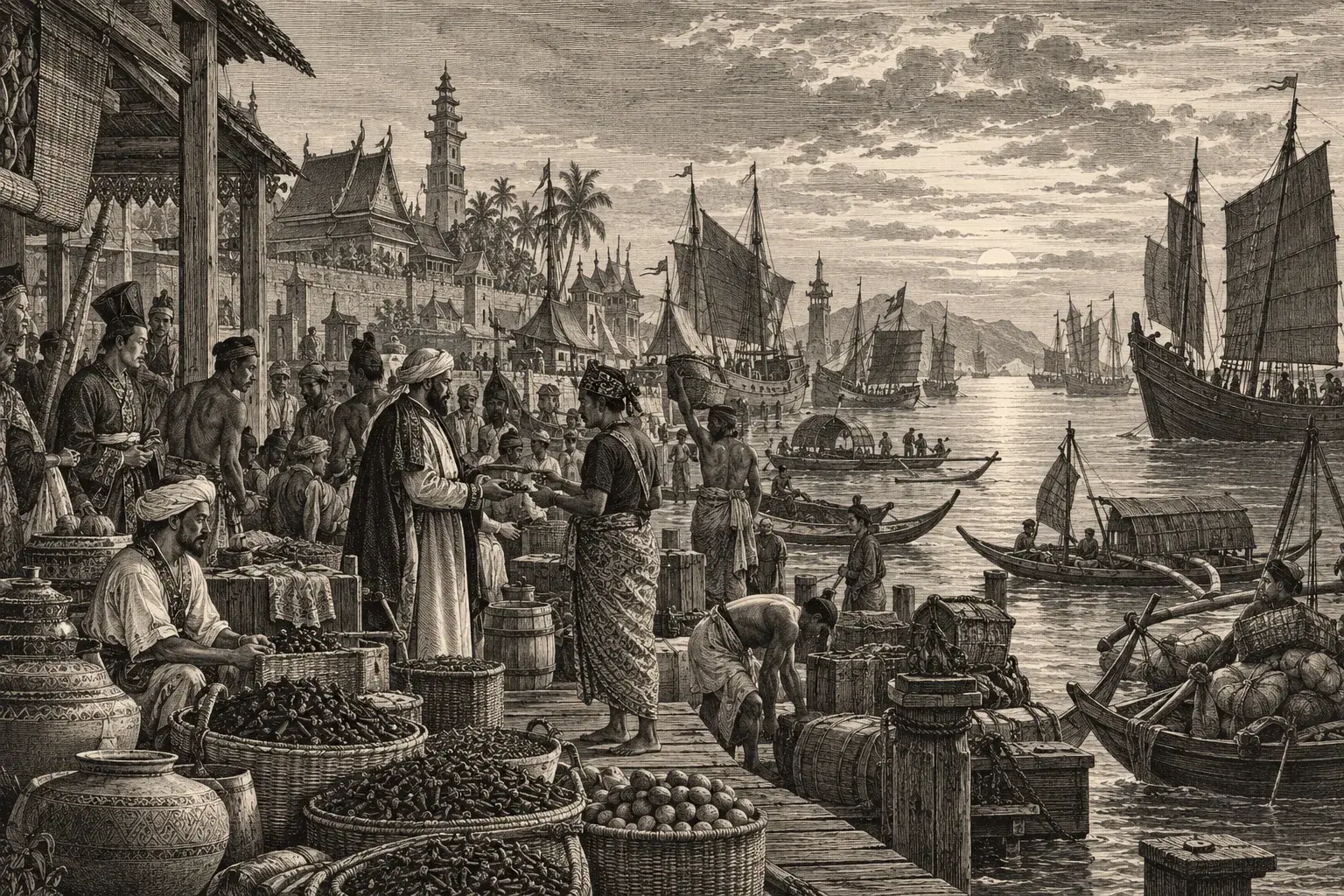
The Egyptians set up a trading tent and ringed it with soldiers — not as a threat, the record suggests, but as a practical measure to keep the goods secure and the negotiation orderly. The market stayed open for several days. People came from across the surrounding country bringing what they had. The cargo that eventually filled the ships was extraordinary in its variety. Elephant tusks. Gold. Ebony. Live apes — which sat on top of the bales of goods during loading, apparently unwilling to go below deck, looking back at the shore they were leaving. Greyhounds. Leopard skins. But the most important cargo, from the Queen's point of view, was the incense. Large quantities of the gum were loaded. And alongside the gum went thirty-one living incense trees, their roots packed in balls of earth and protected with baskets — the ancient equivalent of a carefully prepared container shipment, designed to keep the trees alive through a long sea voyage. Several young Punite chiefs came back with the fleet voluntarily, curious about the distant world the Egyptians had described. The return voyage — overloaded ships, live animals, live trees, live passengers, the long haul back up the Red Sea — was not a small undertaking.
The Return to Thebes — and the Giraffe Nobody Had Seen Before
The fleet reached Thebes through a canal that connected the Red Sea to the Nile — a waterway that the Egyptians had used for exactly this kind of transit, which tells you something about how seriously they took the logistics of long-distance trade. The return was treated as a major public event. Troops in formal dress came out to escort the ships. The royal fleet sent an accompanying squadron up to the temple quay where the explorers were to moor. Then Thebes got to see what had come back. The incense gum. The ivory. The apes. The skins. The Punite chiefs in their unfamiliar dress. All of it drew crowds. But the thing that stopped people entirely was the giraffe. How a giraffe was transported on an Egyptian galley is a question the records do not answer. The ship would have been low-sided, the giraffe would have been tall, and the Red Sea is not a particularly calm body of water. Somehow it arrived alive in Thebes, and the people of the city, who had never seen anything like it, stared. Hatshepsut received the cargo with ceremony. The incense gum was stored in the temple. The Queen herself provided a measuring vessel made from a gold and silver alloy to weigh it out — a detail that suggests she was present, physically handling the accounting of what her ships had brought home.
The Temple — A Paradise Built from What the Ships Brought Back
Hatshepsut had been building a temple in the limestone cliffs above Thebes since before the expedition sailed. Her father had started the work; she had been completing it. The temple at Deir el-Bahri rose in three terraces against the cliff face, each level fronted with rows of limestone pillars, the innermost chamber cut directly into the rock itself. It was unlike anything else in Egypt — more open, more horizontal, more dependent on the relationship between the built structure and the natural cliff behind it. She decided this temple would house the incense trees. Thirty-one sycamore trees from the edge of the known world, planted on the temple terraces and tended carefully enough that they took root and grew in Egyptian soil. She called the result a Paradise for Amen — the god who had given her the command to send the ships in the first place. And then she had the walls of the temple covered with the story of the voyage. Every stage of it. The ships being fitted out. The crossing of the Red Sea. The arrival at the Elephant River. Nehsi landing with his eight soldiers. The table of gifts. Parihu and Aty coming down to meet the Egyptians. The trading tent with its guard. The loading of the galleys. The animals. The trees in their earth balls. The long line of Theban soldiers coming out to meet the returning fleet. The procession through the city. The artists who did the work are anonymous — we know the name of the architect, Sen-mut, who designed the building, but not the sculptors who filled its walls. Whoever they were, they worked from direct accounts and possibly from the envoy's own report, and they recorded what they saw described with a precision that turned the temple into something closer to a documentary than a monument. No explorer before her had published a record of a voyage on this scale. And no record published since has lasted as long.
The Obelisks — 350 Tons of Granite in Seven Months
The voyage to Punt was not the only large thing Hatshepsut commissioned. At some point during her reign — she describes it as coming from a moment of reflection in the palace, a thought about honouring her god — she decided to erect two obelisks before the great Temple of Amen at Karnak. She gave the order. Sen-mut went south to the granite quarries at Aswan. The obelisks were cut, transported, and erected — carved from base to summit with hieroglyphs — in seven months. Each one stood 98 and a half feet tall and weighed approximately 350 tons. To give that some scale: Cleopatra's Needle on the Thames Embankment in London, which caused the British engineers who brought it from Egypt in the 1870s considerable trouble, stands 68 and a half feet tall. Hatshepsut's obelisks were thirty feet taller and significantly heavier — and the people who quarried, moved, raised, and inscribed them did all of it in less time than it takes to build a moderately complicated modern office block. One of them is still standing at Karnak. It is the tallest obelisk in the temple complex. The other fell at some point and lies broken near its companion. Together they are, as the original account says, their own plain evidence of what the people who built them were capable of.
One of Hatshepsut's two granite obelisks still stands at Karnak — 98 and a half feet tall, carved from base to summit with hieroglyphs, quarried and erected in seven months. Its companion lies broken beside it.
What She Left Behind
Someone tried to erase Hatshepsut from history after her death. Her face was removed from images. Her name was cut from inscriptions. Her statues were pulled down and buried in pits near the temple she had built. It was a thorough attempt. It was not thorough enough. The temple walls at Deir el-Bahri survived with enough of their carving intact that the voyage to Punt can still be followed panel by panel — the ships, the trading, the loading, the animals, the homecoming. The standing obelisk at Karnak still carries her name. Her buried statues, excavated in the early twentieth century, are in the Metropolitan Museum in New York in numbers that make the room where they are kept feel like a private audience. And the incense trees she planted on the temple terraces from Punt, the ones she called a Paradise — they grew in Egyptian soil for generations after she died, sustained by careful watering in a climate they were never built for, a small living monument to a voyage that crossed a sea and came back with something worth keeping.