The emperor ran. Leopold I, Holy Roman Emperor, left Vienna in July 1683 as the Ottoman army rolled toward his capital, taking his court with him. A significant portion of the city's wealthy inhabitants followed, loading carts with valuables and heading west. The roads out of Vienna were crowded with refugees. The city they left behind them had a garrison of fifteen thousand men and walls that were already overdue for repair. Three weeks later, the Ottoman army arrived. Two hundred thousand of them, roughly — the numbers in historical sources vary, but nobody disputes it was one of the largest forces assembled in European warfare to that point. Their camp, built in a crescent around the city, covered six leagues of ground and held its own city of tents, including at the center the Grand Vizier's pavilion: silk-walled, gold-embroidered, with its own gardens, baths, and fountains, the holy standard of the Prophet kept inside. For the next sixty-three days, the most important question in Europe was whether Vienna would hold.
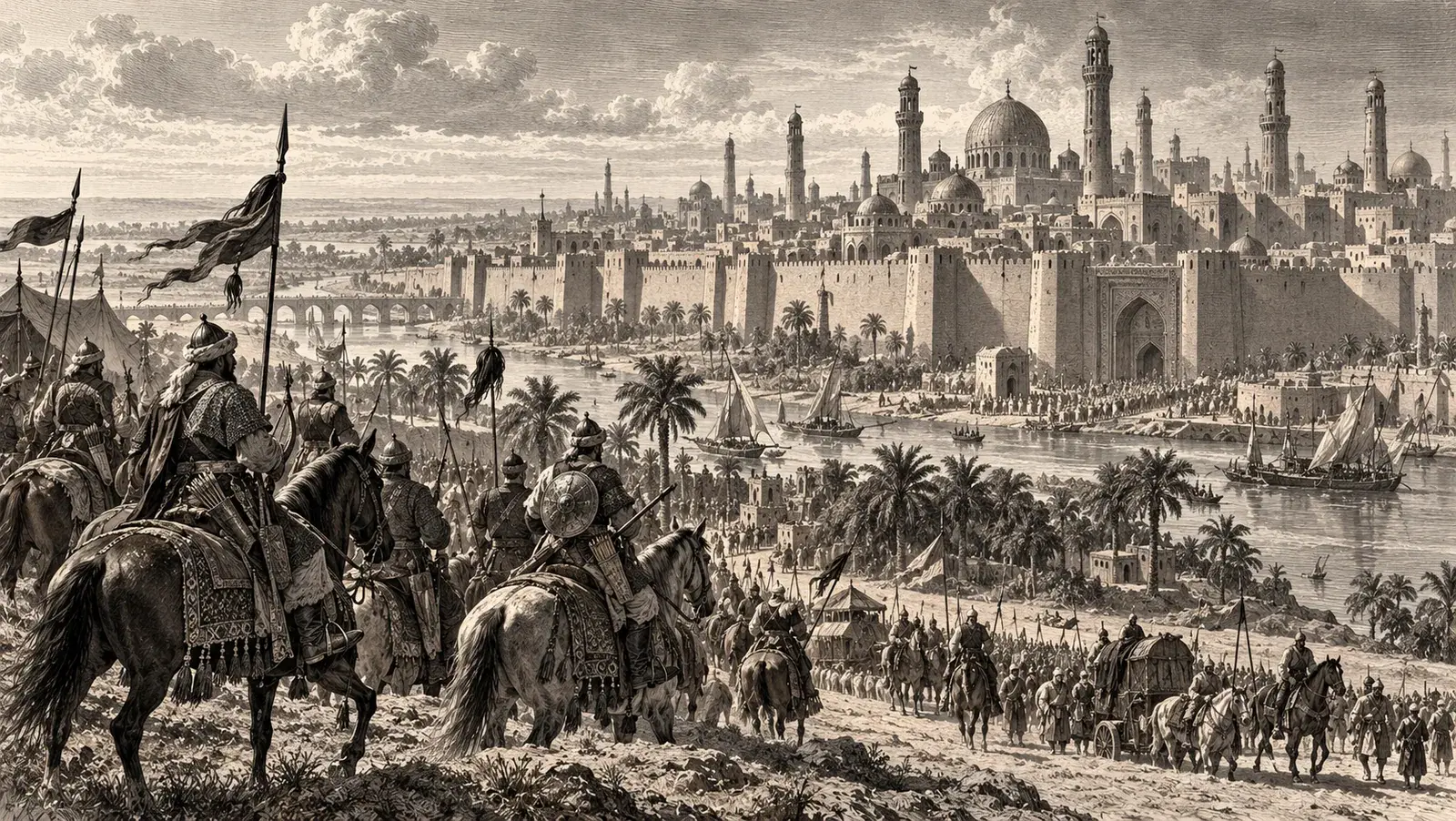
The Ottoman camp outside Vienna in 1683 was effectively a city in itself — its central section held the Grand Vizier's silk pavilion, complete with gardens and baths, while the perimeter stretched so far that the besieging force and the city they surrounded were together larger than almost any settlement in contemporary Europe.
The Man Who Didn't Run
The Duke of Lorraine, whose army was too small to face the Ottoman force in the field, left twelve thousand men inside the city and withdrew to wait for whatever reinforcements western Europe might produce. Command of the defense fell to Count Rudiger von Stahrenberg. Stahrenberg was the right man for a siege. Wounded early in the defense, he refused to let the injury reduce his activity — he had himself carried around the walls daily to inspect the defenses, maintain morale among the garrison, and personally oversee repairs to the damage done each night to what had been broken in the day's bombardment. The Turks worked with impressive energy: they opened trenches two days after arriving, placed three hundred cannon, began undermining the walls systematically. The Burg bastion took the worst of it. On September 4th, a mine under the Burg bastion was detonated with enough force to shake half the city. The bastion was shattered for a width of thirty feet, chunks of wall thrown far across the surrounding ground. Ottoman troops poured into the breach. The defenders were waiting. They drove the assault back with heavy casualties. The next day the Turks charged again; they were repulsed again. The shattered bastion became, as Charles Morris put it, "a very gulf of death." But the city was running out of time. Supplies were nearly gone. The garrison had been fighting continuously for over two months. On September 10th another mine collapsed a second breach wide enough to force a full Ottoman battalion through. Vienna, Stahrenberg reported in a message smuggled out to the relief army, could not hold much longer.
The Cavalry Charge That Ended the Siege in an Afternoon
The relief army that gathered was a coalition — German princes, Poles, Austrians, Saxons, assembled under the loose banner of the Holy League with the Pope's backing. The largest single contingent was Polish, commanded by King John Sobieski, a man with extensive experience fighting Ottomans on the eastern European frontier and possibly the most capable cavalry commander of his generation. The relief force reached the Kahlenberg heights above Vienna on the night of September 11th, 1683. The Ottoman army below them was vast, well-supplied, and occupying prepared positions. By most conventional military analysis, the position of the relief force was extremely dangerous — attacking downhill against a larger force in prepared ground is not a tactic that military theory generally recommends. Sobieski went anyway. On the morning of September 12th, the allied forces attacked in coordinated columns across a wide front, with Sobieski's Polish forces holding the right flank above the city. The battle ran through most of the day — the Ottomans held initially, the fighting was severe, the outcome was not obvious through the middle hours. Then, in the late afternoon, Sobieski personally led the Polish cavalry down off the Kahlenberg heights in one of the largest charges in recorded history — somewhere between seventeen and twenty thousand horsemen in a single mass, striking the Ottoman flank and rear. The Ottoman force broke. Kara Mustafa himself was wounded in the rout. More than twenty thousand of his men were left dead on the field. The magnificent tent, the fountains, the gardens, the three hundred cannon, the enormous camp — all of it was abandoned as the army fled south and east. Vienna was relieved after sixty-three days.
John Sobieski's cavalry charge from the Kahlenberg heights on September 12, 1683 — somewhere between seventeen and twenty thousand horsemen — struck the Ottoman flank in the late afternoon and broke the army that had besieged Vienna for sixty-three days.
What Happened Afterward — To the Vizier, the Turks, and European History
Kara Mustafa didn't survive his failure. Ottoman sultans had a straightforward way of handling grand viziers who lost critical battles — he was strangled in Belgrade in December 1683 on the Sultan's orders, his head delivered to Constantinople as confirmation of the sentence carried out. The defeat at Vienna was not the immediate end of Ottoman military power in Europe, but it was the beginning of a sustained reversal. The next decade and a half saw the Ottomans pushed out of Hungary, defeated at Mohács, and compelled to sign the Treaty of Karlowitz in 1699 — the first major territorial concession the Ottoman Empire had ever made to a Christian power. The empire that had seemed capable of rolling indefinitely westward had met something it couldn't absorb. For Vienna, the siege left physical scars — the walls and bastions that had been systematically demolished over sixty-three days needed years of rebuilding. But the coffee houses that became a feature of Viennese culture are said to trace back, at least in legend, to the bags of coffee found abandoned in the Ottoman camp by soldiers who had never encountered the substance before. The historical weight of September 12, 1683 is not easily overstated. The Ottoman army that arrived at Vienna's walls was the western edge of a military force that had been expanding into Europe for two and a half centuries. What stopped it was sixty-three days of brutal urban defense and one cavalry charge on a September afternoon — and that was enough.