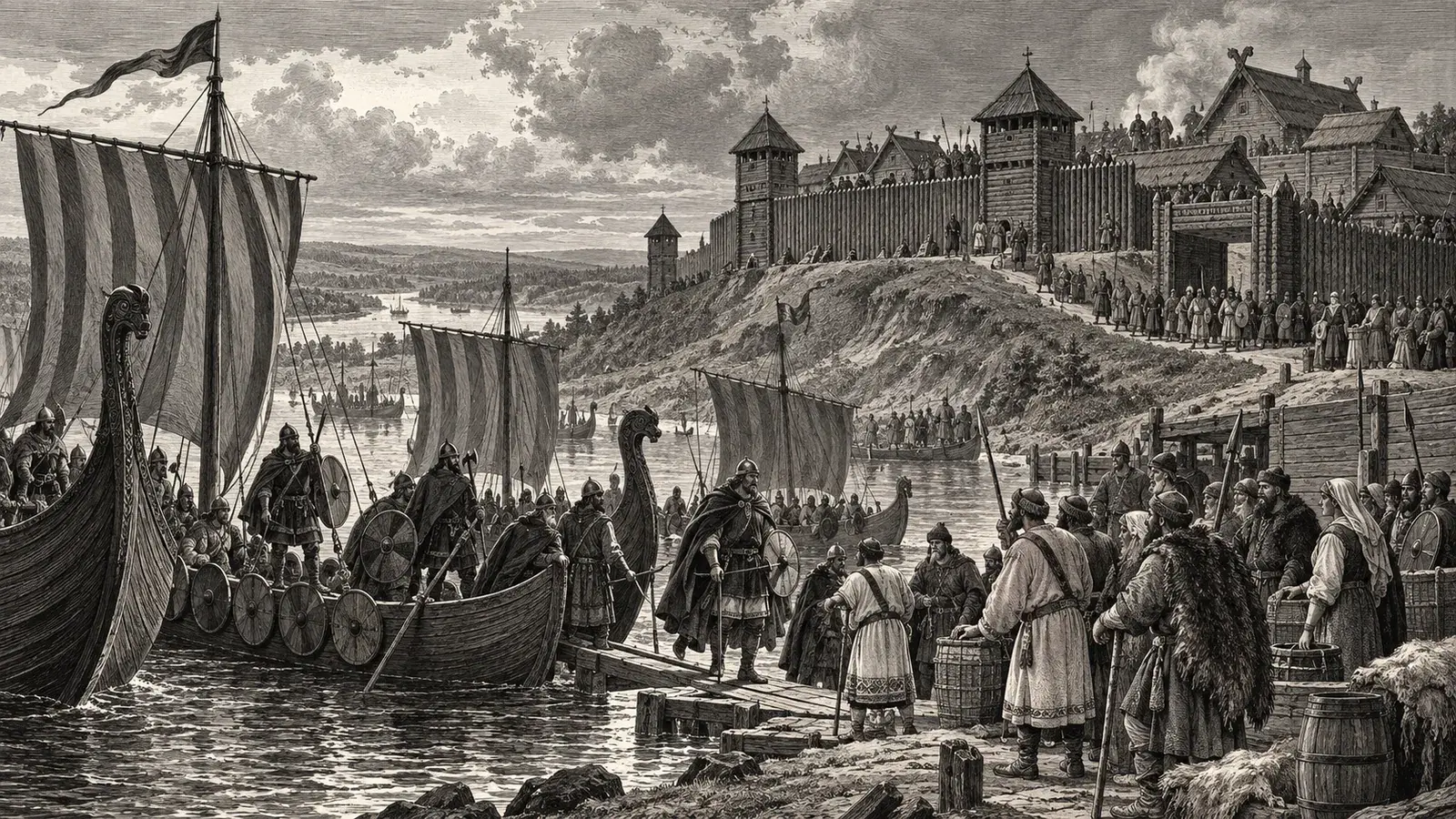
When Rome first marched up to the banks of the Rhine River, you'd expect the thing stopping them to be some massive rival empire with bigger swords and better war machines. It wasn't. The people who held the lands beyond the river were a simple forest folk. They lived in scattered villages and survived by hunting. Later writers sometimes called them "forest children" — not because they were small, but because they were tall, strong adults who still met the most powerful army on earth with a kind of fearless, childlike boldness.
The tribes beyond the Rhine lived in scattered forest villages and fought the Roman army with surprise, knowledge of the land, and stubborn courage rather than big organized battles.
An Enemy Rome Couldn't Figure Out
What really unsettled the Romans was how strange these people seemed to them. The clever, calculating Roman mind couldn't make sense of a chieftain who would cut down a dozen enemies in battle without mercy — but who would also ride, unarmed, into the enemy camp ahead of time just to agree on a fair time and place for the fight, so neither side had an unfair advantage. To the Romans, a mysterious enemy they didn't understand was scarier than a whole forest full of swords.
The Bravest Roman of All
Plenty of Roman generals volunteered for the dangerous job up north, but none was braver than Drusus. He was the first Roman captain to sail the feared Northern Ocean, and he built deep, well-paved trenches on the far side of the Rhine that carried his name for centuries afterward. During the reign of Augustus — the greatest of the Caesars — Drusus loaded his men onto flat-bottomed boats, crossed the Rhine, and plunged into the forest. It was brutal going. The path led through thick woods and trackless swamps, and many men were lost along the way. The tribes had a smart way of fighting. When they lined up in front of their villages, the Romans usually won and drove them back. But the next day, as the army struggled forward, trees that had been half cut the day before would suddenly crash down, as if by invisible hands, until a tangle of logs blocked the road for hours. At night, eerie calls echoed from one side of the forest, answered by cries from far away, until the more superstitious soldiers swore the woods were haunted. Still, Drusus pushed on, all the way to the Elbe River in the middle of Germany — farther than any Roman army had ever gone.
The Warning in the Forest
Then, the old story goes, something strange happened. A figure appeared in Drusus's path — a woman taller than any human and more beautiful than seemed possible, with eyes as blue as the sky and pale hair streaming behind her like a cloud. The soldiers froze in fear. She was said to be the spirit of Germania itself, the living soul of the land, taking human form to protect her home. Speaking in his own language, with a voice like forest music that still made him shiver, she told Drusus: turn back. It was not his fate to see all of this land. The end of his life, she warned, was already near. Shaken, the Romans turned around and made the long march back to the Rhine. But being Romans, they refused to leave quietly. At the farthest point they had reached, they set up a stone monument so that people far in the future would know that in the ninth year before the Christian era, Roman soldiers had pushed this deep into the land. Because the trip ended in disaster, later people called the monument "Accursed." And the prophecy came true: on the way home, before he even reached Roman soil, Drusus fell from his horse and died.
According to legend, the spirit of Germania appeared in Drusus's path and warned him to turn back — and soon after, he died on the journey home.
"Give Me Back My Legions"
Rome mourned Drusus, but Romans hated to admit defeat. When his soldiers told their tale of the glowing vision, people laughed at them. So before Augustus died, another general named Varus crossed the forbidden line and marched into the same forests. Varus had it even worse than Drusus. Drusus at least lost only his own life and got his army home safely. Varus lost two entire legions — the best of Rome's soldiers — in a horrible battle in the swamps. Rome hadn't suffered a disaster like it in living memory. The whole city went into mourning. The story goes that Augustus refused to cut his hair or beard for a month, and that he would cry out, even in his sleep, "O Varus, give me back my legions!" After that, the warning of Germania was finally taken seriously. Augustus decided Rome would stop risking its armies across the Rhine. The river would be the frontier, the edge of the empire — and so it stayed for hundreds of years to come.