His real name was Timur. The Persians and others who had reason to fear him called him Timur-i-Leng — Timur the Lame — because a wound he took in battle as a young man left him with a permanent limp and a withered right hand. Western languages turned that into Tamerlane, which sounds more dramatic but is simply a corruption of the Persian nickname. He was born in 1333 in Transoxiana, the Central Asian region between the Amu Darya and Syr Darya rivers, in what is now Uzbekistan. His father was the chief of a Mongolian-Turkic tribe, a Muslim people who traced their lineage back to the armies of Genghis Khan. By the time Tamerlane was twenty-four, his father was dead and he had maneuvered, fought, and outpoliticked his rivals until he stood at the head of not just his own tribe but the entire Mongolian confederation in the region. What he did next consumed the rest of his life and the lives of a number that historians still argue over — somewhere between ten and seventeen million people killed across his campaigns, by some estimates. Numbers at that scale from the fourteenth century are unreliable. What is not unreliable is the consistent picture across Persian, Arabic, Chinese, and European sources: wherever Tamerlane went, the survivors wished he hadn't come.
Tamerlane was born in Central Asia in 1333, walked with a limp from a battle wound, and built one of the largest empires in history through a combination of military genius and organized brutality that left a trail of destruction from Persia to India to the gates of Constantinople.
How He Built His Empire
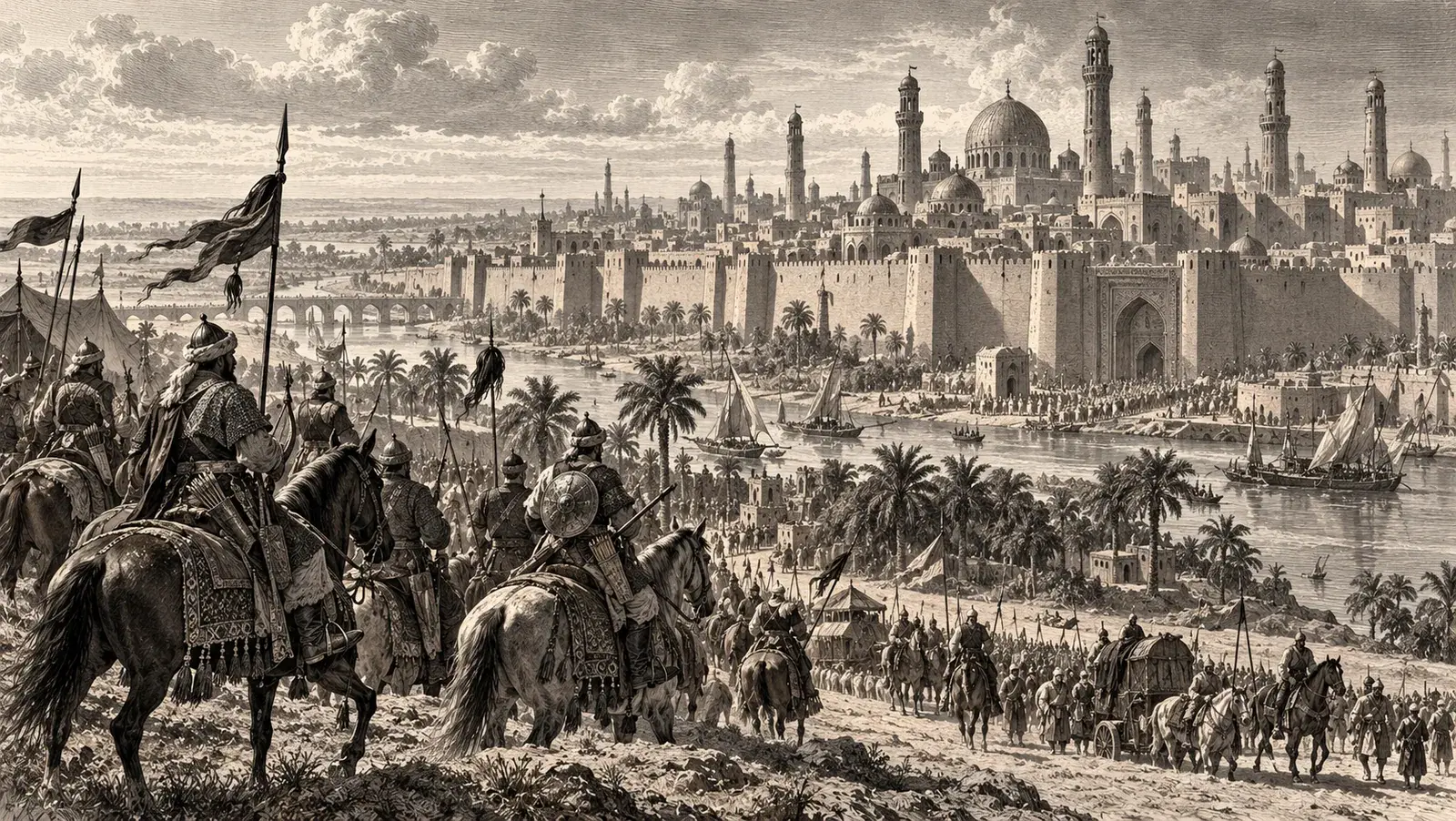
Tamerlane chose Samarkand as his capital and spent years building it into one of the most spectacular cities in the medieval world. The blue-tiled domes and the great Registan square — much of which was built or rebuilt during his reign and the reigns of his successors — still draw visitors today, eight centuries after his death. He understood, as most successful conquerors do, that power requires not only force but display. His campaigns followed a consistent pattern. He would demand submission. If a city refused or rebelled after submitting, the punishment was systematic and public. Towers built from the severed heads of the defeated outside captured cities were not accidental cruelty — they were calculated deterrence. The cities that opened their gates quickly tended to survive more or less intact. The ones that resisted found out what resistance cost. He invaded Persia first, forcing the ruling dynasty to flee, then turned north toward the great Tatar empire of the steppes, then west into Russia far enough to sack several Russian cities before turning back. Then India — his army crossed the Hindu Kush, descended on Delhi, and sacked one of the wealthiest cities in Asia in 1398. The Sultanate of Delhi never fully recovered; the political vacuum his raid created contributed to the eventual Mughal conquest more than a century later. All of this — Persia, the northern steppes, Russia, India — was accomplished in roughly twenty years of campaigning. And he was not finished.
The Cage and the Sultan
The most dramatic episode of Tamerlane's career — the one most written about in both Eastern and Western sources — was his collision with Bajazet I, the Ottoman sultan who had earned the nickname Yildirim, The Thunderbolt, for the speed of his military campaigns. Bajazet had his own enormous ambitions. He had crushed a European crusading army at the Battle of Nicopolis in 1396 and was in the middle of a prolonged siege of Constantinople when Tamerlane's expansion westward made a confrontation unavoidable. The two men exchanged letters that deteriorated into insults. Tamerlane's communications reportedly told Bajazet to remember who he was dealing with. Bajazet reportedly responded in kind. They met at the Battle of Ankara in July 1402. It was one of the largest battles of the medieval world — both armies numbered in the hundreds of thousands, and the result was not close. Part of Bajazet's army, composed of Tatar vassals who had previously served Tamerlane, changed sides during the fighting. The Ottoman army collapsed. Bajazet was captured — the first and, until centuries later, only Ottoman sultan to be taken alive in battle. What happened next is the part that lodged in European and Middle Eastern memory. According to the most widely circulated accounts, Tamerlane had Bajazet confined in an iron cage and transported with the army as it moved from camp to camp. Some versions of the story have the sultan used as a footstool when Tamerlane mounted his horse. Whether the cage was real or a later embellishment of something more mundane — the captive sultan simply kept in close confinement — historians still debate. Bajazet died in captivity a few months after his capture. The effect on the Ottoman Empire was profound. The dynasty nearly collapsed; several of Bajazet's sons fought each other for the throne in a decade-long civil war. Constantinople, which had seemed on the verge of falling, survived another fifty years as a result.
The capture of Bajazet I at the Battle of Ankara in 1402 — and the Ottoman sultan's confinement in what accounts describe as an iron cage — became one of the most retold episodes of medieval history, a symbol of the totality of Tamerlane's military dominance at the height of his power.
The Man Behind the Destruction
What makes Tamerlane genuinely strange as a historical figure is the gap between his destruction and his sophistication. He was illiterate — or at minimum had very limited formal education — but was known for holding extended conversations with theologians, philosophers, and scholars, including the famous historian Ibn Khaldun, who met him personally during the Damascus campaign and left a detailed account. Tamerlane was curious. He asked Ibn Khaldun questions about North Africa with what the historian described as genuine intellectual interest. He was a Muslim who sacked Muslim cities and killed Muslim populations without apparent compunction, yet he patronized Islamic architecture and scholarship, funded mosques and madrasas, and brought craftsmen from across his conquered territories to beautify Samarkand. The tiled tombs of the Shahi-Zinda necropolis, built during and just after his era, are among the most extraordinary examples of medieval Islamic art anywhere in the world. He claimed descent from Genghis Khan — the claim was probably fabricated or at least embellished, since his Turkic-Mongolian lineage was real but the specific connection to Genghis is doubted by modern historians — and modeled his empire-building on the Mongol tradition while simultaneously presenting himself as a defender of Islam against its enemies. None of these contradictions resolved themselves. He died in February 1405 at the town of Otrar in what is now Kazakhstan, three hundred miles into a march toward China with an army of two hundred thousand. He had been ill for weeks. The army turned back. The empire he built lasted another century under his descendants — the Timurid dynasty produced remarkable patrons of art and scholarship — before fragmenting. His tomb in Samarkand, the Gur-e-Amir, is still standing. Soviet archaeologists opened it in June 1941. Germany invaded the Soviet Union two days later. Whether you find that coincidence interesting or irrelevant says something about how you read history.