The word Crusades gets used loosely. People invoke it to describe everything from medieval holy wars to modern political rhetoric, and the word has accumulated enough cultural weight that it now means almost anything depending on who's saying it. The actual history is more specific and stranger than either the romantic version or the anti-religious version tends to admit. These were military campaigns — organized, papally authorized, spiritually incentivized — launched by Western Christians to take and hold Jerusalem and the surrounding region from Muslim rulers. Two centuries of them, roughly from 1095 to 1291, with a series of smaller and weirder expeditions filling the gaps between the major numbered ones. Historians still argue about almost everything beyond that basic definition: which expeditions officially count, what motivated the average soldier who sewed a cross onto his tunic and sold or mortgaged his land to pay for the journey, and whether the whole enterprise was coherent enough to be treated as a single phenomenon. What's clear is that the Crusades reshaped the Middle East, severely damaged Byzantium, produced institutions that outlasted the campaigns by centuries, and left behind a memory that people are still fighting over — in ways that have almost nothing to do with what actually happened between 1095 and 1291.
Pope Urban II's speech at Clermont in November 1095 launched the crusading movement — though what exactly he promised those who took the cross, and how accurately the accounts written afterward captured his words, historians still argue about.
The World That Made Them Possible
Jerusalem had been under Muslim control for over four centuries before the First Crusade. For much of that time, Christian pilgrims had been able to visit the holy sites without serious interference — access varied depending on local rulers, and the situation was never completely stable, but pilgrimages continued. What changed in the 1070s was the arrival of the Seljuk Turks. Their victory over the Byzantine Empire at the Battle of Manzikert in 1071 opened Anatolia to Turkoman settlement and collapsed Byzantine control across a wide area. Pilgrim routes that had been difficult but passable became genuinely dangerous. The Byzantine emperor Alexios I Komnenos sent envoys to Pope Urban II in 1095 asking for military aid. Urban was ready to provide it. The papacy by this point had strengthened its institutional position considerably — the church reform movement of the previous decades had given popes new authority and new willingness to direct armed force toward religious ends. Theologians working under Pope Gregory VII had concluded that dying in a just war was equivalent to martyrdom. The Council of Clermont in November 1095 was the moment all of this crystallized. Urban's speech promised spiritual rewards to those who took up the cross — the accounts differ on whether it was reduced penance or full remission of sins, and the discrepancy matters because it shaped who felt sufficiently motivated to go. What the accounts agree on is that the crowd's reaction was immediate. People shouted Deus vult — God wills it. The crusading movement began, though it would take years before anyone understood what they had started.
The First Crusade — More Chaotic Than It Sounds
The People's Crusade departed before the official expedition even organized itself. Peter the Hermit preached across regions Urban had not reached, drawing thousands of peasants, minor nobles, and urban poor who left months early without waiting for the harvest. The German contingent launched massacres of Jewish communities along the Rhine — the Rhineland massacres of 1096 — before they crossed into Hungary. The people's contingents were destroyed by the Seljuks in Anatolia at Civetot in October 1096. Peter survived. Most did not. The princes' expedition that followed was a different matter. Godfrey of Bouillon, Raymond of Saint-Gilles, Bohemond of Taranto, and other leaders assembled forces totaling somewhere between 60,000 and 100,000 people — an enormous undertaking for the 11th century. They marched through Byzantine territory, took oaths to the emperor Alexios that many of them never intended to honor, and pushed into Anatolia. The siege of Antioch from October 1097 to June 1098 nearly broke the expedition — disease, famine, desertion, and a massive relieving army under the Seljuk commander Kerbogha. The crusaders held the city through a combination of desperation and the discovery of what was claimed to be the Holy Lance. They defeated Kerbogha, continued south through lands whose rulers often granted safe passage rather than fight, and reached Jerusalem on June 7, 1099. On July 15, the crusaders broke through Jerusalem's walls. They spent two days killing the inhabitants — Muslim and Jewish — and looting the city. The accounts differ on the scale; what they agree on is that it was large. Godfrey of Bouillon became Jerusalem's first Western ruler, taking the title Advocate of the Holy Sepulchre rather than king — he reportedly declined a golden crown in the city where Christ had worn a crown of thorns. Within a month, a significant Egyptian relief force had been defeated at the Battle of Ascalon, and most of the crusaders went home, leaving Godfrey with barely 300 knights.
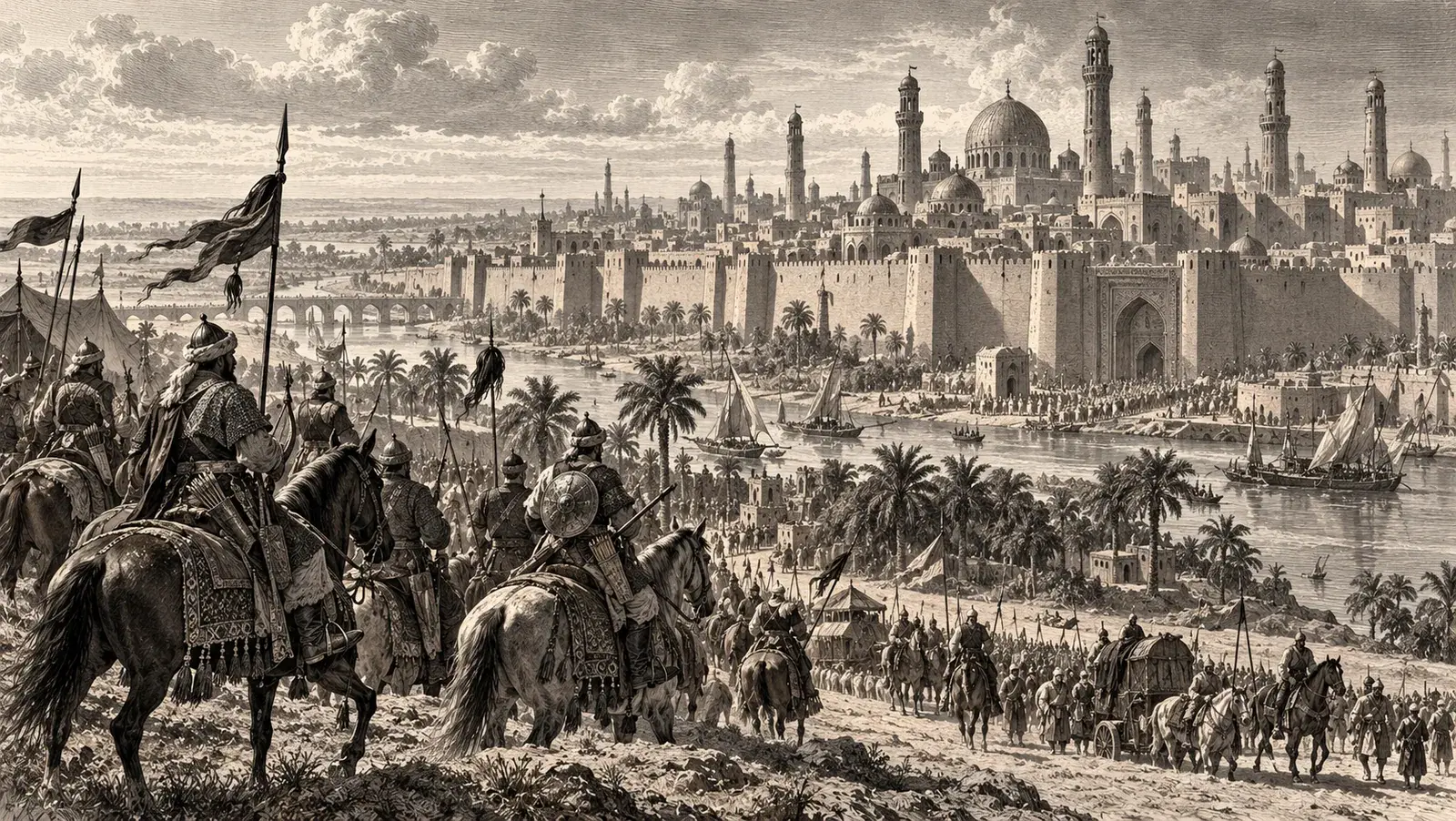
The siege of Jerusalem ended with the city's capture on July 15, 1099 — followed by two days of killing that shocked some contemporaries and shaped how the First Crusade was remembered by both Christians and Muslims for generations afterward.
The Crusader States and the Problem of Holding What You've Won
The First Crusade's success produced four political entities in the Levant: the Kingdom of Jerusalem, the Principality of Antioch, the County of Tripoli, and the County of Edessa. Keeping them viable consumed enormous European energy for the next two centuries. The military orders — the Knights Templar, the Knights Hospitaller, and later the Teutonic Knights — emerged partly because secular rulers couldn't maintain permanent garrisons in the region and partly because the church needed a way to channel aristocratic violence into something it could authorize. They became the structural backbone of the Crusader states. They built and maintained the great fortresses — Krak des Chevaliers, Margat, Beaufort, Belvoir — that anchored the Frankish presence against recurring Muslim pressure. The strategic problem was Muslim unity. As long as the various Muslim powers competed with each other — the Fatimids in Egypt, the Seljuks, the Zengid dynasty, local emirs with their own interests — the Crusader states could survive by exploiting the divisions. When Muslim power began consolidating, the small Frankish territories became increasingly precarious. The fall of Edessa to Zengi in 1144 — the first crusader capital to be lost — triggered the Second Crusade, which ended in 1148 with the failed siege of Damascus and accomplished essentially nothing. Its failure reduced crusading enthusiasm across Western Europe at precisely the moment the Crusader states needed it most.
Saladin and How Jerusalem Was Lost
Saladin occupies a strange position in Western memory — the honorable enemy, the chivalrous Muslim adversary who was somehow more admirable than his Christian opponents. Some of that reputation reflects genuine conduct: his treatment of Jerusalem's population after 1187 was less brutal than what the crusaders had done in 1099, and he ransomed rather than killed many captives. The romantic version tends to skip the decade of ruthless political work that preceded it. Saladin began as a Kurdish general serving Nur al-Din, maneuvered through the chaos of Fatimid Egypt to become its effective ruler, absorbed Syria after Nur al-Din's death in 1174, and spent years uniting the region under his control against the competing ambitions of his own Ayyubid relatives. None of it was particularly chivalrous. It was systematic and patient and it worked. The Battle of Hattin on July 4, 1187 was the decisive moment. Raynald of Châtillon's repeated violations of truces with Saladin had provided the pretext; Saladin's strategy provided the conditions. He drew the Crusader field army across waterless terrain in high summer heat, then set fire to the dry grass. The dehydrated, exhausted army broke. The Templars and Hospitallers captured in the battle were executed. Raynald was executed personally by Saladin. King Guy of Jerusalem was spared. Jerusalem fell twelve days after the siege began, on October 2, 1187. The Kingdom of Jerusalem had been reduced to a handful of coastal towns. The news reached Western Europe through Genoese merchants and triggered a new round of crusade preaching — but the damage had been done. The Crusader states would never fully recover what was lost at Hattin.
Hattin in 1187 was the battle that broke the Crusader states — Saladin drew the army across waterless terrain in summer heat, set the grass on fire, and effectively ended the Kingdom of Jerusalem's capacity to defend itself.
The Third Crusade and What It Actually Accomplished
Three major rulers took the cross after Hattin: Frederick Barbarossa of Germany, Philip II of France, and Richard I of England. Frederick drowned crossing a river in Anatolia before his army achieved anything. Philip arrived, contributed to the long siege of Acre, and left after a personal falling out with Richard. Richard stayed. Richard's campaign from 1191 to 1192 was militarily effective and strategically inconclusive. He retook the coast from Acre to Jaffa, defeated Saladin at the Battle of Arsuf, and twice came within about twelve miles of Jerusalem without attacking it. His reasoning was defensible: capturing Jerusalem without enough men to hold it would be a temporary gain at best. The Treaty of Jaffa in September 1192 gave the Crusader states control of the coastal strip and guaranteed Christian pilgrims access to the holy sites. Jerusalem stayed in Muslim hands. Richard left Palestine in October and was captured in Austria by Leopold V, whose banner he had torn down at Acre during a dispute. He spent over a year as a prisoner before being ransomed for 100,000 marks. The Third Crusade is often presented as a failure because Jerusalem wasn't recovered. But the coastal foothold it secured gave what remained of the Crusader states the base they needed to survive another century. That's a complicated kind of failure.
The Fourth Crusade Goes to the Wrong City
The Fourth Crusade, launched in 1202, never reached the Holy Land. Instead it ended with the sack of Constantinople — a Christian city and the capital of the Byzantine Empire — in April 1204. The sequence by which a crusade aimed at Egypt ended by looting Eastern Christendom's greatest city is one of the stranger passages in medieval history. The short version: the crusaders couldn't pay Venice for the ships Venice had built for them, so they agreed to attack the Christian city of Zara for Venice instead. Then a deposed Byzantine prince offered Constantinople's treasury and church reunification if they'd put him back on the throne. They did. He couldn't deliver. They sacked the city. The longer version involves papal prohibition being ignored at each step, promises made that couldn't possibly be kept, and a series of individually defensible decisions that collectively produced a catastrophe. The Byzantine historian Nicetas Choniates compared the crusaders' conduct in Constantinople unfavorably to Saladin's conduct in Jerusalem — the conquerors of a Christian city had behaved worse than the Muslims they were supposedly fighting. The Latin Empire established after 1204 lasted until 1261 and was under pressure almost from the start. As a crusading outcome, it was essentially negative. It permanently weakened Byzantium at a time when Byzantine survival mattered to any serious western position in the eastern Mediterranean.
The Later Crusades and the Slow Contraction
The Fifth Crusade targeted Egypt, which was strategically correct — control of Egypt was the key to the whole Levant. The crusaders took Damietta in 1219. Then, ignoring both military advice and Emperor Frederick II's explicit orders, they advanced toward Cairo in 1221. The Nile flooded. Egyptian forces opened irrigation channels. The crusaders were trapped and surrendered Damietta for safe passage. The pattern of sound strategy undermined by poor execution was becoming familiar. Frederick II recovered Jerusalem in 1229 through negotiation rather than fighting — the Treaty of Jaffa with Sultan al-Kamil returned the city along with Bethlehem and a corridor to the coast. Frederick had been excommunicated at the time. The Templars and Hospitallers refused to serve under him. He concluded the treaty using intermediaries. Jerusalem was back in Christian hands, and almost nobody involved was satisfied with how it had happened. Louis IX of France — later made a saint — launched two crusades. The Seventh, against Egypt in 1248 to 1251, ended with his capture at the Battle of Mansurah and eventual ransom. The Eighth, in 1270, ended with his death from plague outside Tunis. Both were earnest efforts at a problem that had become increasingly difficult to solve. The Mamluks who displaced the Ayyubid dynasty in Egypt were more systematically aggressive than their predecessors. Baybars launched a methodical campaign against the remaining Crusader positions. Caesarea, Haifa, Arsuf, Safed, Jaffa, Beaufort, Antioch — all fell between 1265 and 1268. Krak des Chevaliers, the great Hospitaller fortress in Syria, fell in 1271. Margat in 1285. The last major position, Acre, fell on May 28, 1291. The remaining mainland strongholds surrendered within weeks.
The fall of Acre in 1291 ended two centuries of Crusader presence in the Holy Land. Plans for reconquest continued for decades, but only the Alexandrian Crusade of 1365 briefly revived serious activity in the region.
What the Crusades Left Behind
The fall of Acre produced proposals, treatises, and plans for recovering the Holy Land that continued for decades. The Alexandrian Crusade of 1365, when Peter I of Cyprus led a force that took and sacked Alexandria for a week before withdrawing, was the last real attempt. Crusading in the strict sense was over, though the word and its institutional machinery persisted in different forms. What the Crusades left behind is harder to assess than what they accomplished in the Holy Land. The military orders continued operating for centuries after their original purpose disappeared. The Hospitallers moved to Cyprus, then conquered Rhodes, then held Malta. The Teutonic Knights continued their campaigns in the Baltic. Crusading taxation, indulgences, and administrative structures reshaped how the papacy and European kingdoms thought about organized collective action. They also produced the image that both sides in subsequent conflicts reached for. Modern political Islam has drawn connections between the Crusades and Western imperialism. Right-wing movements in the West have invoked crusader imagery as a framework for contemporary religious and demographic anxieties. Both uses flatten something that was far too specific and too rooted in 11th-century conditions to translate cleanly into any modern argument. The Crusades were neither the heroic defense of Christian civilization that papal propaganda made them out to be nor the simple story of Western aggression that later critics preferred. They were an unusual medieval phenomenon that grew out of circumstances — a particular arrangement of papal authority, aristocratic piety, economic growth, and geopolitical disruption — that no longer exist. That doesn't make them irrelevant. It means understanding them requires more patience than most modern invocations of the word tend to allow.