A hundred thousand years ago, people were already living in what is now Iran. That number is worth sitting with for a moment — a hundred thousand years. By the time small farming settlements appeared before 10,000 BCE, this land had already seen tens of thousands of years of human presence. Hunters, gatherers, people moving with seasons and animals, people who left behind tools and bones and the faint archaeological trace of lives lived long before anything like a city existed. The civilizations that eventually grew out of this region didn't come out of nowhere. They came out of that depth — layer upon layer of human adaptation, cultural borrowing, and the particular pressures of living on a plateau surrounded by mountains, deserts, and some of the most contested trade routes in the ancient world. What follows is a long story. It starts with a city founded nearly six and a half thousand years ago and runs through a chain of empires that shaped how humans organized governments, practiced religion, built infrastructure, and thought about the relationship between rulers and the people they ruled. Most of these empires are known to historians. Almost none of them get the credit they deserve in popular history.
The ruins of Persepolis — built under Darius the Great and expanded by his successors — still stand in southern Iran as one of the most remarkable architectural achievements of the ancient world, a physical record of the empire's extraordinary reach and ambition.
Elam, Susa, and the World Before Persia
The first major civilization to take hold in this region was Elam, with settlements going back to around 7200 BCE. That's older than Mesopotamia's most famous cities. Elam had its own writing system, its own kings, its own distinct urban culture centered on a city called Susa — one of the oldest continuously inhabited cities in human history, founded around 4395 BCE. Susa is worth pausing on. It predates the period archaeologists call Proto-Elamite, which means it was already a functioning city before Elamite culture as we recognize it even formed. It then spent the next several thousand years being conquered, absorbed, rebuilt, and reconquered — by Sumerians, Assyrians, Medes, Persians, and eventually Alexander the Great's forces. The city changed hands so many times it almost doesn't make sense to assign it a single cultural identity. It was just there, surviving, while empires rose and fell around it. Elam itself went through the same cycle on a larger scale. It was taken over in parts by the Sumerians, then more completely by the Assyrians, and eventually absorbed into the Median Empire. By that point, the name Elam still carried weight — its heartland, its administrative traditions, and its population would all feed into what came next.
The Aryans, the Medes, and the Religion That Changed Everything
Before the third millennium BCE, groups known as Aryan tribes migrated into the Iranian plateau. The word Aryan gets loaded with ugly modern baggage that has nothing to do with its original meaning — in their own language, it meant something closer to noble or free people, a self-designation rather than a racial category. These groups included the ancestors of the Medes, the Persians, the Parthians, and several others who would all eventually leave their mark on this region's history. They brought with them a religious worldview built around dualism — the tension between opposing forces, order against chaos, light against darkness. Fire held a sacred place in this system, treated as a visible expression of divine presence. The main deity was Ahura Mazda, a figure representing wisdom and cosmic order, alongside others like Mithra and Anahita. There's a striking similarity between these early Iranian religious traditions and the Vedic traditions developing simultaneously in northern India, which makes sense given that both groups shared ancestral roots. Somewhere between 1500 and 1000 BCE — the dating is genuinely uncertain — a man named Zoroaster, called Zarathustra in his own language, claimed a direct revelation from Ahura Mazda. His message stripped away the older polytheistic complexity and centered everything on a single moral choice: good or evil, order or chaos, truth or lie. Zoroastrianism became one of the world's first genuinely monotheistic religions, and its influence ran far deeper than Iran. The concepts of heaven, hell, final judgment, the cosmic struggle between good and evil — these show up in Judaism, Christianity, and Islam in ways that scholars continue to trace back, at least partly, to Zoroastrian thought. The Medes were the first of the Aryan groups to build a real empire. Under Dayukku — whom the Greeks called Deioces — they unified and established their capital at Ecbatana around 678 BCE. His successor Cyaxares expanded the territory further, and the Medes became a major regional power. They played a central role in bringing down the Assyrian Empire in 612 BCE, one of the most dramatic collapses in ancient Near Eastern history. But Median dominance had a ceiling. And a younger, quieter Persian kingdom to their south was about to blow through it.
Zoroastrianism — built around the supremacy of Ahura Mazda and the moral opposition between order and chaos — became the religious backbone of Persian civilization and left fingerprints on every major Abrahamic religion that followed.
Cyrus the Great and the First Real Superpower
The Persian kingdom before Cyrus was a secondary state — significant locally but functioning essentially as a dependent of the Medes. Its early kings, Achaemenes and then Teispes, had consolidated control over southwestern Iran and expanded east into Persis, the region whose name eventually became Persia. They absorbed Elamite culture and institutions, blending them with their own. Cambyses I unified the split kingdom again. But through all of this, the Persians existed in the Median shadow. Cyrus II — Cyrus the Great — ended that. He was the grandson of the Median king Astyages, which made his coup against the Medes something of a family affair, and he overthrew Median rule around 550 BCE to found what became the Achaemenid Empire. What he built next was unlike anything the ancient world had seen at that scale. In rapid succession he defeated Lydia in 546 BCE, took Elam around 540, and captured Babylon in 539. By the time he was done, the empire ran from parts of modern Turkey and Syria across to the edges of India. It was the largest empire in the world to that point. The conquests are impressive enough. What's more interesting is the governance. Cyrus did not run his empire the way conquerors typically ran things. He didn't demand that subject peoples adopt Persian religion, language, or customs. He let them keep their own. When he took Babylon, he released the Jewish population that had been exiled there and funded their return to Jerusalem, including the rebuilding of their temple — an act recorded in the Hebrew Bible. The Cyrus Cylinder, a clay artifact discovered in the nineteenth century, describes his policies in his own terms: religious tolerance, fair treatment of subject peoples, the return of displaced populations to their homelands. Historians debate how to read this — whether it represents genuine political philosophy or sophisticated propaganda. It's probably both. But the practical effect was the same either way: an empire that held together because it gave people fewer reasons to revolt. His administrative structure was sharp. At the top, the king. Below, regional governors called satraps, each managing a province. Military command was kept deliberately separate from administrative authority, so no single person could accumulate enough power to threaten the center. A road network connected the empire's major cities, with relay stations providing fresh horses for messengers — a system so effective that Herodotus specifically noted how quickly information could travel across it. On top of all this, Cyrus took practical interest in the physical problems his new territories faced. Water scarcity was a constant pressure on the Iranian plateau and surrounding regions, so he promoted the qanat system — underground channels that moved water from upland aquifers to lower-elevation farmland without evaporation losses. He also supported the yakhchal, an insulated structure that could store ice year-round even in desert climates. These were not vanity projects. They made the empire's agricultural base more stable and its cities more livable. Even the word paradise traces back to Cyrus. His royal gardens — watered by the irrigation systems he developed — were called pairi-daeza in Old Persian, meaning walled garden or enclosed park. The word traveled into Greek as paradeisos and eventually into English as paradise. Cyrus died in 530 BCE, possibly in a military campaign on the empire's eastern frontier.
The Cyrus Cylinder — now held in the British Museum — is one of the oldest known documents describing a ruler's approach to governance and religious tolerance, recording Cyrus's policies toward the peoples his empire absorbed.
Darius, Xerxes, and the Wars with Greece
Cyrus's son Cambyses II extended the empire into Egypt, which meant the Achaemenids now controlled a territory stretching from the Aegean coast to the Indus Valley. After Cambyses, a confused succession crisis eventually resolved in favor of Darius I — Darius the Great — who took the throne in 522 BCE. Darius was an administrator as much as a conqueror. He expanded the road network, standardized weights and measures, and built Persepolis — the ceremonial capital that remained one of the ancient world's most striking cities until Alexander burned it. He also ran into Greece. The Greek city-states along the Aegean coast were technically under Persian authority, and when they rebelled in what historians call the Ionian Revolt, Athens sent ships to support them. Darius's response was to send a punitive expedition to mainland Greece, which ended at Marathon in 490 BCE — a Persian defeat that Greeks remembered for centuries and Persians probably considered a minor frontier annoyance. Xerxes I, Darius's son, took the Greek problem more seriously and assembled what ancient sources describe as an enormous army for an invasion in 480 BCE. He crossed the Hellespont on a bridge of boats, fought his way through Thermopylae, and burned Athens. Then the Greek navy beat his fleet at Salamis, his army was defeated at Plataea, and the invasion collapsed. It was the most famous Persian military failure and the one Western historians have focused on most heavily — partly because the Greeks who wrote about it were very good at making their victory sound world-historical. From the Persian perspective, these Greek campaigns were a significant but contained part of a much larger imperial story. The empire didn't collapse after Xerxes. It continued for another century and a half under a succession of kings, running the largest and most diverse polity the ancient world had yet produced.
Alexander, the Seleucids, and the End of the Achaemenids
The end came from the west. Alexander of Macedon invaded Persia during the reign of Darius III, won three major battles, and by 330 BCE had taken Persepolis — which his forces then burned, an act Alexander later claimed to regret. Darius III fled east and was eventually murdered by one of his own men, Bessus, who briefly claimed the Persian throne before Alexander hunted him down. Alexander died in Babylon in 323 BCE without having sorted out his succession, and his empire split almost immediately among his generals. Seleucus I Nicator got the eastern portion — a huge stretch including Mesopotamia, Persia, and Central Asia — and established the Seleucid Empire. The Seleucids kept much of the Persian administrative apparatus because it worked and because they didn't have anything better ready to replace it. But they layered Greek culture heavily over everything — Greek officials, Greek as the court language, Greek cities founded across the territory. It was a real cultural shift, not just a name change at the top. It didn't hold everywhere. By around 247 BCE, Parthia — a region in what is now northeastern Iran — broke away under a leader named Arsaces I. That breakaway became the seed of something much larger.
The Parthian Empire and the Army That Broke Rome
The Seleucid Empire slowly fell apart. Antiochus III tried to reverse the decline but was decisively beaten by Rome at the Battle of Magnesia in 190 BCE, after which the Seleucids never really recovered. They shrank to a rump state in Syria and were eventually absorbed by Rome in 63 BCE. Meanwhile the Parthians, under a capable series of rulers including Mithridates I, expanded steadily into the territories the Seleucids were losing. By the mid-second century BCE they controlled most of Iran and Mesopotamia and were well on their way to building an empire of their own. Their governing approach was looser than the Achaemenids. Rather than directly administering every province, they let local kings keep their thrones in exchange for loyalty and tribute. This reduced the administrative burden and, more importantly, gave local elites a stake in the system's stability. It worked — Parthia held together for nearly five centuries. Militarily, they developed something the ancient world hadn't quite seen before: heavy cavalry supported by horse archers using a tactic that became so associated with them it still carries their name. The Parthian shot — where mounted archers would pull away as if retreating, then twist in the saddle and shoot backward at pursuing enemies — was devastatingly effective against armies trained for close-quarters infantry combat. Rome discovered this the hard way. In 53 BCE, the general Crassus — one of the wealthiest men in Roman history and part of the ruling triumvirate with Caesar and Pompey — marched east to fight the Parthians and was destroyed at the Battle of Carrhae. He died in the aftermath. Mark Antony tried again decades later and fared only marginally better. The Parthians and then their Sassanian successors remained the one power Rome consistently could not subdue across four centuries of conflict.
Parthian cavalry tactics — particularly the mounted archer's ability to fire while in apparent retreat — proved remarkably effective against Roman legions, and the empire's military record against Rome stands as one of the most consistent in the ancient world.
The Sassanians: The Last Persian Empire
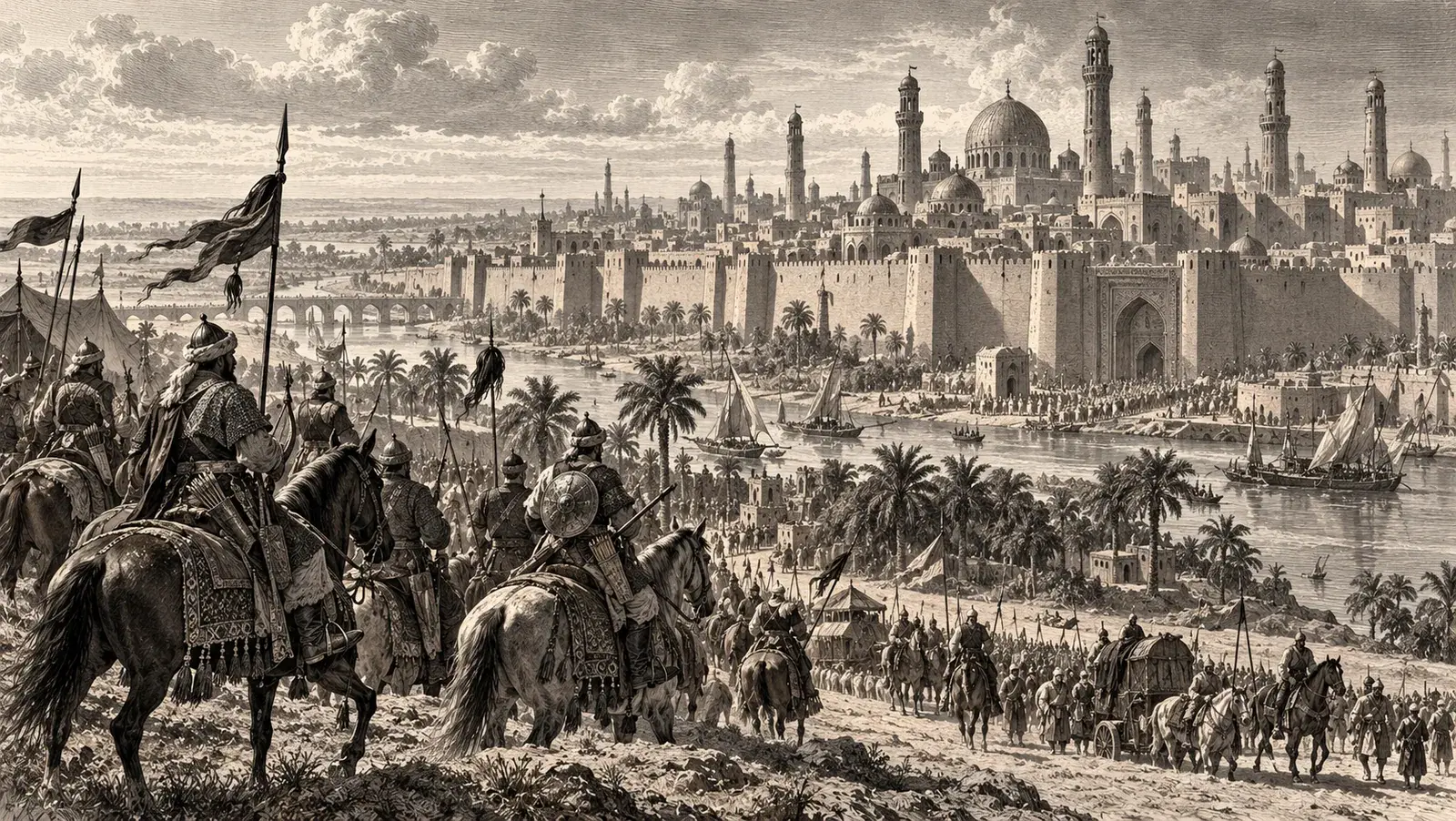
By 224 CE, the Parthian Empire had been grinding against Rome for so long that its own internal structure was showing the strain. Ardashir I, a vassal king from the Persis region — the old heartland of Achaemenid power — overthrew the last Parthian king, Artabanus IV, and founded what became the Sassanian Empire. Ardashir framed his project in explicitly Persian terms: a restoration of the old order, built on Zoroastrian principles, positioned as the legitimate heir to everything Achaemenid. Whether that framing was historically accurate matters less than the fact that it worked as political identity. The Sassanians built a strong, centralized state and spent the next four centuries as Rome's most capable and persistent opponent. Shapur I, who followed Ardashir, turned out to be one of the ancient world's more remarkable rulers. He expanded the empire militarily — and at the Battle of Edessa in 260 CE, he captured the Roman emperor Valerian. An actual Roman emperor, taken alive. It was the kind of event that shocked the Mediterranean world and still shows up in the rock reliefs Shapur had carved to commemorate it. He also fought Rome during its worst period of internal instability — the Crisis of the Third Century — and used Rome's weakness effectively. But Shapur was not just a military figure. Like Cyrus centuries before him, he practiced genuine religious tolerance. Jews and Christians could worship freely. He invited Mani, the founder of Manichaeism, to his court and engaged with his ideas — a striking openness for a ruler whose empire was formally organized around Zoroastrian orthodoxy. Infrastructure continued to develop under his reign: domed architecture, improved qanat systems, wind towers for passive cooling in hot climates, techniques that were genuinely sophisticated by any standard. The peak of Sassanian culture arguably came under Kosrau I in the sixth century, known as Anushirvan — the Just Soul. He reformed the tax system to reduce the arbitrary burden on ordinary people, reorganized the military for better defensive coverage, and made the Academy of Gondishapur into a serious intellectual institution that drew scholars from India, China, and the Greek-speaking world. Medical knowledge, philosophy, mathematics — Gondishapur synthesized them across traditions in a way that anticipated what later Islamic scholars would do on an even larger scale. Kosrau's treatment of prisoners of war was also notable. Unlike most ancient systems, prisoners under the Sassanians were treated closer to paid labor than property. Harming them was legally prohibited. It's a detail that doesn't fit the standard image of ancient conquest, but it was real. The Sassanian Empire eventually weakened through a combination of plague, exhausting wars with the Eastern Roman Empire, and internal court politics that produced a string of short-lived rulers in the seventh century. When Arab Muslim armies arrived in the 630s, they faced an empire that was still impressive on paper but had been drained by decades of conflict. The conquest came quickly by the standards of what the Sassanians had withstood before. But the fall of the Sassanian Empire didn't erase Persian civilization. It absorbed into what came next. Persian administrative systems shaped early Islamic governance. Persian literature, architecture, and scholarship fed directly into the Islamic Golden Age. The language survived. The cultural memory survived. Even today, the connection between modern Iran and ancient Persia is not a historical abstraction — it runs through language, religion, art, and a sense of civilizational continuity that most countries in the world simply don't have access to. A hundred thousand years of human presence on that plateau left marks that empires come and go without entirely erasing.
The rock reliefs at Naqsh-e Rostam record one of the ancient world's most stunning military moments — Shapur I standing over the kneeling Roman emperor Valerian, the only Roman emperor ever captured alive by an enemy force.