When the Prophet Muhammad died in 632 CE, his successors—the caliphs—took up the task of spreading both the new faith of Islam and the political power that came with it. Abu Bakr, the first caliph, inherited the same burning zeal as the Prophet but also carried an insatiable appetite for expansion. His armies, driven by a belief in divine destiny, began what would become one of the most dramatic waves of conquest in world history. The soldiers of Islam, known to Europeans as the Saracens, fought with the Qur’an in one hand and the sword in the other. Prisoners were often given a stark choice: accept Islam or face death. For the warriors themselves, death in battle was no defeat but a gateway to eternal bliss, where they believed paradise awaited those who fell fighting for the faith. This mixture of spiritual fervor and worldly ambition fueled a movement that soon swept across continents. Within a few decades, Persia had fallen, Syria and the Holy Land were under Muslim control, and Egypt had been wrested from the Eastern Roman Empire. The Arab armies even pressed hard against Constantinople, though the Byzantine capital’s formidable defenses repelled them again and again. When direct conquest of the city proved impossible, the Muslims turned their eyes westward across the Mediterranean.
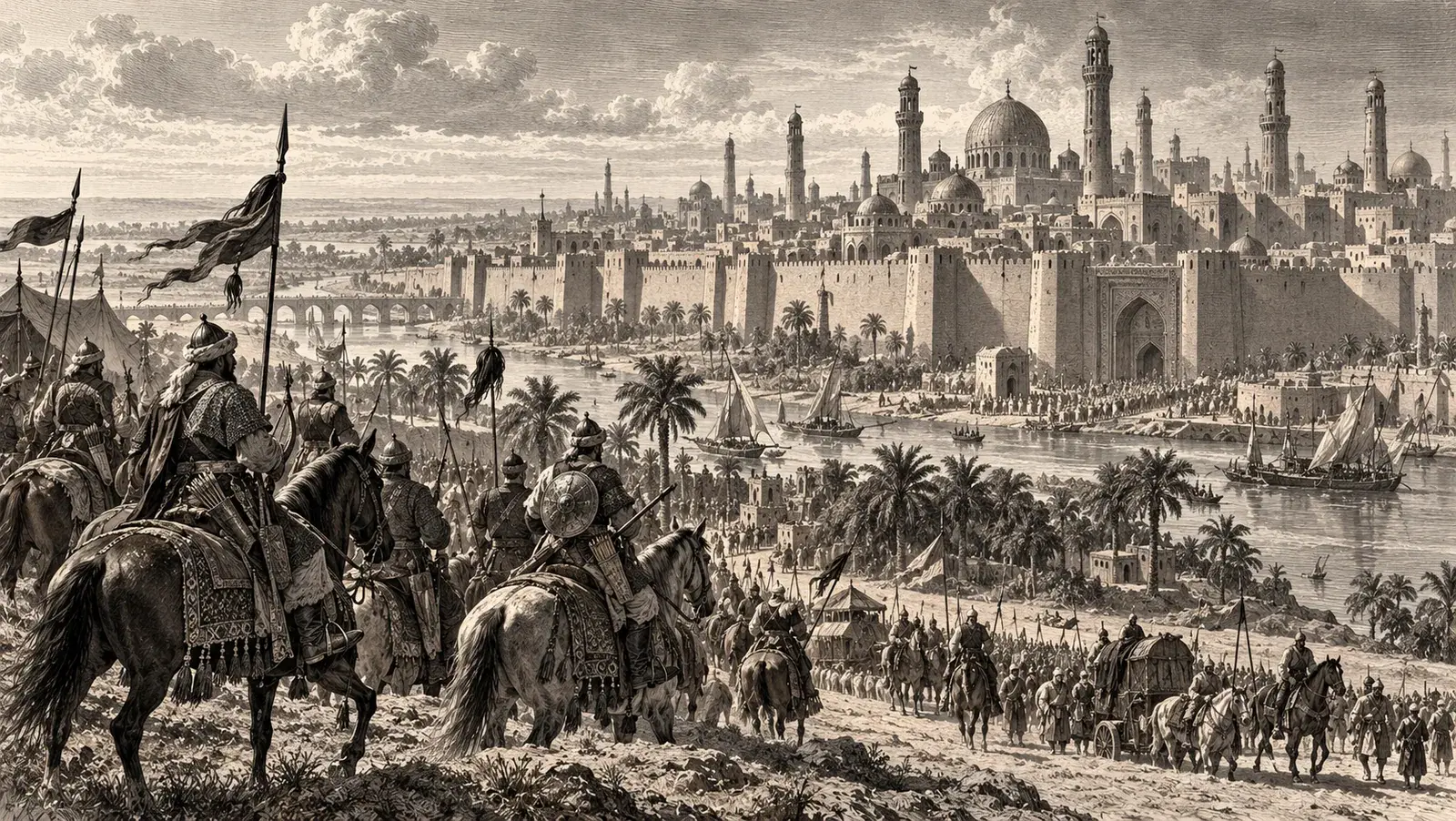
Arab cavalry during the early Muslim conquests in the 7th century.
North Africa and the Road to Europe
From their strongholds in Egypt, Muslim armies advanced across North Africa, overrunning ancient lands once ruled by Carthage and later by Rome. By the early 8th century, the Arabs had conquered territory as far as the Atlantic coast. The former Vandal kingdom, once restored to Byzantine rule under Justinian, was now absorbed into the expanding caliphate. Standing on the western edge of Africa, Arab generals looked northward across the narrow Strait of Gibraltar. On the opposite shore lay Spain, a land of rich cities and fertile plains. For nearly three centuries it had been dominated by the Visigoths, a Germanic people who had settled there after the fall of Rome. Their kingdom stretched not only across the Iberian Peninsula but also into parts of southern Gaul. Yet beneath this surface of power, the Visigothic state was plagued by division and instability.
Decline of the Visigoths
The Visigothic monarchy was rarely secure. Kings rose and fell with alarming frequency—some murdered, others deposed. Noble families schemed constantly for power, while revolts and bloody rivalries weakened the kingdom from within. The Jewish population, subjected to severe persecution, was another source of unrest. In 710 CE, a noble named Roderick seized the Visigothic throne, but his rule was contested from the start. Among his enemies was Count Julian, a governor in North Africa who harbored a bitter personal grudge against the new king. Seeing an opportunity, Julian reached out to the Muslim commanders across the strait, inviting them to intervene in Spain. To the discontented Visigothic nobles, the plan seemed simple: the Arabs would depose Roderick, plunder the land, and then withdraw. They could hardly have been more mistaken.
Visigothic nobles quarrelling in a royal hall before the Arab conquest of Spain.
Tarik ibn Ziyad and the Battle of Guadalete
In 711 CE, a Muslim army under the command of a young Berber general named Ṭāriq ibn Ziyād crossed the strait. The rocky promontory where his forces landed would forever bear his name: Jabal Ṭāriq, “the Mountain of Tarik”—today known as Gibraltar. There he fortified his camp, marking the beginning of Gibraltar’s long and storied military history. Roderick hastily gathered his troops and marched south to confront the invaders. Near the town of Xeres (modern-day Jerez de la Frontera), the two armies clashed in what became known as the Battle of Guadalete. The Visigothic ranks, however, were riddled with treachery. Many nobles deserted mid-battle and even joined Tarik’s forces. The defeat was catastrophic. Roderick, who had entered the battlefield dressed in silks and a jeweled crown, fled when the tide turned. In his desperate retreat, he attempted to cross a nearby river but drowned, sealing his fate as the last king of the Visigoths.
Battle of Guadalete between Muslim forces led by Tarik ibn Ziyad and King Roderick’s Visigothic army.
Collapse of Visigothic Spain
The fall of Roderick left Spain defenseless. City after city surrendered to the Muslims, often without resistance. Within months, the Visigothic kingdom, which had stood for nearly three centuries, simply vanished from the political map. Only a small strip of territory in the mountainous northwest remained beyond Arab control. What began as a campaign of plunder quickly turned into full-scale conquest. Far from retreating after victory, the Muslim armies advanced relentlessly northward. By the early 8th century, nearly the whole of Iberia had become part of the vast Umayyad Caliphate. From there, Muslim forces even pushed across the Pyrenees into Gaul, capturing much of southern France before being halted by Frankish resistance at Tours in 732.
Arab Rule and the Birth of al-Andalus
While the speed of the conquest was astonishing, the legacy of Muslim rule in Spain would prove even more remarkable. Unlike the earlier Germanic invasions that had shattered much of Roman culture in western Europe, the Arabs brought with them a highly developed civilization. They introduced advances in science, medicine, mathematics, and architecture, preserving and expanding upon the classical learning that had been fading elsewhere. Under their rule, Spain—known in Arabic as al-Andalus—would become one of the most prosperous and intellectually vibrant regions of medieval Europe. Cities like Córdoba, Toledo, and Granada flourished as centers of scholarship, trade, and cultural exchange. Even after the Christian Reconquista began to push back Muslim power, the influence of Islamic Spain left an enduring mark on European history.
Medieval Córdoba, center of learning and culture under Arab rule in al-Andalus.
Conclusion
The Arab conquest of Spain was not merely the fall of one kingdom and the rise of another. It marked the arrival of a new world power in Europe and reshaped the cultural and political landscape of the continent. In less than a century and a half, the Arabs had built one of the greatest empires in history, and their presence in Spain would last for nearly eight centuries.