When we look back at the early Middle Ages, one of the turning points for Western Europe came in the clash between the expanding Muslim forces from the south and the Franks of Gaul. This encounter not only determined the fate of Christian Europe but also paved the way for the rise of one of the most influential dynasties in European history — the Carolingians.
Constantinople and the Western Threat
By the 8th century, the Muslim expansion seemed almost unstoppable. In the east, the walls of Constantinople had held firm against repeated Arab sieges, preserving the Byzantine Empire as a Christian stronghold. Yet even as the Eastern Roman capital resisted, Muslim armies made their way through the Iberian Peninsula and crossed into Gaul. For a moment, it seemed as though nothing could halt their progress. The task of defending Western Europe fell not to Rome or Byzantium but to the Franks, one of the Germanic kingdoms that had taken root on the ruins of the Western Roman Empire. The Franks had been united under Clovis in the late 5th century, but after his death their realm was plagued by internal divisions and weak rulers. By the early 7th century, the kings of the Merovingian dynasty had largely become figureheads — remembered in history as the Rois Fainéants, the “Do-Nothing Kings.” Real power shifted into the hands of the mayors of the palace, officials who had once been stewards of the royal household but gradually became the true rulers of the Frankish kingdom.
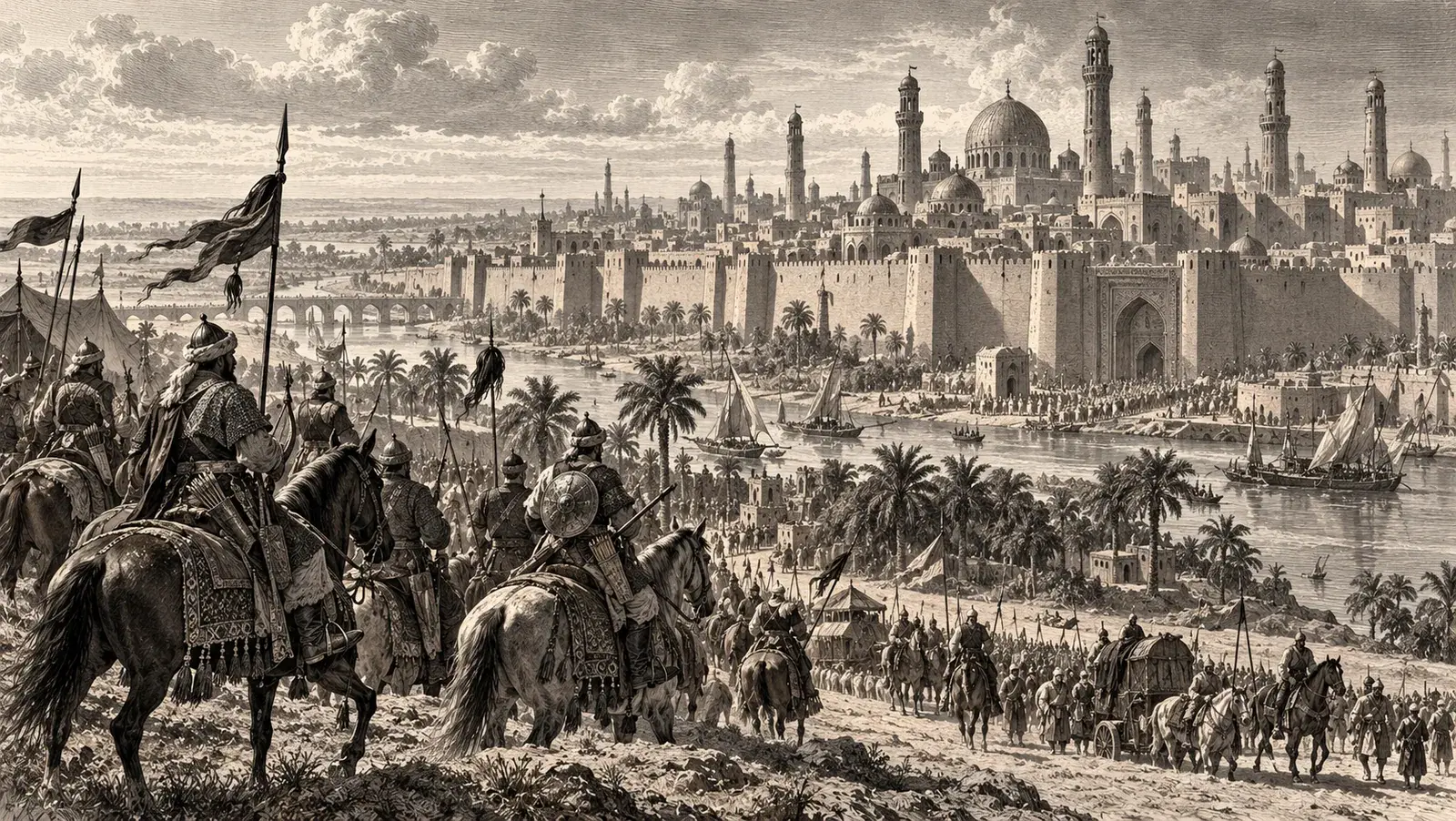
Byzantine Constantinople resisting Arab siege with towering city walls.
Charles the Hammer
Among these powerful mayors, none proved greater than Charles Martel, later remembered as “the Hammer.” It was he who took up the challenge of facing the Muslim advance into Gaul. His leadership was not just a matter of defending Frankish lands but of holding back a tide that threatened to engulf all of Western Christendom. The confrontation came at what has often been called the Battle of Tours (though the fighting actually took place closer to Poitiers) in 732. Here, the Frankish infantry, armored and disciplined though slower in movement, stood against the swift cavalry of the Muslim forces. Again and again, the Arab horsemen launched charges, shouting cries of “Allahu Akbar,” only to be beaten back against the solid Frankish line. At one point, a rumor swept through the Muslim camp that the Franks had attacked from behind and that their treasure was in danger. A large portion of the cavalry broke off to protect their spoils, and the battle began to swing decisively in Charles’s favor. As the Frankish soldiers pressed forward, the Saracen army collapsed, retreating under the weight of the assault. When the sun set that evening, Charles had won a victory that resonated far beyond Gaul. He had secured not only the survival of the Frankish kingdom but arguably the future of Christian Europe. Though he did not immediately drive the Muslims from the continent, within a few years he launched new campaigns and pushed them south of the Pyrenees, out of France for good.
The Papacy Turns to the Franks
Charles Martel’s triumph earned him immense prestige. Yet, while he held the power of a king, he never claimed the crown. Upon his death in 741, his son Pepin the Short inherited not only his authority but also the question of legitimacy. By this time, the papacy had begun to look increasingly to the Franks for support. The Byzantine emperors, distant and preoccupied, were less able to defend Rome from its enemies, particularly the Lombards of northern Italy. Pope Gregory III had already appealed to Charles Martel for help, though Charles chose to maintain friendly relations with the Lombard king rather than intervene. It was under Pepin, however, that the alliance between the papacy and the Frankish rulers became cemented.
Pope sending appeals for help to the Franks against the Lombards.
Pepin and the Crown by Divine Right
Pepin ruled as his father had, in all but name a king. But he longed to turn de facto power into de jure authority. To settle the matter, he appealed directly to Pope Zacharias with a carefully phrased question: Should the title of king belong to the man who bore the responsibilities of rule, or to the man who sat idly in his palace? The pope’s answer was exactly what Pepin hoped for. By the authority of Saint Peter, Zacharias declared that the true king was he who wielded power. With that pronouncement, the last Merovingian monarch was deposed, his long hair — the ancient symbol of Frankish kingship — cut off, and he was sent into monastic retirement. In 751, Pepin was formally anointed as the first Carolingian king. This coronation was unlike the old Frankish tradition, in which a ruler was lifted on a shield and acclaimed by his warriors. Instead, it took place in the church at Soissons, where Pepin knelt at the altar to receive the crown from the hands of Saint Boniface, the missionary to the Germans. It was a ritual of profound symbolic weight, for Pepin was now a king not only by the will of his people but also by the grace of God.
Coronation of Pepin the Short anointed by Saint Boniface.
Kingship and the Church
This moment marked the birth of a new political and religious order in Europe. The concept of “kings by the Grace of God” — rulers sanctified by divine approval — took root, a principle that would shape European monarchy for centuries. The papacy, too, had gained something immense: the power to legitimize kings. Yet papal favors came with expectations. Soon after Pepin’s coronation, Pope Stephen II found himself in desperate need of Frankish support. A new Lombard king, Aistulph, was threatening Rome and Ravenna, disregarding earlier peace agreements. When written appeals failed, Stephen crossed the Alps in person in 753, enduring winter snows and swollen rivers to plead with Pepin face-to-face. In a dramatic scene, the pope appeared before Pepin in penitent garb, ashes sprinkled on his head, refusing to rise until the king promised aid. Pepin agreed, and in gratitude Stephen crowned him once again, this time also anointing his wife and sons. The papacy now bound the Carolingian dynasty to itself with spiritual authority and threatened excommunication against anyone who dared challenge their rule.
The Donation of Pepin and the Birth of the Papal States
True to his word, Pepin marched into Italy and defeated the Lombards. In victory, he faced a crucial choice: to whom should the conquered territories belong? By rights, Ravenna and its surrounding lands were still part of the Byzantine Empire. Yet Pepin bypassed the emperor and instead gifted the lands directly to Saint Peter and his successors. This act, known as the Donation of Pepin, fundamentally altered the balance of power in Italy. The pope was no longer just the spiritual leader of Western Christendom but also a temporal ruler, the head of what came to be known as the Papal States. With the keys of the cities solemnly placed on the tomb of Saint Peter, the pope emerged as both priest and prince. While Pepin gained the Church’s blessing to secure his dynasty, the pope gained something far more tangible — territory and sovereignty. It was, in many ways, a turning point where the Church exchanged part of its spiritual independence for temporal power, a decision that would have profound consequences for centuries to come.
Legacy
The defeat of the Saracens at Tours and the rise of the Carolingians reshaped the destiny of Western Europe. Charles Martel’s battlefield victory halted Muslim expansion, while Pepin’s alliance with the papacy transformed kingship into a sacred institution. Together, these developments laid the groundwork for an empire that Pepin’s son, Charlemagne, would later expand into a realm that defined medieval Christendom. In the end, the Franks not only defended Europe from external conquest but also forged a new political and religious partnership that bound together throne and altar. It was a partnership that elevated rulers and popes alike but also sowed the seeds of future conflict between crown and Church.