Prince Hal — that was what people called him before he became Henry V, and the nickname stuck because it fit. The heir to the English throne spent his youth in the company of men who drank too much, brawled in taverns, and generally gave the impression that the next generation of English monarchy was going to be a disaster. One of his companions was a fat, boastful knight whose stories always grew in the retelling. Shakespeare turned him into Falstaff, one of the great comic characters in English literature. The historical original was probably less charming. Then Henry IV died in 1413, and Prince Hal became Henry V, and everything changed. He dismissed his old companions, telling them plainly that the days of wildness were behind him. He surrounded himself with serious advisors and turned his attention to France. What followed, in the next nine years before fever killed him at thirty-five, was one of the most concentrated reigns of achievement in English medieval history — and one of the most consequential failures.
Henry V came to the English throne in 1413 at about twenty-five years old and immediately began preparing for war with France. His victory at Agincourt two years later, against an army several times larger than his own, made him the most celebrated English king of the fifteenth century.
Why France — Again
The Hundred Years War had been grinding on since the 1330s when Henry V took the throne, but it had gone quiet for a while. The great English victories of Crécy and Poitiers were sixty and fifty years in the past. The Black Prince was dead. The English position in France had shrunk considerably from its high point. Henry V revived the old claim — that English kings were by right also kings of France, a position Edward III had advanced and the French Salic Law blocked — and backed it with an army. He had good reasons beyond ambition. A foreign war was useful for national unity, particularly for a dynasty whose grip on the throne was not entirely secure. The Lancastrian claim to the English crown had its own complications, and keeping the nobles busy fighting France was preferable to having them fight each other. He also genuinely believed his claim was just, or acted consistently as if he did. Before the campaign he sent formal demands to the French king, detailing what he wanted. When those were refused, he raised an army of thirty thousand and crossed the Channel in August 1415.
Agincourt: The Impossible Victory
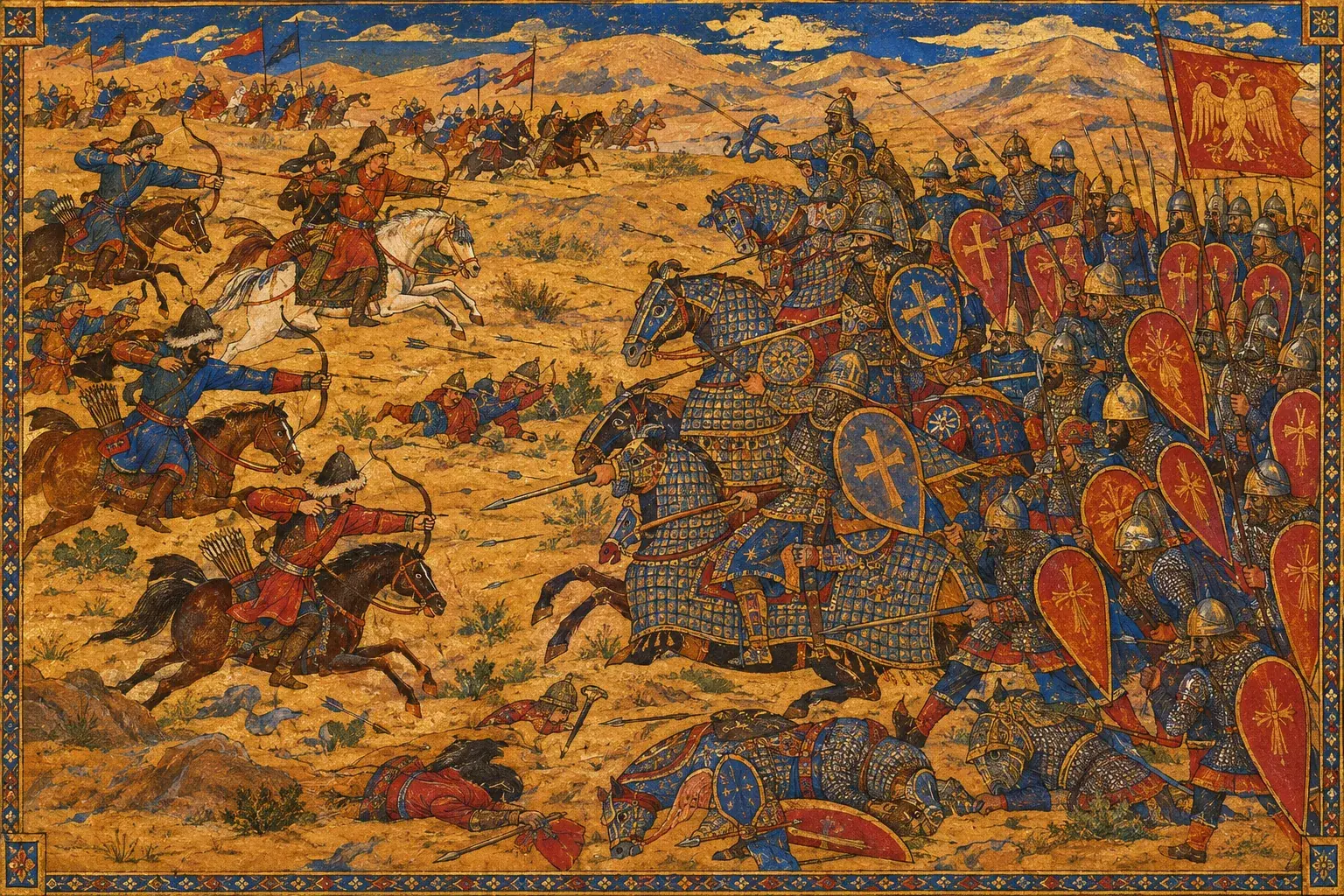
The campaign almost went wrong before the famous battle. Henry's army besieged Harfleur, took it after five weeks, but lost thousands of men to dysentery in the process. By the time he set out to march across northern France to Calais — the standard winter safe harbor for English armies — his force was down to perhaps fifteen thousand exhausted, sick men. The French intercepted him at a field near the village of Agincourt on October 25, 1415, St. Crispin's Day. The French had fifty to sixty thousand, heavily armored cavalry and men-at-arms, the greatest concentration of French military power that had been assembled in years. Henry deployed his men-at-arms in the center and his archers on the flanks, positioning stakes in the ground in front of the bowmen to break cavalry charges. The field narrowed between two woods, preventing the French from using their numerical advantage to simply wrap around the English flanks. When the French cavalry finally advanced — after a long standoff during which Henry reportedly walked among his men, calling them his band of brothers, telling officers who wished for more men that he would not want a single one from England more — the English archers opened on them at close range. A clothyard arrow from a warbow could punch through armor plate. Several thousand archers could produce a volume of fire that the most experienced French knight had no answer for. The cavalry broke. The dismounted knights who followed got mired in mud churned up by rain and trampling horses and reached the English lines exhausted, in broken formation, unable to fight effectively in heavy armor they could barely move in. The English men-at-arms met them and it became less a battle than a killing ground. French losses: somewhere between seven and ten thousand killed, with around fifteen hundred noble prisoners taken for ransom. English losses: a few hundred at most. The disproportion was so extreme that contemporary writers on both sides struggled to account for it in terms that made sense.
At Agincourt on October 25, 1415, Henry V's outnumbered English army — reduced by disease and exhaustion to roughly fifteen thousand — defeated a French force estimated at fifty thousand or more, largely through the devastating effectiveness of English longbowmen on a narrow, muddy field.
Rouen and the Road to the French Crown
Agincourt was the high point of Henry's fame, but it was not the end of the war. He came back to France in 1417 with a larger force, and this time the campaign was systematic — city by city, castle by castle, methodical reduction of Normandy, which had been in French hands for over two hundred years. Rouen, the largest and richest city in France, held out the longest. Henry settled in for a siege, surrounding the city completely and cutting off all supplies. The city was stuffed with refugees who had fled the English advance, and eventually, when food ran out, the garrison expelled twelve thousand of them — the poor, the elderly, the sick — to reduce the mouths to feed. Henry would not let them through his lines. They died in the ditch between the French walls and the English trenches, through the winter of 1418 to 1419. Rouen surrendered in January 1419. The whole of Normandy followed. The French position had collapsed so completely that by 1420, the Treaty of Troyes was signed — Henry would marry the French princess Katherine, and upon the death of the French king Charles VI, he would inherit the French throne. The French king Charles VII, the legitimate heir, was disinherited by his own father. At Christmas 1420, Henry entered Paris in triumph.
The Death That Undid Everything
Henry V died on August 31, 1422, at the age of thirty-five. Dysentery, probably — the same disease that had weakened his army at Harfleur seven years earlier. He had been ill for weeks while trying to continue the campaign. Charles VI of France died less than two months later. Under the Treaty of Troyes, the English baby Henry VI — nine months old — was now theoretically king of both England and France. The problem was that France did not accept this. The disinherited Charles VII had supporters, and those supporters had armies, and the war that Henry V had nearly resolved continued for another thirty years after his death. Joan of Arc emerged during this phase, and by 1453, England had lost everything in France except the port of Calais. Henry V is remembered as a great king, and by the measures of his own time he was. He was genuinely beloved by his soldiers, genuinely feared by his enemies, and his administration was more competent and less corrupt than most medieval governments. He had real strategic vision and real physical courage. But he also died with no plan for how his nine-month-old son was supposed to govern two countries simultaneously. The war he had nearly won became the war his dynasty eventually lost, and the instability from that loss fed directly into the Wars of the Roses that tore England apart for thirty more years after that. Agincourt remains. Shakespeare made it immortal. Henry's real legacy is considerably more tangled.