A lot of people wonder about this when they look at a map of the Arctic. There's Denmark — a flat, relatively small country wedged between Germany and the Scandinavian Peninsula — and then, way out in the North Atlantic, hugging the Arctic Circle, is Greenland. The largest island in the world. A place so enormous that if you dropped it over Europe, it would cover most of the continent. And yet it's Danish. Sort of. Today, Greenland is an autonomous territory within the Kingdom of Denmark. It runs most of its own daily affairs — its own government, its own courts, its own police — but it sits officially under the Danish crown, with Denmark handling defense and foreign affairs. Greenlanders are Danish citizens. Greenland is not part of the European Union, even though Denmark is. And a significant chunk of Greenland's government budget comes directly from Copenhagen each year, which matters a lot in a place where the economy doesn't generate enough on its own to cover everything. The question of how that relationship formed isn't a simple one. It didn't happen through a single conquest or a clean colonial takeover. It accumulated — through Viking sailors, medieval political mergers, a Norwegian-Danish split, a World War that temporarily cut the island off from Europe, and decades of back-and-forth between Greenlandic leaders and the Danish government about what kind of arrangement actually made sense. That process isn't finished.
Nuuk — formerly called Godthåb — sits on Greenland's southwest coast where the climate is milder than the interior. Founded as a Danish settlement in 1721, it has been the administrative center of Greenland ever since and is home to the island's government today.
Before the Europeans — Who Was Actually There First
Long before any Norse sailor or Danish missionary set foot on Greenland, the island had already been home to people for thousands of years. Around 2500 BC, different Arctic peoples began crossing from what is now Canada and settling on Greenland's coasts. These Paleo-Inuit cultures adapted to conditions that would be genuinely hostile to most humans — extreme cold, long winters with almost no sunlight, an environment where survival required very specific knowledge and tools passed carefully from generation to generation. Several distinct cultures came and went over the following millennia, each one occupying the island for a period and then giving way to the next. The ancestors of Greenland's present-day Indigenous population arrived later. The Thule people moved east from Alaska and reached Greenland around 1300 CE, bringing with them technologies that changed what was possible in the Arctic — dog sleds, specialized hunting harpoons designed for sea mammals, kayaks built for different conditions than those used by earlier groups. Over time the Thule replaced or absorbed the earlier populations and became the foundation of the Inuit culture that still exists in Greenland today. This is the part that often gets skipped in histories focused on European contact: by the time Norse settlers showed up, Greenland was not an empty place waiting to be discovered. It had been continuously inhabited for over three thousand years.
Erik the Red and the Name That Was a Sales Pitch
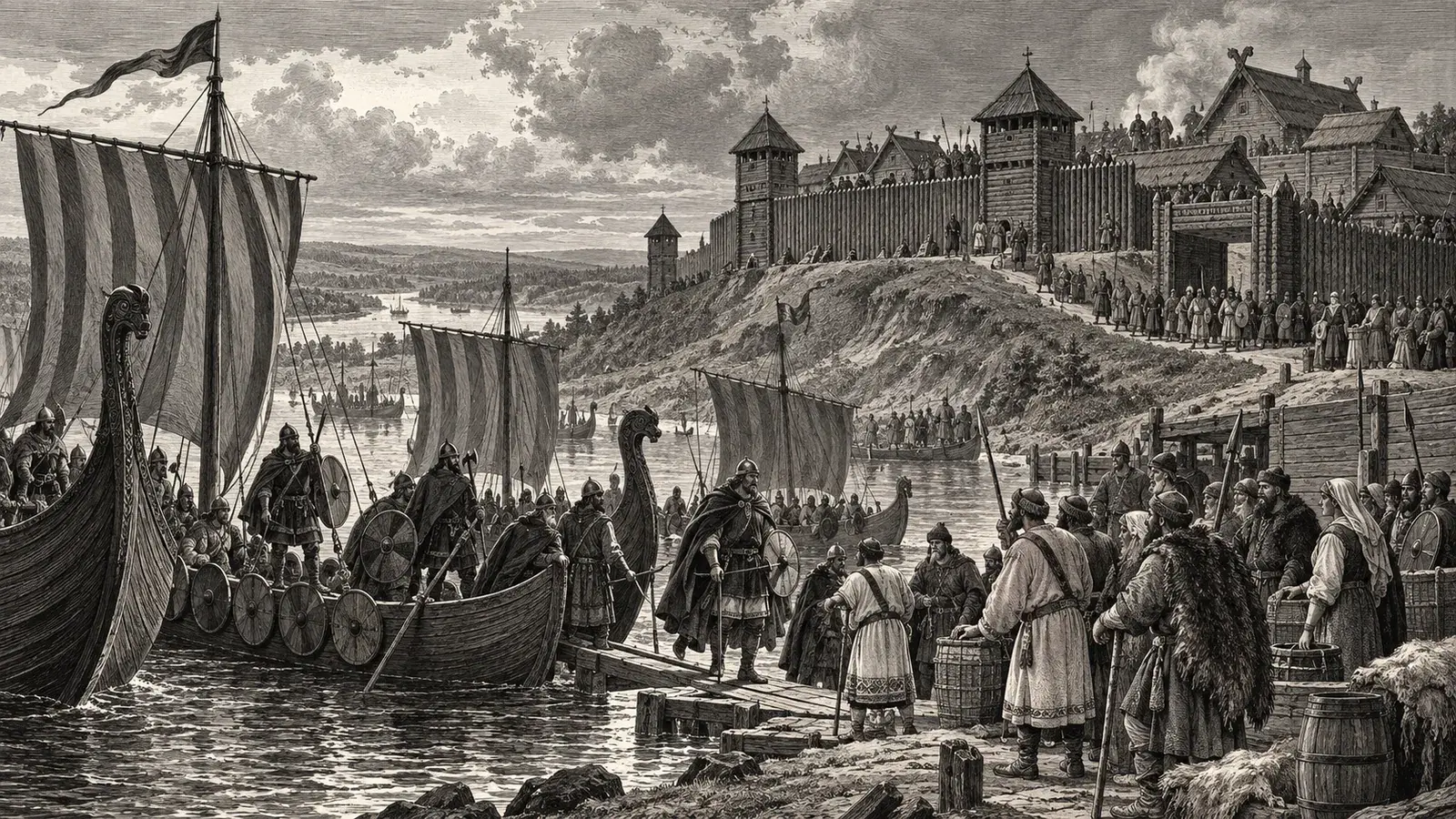
In the late 900s CE, Norse settlers sailed out from Iceland and established farming communities along Greenland's southwest fjords — the only part of the island where the combination of land and climate made limited agriculture viable at all. Icelandic sagas credit Erik the Red with leading this settlement, or at least being the reason it happened. He'd been exiled from Iceland after a dispute — the sagas are somewhat vague about exactly what he did — and sailed west to scout the land he'd heard rumors about. He spent time exploring the coastline, decided it was worth settling, and went back to Iceland to recruit followers. The name he chose, Greenland, was deliberate. According to the sagas, he reasoned that people would be more willing to make the crossing if the destination had an appealing name. It was essentially a marketing decision, made by a man who needed others to follow him to an island where he couldn't legally return to Norway. Whether the name also reflected genuinely green coastal areas he saw during summer, or was pure persuasion, the sources don't settle cleanly. The settlements lasted for hundreds of years. They eventually came under Norwegian rule in 1261, tying Greenland to Scandinavian politics for the first time. When Norway later entered a political union with Denmark, Greenland came along as part of the package — a piece of a territorial arrangement that had nothing specifically to do with Greenland itself.
Norse settlements along Greenland's southwest fjords lasted for several centuries after Erik the Red led the first major colonization effort in the late 900s, eventually falling under Norwegian and then Danish-Norwegian rule before disappearing entirely by the 1400s.
The Norse Settlements Disappeared — Nobody Knows Exactly Why
By the 1400s, the Norse communities had gone silent. No letters home. No ships arriving or leaving. They simply stopped appearing in written records. Archaeologists and historians have spent a lot of time trying to reconstruct what happened, and the current thinking is that it wasn't one single catastrophic event. It was a slow accumulation of pressures. The Little Ice Age brought colder temperatures that made already marginal farming even harder. Walrus ivory — the trade good that had connected Greenland to European markets — lost value as elephant ivory from Africa became more available, which cut into the economic viability of staying. Tensions with Inuit groups may have added to the difficulty, though the evidence for serious conflict is less clear than older accounts suggested. Church records show farms and then churches being abandoned one after another over time. The settlers, as best anyone can tell, didn't die suddenly. They left gradually. As conditions worsened, families gave up and sailed away until nobody remained. It was an ending by attrition rather than catastrophe.
Hans Egede Arrived Looking for Norse People and Found Nobody
European ships kept sailing to Greenland's waters after the Norse settlements ended. Portuguese sailors mapped stretches of the coastline in the early 1500s while hunting for new routes to Asia. Danish-Norwegian expeditions in the early 1600s tried to locate the old Norse communities and assert claims to the island, with limited success given the ice and weather conditions. The real turning point came in 1721. A missionary named Hans Egede organized an expedition and sailed to Greenland under the sponsorship of Denmark-Norway, convinced that Norse descendants might still be living there and might have drifted from Christianity over the centuries. His plan was to find them and reconnect them to the Church. He found no Norse people. They had been gone for at least two centuries. What he found instead were Inuit communities, and he ended up staying to work among them — learning the language, establishing relations, and founding a settlement that he called Godthåb. That settlement grew into Nuuk, Greenland's capital today. From that point, Denmark steadily built up its administrative and commercial presence. Danish merchants were brought in and given access to trade while other foreign traders were kept out, allowing the kingdom to keep tight control over what moved in and out of the island.
Wars, Treaties, and How Greenland Became Officially Danish
The formal transfer of Greenland to Denmark came not from conquest but from the aftermath of war in Europe. When Denmark and Norway were split apart in 1814 through the Treaty of Kiel — a consequence of the Napoleonic Wars and Norway's subsequent union with Sweden — Greenland was assigned to Denmark rather than going with Norway. It was a diplomatic decision made in a European peace negotiation, and Greenland had no part in it. The arrangement was tested in the early 1930s when Norway claimed sovereignty over a section of eastern Greenland, arguing the land was effectively unoccupied and therefore open. Denmark disputed this and brought the case to the Permanent Court of International Justice. The court ruled in Denmark's favor, confirming Danish authority over all of Greenland and closing the dispute. World War II complicated things in a way nobody had planned for. Germany occupied Denmark in 1940, which severed the connection between Copenhagen and Nuuk and left Greenland in an exposed position. The United States stepped in, reaching an agreement with the Danish ambassador in Washington to provide protection and establishing military bases on the island. American forces used Greenland as a key position in the North Atlantic for the rest of the war. After the war, those bases remained — defense agreements kept US forces present through the Cold War, and Greenland's strategic value in the event of a conflict between NATO and the Soviet Union made it a significant piece on the geopolitical board. Some of what American forces were doing there, including secret projects on the ice, wasn't fully shared with Danish leadership at the time.
Greenland's position in the North Atlantic made it strategically important during World War II and the Cold War — American forces established bases there beginning in 1941, and those bases became a key part of NATO's Arctic defense posture for decades afterward.
From Colony to Autonomy — The Long Negotiation
After the war, Denmark revisited its colonial relationship with Greenland. In 1953, Greenland's status changed — it stopped being a colony and became an integrated part of Denmark under a revised constitutional arrangement, with representation in the Danish parliament. This didn't immediately change how things worked on the ground. For years, policies pushed Danish language use in schools and government offices in larger towns, which sat uncomfortably with a population whose culture and language were something else entirely. The friction from that period contributed to a growing political movement among Greenlanders for more control over their own affairs. In 1979, after a public referendum, Greenland gained home rule. Local leaders took over many internal decisions. Another vote in 2008 pushed things further, and in 2009 a self-rule arrangement came into effect — giving Greenland's own government authority over courts, policing, and natural resources, while Denmark retained responsibility for defense, foreign policy, and continued providing the annual financial transfers that make up a significant portion of the island's budget. In 2012, Greenlandic — Kalaallisut — became the island's sole official language, a marker of how much had shifted culturally and politically since the days when Danish was the language of government and schooling. Conversations about possible full independence come up regularly in Greenlandic politics. The economic dependency on Danish transfers is the main obstacle — building a self-sustaining economy in an Arctic island of roughly fifty-six thousand people is genuinely difficult, and the revenues from fishing and emerging mineral extraction haven't yet reached the point where independence becomes financially straightforward. But the direction of travel over the past several decades has been consistently toward more Greenlandic control, not less. So when people ask how Denmark got Greenland — the real answer is that it happened in pieces, across more than a thousand years, through Viking settlers who named a frozen island something inviting, through political unions that tied distant territories together without asking them, through a missionary who arrived too late to find the people he came for, through wars and court rulings and Cold War strategy, and through decades of a relationship that both sides are still actively negotiating. That negotiation is ongoing.
Since gaining self-rule in 2009 and establishing Kalaallisut as its sole official language in 2012, Greenland has continued building its own governmental and cultural identity — while the question of full independence from Denmark remains an open and actively debated part of island politics.