In 1258, Mongol armies rolled the last Abbasid caliph inside a carpet and had horses trample him to death — because Mongol tradition held that royal blood must never touch the ground — and in doing so wiped out five hundred years of Islamic governance from Baghdad in a single week. That act alone tells you everything about the Ilkhanate: brutal, deeply strange, and loaded with contradiction. These were Mongol conquerors who would later convert to Islam, fund Persian poetry, and build one of the world's most advanced astronomical observatories in the middle of campaigns that killed millions. None of that fits into a tidy story. Which is probably why this particular empire is worth paying close attention to.
The Man Who Flattened Baghdad: Hulegu Khan and the Birth of the Ilkhanate
Hulegu Khan, grandson of Genghis Khan and founder of the Ilkhanate around 1256, was given roughly a fifth of the entire Mongol military by his brother Möngke Khan to conquer the western territories.
Hulegu Khan wasn't some distant warlord who stumbled into an empire. He was a grandson of Genghis Khan, a brother of Kublai Khan, and — in a detail that mattered enormously for what followed — also a brother of Möngke Khan, the Great Khan who sent him west in the early 1250s with roughly a fifth of the entire Mongol military. That's not a scouting party. His wife, Doquz Khatun, was a Nestorian Christian (which was actually quite common among certain Mongol noble families of that period), and her faith partly explains why some European Christian powers briefly dreamed he might become an ally against the Mamluks. He wasn't, exactly. Still, the religious picture around Hulegu was always tangled and strange.
The title 'ilkhan' is worth unpacking — it meant something like 'subordinate khan,' acknowledging the authority of the Great Khan back in Mongolia while giving Hulegu formal control of the western territories. So the Ilkhanate began as a provincial administration, not an independent state. It only became a truly independent khanate after 1260, when the Mongol Empire started fracturing into rival successor states and the idea of a single supreme Great Khan collapsed in practice. Hulegu's descendants would then rule Persia for the next eighty years — longer than most people expect when they first hear about this empire.
Before Hulegu Arrived, the Mongols Had Already Been Wrecking Persia for Decades
The Mongol campaign against the Khwarazmian Empire beginning in 1219 — launched after Shah Muhammad II killed Mongol-dispatched merchants — left a trail of destroyed cities and shattered irrigation systems that Persia would spend decades trying to repair.
Most people treat the Ilkhanate as the starting point, but Mongol armies first tore through Persia around 1219, when Genghis Khan declared war on the Khwarazmian Empire after its ruler, Muhammad II, ordered a group of Mongol-dispatched merchants killed. That was not a smart decision. Generals Jebe and Subutai swept through the region, leaving cities burned and populations scattered. Persia had barely started recovering when Chormaqan's army returned in 1231 under orders from Genghis's son Ögedei and completed the job.
By 1237, the Mongols controlled most of Persia, Armenia, Georgia, and Afghanistan. After the Battle of Köse Dağ in 1243, Anatolia fell under Mongol dominance too, with the Seljuk Sultanate of Rûm — once a formidable Turkish state — reduced to a vassal. So when Hulegu formally arrived in the mid-1250s with his massive force, he wasn't building an empire from open ground. He was walking into a region that had been punched flat and was only just beginning to rebuild. The Ilkhanate grew from that prior devastation, which is part of why separating Hulegu's specific legacy from the broader Mongol one is genuinely difficult.
One Week in 1258: How Hulegu Khan Ended a Caliphate That Had Stood for Five Centuries
The fall of Baghdad in February 1258 shocked the Muslim world — the Abbasid Caliphate, which had governed from Baghdad since 762, was erased in roughly two weeks of fighting.
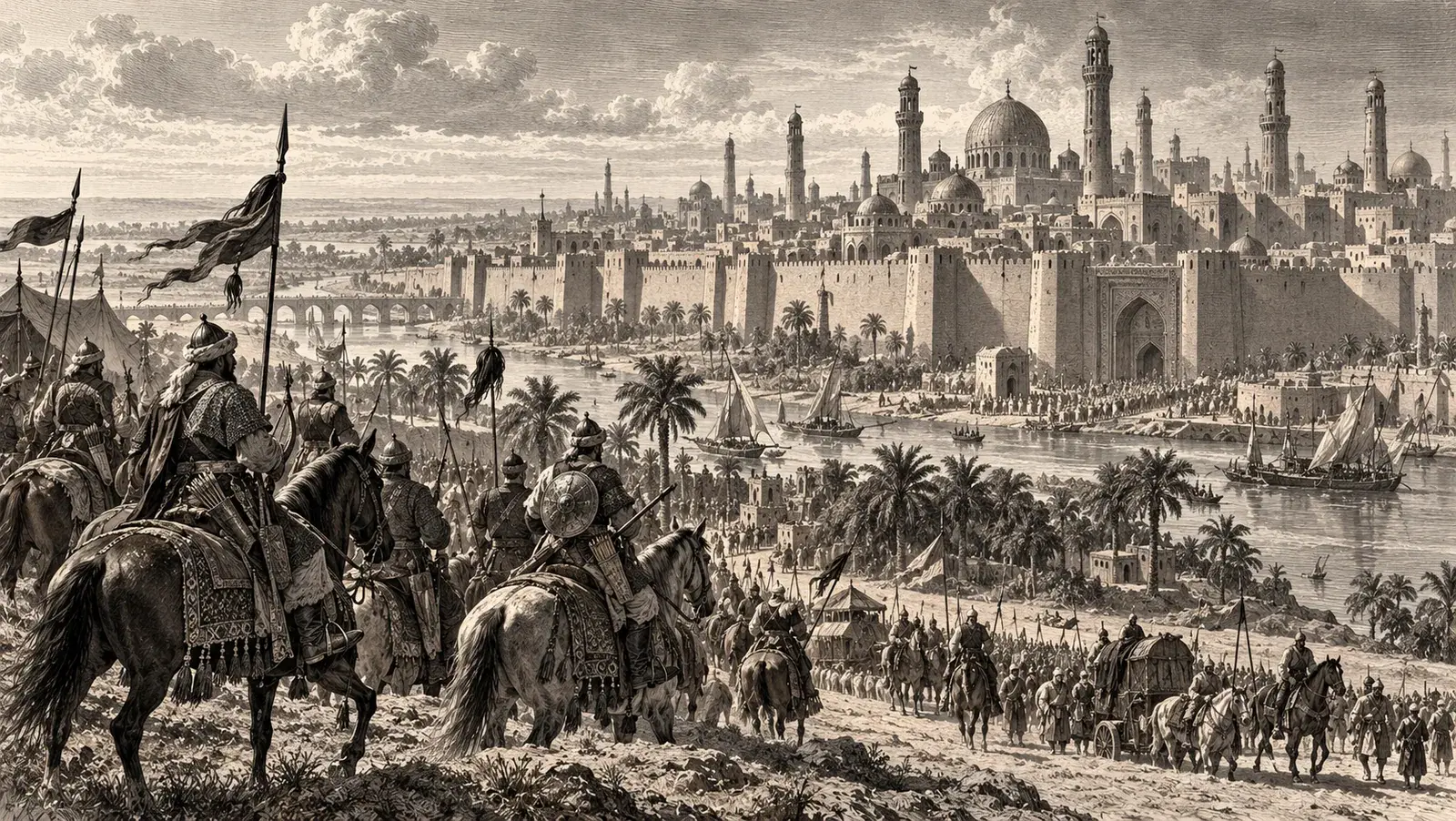
The Abbasid Caliphate — based in Baghdad since 762 — wasn't just a political state. The caliph was the symbolic head of the Sunni Muslim world, carrying religious authority that stretched back (in theory) to the earliest days of Islam. When Hulegu's forces arrived outside Baghdad in late 1257, Caliph Al-Musta'sim reportedly dismissed the threat and failed to organize a proper defense. Whether that's historical fact or later embellishment, nobody's fully certain — but the result was the same: a siege lasting roughly two weeks, followed by the city's fall in February 1258.
What followed is described in Arabic and Persian sources as catastrophic — libraries emptied or burned, scholars killed, irrigation canals destroyed, the city's population devastated. Casualty figures in medieval chronicles run into the hundreds of thousands, though most historians believe these numbers were significantly exaggerated by writers trying to convey the sheer scale of horror. The caliph died wrapped in that carpet. Hulegu then proclaimed himself ilkhan. It was the end of the Abbasid Caliphate — the last one of its kind — and nothing would replace it in quite the same way for centuries.
Ain Jalut, 1260: The Battle at a Tiny Spring That Stopped the Mongol Advance Forever
The Battle of Ain Jalut on September 3, 1260, led by Sultan Qutuz and General Baybars, is widely considered a turning point in medieval history — the first major open-field defeat of a Mongol army, permanently blocking westward Mongol expansion.
After sacking Baghdad, Hulegu pushed west and briefly took Aleppo and parts of Syria in early 1260. And then something unexpected happened: Möngke Khan died back in Mongolia, forcing Hulegu to pull most of his forces east to participate in choosing the next Great Khan. He left a rearguard of roughly 10,000 troops in Palestine. That turned out to be far too few.
The Mamluk Sultanate of Egypt, led by Sultan Qutuz and his general Baybars, met the reduced Mongol force at a spring called Ain Jalut (Eye of Goliath) in September 1260 and defeated them decisively. This might not sound dramatic until you consider that Mongol armies had almost never lost a major open-field battle since Genghis Khan united the steppe decades earlier. The loss didn't destroy the Ilkhanate — far from it. But it drew a line that the Mongols could never push past. Syria and Egypt stayed beyond their reach for the rest of the Ilkhanate's existence.
Mongols vs. Mongols: Why the Ilkhanate Kept Fighting Its Own Cousins to the North
The war between the Ilkhanate and the Golden Horde, ignited around 1262 over the deaths of Jochid princes in Hulegu's service, permanently blocked Ilkhanid expansion northward and forced years of costly two-front conflict.
The Ilkhanate's most persistent enemy wasn't an outside power — it was the Golden Horde, a Mongol khanate on the Russian steppes led by Berke Khan, who was unusually for a Mongol ruler a practicing Muslim. When three Jochid princes serving in Hulegu's army died under suspicious circumstances in 1262, Berke declared war. Mamluk historians recorded that Hulegu had massacred Berke's troops and refused to share war booty with him, but those historians had obvious reasons to dramatize the feud, so the exact truth is genuinely hard to pin down.
One Ilkhanid army crossed the frozen Terek River chasing a Golden Horde encampment, only to be ambushed when the ice broke beneath them — a painful and rather literal example of overreach. The Chagatai Khanate to the east also kept probing at the Ilkhanate's borders throughout this period. So the Ilkhanate was perpetually squeezed: the Mamluks blocked expansion to the west, the Golden Horde harassed from the north, and the Chagatai pressured from the east. The borders, more or less, stopped where they started.
Buddhist, Christian, Shamanist, and Then Muslim: The Ilkhanate's Chaotic Religious Identity
The early Ilkhanate wasn't systematically hostile to any particular faith, at least not by medieval standards. Hulegu's wife was Nestorian Christian. The early ilkhans practiced a blend of Mongolian shamanism and Buddhism. Christians, Muslims, and Jews all operated within the territory, sometimes competing directly for court favor. But that tolerance was never principled — it was practical, and it could flip. Arghun Khan, who ruled in the 1280s, actively pushed back against Muslim influence, favoring Buddhist traditions and seeking alliances with European Christian powers against the Mamluks.
Then in 1295, Ghazan converted to Islam and declared it the official state religion. Buddhist temples were ordered destroyed — though he later relaxed the harshest policies after his chief enforcer Nawruz was removed and killed in 1297. What's genuinely strange is that none of this religious change softened the Ilkhanate's hostility toward the Mamluk Sultanate, which was also Muslim. Ghazan invaded Syria after converting. The conflict stayed political and territorial, not religious, regardless of what the ilkhans believed personally.
Ghazan Khan: The Ruler Who Actually Tried to Fix the Ilkhanate — and Almost Managed It
Ghazan Khan (r. 1295–1304) is generally considered the most effective Ilkhanid ruler — he converted to Islam, reformed tax collection, stabilized administration using Persian expertise, and scored the Ilkhanate's only major battlefield victory against the Mamluks in 1299.
Ghazan, who reigned from 1295 to 1304, inherited an administration that had been bleeding money and credibility for years. His predecessor Gaykhatu had introduced paper money borrowed from the Yuan dynasty's monetary system — one of the more inventive experiments in medieval finance — but it failed spectacularly in Iran. Merchants refused to accept the notes, trade seized up, and the whole attempt was abandoned after roughly two months. Ghazan had to rebuild fiscal credibility from that low point, and he did it by leaning heavily on Persian administrative expertise.
He brought in Persian administrators, worked to curb the corruption gutting tax revenue, and managed to win the Battle of Wadi al-Khaznadar in 1299 — the only significant Mongol military victory over the Mamluks in the entire history of that conflict. But he couldn't hold Syria for long; the Mamluks pushed back the following year. Still, his reign stands as the closest the Ilkhanate came to functioning as a stable, well-run state. His vizier Rashid al-Din also completed the Jami al-Tawarikh — a world history that stands among the most ambitious intellectual projects produced anywhere in the medieval world.
Why Did Hulegu Khan Build a Cutting-Edge Star Observatory in the Middle of His Wars?
Here's a detail that doesn't fit the image of pure conquest: when Hulegu arrived with his vast army in the 1250s, he also brought Chinese scholars and astronomers with him. And on a hill near Maragheh — his first capital, in what's now northwestern Iran — he funded the construction of a major observatory. The famous Persian astronomer Nasir al-Din al-Tusi ran it, and according to historical sources, al-Tusi learned about Chinese astronomical calculation methods directly from the scholars Hulegu had transported west. The work produced at Maragheh influenced Islamic and, eventually, European astronomy for generations.
Because Persian was the language of Ilkhanid administration, Persian literature and historiography flourished under Mongol rule — a counterintuitive outcome for a dynasty that conquered by fire. Because the rulers wanted legitimacy with their subjects, they funded art and scholarship. Because they sat astride major trade routes, goods and ideas moved through the territory in extraordinary volume. Chinese, Persian, Mongol, and Arabic intellectual traditions all collided and mixed under Ilkhanid patronage. The destruction of Baghdad's libraries in 1258 was real and devastating. So was the cultural output that followed in subsequent decades. Both things are true, and neither erases the other.
Paper Money Disasters and Poisoned Rulers: How the Ilkhanate's Political Core Started Rotting
Gaykhatu Khan, who ruled from 1291 to 1295, is something of a footnote — but an instructive one. He needed money to keep his supporters loyal and spent faster than the treasury could manage. His vizier's solution was to import the Yuan dynasty's paper money system (called chao), which had worked reasonably well under China's strong centralized control. In Iran, with its different economic traditions and a merchant class deeply skeptical of the new currency, it failed almost immediately. Trade stopped. The experiment collapsed within two months and Gaykhatu was overthrown shortly after.
His predecessor Arghun had also been murdered — probably poisoned in 1291, though the exact circumstances remain murky to this day. Before him, Tekuder had been overthrown by his own nobles. None of this was coincidence. The pattern of violent succession, financial mismanagement, and short reigns meant the Ilkhanate never developed the deep institutional structure that could survive a bad ruler or an unexpected crisis. That structural fragility was always sitting underneath the surface, waiting for the right combination of problems to arrive.
The Black Death Hit the Ilkhanate Before Almost Anywhere Else in the Known World
The Black Death struck the Middle East and Central Asia in the 1330s, devastating trade networks and urban populations across the Ilkhanate's territory at precisely the moment of maximum political vulnerability.
The last strong ruler of the Ilkhanate, Abu Sa'id, died in 1335 without an heir, and that alone would have been a terminal political crisis. But disease had probably been weakening the state's foundations for years before that point. The Black Death struck Central Asia and the Middle East in the 1330s, and the Ilkhanate's territory was directly in its early path — trading cities, military garrisons, and administrative centers all hit hard. Exactly how much the plague contributed to the political disintegration is honestly still debated among historians, because the evidence is patchy and the timeline is compressed.
After Abu Sa'id's death, the territory cracked apart into competing successor dynasties — the Jalayirids, the Chobanids, the Muzaffarids — each holding a piece of what the Ilkhanate had been. None of them had the resources or the legitimacy of the original khanate. Within a generation, the unified territory was gone. The Ilkhanate had lasted about eighty years — a short run by historical standards, but long enough to reshape the region in ways that didn't simply reverse themselves when the Mongols were gone.
What Did the Ilkhanate Actually Leave Behind? More Than Anyone Expected From Mongol Conquerors
Here's the strange part about the Ilkhanate's legacy: the Mongols — outsiders who didn't speak Persian and had no roots in Iranian tradition — helped revive the idea of Iran as a unified political entity. Because Ilkhanid rulers needed legitimacy with their Persian subjects, they hired historians to connect them to the ancient Sasanian Empire. Persian scholars and administrators played along, developing the concept of 'Iran-zamin' (Land of Iran) as an ideological foundation for the whole project. That concept fed directly into the Safavid Empire, which rose in 1501 and made Iranian political identity central to its own state-building. The unification wasn't what the Mongols intended — but it happened anyway.
And then there's the Jami al-Tawarikh — the world history commissioned under Ghazan and written by his vizier Rashid al-Din, one of the most ambitious intellectual projects produced anywhere in the medieval world. There's the miniature painting tradition that flourished under Ilkhanid patronage. There's the Maragheh Observatory's lasting influence on later astronomy. None of that erases what happened in Baghdad in February 1258. But it complicates the story in ways worth sitting with honestly. The Ilkhanate was catastrophe and crucible both at once — and the world it left behind still carries the marks.