In 1206, a man who had spent years fighting off rival tribes, surviving kidnappings, and clawing his way back from the edge of total defeat stood before an assembly of Mongol leaders and was proclaimed ruler of all Mongols. His name was Temüjin. The title they gave him was Genghis Khan. What followed over the next 70 years is one of those things that sounds made up when you first hear it. The Mongols built the largest land empire in the history of the world — bigger than Rome, bigger than Alexander's empire, bigger than anything before or since. At its peak, it covered around 24 million square kilometers and held somewhere between 100 and 120 million people under a single authority. To put that in terms that actually land: you could travel from Korea to Hungary and never leave Mongol territory. The Pacific Ocean and the Mediterranean were both, at various points, accessible from the same empire. China, Persia, Russia, and Central Asia all fell to the same army under the same command structure. And then it fell apart. That part is just as interesting.
At its height in 1279, the Mongol Empire covered roughly 24 million square kilometers — about 16 percent of the Earth's total land area. No land-based empire before or since has come close to matching that size.
Who Was Temüjin Before He Became Genghis Khan
The story of Genghis Khan doesn't start with conquest. It starts with a kid whose father was poisoned by enemy tribesmen when he was around nine years old, leaving his family abandoned on the steppe with no clan to protect them. The Mongolian steppe in the 12th century was not a forgiving place to grow up without protection. Different tribes — the Tatars, the Merkits, the Naimans, the Keraits — competed for grazing land, raided each other's camps, and formed shifting alliances that could collapse over a single insult. Loyalty ran through family lines and tribal bonds, and Temüjin's family had just lost both. He survived anyway. He killed his own half-brother in a dispute over food. He was captured by a rival clan and held with a wooden collar around his neck before escaping. His new wife Börte was kidnapped by the Merkit tribe shortly after their marriage — a revenge raid, because Temüjin's mother had herself been abducted years earlier from a different tribe. Temüjin got his wife back, but she had been held long enough that the paternity of their first son Jochi was never certain. That uncertainty would cause problems for decades. What Temüjin turned out to be good at — very good — was building alliances and then keeping them. He secured the loyalty of his father's old friend Toghrul, leader of the powerful Kerait tribe. He brought in a childhood friend named Jamukha. Over the course of about 20 years, through a combination of military victories, strategic marriages, and the occasional brutal purge of enemies, he systematically dismantled or absorbed every rival tribe on the Mongolian plateau. By 1206, there was no one left to challenge him. The kurultai — the great assembly — proclaimed him Genghis Khan and he spent the next two decades pointing the unified Mongol military outward.
Genghis Khan was born around 1162 and died in 1227. In roughly 20 years of external conquest after unifying Mongolia, he built an empire twice the size of the Roman Empire at its height.
What Made the Mongol Army So Hard to Stop
Nomadic armies before the Mongols had a well-known problem: they were excellent in open steppe warfare but fell apart in front of city walls and couldn't hold conquered territory for long. They'd raid, loot, and scatter. Genghis Khan built something different. The organizational foundation was a decimal system. Every soldier belonged to a unit of ten, which belonged to a unit of a hundred, which belonged to a unit of a thousand, which belonged to a unit of ten thousand. Simple, but the key detail was that men from different tribes were deliberately mixed together, breaking the old loyalty patterns. Your unit was your new tribe. Deserting meant abandoning the men next to you, and if a unit broke and ran, the entire unit faced punishment. The reforms created a kind of military discipline that nomadic forces had never had before. Every Mongol man was a soldier from childhood. They grew up riding horses before they could properly walk, and they learned to shoot composite bows — built from wood, horn, and sinew — from horseback at full gallop. The Mongol bow had a range of around 325 meters under normal conditions, and skilled archers could hit targets at considerably longer distances. A soldier on campaign typically brought five or six horses, switching between them to keep the animals fresh. An army of 100,000 Mongols arrived with half a million horses. The tactics they used were not complicated, but they were extremely hard to counter. The feigned retreat — where Mongol cavalry would appear to flee in panic, pulling enemy forces out of formation, then wheel around and cut them down in the open — was practiced until it was automatic. Enemy commanders knew it was coming and still fell for it, because the alternative was letting the Mongols just ride away. They also got very good, very quickly, at the one thing nomadic armies historically couldn't do: siege warfare. After the early conquests, Mongol armies brought along Chinese and Persian engineers who could build trebuchets, catapults, and specialized rams. City walls stopped being the protection they once were. And then there was the psychological dimension. The Mongols made a calculated decision to be known as the most terrifying army in the world. Cities that surrendered quickly were generally left intact and taxed. Cities that resisted were destroyed completely, their populations massacred, and word of that massacre was actively spread to the next city on the route. It worked. Plenty of cities handed over their keys without a fight.
Mongol soldiers trained as horse archers from childhood and typically brought five or six horses on campaign. The combination of mobility, firepower, and military discipline made their army unlike anything their enemies had faced.
The Conquests: China, Persia, Russia, and the Edge of Europe
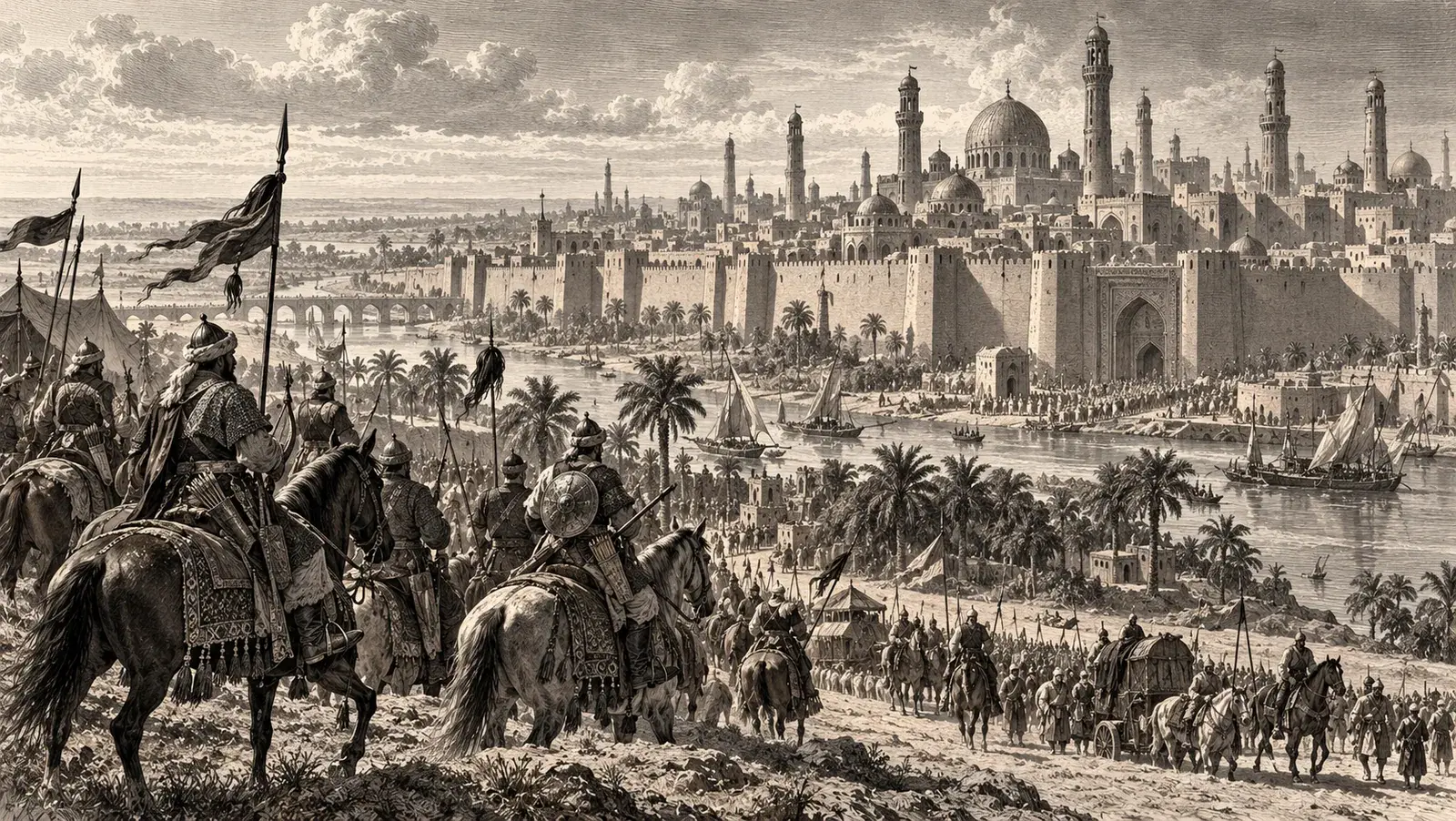
Genghis Khan died in 1227 having already built an empire that ran from the Pacific coast of China to the Caspian Sea — twice the size of the Roman Empire at its peak, and he'd done it in about 20 years. His son Ögedei took over and kept pushing. In China, the Mongols were fighting on two separate fronts simultaneously — against the Jin dynasty in the north and maneuvering against the Song dynasty in the south. The Jin capital fell in 1234. Full conquest of Song China would take another four decades, but the direction was set. In the west, Ögedei's general Subutai led one of the most audacious military campaigns in recorded history. Moving through Russia in winter — the Mongols actually preferred fighting in cold weather, when frozen rivers became highways for cavalry — the army broke apart the principalities of Kievan Rus one by one. Kiev, then one of the largest cities in Europe, was sacked in 1240. The Mongol army then split into columns and pushed into Poland and Hungary simultaneously. They beat a combined European force of Polish knights, Teutonic Knights, and Hospitallers at Legnica. They crushed the Hungarian army at the Battle of the Sajó River. Vienna was potentially days away. Then Ögedei died in December 1241, and Mongol military tradition required all princes to return for the succession assembly. The army pulled back. Europe never knew how close it had come. In the Middle East, Hulagu Khan — Genghis's grandson — sacked Baghdad in 1258, ending the Abbasid Caliphate that had been the center of the Islamic world for 500 years. The caliph was reportedly rolled in a carpet and trampled by horses, a Mongol method reserved for important enemies whose blood was not to be spilled on the ground. The city's famous libraries were destroyed. Contemporary accounts describe the Tigris running black with the ink of books and red with blood. The Mongols pushed into Syria, and it looked like nothing would stop them from taking Egypt too. Then Möngke Khan, the ruling great khan, died on campaign in China in 1259. Hulagu pulled most of his forces east for the succession dispute. The small Mongol force he left behind in Syria was defeated by the Egyptian Mamluk army at the Battle of Ain Jalut in 1260 — the first time a Mongol force had been decisively beaten in the field. The Mongols never got further west than Syria again.
The Mongol sack of Baghdad in 1258 is considered one of the most catastrophic events in Islamic history. The city had been the center of the Islamic world for 500 years. The destruction of its libraries and the killing of the caliph sent shockwaves across the Muslim world.
How the Mongols Actually Ran Their Empire
Conquering territory and governing it are two completely different problems, and the Mongols figured out reasonably workable solutions to the second one. Genghis Khan set up religious freedom as an official policy from the beginning. This wasn't idealism — it was practical. The empire contained Buddhist monks, Christian priests, Muslim imams, Taoist scholars, and shamans all operating within the same political structure. Trying to enforce a single religion would have been a constant source of rebellion. Instead, all religious leaders were exempted from taxes and public service requirements, and local religious customs were left alone as long as political loyalty was maintained. The empire also built and maintained one of the most impressive communication systems the medieval world had ever seen, called the Yam. Relay stations were set up roughly every 40 kilometers across the entire empire. A messenger arriving at a station would swap for a fresh horse and a fresh rider, allowing messages to cover something like 400 kilometers per day under good conditions. When the great khan died in Karakorum, the Mongol armies in Central Europe knew about it within four to six weeks. This was faster than almost anything operating in Europe at the time. Trade was actively encouraged. Genghis had depended on merchants for information and supplies before the empire was even built, and he never stopped treating them as assets. Merchants traveling through Mongol territory with the right documentation got protection, relay station access, and tax exemptions. The empire invested in roads and infrastructure, and the result was a period of remarkable commercial activity across Eurasia that later historians called the Pax Mongolica — the Mongol Peace. Governance at the local level generally meant keeping existing administrators in place as long as they delivered taxes and didn't cause problems. The Mongols were not interested in running the day-to-day affairs of a dozen different civilizations simultaneously. They collected tribute, maintained military control, kept the trade routes open, and mostly left local culture alone.
The Yam relay system allowed messages and goods to travel across the entire Mongol Empire at speeds that wouldn't be matched for centuries. Relay stations spaced every 40 kilometers meant a rider could cover enormous distances with fresh horses at every stop.
Kublai Khan and the Yuan Dynasty
After Möngke Khan died in 1259, two brothers — Kublai and Ariq Böke — each called their own assembly and each declared themselves the new great khan. This was not a situation that could coexist. Kublai won the civil war that followed, but the victory came at a price. The western parts of the empire — the Golden Horde in Russia and the Chagatai Khanate in Central Asia — never fully accepted his authority. The empire that Genghis had built as a single entity was already fracturing into independent pieces that just happened to share a family tree. Kublai finished what his predecessors had started in China, completing the conquest of the Song dynasty by 1279. He moved his capital to what is now Beijing, renamed it Khanbaliq, and governed China as the Yuan dynasty. Some Mongol traditionalists were deeply uncomfortable with this — they felt Kublai was becoming too Chinese, too tied to sedentary culture, too far from the steppe. They weren't entirely wrong. Kublai built universities, academies, canals, and public schools. He patronized Chinese art and scholarship. He kept extensive Mongol records listing over 20,000 public schools created during his reign. He also tried to push further. His invasions of Japan in 1274 and 1281 both ended in failure — the second time largely because typhoons destroyed much of his fleet. The Japanese called those storms kamikaze, divine winds. His campaigns into Vietnam and Burma were expensive and ultimately inconclusive. The Mongols found their limits in jungle and tropical terrain the same way many empires before and after them did. Marco Polo arrived at Kublai's court sometime in the 1270s and spent around 17 years in his service. His account of what he saw — the wealth, the scale of the cities, the sophistication of the administration — was so far beyond what Europeans knew about Asia that many readers back home assumed he was making things up. He wasn't.
Kublai Khan completed the Mongol conquest of China and founded the Yuan dynasty in 1271. He was the first non-Chinese ruler to conquer all of China, and his court at Khanbaliq attracted visitors from across Eurasia, including Marco Polo.
The Pax Mongolica: When Trade Connected East and West
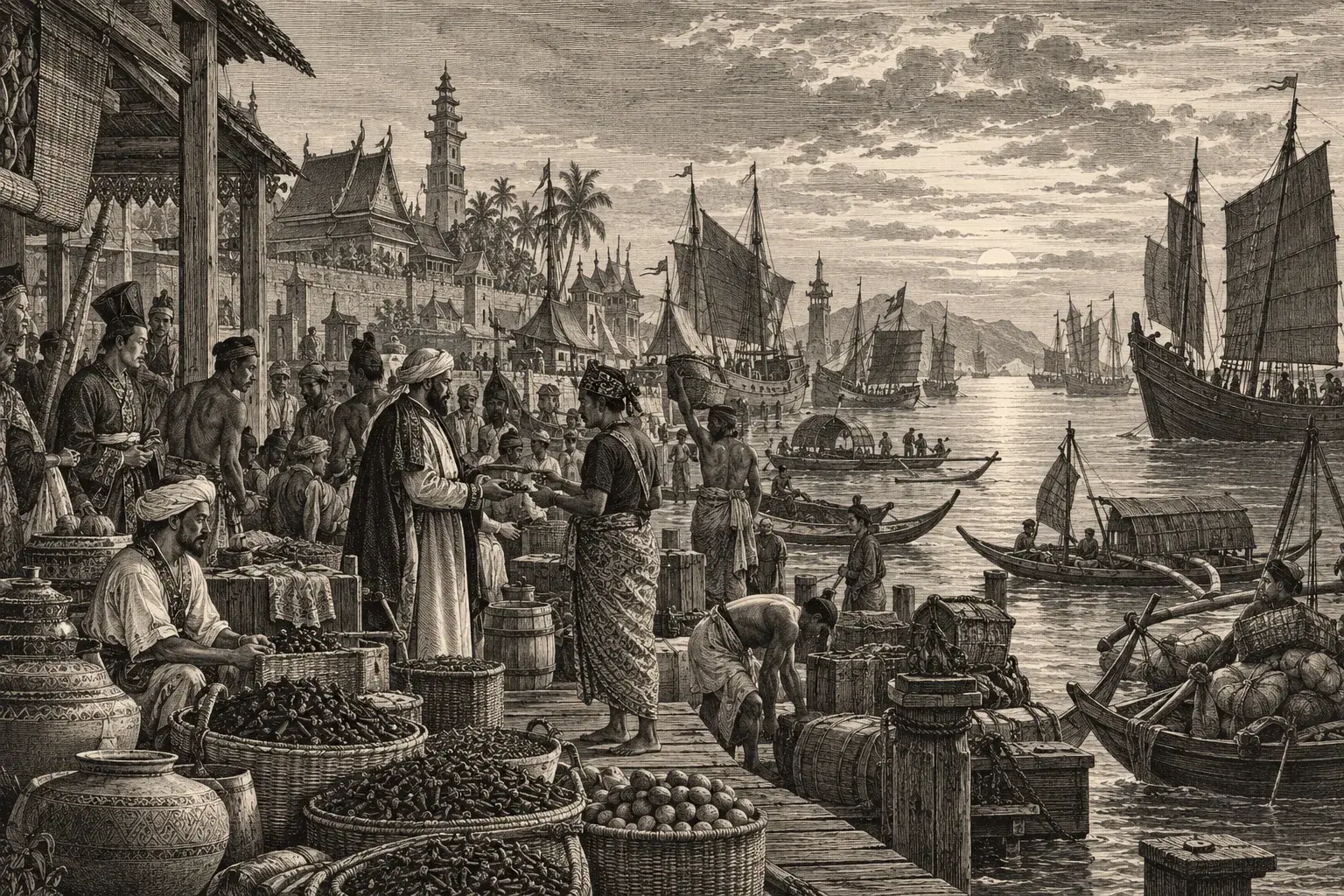
For roughly a century — from around 1260 to the mid-1300s — the Mongol Empire made overland travel between China and Europe not just possible but relatively safe. That was almost unprecedented in human history. The Silk Road wasn't a single road. It was a network of routes, and for most of its existence those routes passed through a patchwork of different kingdoms, bandits, tolls, and political complications. The Mongol unification removed most of that friction. A merchant with the right documentation could travel from the Mediterranean to Beijing without crossing a hostile border. Goods moved in both directions in quantities that hadn't been seen before. Chinese silk and porcelain went west. Glass, wool, and silver went east. Technologies crossed the same routes — papermaking and printing moved from China into the Islamic world and eventually into Europe. The magnetic compass, gunpowder, and advanced textile techniques all traveled along these routes during the Mongol period. Mercantile families from Venice and Genoa established trade relationships directly with Mongol rulers. The Polo family — Marco's father and uncle had already been to Kublai's court before Marco's famous journey — were one example of many. Mongol rulers actively partnered with foreign merchants, providing capital and protection in exchange for a share of profits. The cultural exchange ran deeper than goods. Astronomical knowledge from Persian scholars reached Chinese courts, and Chinese mathematical techniques reached Persian ones. Guillaume Boucher, a Parisian goldsmith who somehow ended up at the Mongol capital Karakorum, built Möngke Khan an elaborate silver fountain tree that dispensed wine, fermented mare's milk, honey mead, and rice wine from four different spouts. The Mongol capital contained Buddhist monasteries, mosques, Christian churches, and Taoist temples within the same city walls. None of this was driven by idealism about cultural exchange. It was driven by the Mongol understanding that wealthy trade routes generated tax revenue, and that merchants were more useful alive and moving than dead or scared.
The Pax Mongolica created roughly a century of relatively safe overland trade across Eurasia. Marco Polo's journey east is the most famous example, but thousands of merchants, diplomats, and missionaries made similar trips during this period.
The Family Fights That Broke the Empire Apart
Genghis Khan divided his empire among his sons before he died — a standard Mongol practice. His intention was that the empire would remain a joint family property, with a single great khan at the top coordinating everything. This worked reasonably well for two generations. It fell apart in the third. The core problem was that Mongol succession rules didn't clearly prioritize one son over another, and Genghis had four sons plus several grandsons of ambiguous paternity, all of whom had their own armies and their own followings. Every time a great khan died, the question of who came next became a potential civil war. The conflict wasn't just about who sat on the throne. It was also about what the empire was supposed to be. One faction wanted the Mongols to stay nomadic, to keep their steppe identity, to avoid getting absorbed into the sedentary civilizations they'd conquered. Another faction — and Kublai represented this tendency strongly — believed governing a vast empire required adopting the administrative practices of the people you were governing. Both arguments had real merit, and neither side could fully convince the other. By the time Kublai died in 1294, the empire had already broken into four essentially independent khanates. The Yuan dynasty in China. The Ilkhanate in Persia and the Middle East. The Golden Horde covering Russia and parts of Eastern Europe. The Chagatai Khanate in Central Asia. They still traded with each other and occasionally recognized a nominal common authority, but they were separate states with separate interests. The conflicts between them were sometimes military. Hulagu's Ilkhanate fought the Golden Horde over control of the Caucasus region. Different khanates backed different claimants in succession disputes. The grandsons and great-grandsons of Genghis Khan spent as much time fighting each other as they did fighting outside powers.
By the time Kublai Khan died in 1294, the unified Mongol Empire had fractured into four independent khanates. They shared a family tree but pursued separate policies and sometimes went to war with each other.
The Black Death and the Collapse
The Mongol Empire didn't just fall from within. It got hit by something from outside that nobody could fight: plague. The Black Death, which devastated Europe between 1347 and 1351, killing somewhere between a third and half the population of the continent, almost certainly traveled west along Mongol trade routes. The same networks that had allowed goods and ideas to cross Eurasia efficiently also moved disease efficiently. The outbreak appears to have originated somewhere in Central Asia and spread through Mongol territory before reaching the Black Sea port of Caffa, where Genoese merchants were based. In 1346, a Mongol army under Janibeg besieged the city. When plague broke out in his own camp, he reportedly used catapults to throw infected corpses over the city walls. Whether or not that specific story is accurate, the Genoese ships that fled the siege brought the disease to Sicily and southern Italy, from where it spread across Europe. Inside the Mongol khanates, the plague was just as devastating. It cut off commercial connections that the Pax Mongolica depended on. It killed the administrators, merchants, and skilled workers who kept the system running. The population of Persia, already reduced by the initial Mongol conquests, dropped dramatically again. China's population, which had been around 120 million before the Mongol conquest, was down to around 60 million by 1300 from a combination of warfare, famine, and disease. The Ilkhanate in Persia disintegrated between 1335 and 1353, collapsing into competing local warlords after the last Ilkhan died without a clear successor. The Yuan dynasty in China faced Han Chinese rebellion and lost the country to the Ming dynasty in 1368, retreating north to Mongolia. The Golden Horde fragmented into smaller competing khanates through the late 1300s and 1400s. The Chagatai Khanate held on the longest in various forms, with remnant states surviving into the early 1700s. Timur, known in the West as Tamerlane, swept through Central Asia and Persia in the late 1300s, styling himself as a restorer of Mongol glory while actually finishing off what was left of the Mongol political order. He wasn't a Genghisid himself — he ruled through puppet khans from the right bloodline — and the empire he built died with him.
The same trade networks that made the Pax Mongolica possible also carried the Black Death westward. The plague that killed up to half of Europe's population traveled along Mongol-maintained Silk Road routes before reaching the Mediterranean.
How Destructive Were the Mongols, Really
This is a question historians still argue about, and the honest answer is: very, but the numbers are contested and the context matters. Researcher R.J. Rummel estimated that the Mongol Empire killed around 30 to 40 million people over the course of its conquests. Other estimates go higher. China's population appears to have dropped from around 120 million to 60 million during the Mongol period, though some historians argue that administrative collapse and disease account for much of that decline rather than direct violence. The Iranian plateau was hit particularly hard. One historian estimated that Iran's population didn't recover to its pre-Mongol level until the mid-20th century. For Russia, estimates of the death toll range widely, though about half the population may have died in the initial invasion. Hungary lost up to half of its two million people in the Mongol campaign of 1241-1242. These numbers are genuinely staggering, and they shouldn't be softened. The destruction of Baghdad, the annihilation of cities like Merv and Samarkand, the systematic killing of populations that resisted — these were deliberate policies, not side effects. But the picture gets complicated when you hold that alongside everything else. The same empire that destroyed Baghdad also protected trade routes that connected civilizations. The same rulers who ordered massacres also decreed religious freedom and funded observatories. Möngke Khan reportedly solved difficult problems in Euclidean geometry for fun and sent for the astronomer Nasir al-Din al-Tusi to build him an observatory. The Maragheh Observatory that Tusi eventually built under Hulagu Khan held around 400,000 books saved from the siege of Baghdad and produced astronomical tables that influenced science as far away as Europe. None of that cancels out the death toll. But the Mongol Empire was too big and too complicated to fit into a single moral category.
What the Mongol Empire Left Behind
The Mongol Empire is gone, but the world it helped shape is still here. Russia is the clearest example. Moscow was a minor town under Mongol rule, given tax collection responsibilities by their Mongol overlords. The practical effect was that Moscow's princes got wealthy and connected while other Russian cities stayed weak. When the Mongol grip finally loosened in the late 1400s, Moscow was positioned to become the center of a new Russian state. Ivan III's victory in the Great Stand on the Ugra River in 1480 is usually marked as the end of Mongol rule in Russia, and almost immediately Moscow began expanding into the political vacuum the Mongols left. The Ottoman Empire, which became the dominant power in the Middle East and Eastern Europe after the Mongol collapse, built directly on the political and administrative ruins of what the Mongols had cleared away. The Silk Road trade routes that the Mongols had maintained became the Ottoman Empire's economic foundation. In genetics, a 2003 study found that roughly 8 percent of men in a large region of Asia carry a Y chromosome that traces back to a common ancestor living around 1000 years ago in Mongolia — almost certainly Genghis Khan and his male relatives. That works out to about 16 million men today, and about 1 in 200 men worldwide. The Mongol script, adapted from the Uyghur script and formalized under Genghis Khan, is still used in Inner Mongolia today. The Secret History of the Mongols, written for the royal family after Genghis's death, is the oldest surviving work of Mongolian literature and remains the primary source for understanding who Genghis Khan actually was, filtered through the biases of his own descendants. Christopher Columbus, when he sailed west in 1492, was trying to reach Cathay — the land of the Great Khan in China. The Mongol Empire had been gone for over a century, but the idea of it, the memory of an Asian empire of extraordinary wealth accessible by overland routes, was still driving European exploration. The attempt to find a sea route that bypassed the Mongol successor states controlling the land routes is one of the reasons Europeans ended up in the Americas.
Genghis Khan remains a foundational national symbol in Mongolia today. The empire he built lasted less than two centuries in its unified form, but its political, genetic, and cultural footprints can still be traced across much of Eurasia.
Why the Mongol Empire Still Matters
The Mongol Empire is one of those historical episodes that doesn't sit comfortably in any single category. It wasn't purely destructive and it wasn't purely beneficial — it was both, on an enormous scale, simultaneously. For the regions it conquered, the experience varied enormously depending on whether they submitted early or resisted. Persia and parts of the Middle East never fully recovered demographically. China lost tens of millions of people but was eventually integrated into a trade network that made it richer than it had been. Russia suffered devastation and then spent two centuries under Mongol rule before emerging as a state shaped, in important ways, by the administrative habits of its former masters. For the global exchange of ideas and technology, the argument can be made that the Mongol period compressed centuries of development into decades. Gunpowder, printing, the compass, and advanced astronomical techniques all moved faster and further because of Mongol infrastructure than they would have otherwise. Whether that offsets the death toll is not a calculation historians generally try to make — it depends on what you think human lives are worth measured against future technological development, and that's not a historical question. What is a historical question is whether any single leader before the industrial era shaped the world as thoroughly as Genghis Khan did. The honest answer is probably not. His direct descendants ruled most of Eurasia for over a century. His indirect effects — on Russia, on the Ottoman Empire, on European exploration, on the movement of diseases and technologies — lasted much longer. A man who started with nothing on the Mongolian steppe, whose father was poisoned and whose family was abandoned to die, ended up killing around 11 percent of the world's population and connecting the other 89 percent in ways that hadn't existed before. That is not an easy thing to look at directly. But it's there.