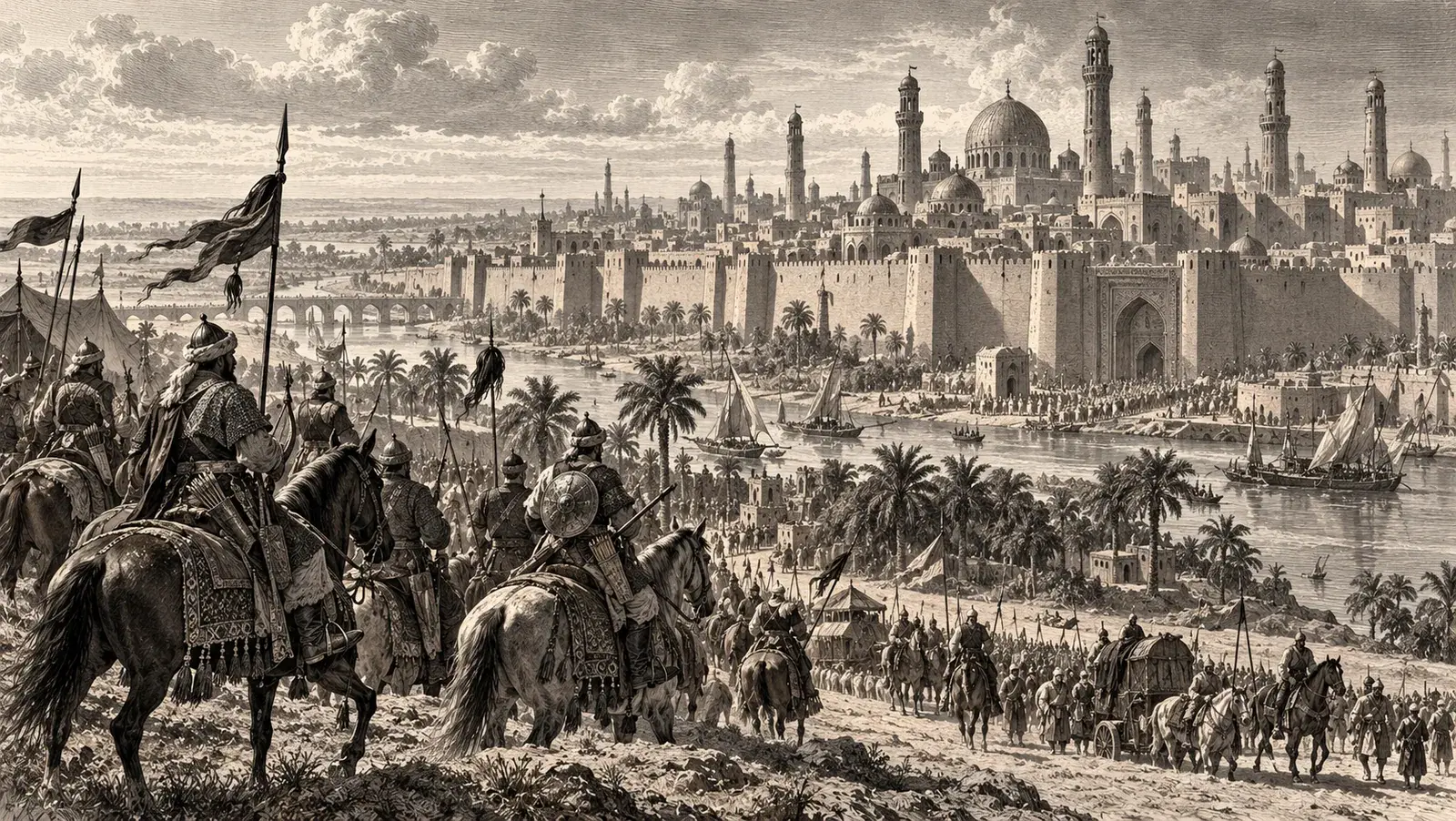
When Kublai Khan decided to add Japan to his empire in 1281, he had already conquered China. He had overrun Central Asia. His grandfather Genghis had built the largest contiguous land empire in history, and Kublai was extending it further. A hundred thousand men in three thousand ships crossing the sea to take one island chain — by the standards of the Mongol military record, this was not an overreach. It did not go as planned. The Japanese fought back fiercely on land and inflicted enormous casualties. Then a typhoon hit. The fleet was destroyed. The army that had landed, cut off from resupply and reinforcement, was finished. No foreign army has put soldiers on Japanese soil since. The storm that saved Japan entered the national memory as kamikaze — the divine wind — a name that would be applied, with different implications, to a different kind of sacrifice in a different kind of war six and a half centuries later. In 1281, it simply meant that the weather had done what the army alone might not have managed.
Kublai Khan's invasion fleet of three thousand ships was destroyed by a typhoon in 1281 after Japanese forces had already inflicted heavy losses on the landed army — the storm entered Japanese memory as kamikaze, the divine wind, and no foreign army has invaded Japan since.
The Hojo Regents — Power Without the Title
Before the Mongols came, Japan had been governed for two decades by the Hojo clan, who had stepped into the power vacuum left by the death of the first shogun, Yoritomo, in 1199. The Hojos were regents — not shoguns themselves, not emperors, but the people who told the shoguns what to do, operating through a puppet structure that gave them complete control while leaving the formal titles with others. This arrangement persisted for over a hundred years. They are best remembered, outside Japan, for holding off Kublai Khan. Inside Japan, their long period of rule ended in self-destruction. In 1318 they made the mistake of attacking the Emperor Go-Daigo directly and driving him from his throne. This was a different order of political miscalculation from anything they had previously committed. The emperor, whatever his actual power at any given moment in Japanese history, occupied a sacred position that the country would not accept being violated. The Hojos had managed their authority precisely by working around the imperial institution rather than against it. When they moved against it openly, the reaction was swift and fatal. Go-Daigo was restored; the Hojos were destroyed.
Two Emperors, One Country — The Ashikaga Era
Go-Daigo's restoration did not produce stability. A dispute over succession led powerful northern lords to set up a rival emperor, and for roughly sixty years Japan had two imperial courts simultaneously — the Northern Court backed by the Ashikaga clan, the Southern Court representing the older line. The Ashikaga won. Their head became the new shogun, and the office stayed in the family from 1333 to 1565. The Ashikaga shogunate produced some of the most refined cultural achievement in Japanese history. The courts they maintained attracted painters, poets, and scholars. The temples and gardens built under their patronage are still considered among the finest in Japan. Noh theatre developed during this period. The tea ceremony took on the form that has defined it ever since. By the standards of aristocratic culture, these were prosperous centuries. By the standards of everyone else, they were not. The Ashikaga were patrons and aesthetes, but they were not effective governors. The strong central control that earlier strong shoguns had maintained over the regional lords broke down. The Daimyo — the great lords who controlled the provinces — found themselves with more military capacity and less central oversight than at any previous point in Japanese history, and they used it against each other.
The Daimyo — Warlords, Castles, and the Farmers Who Fed Everyone's Army
Daimyo means great name. It was the title given to the head of a powerful hereditary family, and under the Ashikaga the daimyo effectively became the governing reality of Japan while the shogunate remained its nominal authority. A daimyo lived in a fortified castle with his Samurai retainers around him, controlled the farmland of his territory, and collected the rice that sustained his military household. A powerful daimyo might command thousands of Samurai. The whole edifice rested on the farmers who worked the land — who had no army, no castle, no meaningful capacity to resist, and who therefore suffered regardless of which side they found themselves on when the armies moved. The friend required your grain as a matter of course. The enemy plundered and burned. If a daimyo happened to be a competent administrator who kept the peace in his domain and protected the farmers under his protection, the people there were fortunate. Such daimyo existed. They were not the norm. The norm was continuous warfare between neighbouring lords, each trying to expand his territory and his tax base at the expense of everyone around him, with the farming population absorbing the damage at both ends. This was Japanese feudalism at its most uncontrolled: structurally identical to the European pattern, with lords and retainers and castles and dependent peasantry, but without the moderating institutions that eventually constrained European noble power. No Magna Carta. No common law. Just the logic of force operating without effective check for a very long time.
The Daimyo — great lords who controlled the provinces with their Samurai retainers — operated with minimal central oversight under the declining Ashikaga shogunate, producing a century of continuous warfare that devastated the farming population while the shogunal court refined its arts in Kyoto.
The First Europeans — Shipwrecked, Armed, and Carrying a Gun Nobody Had Seen
Marco Polo had told Europe about Japan in 1295. Europeans did not actually get there until 1542, when a group of Portuguese sailors wrecked on the Japanese coast and became the first Europeans to set foot in the country. They were received with curiosity rather than hostility. A few years later, a Portuguese traveller named Mendez Pinto reached Kyushu with a matchlock musket — a firearm of the kind that had been in use in Europe for some decades. When he fired it, the reaction was immediate and practical. The Japanese authorities who witnessed it were not frightened. They were interested. They wanted to know how it worked, how the powder was made, and how to produce the weapon themselves. Japanese craftsmen began making matchlocks. They were good at it. Within a relatively short time, domestic firearms production had scaled up to the point where matchlocks were in common use across Japan — a country that had gone from no firearms at all to a well-armed population in the space of a few decades, driven entirely by the internal demand of a society already organised around warfare. The technology arrived at exactly the moment when the daimyo system had made military capability the central fact of Japanese political life. It was absorbed and replicated with a speed that should not have surprised anyone who understood what kind of country Japan was.
Francis Xavier — Two Fugitives on a Dock and a Mission That Changed Japan
In 1547, Mendez Pinto's ship was preparing to leave Japan when two men came running to the dock, pursued by horsemen. They were fleeing for their lives and begged to be taken aboard. The Portuguese took them. The pursuing horsemen demanded the men be handed back. The Portuguese declined, and the ship sailed. The two men were brought eventually to Malacca, where they came to the attention of Francis Xavier — the Spanish Jesuit priest and missionary who was already one of the most consequential figures in the spread of Catholicism across Asia. Xavier had been thinking about Japan for some time. The arrival of these two men, one of whom was a person of standing named Anjiro, gave him direct access to someone who could tell him about the country from the inside. Anjiro and his servant converted to Christianity and learned Portuguese. In 1549 they sailed back to Japan with Xavier. Xavier landed at Satsuma in Kyushu. The local ruler gave him permission to preach, and the mission found genuine traction among the population. In 1550 Xavier crossed to the main island and made his way to Kyoto, the capital. The authorities there were less welcoming, but he preached in the streets and apparently made an impression. He left Japan in 1551 after two years and three months, intending to establish a mission in China. He died the following year at forty-six, in Goa, and was buried there. The missionaries he left behind continued the work. The Christian faith spread through Japan faster than almost anyone had expected. Portuguese trade brought Nagasaki into prominence — the port was handed over to them and became, for a period, effectively a Christian city. Churches were built in Kyoto and elsewhere. The Jesuit order established missions across the country, and in some provinces the conversion rate reached genuinely large numbers.
Francis Xavier landed in Japan in 1549 with two Japanese converts he had met by chance in Malacca — and within decades the Catholic mission had produced hundreds of thousands of converts, churches in the capital, and a Christian city at Nagasaki.
Two Samurai Princes in Rome — The Most Unlikely Audience of 1582
In 1582, a mission left Japan for Rome. The journey was enormously long — across Southeast Asia, around India, up through Africa or overland through the Middle East, across the Mediterranean. It was completed successfully. And when the delegation arrived in Rome, what the city saw was something it had no framework for. Two Japanese Christian princes rode through the streets of Rome in robes heavy with embroidery, swords at their belts — the two swords that marked their Samurai rank, worn as naturally as a European nobleman might wear a sword, because that is what they were. Around them rode Roman princes, the papal military escort, and senior officials of the Vatican. Guns fired salutes. The crowd that lined the streets was enormous. In the Hall of Audience they knelt before Pope Gregory XIII. The Pope, apparently moved, did not simply receive them formally — he got up and raised them himself, and kissed their foreheads. This was the condition of Japanese Christianity at the end of the sixteenth century: strong enough to send ambassadors to Rome, connected enough to receive a papal reception, deep enough in some provinces to count converts in the hundreds of thousands. What happened next — the decision by Japanese rulers that Christianity represented a political as well as a religious threat, the persecutions, the expulsion of the missionaries, the near-total suppression of Japanese Christianity for the next two and a half centuries — is a different chapter. For this moment, in 1582, two men who had grown up learning how to use the swords at their hips sat in the most powerful Christian institution in the world and were treated as honoured guests from the farthest edge of the known world.
The Tensho Embassy of 1582 brought two Japanese Christian princes to Rome — wearing embroidered robes and carrying their Samurai swords — to be received by Pope Gregory XIII in the Hall of Audience, one of the most unlikely encounters of the sixteenth century.