In the early 1400s, Central Europe faced a huge conflict that changed the region for years to come. Between 1409 and 1411, Poland and Lithuania fought the Teutonic Knights in what is now called the Polish–Lithuanian–Teutonic War, or the Great War with the Teutonic Order. This wasn’t just a fight with swords and armies—it was also a struggle over religion, power, and survival.
Teutonic Knights in white cloaks with black crosses standing by a fortress on the Baltic coast.
Who Were the Teutonic Knights?
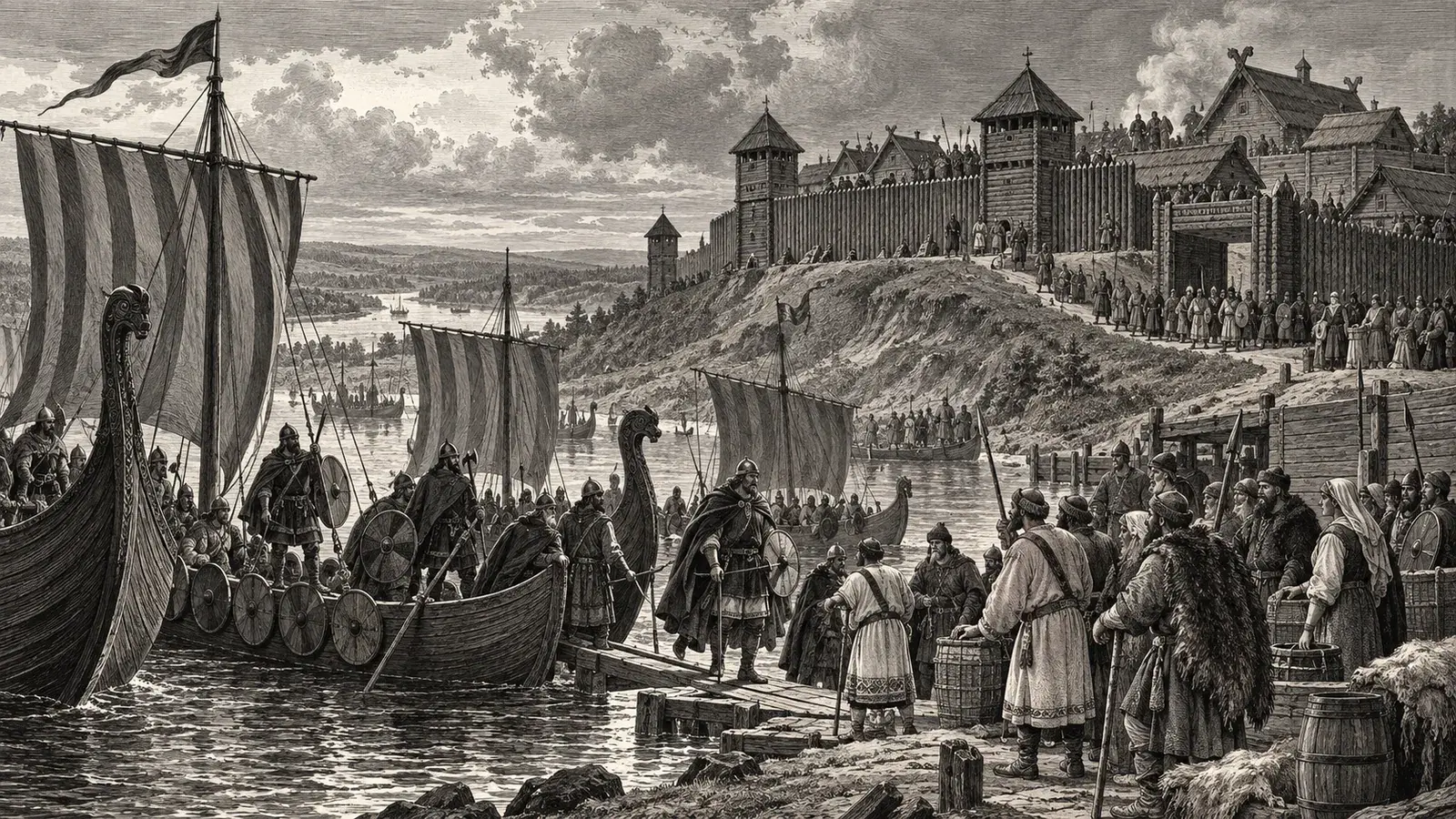
The Teutonic Knights started out as a group of warrior monks who fought in the Holy Land during the Crusades. By the 1200s, they had moved north to Europe. Invited by Duke Konrad of Masovia, they began fighting the pagan Prussians. With support from the Pope and the Holy Roman Emperor, the Knights conquered land along the Baltic Sea and built their own state. Once they controlled Prussia, the Knights set their sights on Lithuania, which was still pagan at the time. For nearly a century, they raided villages, burned homes, and captured people. The area of Samogitia was especially important to them, because if they controlled it, they could connect all their lands. For a short time in the 1380s, they even managed to take it.
A New Union Changes Everything
In 1385, something happened that shook the Knights’ plans. Jogaila, the Grand Duke of Lithuania, married Queen Jadwiga of Poland. Jogaila became Christian, took the name Władysław II Jagiełło, and united Poland and Lithuania. This new alliance was powerful and made the Teutonic Knights’ excuse for fighting—that they were spreading Christianity—much weaker. The Knights, however, claimed the conversion was fake and kept raiding. The sides also fought over land. Poland wanted areas like Dobrzyń Land and Gdańsk, while the Knights held tightly to Samogitia. They also controlled trade routes, which hurt Polish and Lithuanian merchants.
Queen Jadwiga of Poland and Grand Duke Jogaila marrying, uniting Poland and Lithuania under one crown.
The Rebellion in Samogitia
In 1409, the people of Samogitia rebelled against Teutonic rule with help from Lithuania. The Knights’ leader, Grand Master Ulrich von Jungingen, reacted quickly. He declared war on August 6, 1409, and sent his army into Polish lands, capturing towns and destroying farms. Poland struck back, while Samogitian rebels attacked other Teutonic strongholds. Neither side was ready for a long war, so they agreed to a short truce in October. But during the break, both sides prepared for a bigger battle. The Knights asked Hungary for help, while Jagiełło and his cousin Vytautas planned to join their armies and attack the Teutonic stronghold at Marienburg.
The March to Grunwald
In the summer of 1410, the Polish and Lithuanian forces met at Czerwińsk. There, they built a floating bridge over the Vistula River so their huge army could cross together. Once joined by Masovian troops, they marched straight into Teutonic territory. Von Jungingen thought Poland and Lithuania would attack separately, but instead, they advanced together. The two armies were about to meet at Grunwald.
Battle of Grunwald
On July 15, 1410, one of the biggest battles of the Middle Ages began. The Polish–Lithuanian army may have had around 30,000–40,000 men, while the Teutonic Knights had about 20,000. Jagiełło’s army included many different groups: Catholic Poles, pagan Samogitians, Orthodox Ruthenians, and even Muslim Tatars. The Knights, on the other hand, were joined by crusaders from across Europe. Before the battle, the Knights sent two swords to Jagiełło and Vytautas, mocking them and daring them to fight. The Lithuanians charged first but then retreated, possibly as a trick. The Polish lines held strong as the Knights pushed forward. At one point, a Teutonic fighter nearly reached King Jagiełło, but the king’s secretary, Zbigniew Oleśnicki, saved him. Later, the Lithuanians returned and attacked again. Grand Master von Jungingen tried to lead a final charge but was killed. With their leader gone, the Knights’ army collapsed. Their camp was overrun, thousands were killed, and even more were captured. In one day, the Teutonic Order lost most of its strength.
The Battle of Grunwald showing Polish and Lithuanian forces defeating the Teutonic Knights.
The Siege of Marienburg
Even after the great victory, Jagiełło and Vytautas did not march quickly on Marienburg, the Knights’ main castle. They moved slowly, giving the Knights time to prepare. Commander Heinrich von Plauen made sure the fortress was ready for a long defense. The Polish–Lithuanian army laid siege to Marienburg, but sickness, lack of supplies, and exhaustion weakened them. By September, they gave up the siege. The Knights, though badly beaten, managed to survive.
Polish and Lithuanian armies laying siege to the fortress of Marienburg.
The Peace of Thorn
In October 1410, Polish forces won another battle at Koronowo. Still, both sides were tired of fighting. By February 1411, they signed a peace treaty known as the Peace of Thorn. Poland regained Dobrzyń Land, Lithuania kept Samogitia (for the lifetimes of Jagiełło and Vytautas), and the Teutonic Knights had to pay a huge amount of money. The payments nearly bankrupted the Knights. To raise money, they borrowed, raised taxes, and even took wealth from churches. This angered their people and caused unrest in towns like Gdańsk and Toruń. Over time, the Knights became weaker and relied more on mercenaries.
The Fall of the Teutonic Order
Although the treaty didn’t change the borders much, it marked the beginning of the Knights’ decline. Their reputation for being unbeatable was destroyed at Grunwald. Heavy taxes and endless debts made their people lose faith in them. Meanwhile, Poland and Lithuania grew stronger and more respected. The disputes went on until 1422, when the Peace of Melno was signed, but by then the shift in power was already clear. The Teutonic Order was fading, while Poland and Lithuania were rising.
The decline of the Teutonic Order shown with crumbling fortresses and unrest among townspeople.
Why This War Matters
The Polish–Lithuanian–Teutonic War was far more than a medieval border dispute. It was a defining moment that signaled the decline of crusading orders and the rise of powerful national alliances. The Battle of Grunwald became a legendary symbol of unity and determination, celebrated in chronicles, paintings, and national memory for centuries to come. Even today, over six hundred years later, the lessons remain clear. Religious justifications for conquest no longer carried the weight they once had, and clever diplomacy could achieve as much as battlefield courage. For the Teutonic Knights, the war marked the beginning of decline and eventual collapse.