The official answer for why the Great Pyramid of Giza is empty is that it was robbed. Thousands of years of tomb raiders, the argument goes, cleared out whatever Khufu was buried with until nothing remained but bare granite chambers that archaeologists found in the nineteenth century and have been puzzling over ever since. That explanation has always had a problem: no one has ever found evidence of the robbing. No burial goods outside the pyramid. No ancient accounts of the looting. No disturbed seals of the kind left at every other major Egyptian tomb that was actually robbed. The pyramid was found empty, and the most widely accepted reason is that it was emptied — but the when and how and by whom remain genuinely unclear. There is another explanation, much older and considerably stranger, preserved in Sumerian clay tablets and Egyptian temple inscriptions. It does not involve tomb robbers. It involves a war, a siege, a ceasefire negotiated by a goddess, and a victorious god walking through the pyramid's internal passages and methodically dismantling everything inside. This is what some researchers call the Pyramid Wars — a reading of ancient mythology that treats the old stories not as fiction but as a distorted record of actual events. It is not mainstream history. It is not archaeology. But the texts it draws on are real, the mythological conflicts are real, and the questions it raises about the pyramid's construction and purpose are, at minimum, interesting. Here is the story as the ancient sources tell it.
The Great Pyramid of Giza was found empty — and ancient Sumerian texts offer one explanation for why: a war was fought over it, and the victor stripped out everything inside before leaving.
Two Brothers and a Problem That Never Got Resolved
The root of the conflict, in this reading, was a succession dispute that went back to the very top of the Anunnaki hierarchy. Anu, the father of the gods, had two sons who mattered: Enki and Enlil. Enki was the firstborn. Enlil was not. But Enlil was born to Anu's official half-sister wife, which in ancient royal tradition — and the Anunnaki apparently observed something like ancient royal tradition — gave the son of the legitimate marriage priority over the son of a concubine, regardless of birth order. So Enki, the firstborn, did not inherit. Enlil, younger but more legitimately born, held the higher rank. If you want to understand basically everything that follows in these myths, that single fact is the place to start. Enki and Enlil were both powerful, both intelligent, both commanding enormous followings. And one of them had been passed over in a way that never stopped being a source of tension. The conflict that grew out of this family arrangement eventually spread across two continents and, according to these accounts, involved flying machines, siege warfare, poison weapons, and a final standoff inside the largest stone structure ever built. The researchers who take this material seriously call the resulting wars the Pyramid Wars. Zecharia Sitchin, whose translations and interpretations of the Sumerian tablets drove much of this alternative reading, used that name specifically. Whether you read these as literal history or as mythology with a political subtext, the stories themselves are remarkable.
The Pyramids Were Not Tombs — According to the Myth
In this interpretive framework, the Great Pyramid complex at Giza was not built as a burial site. It was built as infrastructure — specifically as a guidance and communication system connected to a wider network of sites across the ancient Near East. After a great flood that appears in multiple ancient traditions, the story goes, landmarks were needed to help navigate from above. The pyramid complex was designed partly for this purpose. The texts also describe the pyramids as containing equipment for signaling and for defense — crystal devices, directional stones, systems whose outputs were sent through angled channels toward the pyramid's exterior faces. The inscription at the temple of Edfu in Egypt provides what some researchers see as a starting point for the conflicts that would eventually center on these structures. The text describes a moment when Ra, called the Falcon of the Horizon, received a warning: enemies were plotting against him. Horus, the Winged Measurer, reported the threat. Ra ordered Horus to strike first. Whether this is read as myth or as garbled history, it sets up a pattern that repeats throughout these stories — one side moves against the other, often using the Giza complex as the prize that justifies the fighting.
The Temple of Edfu contains inscriptions describing Horus being ordered by Ra to strike against enemies — texts that some researchers read as early references to the conflict that became the First Pyramid War.
The Enki and Ninharsag Story — and Why It Matters Here
Before the wars started, a political situation had already developed that made them almost inevitable. A Sumerian story known as Enki and Ninharsag is usually read as an agricultural myth — a poem about plants growing in a fertile land, about healing, about gods behaving badly and facing consequences. In the alternative interpretation, it is something else: a record of Enki's attempt to secure his lineage's position through strategic reproduction. The story describes Enki traveling to meet Ninharsag, the great healer goddess, in the marshlands between Egypt and the Sinai. What follows is a complicated series of unions — Enki with Ninharsag, then with their daughter, then with his granddaughter — that eventually produces eight new deities, six female and two male. Ninharsag's reaction when she understood the full scope of what had happened was not mild. She struck Enki with a serious illness, working her healing knowledge in reverse to produce harm instead of cure. The other Anunnaki begged her to relent. Eventually she did — healing him organ by organ, piece by piece — and afterward Enki proposed that the eight new gods be assigned territories and roles. Egyptian texts from Memphis tell a parallel version: Ptah, identified with Enki, created eight gods from parts of his body and distributed cities and sacred places among them. Both stories end in the same place: the appearance of eight new divine figures, followed immediately by a division of territory. Why does this matter for the wars? Because the question of who was born from whom determined who had a claim to what. One particularly important claim in these texts is that Osiris was actually the son of Ra, not Geb — conceived through a secret union — which made his inheritance of Lower Egypt contested in ways that the official genealogy did not show. That contested parentage, according to this reading, is the real reason Seth killed him.
The First Pyramid War: Horus Versus Seth
The conflict between Horus and Seth is one of the most famous stories in Egyptian mythology. It is usually explained in terms of geography: Upper Egypt versus Lower Egypt, the desert versus the fertile delta, order versus chaos. These readings are not wrong exactly — the myth does carry those meanings. But in the Pyramid Wars interpretation, there is a more specific prize underneath all of that symbolism. Seth was given Upper Egypt. Osiris received Lower Egypt. The real object of competition, in this reading, was control of the Giza plateau — which sat at the boundary between the two regions and which contained the pyramid complex that supposedly connected Earth to a wider network. Whoever controlled Giza controlled the connection. Seth managed to kill Osiris and take control. Then Horus — grown, supported by allies linked to Enki's faction across Africa — began his campaign to take it back. This is identified as the First Pyramid War. The texts describe it as the first time humans became directly involved in the Anunnaki's political struggles. Horus moved north through Upper Egypt, fought a major engagement near the chain of lakes between Egypt and the Sinai, and drove Seth's forces eastward. Eventually the council of gods awarded all of Egypt to Horus. Seth was expelled and eventually settled in the eastern regions linked with Canaan. That eastward movement of Seth's faction into Canaan is where the story connects, in this interpretation, to certain puzzling passages in Genesis and the Book of Jubilees — texts that describe Canaan settling in land not assigned to his lineage and suffering a curse for it. The alternative reading treats this as a reference to the territorial fallout from Seth's defeat: Enki-faction forces now occupied the corridor from Giza through Sinai toward what would become Jerusalem, and the Enlil faction — which considered that territory its domain — was not prepared to accept the situation.
The famous Egyptian conflict between Horus and Seth is usually read as a myth about order versus chaos — but the Pyramid Wars interpretation places control of the Giza pyramid complex at the center of the dispute.
The Second Pyramid War: Ninurta's Campaign
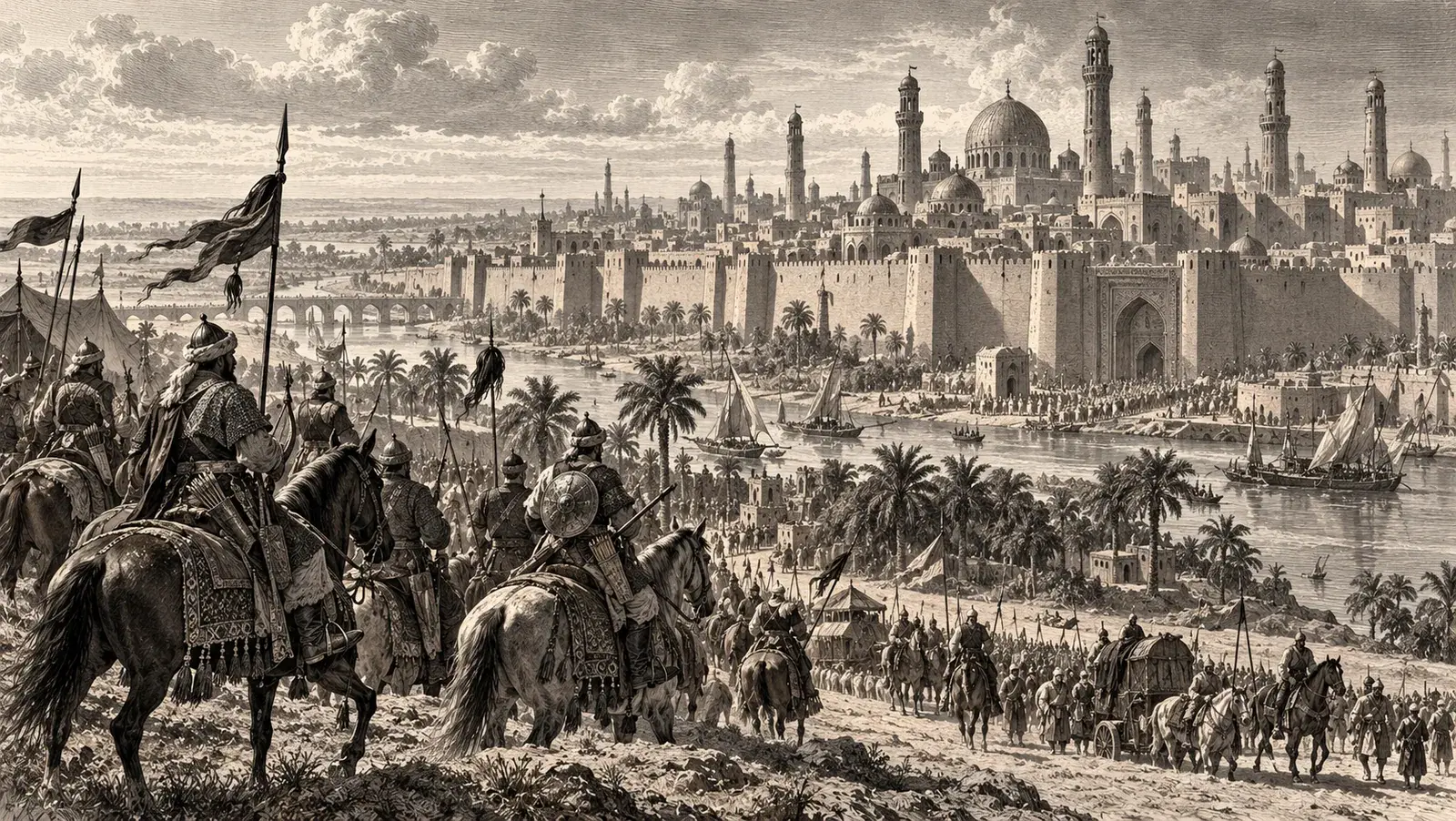
About three centuries after the first war, the Enlil faction moved to take back what it considered its territory. The Sumerian texts grouped under what scholars call the Myths of Kur — along with the long epic Lugal-e Ud Melam-bi — are read in this interpretation as poetic records of what happened next. The central figure on the Enlil side was Ninurta, described as Enlil's greatest warrior. His main opponent was Marduk, son of Enki. The campaign opened in the Sinai Peninsula, where the Enki-faction forces were pushed back toward their African strongholds. The fighting then shifted into mountainous regions of Africa — the texts describe this second phase as more violent than the first — before eventually converging on the pyramid complex itself. Ninurta's most significant weapon in this campaign was something the texts call the IM DU GUD — the Divine Storm Bird. The poem describes it as a mechanical flying craft with a wingspan of roughly seventy-five feet, capable of diving from altitude to strike fortified positions. In the text, Ninurta uses it to attack enemy strongholds from above, smashing through walls that ground forces could not breach. The god Adad worked alongside Ninurta, targeting supply lines — destroying fish sources, scattering cattle — to weaken the defenders through attrition. Ishtar, who joined the campaign at some point, is described releasing a weapon that turned the skies red and devastated enemy formations. The image is striking regardless of how literally you take it. As the pressure mounted, the Enki faction withdrew deeper south. The texts describe what happens next in terms that are, if taken at face value, extremely grim. Ninurta's forces attacked the city of Meslam, a temple city in the domains linked with Nergal, using what the damaged tablet fragments describe as poison-filled missiles. The texts say the poison alone destroyed the city. Those who survived fled into nearby mountains. Fire attacks followed. The descriptions — rivers running with blood, sensory deprivation caused by the weapons, land left devastated — read like accounts of something considerably worse than conventional ancient warfare.
Cylinder seal images from ancient Mesopotamia show what may be Ninurta's Divine Storm Bird flying in triumph above two pyramids — described in the Sumerian epic Lugal-e as a mechanical flying craft used in the Second Pyramid War.
The Siege of the Great Pyramid
The war's final phase is where it gets genuinely strange — and where the connection to the empty pyramid chambers becomes explicit in these texts. The remaining Enki-faction gods, driven from their other positions, withdrew into the Great Pyramid itself. A skilled figure — the texts suggest Enki or possibly Thoth — raised a protective barrier around the structure that Ninurta's weapons could not penetrate. The defenders were trapped but apparently untouchable. Then Nergal, one of the Enki-faction gods, slipped out of the siege at night carrying weapons and managed to reach the pyramid with a small group of allies. The text says he entered through doors that could open by themselves. Once inside, he reinforced the pyramid's defensive systems using crystal stones and mineral components — including something called the Water-Stone and the Apex-Stone. Ninurta changed his approach. He brought in Utu — Shamash, the sun god — to cut off the underground water supply near the pyramid's base, disrupting whatever the structure needed to function. The defenders found themselves running out of food and water. At this point, a younger god — believed by some researchers to be Horus — tried to escape the pyramid disguised as a ram. Ninurta's weapon struck him before he got clear, destroying his eyesight. The Egyptian legend of Horus being injured in the eyes by a blast of fire is sometimes cited here as a parallel account of the same event from a different tradition. That injury triggered the turning point.
Ninharsag Ends the War
Ninharsag occupied an unusual position in the conflict. She was the great healer, respected by both factions. She was also Ninurta's mother. When the cries went up for someone to save the injured young god inside the pyramid, she was the figure both sides could accept as a mediator. The ninth tablet of Lugal-e records what she did. She told Ninurta — her own son, the victorious commander — that she was crossing the battle lines to enter the pyramid alone. He was startled enough that the text records his reaction explicitly. But when it was clear she would not change her mind, he gave her protective clothing, possibly to shield her from whatever the weapons had left behind in the surrounding area. She reached the pyramid and called out to Enki. The conversation between them is partly missing from the damaged tablets. What survives is the outcome: Enki agreed to surrender the pyramid to Ninharsag's authority, but with a condition. The surrender would hold only until a future time when the question of dominance would be decided again. She brought this offer back to Ninurta's side. Adad initially rejected it — victory, he argued, was nearly complete. Enlil overruled him. The ceasefire held. Ninharsag returned to the pyramid. She swore by the stars that Enki and his sons would be safe. Slowly, Enki agreed. He took her hand. He and the remaining defenders walked out of the pyramid and withdrew with her to the Harsag. Ninurta's forces watched them leave. The pyramid stood empty.
Ninharsag — healer, mother of Ninurta, and the one deity trusted by both sides — crossed the battle lines alone to negotiate the surrender of the Great Pyramid and end the Second Pyramid War.
What Ninurta Found Inside — and What He Did With It
The later tablets of Lugal-e describe what happened when Ninurta entered the Great Pyramid. The texts place this around 8670 BCE in Sitchin's timeline. What Ninurta supposedly found was not an empty tomb or a burial chamber. It was an operational facility. Moving up the Ascending Passage and reaching the junction with the Grand Gallery, he first went along the horizontal corridor into a large east-west aligned chamber. Set into the eastern wall was a device called the SHAM — the Destiny Stone. It glowed deep red. It had, according to the text, been used to track Ninurta's movements while he was in flight during the war. He ordered it smashed. Back in the Grand Gallery, the text describes rows of crystal stones along both sides of the passage, each radiating a different color, producing what the text calls a rainbow effect. These were components of the pyramid's signaling and defensive systems. At the top of the gallery, three sealed barriers — described as the bolt, the bar, and the lock — protected the upper chamber. After they were cleared, Ninurta entered what the text treats as the most restricted space in the structure. Inside was the GUG — the Direction-Determining Stone — whose signals were amplified through hollow spaces above the chamber and projected outward through angled channels in the pyramid's faces. He ordered it destroyed too. Then he walked back through the Grand Gallery, stopping at each crystal stone and deciding its fate. Some were crushed on the spot. Others were taken to be displayed in Mesopotamian temples as war trophies. The rest were allocated to the new Mission Control Center being established elsewhere. Finally, he addressed the apex of the pyramid — the UL Stone, the crowning piece. His order was simple: remove it. It was not to be seen in place again. With that, Ninurta left. The pyramid was still standing. It was just empty now — of everything it had apparently once contained.
What to Do With All of This
None of this is archaeology. The mainstream position on the Great Pyramid — that it was a tomb for Khufu, that it was robbed in antiquity, that the chambers served funerary purposes — remains the consensus among Egyptologists, and that consensus is not based on nothing. But the texts that the Pyramid Wars interpretation draws on are real. The Lugal-e epic exists. The Edfu inscriptions exist. The Enki and Ninharsag story exists. The Horus and Seth conflict is one of the most extensively documented narratives in ancient Egyptian religion. The question of how much of any of this reflects something that actually happened — as opposed to political allegory, religious cosmology, or pure mythology — is genuinely open and has been debated by serious scholars as well as alternative historians. What is harder to dismiss is the pile of questions that orthodox explanations of the Great Pyramid leave unresolved. The missing capstone. The empty chambers that archaeologists found without any sign of burial goods. The internal structure — the Grand Gallery, the shafts angled toward specific points on the horizon, the so-called King's and Queen's Chambers with their unusual proportions — that does not obviously match any other Egyptian tomb ever excavated. These are real anomalies, even if the explanation offered by the Pyramid Wars interpretation is not the one most Egyptologists would reach for. Ancient stories have a habit of being more than one thing at once. The Iliad is simultaneously a poem about honor and grief and a story that preserves something real about a Bronze Age conflict in western Anatolia. The Mahabharata is simultaneously a philosophical text and a narrative that carries genuine historical memory of warfare in ancient India. The Sumerian myths about Enki and Enlil may be simultaneously theological allegory and a distorted record of political conflicts that actually happened — fought between people, not gods, but people important enough that subsequent generations turned them into gods. The Great Pyramid still stands. The apex stone is still gone. The chambers are still empty. Cylinder seals from ancient Mesopotamia show what looks, to some eyes, like a winged machine flying above two pyramids. Make of all that what you will.