The battle of Meligalas raged over three days in September 1944 in a small town in south-western Greece, fought between Greece's resistance fighters and its collaborators. It ended in the collaborators' defeat and a large-scale massacre of the defeated soldiers and civilians, who had been thrown into an old well.
The name Meligalas and the events that had occurred there continued to be contentious well into the present day. To the post-war right, it was an expression of the horrific nature of communism and a symbol of the fascist resistance, while to the left, it was an example of antifascist zeal, transmuted into the slogan “Three words – Death to the fascists,” scrawled on university walls by the students of the 1960s. To this day, descendants of those murdered in Meligalas raise their banners alongside the far-right, while the number of casualties varies from approximately 400 to over 2500 depending on the source. In order to understand the significance of the battle and the massacre, it is necessary to examine the events leading up to it in detail, as well as the subsequent confrontation, in order to understand what exactly happened to the people of Meligalas and why.
Resistance in Occupied Messenia, 1942-1943
When Germany occupied Greece in April 1941, the territory was quickly divided between the German army and the Italian one, as the latter was not interested in participating in the campaign against the Soviet Union that began in June. With the exception of the western part of the Peloponnese, which was controlled by Italy, Greece's military resources were focused on resisting the German troops. In 1942, the communist-led National Liberation Front, EAM, began to organize itself in Kalamata Province. Initially, EAM/ELAS groups were formed in opposition to the Italian occupation, which was particularly oppressive in terms of food supplies. However, apart from a few minor engagements with the Greek Gendarmerie and the Italian Army, these groups were relatively ineffective, and by the end of 1942, they were either disbanded or evacuated to Central Greece.
The occupation authorities declared the Peloponnese free of partisans in April 1943. At the same time, Dimitris Michas, an EAM activist and former Italian prisoner of war, was ordered to form a detachment on EAM's behalf. His group, together with mainland reinforcements, was involved in several successful attacks on Italian positions and units, and by June, the Greek People's Liberation Army, ELAS, had about 500 partisans in the Peloponnese. They were fragmented into small groups due to the lack of resources and organization, and in August, according to the German intelligence report, there was a group of 800 men under Kostas Kanellopoulos in the Messenian mountains.
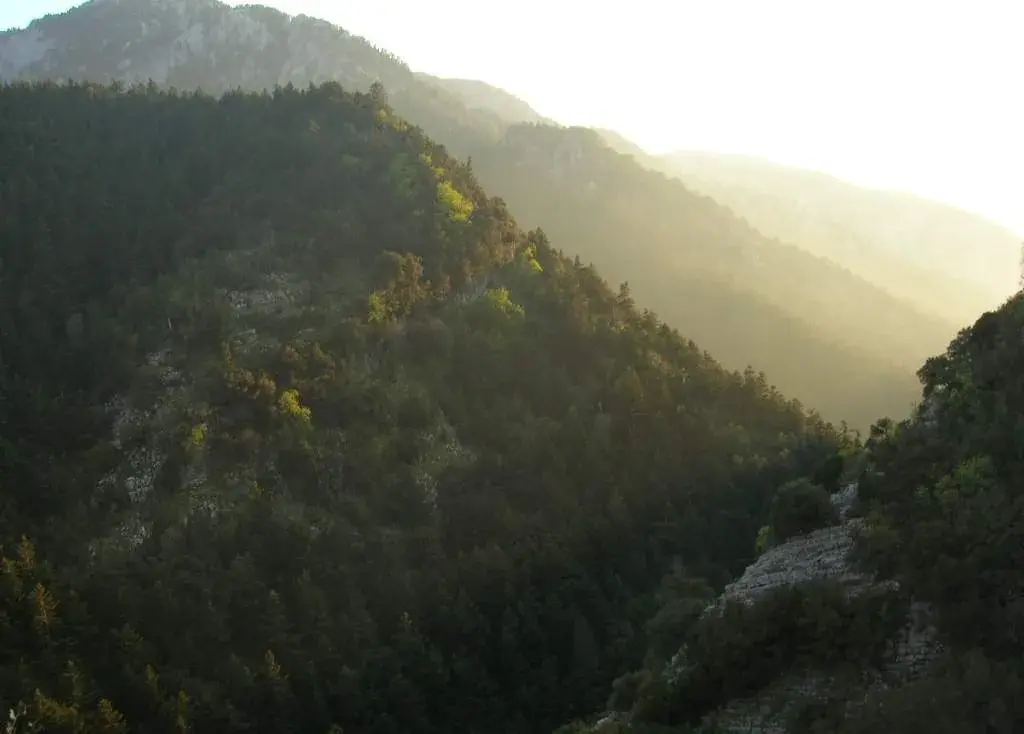
The mountains of Messenia sheltered the partisan bands of ELAS during the occupation.
Image Credits: Wikimedia Commons (CC BY-SA 3.0)
However, there was also an anti-communist resistance in the region. In early 1943, the Hellenic Army (ES), made up of royalist officers, was formed. Initially, it adopted a neutral stance, but in July, ES proclaimed its opposition to EAM and began to coordinate with royalist organizations. The British were unable to bring the various resistance groups to common action, and in August, hostilities broke out between ES and ELAS. At the same time, Dionysios Papadongonas, one of ES's leaders, and possibly Tilemachos Vrettakos, began cooperating with the Italians and Germans. The latter provided limited assistance to ES, but after a clash with the German troops at Pyrgaki, Vrettakos suffered heavy losses, and the Allied airdrops of supplies to both resistance groups were canceled. ES was defeated in October, and thus ELAS became the only organized fighting force in the region.
The Security Battalions and German Anti-Partisan Policy
After the Italian capitulation in September 1943, the anti-partisan operations in the Peloponnese were transferred to German Major General Karl von Le Suire of the 117th Jäger Division, who was the sole military commander in the region as of October. An Italian Carabinieri barracks was located in Meligalas, but otherwise, the town was occupied by two companies of German infantry. After the capitulation, ELAS received a significant boost in supplies, popularity, and armaments, and with their British allies, began attacking German positions. In the mountains, the partisans began to act as an occupying force, as they were the only military presence in the region, and met with great resistance from the local population.
The locals suffered greatly from the partisans as the villages had to provide food supplies to them, despite the famine, the disruption of the economy, and the hyperinflation. Additionally, the Germans engaged in punitive operations, which caused many civilian deaths, but they were relatively infrequent before December, when the murders began in Kalavryta, committed by Le Suire. In 1943, the German command came to the conclusion that it was not in a position to effectively combat ELAS, and it was decided to utilize the anti-communist forces in order to “free Greece from Bolshevism,” as the phrase went, in order to avoid further bloodshed. Thus, the Evzone Battalions of Ioannis Rallis's collaborationist government and the Security Battalions began to be formed, independently raising volunteers and receiving weapons from the Nazis. It is noteworthy that the Security Battalions were formed in the Peloponnese region specifically, as the local population demonstrated a certain degree of sympathy for the royal family, as well as for the anti-communism. Five battalions were formed under the command of Papadongonas.
In Messenia, the Security Battalions were formed at the request of the collaborationist prefect Dimitrios Perrotis. Thus, a municipal battalion was formed in Kalamata in February, which was merged with another one from Athens in Meligalas in March, in order to secure the road to Tripoli. The Security Battalion of Messenia was formed, which had five companies: one in Kopanaki, one in Kalamata and three in Meligalas. The districts of Messenia, Laconia, and Arcadia were controlled by battalions of the Security Service, which were subordinate to Higher SS and Police Leader Walter Schimana. However, the relationship between the various battalions and the German command was based on personal connections, which gave them considerable autonomy. Additionally, the battalions were stationed in the towns and participated in anti-partisan operations, selecting the prisoners to be killed and taking hostages, for example, in retaliation for the killing of Major General Franz Krech in April 1944. Moreover, the units of the Meligalas-Kalamata Security Battalions were known to hold meetings in the town, openly calling themselves anticommunists and using the racist antisemitic, and Slavic rhetoric of the Nazi party.
Meanwhile, ELAS continued its attacks on the German positions, beginning in April with an assault on the first German-garrisoned town, Meligalas, which failed. In April, the EAM leader Georgios Siantos sent Aris Velouchiotis to establish order and conduct attacks in the 3rd ELAS Division, which numbered some 6000 men, faced with 18,000 German soldiers and 5000 Battalionists. Velouchiotis imposed strict discipline and intensified the attacks. Felmy proclaimed the Peloponnese a battlefield in May, thereby enabling Le Suire to impose martial law there, which did not have any effect on ELAS's continued presence in the region. The partisans were waging a relentless war in Messenia, where the entire country was in flames, and where thousands of homes and 1500 residents were killed in Kalamata during the war. The Security Battalion attacks continued throughout the summer, although they were weakened by the ELAS's OPLA killing of the Messenian Battalion commander in June in retaliation for which Major Smyrlis killed 27 communists. By late August, clashes with the Germans had decreased, but they continued with the Security Battalions.
The Collaborators and the Allied Political Problem
The actions of the Security Battalions were a political problem for the Allies even before the battle of Meligalas. At the Moscow Conference in November 1943, a joint Statement on German Atrocities was issued by Roosevelt, Churchill, and Stalin, which included accusations against collaborators, and a law was passed by the government of Greece in exile, which deprived the collaborationist government's officials of their citizenship. Additionally, according to the law passed by the Political Committee of National Liberation (PEEA), collaborators could be sentenced to death for crimes against the state, including high treason. However, the British had always been opposed to the idea of EAM and wanted to use the Security Battalions as a tool against the communists, as well as to turn them into the core of the future national army. Therefore, even as PEEA passed its laws, Papandreou sought to withhold condemnation of the Security Battalions, arguing that it had already been passed at the Lebanon Conference in May 1944. Moreover, in June, the British canceled the anti-Security Battalions propaganda. When the Red Army approached the region, the German command decided to withdraw the 117th Division from the Peloponnese, which occurred on 23 August, and to leave the country entirely three days later. The British wanted to ensure that the handover of power took place with the minimum possible change in the existing order and that weapons did not fall into the hands of the partisans. EAM/ELAS, for its part, wanted to liberate the region from the collaborationist police and Security Battalions, and Velouchiotis sent them an order for the 3rd Division to occupy the cities after the departure of the Germans and liquidate the Security Battalions with all their might.
- The British wanted to use the Security Battalions against the communists and as the core of a future national army.
- The PEEA passed laws allowing collaborators to be sentenced to death for high treason.
- George Papandreou sought to withhold immediate condemnation of the Security Battalions following the Lebanon Conference.
- EAM/ELAS aimed to liberate the region from collaborationist forces and liquidate the Security Battalions.
When the Germans left, the threat of revenge was real. On 3 September, ELAS military chief Stefanos Sarafis appealed to the members of the Security Battalions, urging them to surrender their weapons to save their lives. At the same time, British Lieutenant-general Ronald Scobie ordered his deputy in Athens to tell the Security Battalion members to defect or surrender to the British, promising them to treat them as prisoners of war, which did not apply to the Peloponnese region. On 6 September, the new national unity government, which Greece's resistance groups had agreed to, declared that the members of the Security Battalions were criminals against the fatherland. At the same time, it ordered resistance groups to cease all acts of revenge, calling for order and respect for private property and lives, which were now under the protection of the state.
Moreover, the Germans had left behind weapons and a policy of sabotage. Walter Blume, the chief of the German security police in Greece, had developed the concept of “chaos,” which implied the demolition of the infrastructure and the arming of the population in order to turn Greece into a cradle of civil war. The more radical elements of the Nazi command wanted to kill the politicians of the pre-war pro-British government, but this plan was thwarted by its moderates. In early September, the Germans destroyed bridges and tracks and provided weapons to the Security Battalions as they withdrew from the country.
The Fall of Kalamata and the Concentration at Meligalas
According to the decision of the national unity government, ELAS was given the task of liquidating the Security Battalions. Accordingly, in Pyrgos, the capital of Elis, the battalion commander Georgios Kokkonis declared his loyalty to the king and the national government and agreed to leave for Tripoli when an official representative arrived. However, ELAS demanded the immediate surrender of the battalion's weapons, and a battle began, which ended with the partisans capturing the city on 10 September after a siege.
In Kalamata, the Germans withdrew from the city on 5 September, leaving behind the Gendarmerie as the only military force. Through the representatives of the Allied Middle East command, ELAS contacted the prefect Perrotis and proposed that the local Security Battalions be disarmed and detained as prisoners of war until the arrival of the national government. This request was refused, and on 9 September, the partisans launched an attack on the city. As the Security Battalion members surrendered, many civilians arrived in Kalamata in order to take revenge on them.
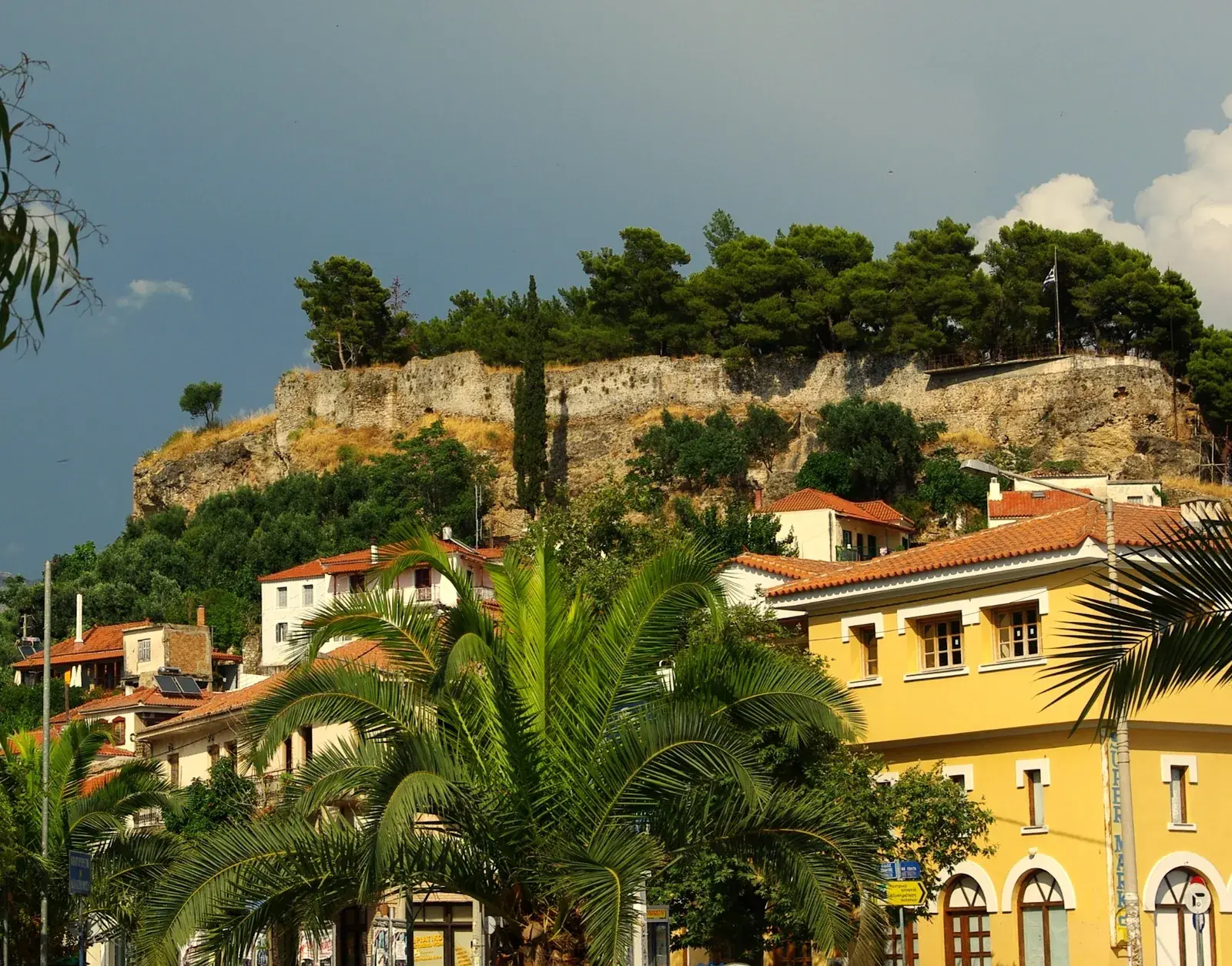
Security Battalion members took up positions across Kalamata, including the castle, before the city fell to ELAS on 9 September 1944.
Image Credits: Koppi2, via Wikimedia Commons (GFDL 1.2)
Approximately 100-120 members of the battalion under the command of 2nd Lieutenant Nikos Theofanous and Perrotis escaped via the unguarded railway to Meligalas, where 800 members of the Security Battalion were stationed. On the way, Theofanous spread rumors among the locals that the partisans were killing people and conscripting both Battalionists and peasants. Additionally, 100-120 men from Kopanaki arrived in Meligalas on 11 September. Accordingly, the battle for Meligalas was necessary for ELAS in order to secure the region.
The archimandrite Ioil Giannakopoulos arrived in the town with two British officers in order to propose to the Security Battalion commanders to surrender their weapons to the ELAS and to be transferred to a special internment prison, where they would be held until the arrival of the national government. After that, the lives and property of the Battalion members and their families would be guaranteed. This request was refused by Perrotis, as were the appeals from the families of the Battalion members who arrived in Meligalas from surrounding villages.
Three Days of Fighting, 13-15 September 1944
The Security Battalion concentrated its forces in Meligalas, constructing a defensive position. Inside the central church of Agios Ilias, the Battalionists placed a heavy machine gun at the clock tower and allocated their 50 light machine guns to the houses surrounding it, as well as the ramparts of the town's paddock. The houses were additionally fortified and their contents removed in order to clear the fire channels. At dawn on 13 September, about 1200 partisans attacked Meligalas, using the 8th and 9th Regiments. Giannis Michalopoulos of the 9th Brigade Staff, who was sent to examine the situation, developed a plan with the 1/8 and 1/9 battalions. Accordingly, four battalions attacked the town from different directions, while the partisans' single 10.5-cm gun, which did not have a carriage, was positioned on the Skala heights. According to the plan, 2/9 Battalion was to make a rapid advance in order to storm the church from two sides.
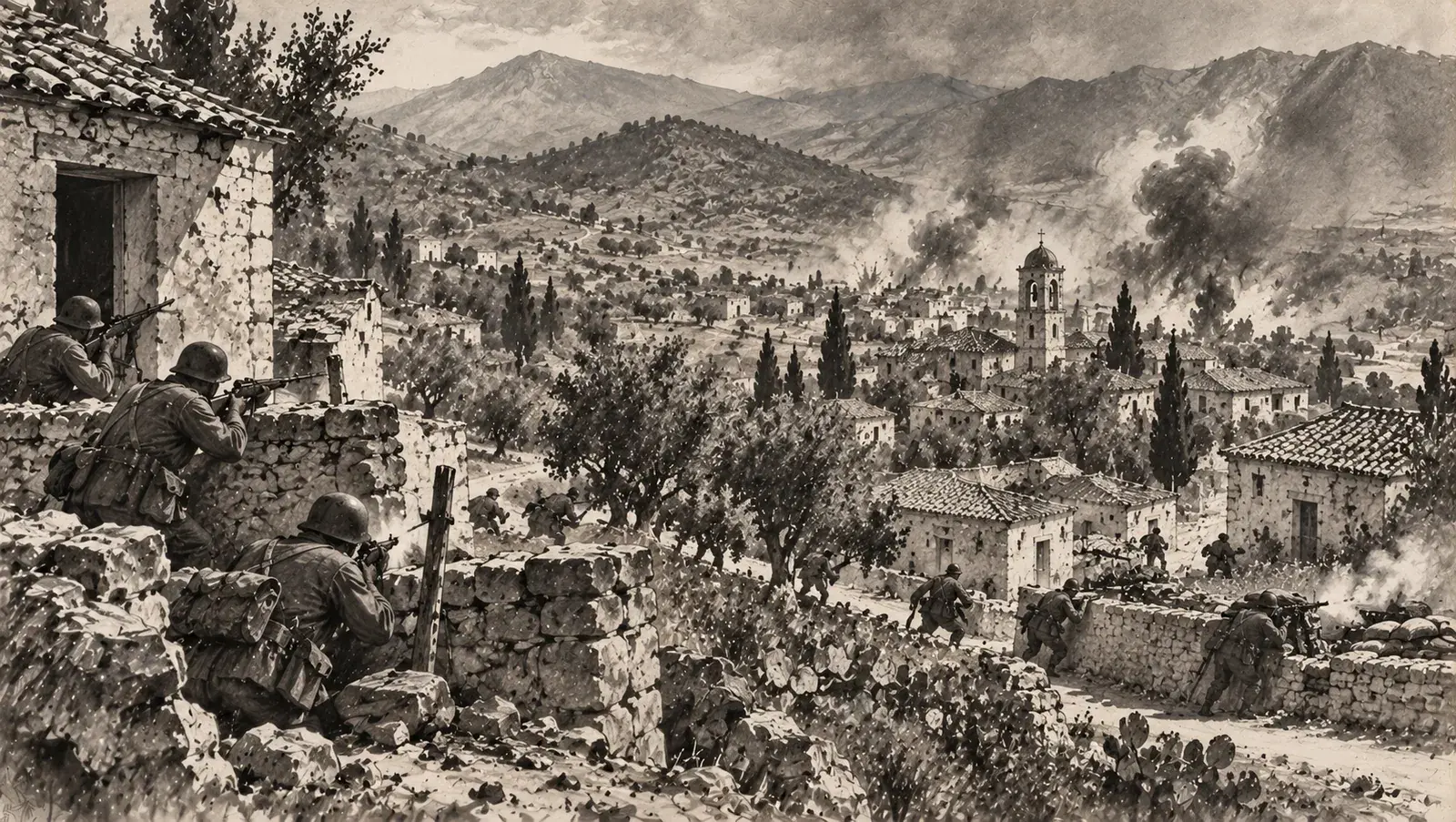
Meligalas, a small town in Messenia, where the Security Battalions made their stand in September 1944.
The attack was impeded by the minefield, which was improvised from grenade boxes and dynamite, laid by the Battalionists the previous evening during the negotiations. The plan was changed, and a company under the command of Kostas Basakidis was sent to storm Agios Ilias. The attack caused the Battalionists to remove the machine gun from the tower, and the assault by the 1/8 Battalion pushed back the defenders at the station, who were holding EAM hostages, and led to the partisan killing of Major Smyrlis.
The lines were held until night, but the losses, as well as the demoralization of the Battalionists, who had been reinforced, grew. The commander of the 1/8 Battalion, Major Dionysios Papadopoulos, sent a detachment to request the assistance of Gargalianoi, but the Battalionists, upon leaving Meligalas, renegaded on the deal. On the following day, a British group was invited to the town in order to discuss the surrender terms with the partisans, but they were refused. At noon on 14 September, thirty partisans threw German Teller mines at the barbed wire around the church, but were repelled with gunfire. Once again, the attack by the 1/9 Battalion under Basakidis was launched, but the attacking group, finding itself isolated, was driven back by a counterattack. The partisans were suffering greatly from the open fighting, and the sight of the wounded combined with the news of the murder committed by the Battalionists caused the civilians to swell with even greater fury.
At dawn on 15 September, the Battalion leaders convened in order to discuss the situation. Papadopoulos suggested retreating to Gargalianoi, but the meeting was interrupted by the shelling of the house where the Battalionists were gathered. The news of the planned withdrawal fueled the anger of the wounded and the EAM hostages, and a new attack began. The partisans drove the Battalionists out of the town, but at great cost, and the 1/8 Battalion hoisted a white flag over the building. At the same time, a group of thirty Battalionists under Major Kazakos attempted to escape south towards Derveni but suffered heavily from the Reserve ELAS, the Mavroskoufides, the personal guard of Velouchiotis, and the 11th Regiment, which was waiting for them near Anthousa.
The Executions at the Well
When the battle was over, the civilians entered Meligalas, and many of them went on a rampage, killing and plundering. According to the report preserved in the Communist Party of Greece's archives, they were the villagers from Skala, whom the Germans had burned. In the bedesten, among the hostages taken by the Battalionists, the leader of the partisans Velouchiotis noticed a gendarme who he had previously arrested and freed, and ordered him executed. This decision was made in accordance with the general policy of the partisans, who began to release the known collaborators in Skala and Meligalas in order to encourage the local population to rise up against the Battalionists. In addition to them, a number of civilians and EAM members were killed. However, this mass killing only began after the end of the battle, as the partisans' control of the town was far from complete. In Meligalas, another phase of the revenge began, in which the killing of the Battalionists was expressed in a more organized manner.
A tribunal was established in the town, whose judges were the lawyers Vasilis Bravos and Ioannis Karamouzis. In the lists provided by the local EAM detachments, the approximately 60 officer and non-commissioned staff of the Security Battalions were condemned to death, as were many ordinary soldiers for “crimes against the people.” The executions began in the abandoned well, the pigada, located outside the town. Following the custom that the partisans established, the Battalionists were killed not by the ELAS soldiers, in order to prevent revenge, but by a detachment of the 8th Regiment, most likely from Kosmas and Tsitalia in Arcadia.
The actions of Velouchiotis depend largely on whose report is being considered. On 17 September, he arrived in Kalamata, where Perrotis and the other collaborationist officials were sent in the meantime. There, the locals, breaking through the ELAS cordon, killed some of the Battalionists, and twelve of them were hanged from the lampposts.
The Casualty Numbers and Contested Figures
The number of casualties in the battles around Meligalas and the subsequent well massacre has not been established to this day. According to an ELAS communique published by Major General Emmanouil Mantakas on 26 September 1944, 800 Battalionists were killed. In his memoirs, Sarafis repeats this figure, noting that they were called Rallides, after the collaborationist prime minister. The report published by the Red Cross is naturally more objective, but it also leans toward the high side, as it states that more than 1000 people were killed. According to the report compiled a year later by the noted Greek coroner Dimitrios Kapsaskis and his assistants, 708 bodies were recovered from the well in Meligalas.
The authorities of the post-war Greek right do not hesitate to cite much higher numbers of victims, from 1110 to over 2500. For instance, the National Radical Union politician Kosmas Antonopoulos, whose father was murdered by ELAS, writes about 2100 people killed in Meligalas, citing the figure of 699. Ilias Theodoropoulos, whose brother died in the battle, gives a figure of between 1500 and 2000 victims in his brochure published by the Society of Victims of the Meligalas Well, along with a list of 1144 names, including 108 from Meligalas itself. Included in the numbers are those killed in the battles and those murdered after the end of hostilities, including those killed in Kalamata, such as Perrotis, who was lynched there.
The figures provided by the apologists for the EAM are much more restrained. The most detailed account of these is the report by one of the battalions, which gives a figure of 120 killed during the battles and between 280 and 350 murdered. Among the known victims are eighteen elderly residents, twenty-two women, and nine boys, in addition to eight children, and one girl; and the rest are men of fighting age.
| Source | Figure given |
|---|---|
| ELAS communique (Maj. Gen. Mantakas, 26 Sept 1944) | 800 Battalionists killed |
| Stefanos Sarafis, memoirs | 800 (repeats the ELAS figure) |
| Red Cross report | More than 1,000 |
| Coroner Dimitrios Kapsaskis (report a year later) | 708 bodies recovered from the well |
| Kosmas Antonopoulos (right-wing politician) | About 2,100 |
| Ilias Theodoropoulos (Society of Victims brochure) | 1,500–2,000, with a list of 1,144 names |
| Battalion report cited by EAM's defenders | 120 killed in battle, plus 280–350 murdered |
Aftermath, the Caserta Agreement and British Policy
Meligalas and Kalamata not only dealt a severe blow to EAM, but the organisation's leadership first of all denied any massacre, and then, having admitted it, not only condemned it but also claimed – the more moderate Svolos and Sarafis – that they followed the orders of the unity government, having issued orders for the cessation of killings.
In addition, these events demonstrated that ELAS was ready to suffer significant losses to crush the opposition before the arrival of the British, which influenced their policy. Thus, the liaison officers in the Peloponnese, who in previous months had been instructed not to interfere, were now ordered to ensure the surrender of the weapons of the Security Battalions to the British and not the partisans. Thanks to the intervention of British officers and the Red Cross and government officials and sometimes even local EAM authorities, many battalions in the central part of the country and the Peloponnese were disbanded without bloodshed.
However, in Tripolis, despite the efforts of mutual emissaries, the negotiations between Papadongonas and the 3rd Division of ELAS failed, and while the partisans closed in on the city, mined the road and the water sources, and ran out of ammunition, the Battalionists panicked. Some units surrendered, but others began to terrorize the local population, placing persons suspected of being partisans in concentration camps. Meanwhile, Papadongonas menaced to destroy the city if the ELAS Battalion attacked, subjecting the city to a siege, mining it, and killing people on the streets. He finally surrendered at the end of September to a British regiment.
At the same time, there were cases of Battalionists being killed, both in the battles between partisans and battalions and in the attacks by villagers to Battalionists who had surrendered, for example, in Pylos and in Kefalonia, in northern Greece. The reason for this was primarily revenge, but sometimes it was facilitated by the EAM cadres.
It is noteworthy that both sides paid great lip service to order and legality – EAM, preparing for the general reduction of the partisan forces at the time of the arrival of the British, pursued the goal of creating a climate of orderliness in the country, restoring the functions of the state apparatus as fully as possible, and eliminating revenge, in order to subsequently enjoy the glory of the national liberators and consolidate its power. Meanwhile, the National Guard, created by the British as an alternative to the collaborationist Gendarmerie, was initially under the control of the EAM. In addition, while ELAS in many places was relatively humane in its actions, in other places it was quite harsh. The release of the collaborationists began already in August 1944 at the initiative of the British; it was completed in the fall of 1944. The National Civil Guard, created by the EAM, remained in operation until the end of the war, and in Patras, joint patrols of British soldiers and members of the Civil Guard were organized until November 1944.
It is by no means a particular feature of Greece that the victory over the Nazis was followed by a wave of revenge exacted on the heels of the Wehrmacht. From the Baltic States to the Adriatic ports, the armed forces of the Nazis and their collaborators were expelled from the countries occupied by them. The return of the collaborationists who had fled with the Wehrmacht began in Germany in the last weeks of the war; in France, the number of them reached about 3000 in 1946, and in Italy – 12000 to 20000.
The Caserta agreement of Sept. 26, 1944, between the National Unity government of Papandreou, the EDES of Napoleon Zervas, the ELAS of Sarafis, and the British commander in chief Ronald Scobie was signed, among other things, on the basis of the assumption that ELAS and EDES would be subordinate to Scobie, and the Security Battalions, as an instrument of the enemy, would be disarmed.
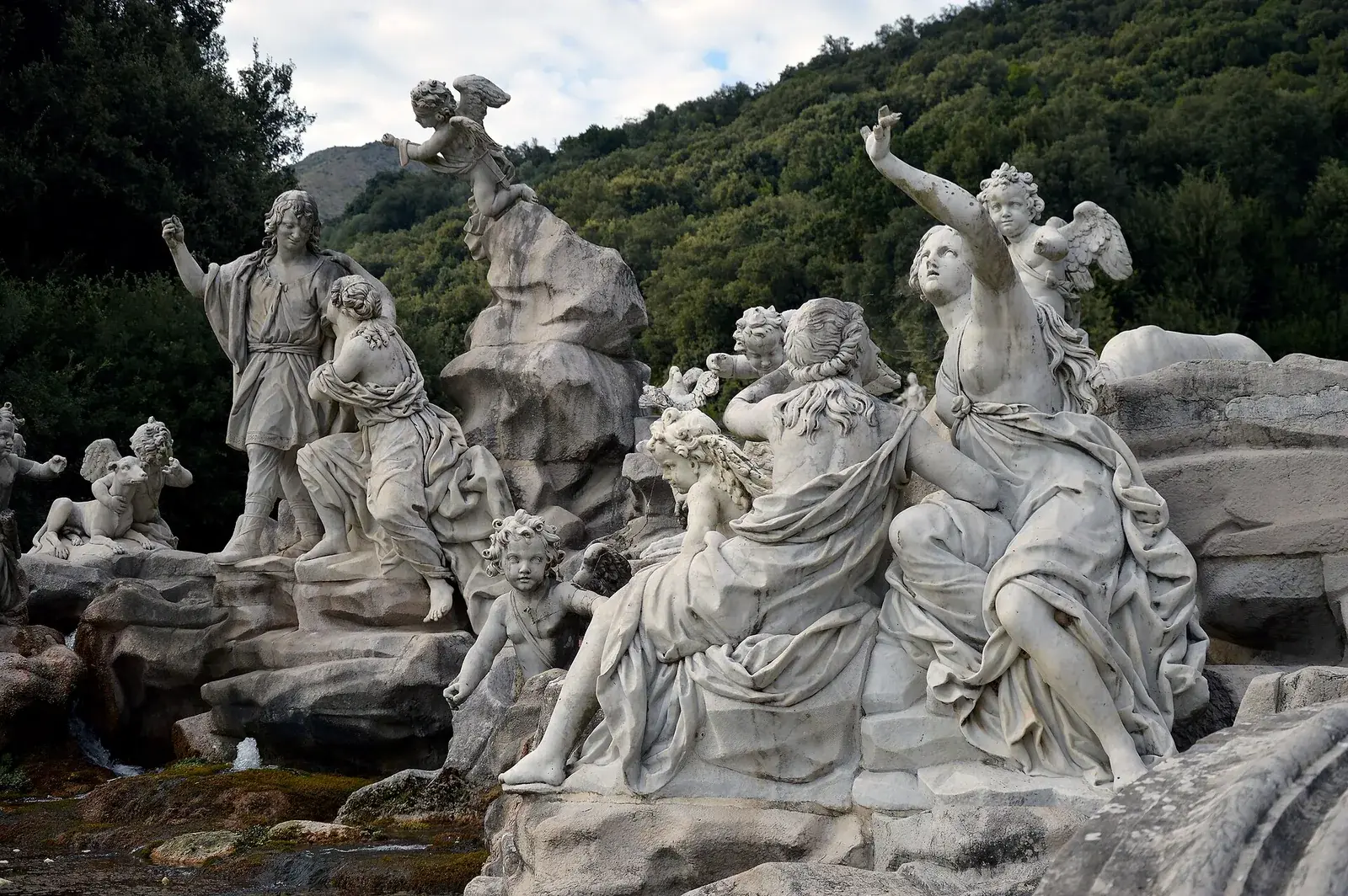
The Caserta Agreement was negotiated at the Allied headquarters in the palace at Caserta, Italy, in September 1944.
Image Credits: Livioandronico2013, via Wikimedia Commons (CC BY-SA 4.0)
According to the agreement, Scobie was to disarm the Security Battalions, who were to surrender weapons to his troops, and to ensure their protection while disarming. One of the most amazing manifestations of the anachronistic nature of the post-liberation order in Greece was that the families of the victims of Meligalas sometimes received pensions from the collaborationist government according to law no. 927/1943 on the protection of state officials, which provided for payments to employees murdered “during the performance of their duties at the hands of anarchist elements,” which continued to be valid after the victory.
How Meligalas Became a Political Slogan
Since 1945, an annual commemoration service has been held under the auspices of local authorities, in which government representatives, including members of the military junta, participated. In 1953, donations in kind and money were collected, and a cross and chapel were built near the well; the wellside landscaping was completed under the regime of the military junta.
The events of Meligalas were used for political purposes right away. The civil war began almost immediately after the liberation, so that the right-wing establishment could present itself as defenders of the fatherland, having resisted the communist coup. In Greece, the memory of the “National Schism” was still fresh, which sharply contradicted the very idea of the national unity government. At the same time, the authorities that came to power after the war – the Papandreou government – acted as the legitimate heir to the royal government in exile and was opposed to the collaborationist regime. Therefore, in the published proclamations on the occasion of the anniversary of the events in Meligalas and in the speeches of officials attending the commemorations, the victimization of Battalionists was not explicitly mentioned because, strictly speaking, they were not “national enemies” as defined by royal decree no. 927/1943. The emphasis was on the fact that the victims were not “quislings” but national heroes, patriots, or simply citizens.
When the military junta was overthrown in 1974, Karamanlis, the prime minister of the new government, announced a policy of democracy while firmly supporting the anti-communist rhetoric established by the royal family. The right-wing New Democracy party took over the tradition of commemorating the events of Meligalas as an expression of the struggle against communism, presenting this struggle as a defense of national independence. Meanwhile, the left-wing organizations saw the repetition of the tactics of the civil war. In 1982, after the PASOK victory, the Ministry of Interior considered these commemorations to be discriminatory against their supporters, as well as forty years of division, and prohibited their holding. The organizers were the Society of Victims of the Meligalas Well, founded in 1980, and from now on, the speeches were more nuanced, less heroic, and more about the suffering of the victims and their families. In recent decades, the event has turned into a kind of rally, with the participation of both victims' relatives and neo-Nazi groups such as Golden Dawn.
The traditional right-left confrontation began to be expressed also in the struggles between the university organizations associated with “Rigas Feraios” and the ONNED nationalist organization and its student wing. After PASOK lifted the ban in 1982, the “Rigas Feraios” communist youth organization responded by introducing the slogan “EAM-ELAS-Meligalas” as a direct reply to the right-wing rhetoric about the “Battalionists.” In the materials for the 1992 student festival on the theme of the Greek Resistance, this slogan was repeated several times. In the early 2010s, the rhetoric about the “Battalionists” became current again in Greece, first of all because the neo-Nazi Skin Heads group and the far-right Golden Dawn had entered the Hellenic Parliament. In this context, anarchists began to reevaluate the events of the Civil War, calling it militant anti-fascist resistance, which is now often referenced in their rhetoric.
The Polish writer Jan Kott, who wrote about the end of the Second World War, once said that “never before has the line been so thin between the demands of revenge and the demands of justice.” This is probably the best formulation of the essence of the events of Meligalas. And so after eight decades, after the end of the Civil War and two world wars, after the triumph of fascism and communism, after the restoration of democracy and the proclamation of the rule of law – the time has come to revise, to revalue, to distinguish between revenge and justice, between killers and victims. In two diametrically opposite concepts, which have been pitted against each other for so long in Greece, with equal rights and without any clear definition, hundreds, perhaps thousands, of dead people who continued to suffer after their deaths from the hatred of their neighbors are trapped.