Valentine's Day has been dedicated to a saint of whose existence we can barely discern. There may be one and there may be three Valentines of various levels of authenticity, but none of the stories about the saint have been written earlier than the day he supposedly died. The connection to the holiday is also unclear — could it have been a medieval Englishman talking about birds?
This is not cynicism, but rather a prelude to the most interesting part — how and why this day was formed — the martyrdom, the pagan ritual that was merged into it, the medieval poem, and the Roman god of love. After a brief overview, let's take a closer look at each of these events.
Valentine's Day, the Second Largest Seller of Cards in the World
It is hard to believe that the holiday that has been declared the second largest seller of cards in the world (after Christmas) with 151 million cards sold, according to data published in a 2012 Guardian article, has a rather dubious history. It began right there, in the third century, in the troubled times of the Roman Empire. The emperor Severus Alexander was murdered in 235 AD, which led to the Crisis of the Third Century, which lasted until 284 AD. Alexander managed to protect the empire from the Sassanian Persians in the east, but his policy of peace and mutual understanding with the Germanic tribes in the north made him unpopular with his own troops, who killed him. A period of wars and upheavals began, during which the empire began to disintegrate.
It was Claudius II Gothicus who took over the reign of the Roman Empire from 268 to 270 AD. He was one of the so-called barracks emperors who came to power due to military success. Claudius II led the war with the Goths and in 268 or 269 AD achieved a significant victory near Naissus, which allowed him to create a stable empire and laid the foundation for the reign of Aurelian. He became a popular emperor – and a sworn enemy of Christians, ordering Valentine's execution. According to some, Claudius prohibited marriage because he believed it to be a distraction for soldiers.
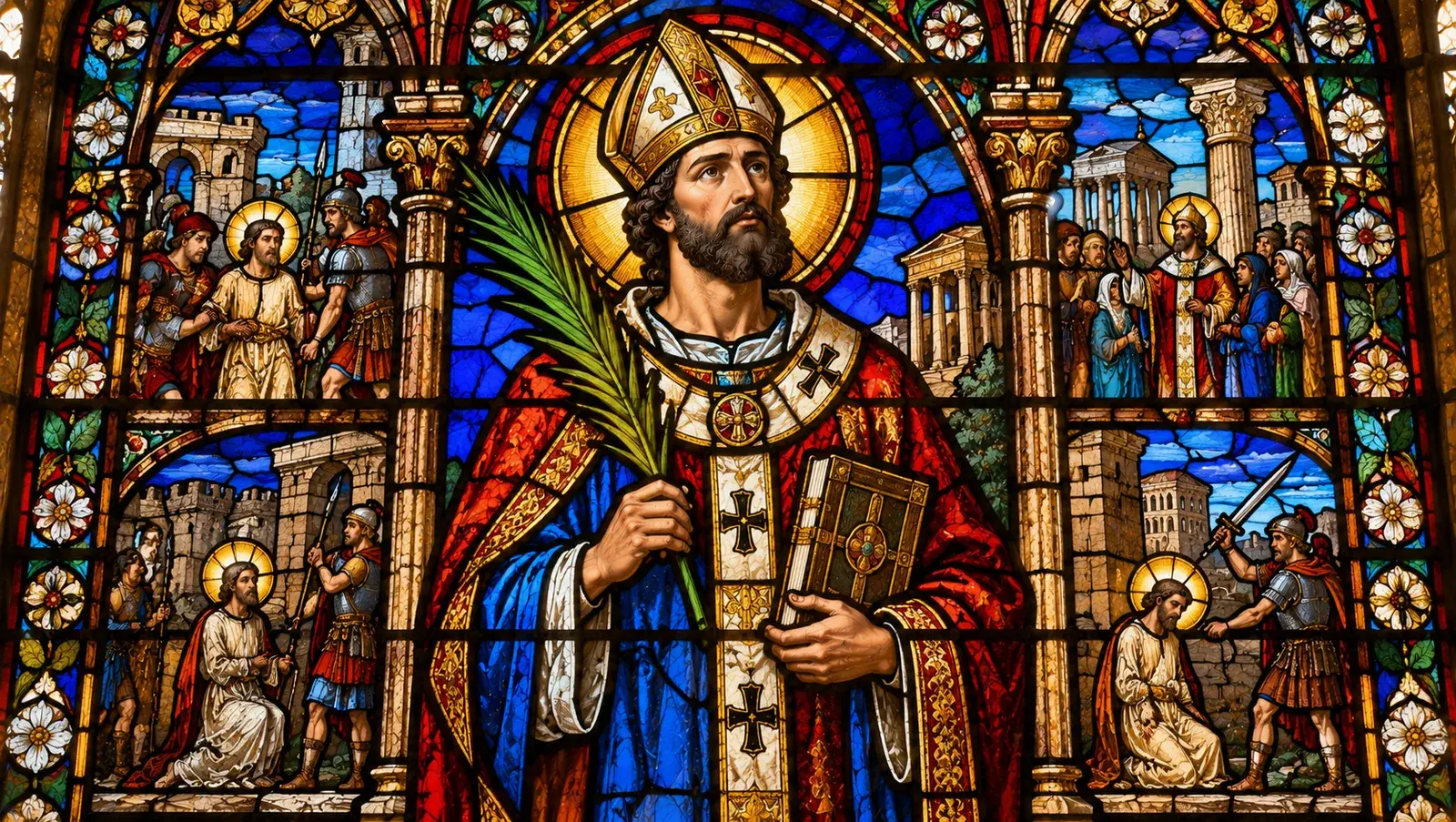
Almost everything told about St. Valentine, from his profession to his execution, comes from legends written centuries after his death.
Meanwhile, we know little about the figure of St. Valentine himself. The early martyrologies mention at least three men named Valentine who were martyred around 14 February: a priest in Rome, a bishop from Terni, and a third Valentine martyred in the Roman province of Africa whose name and story are otherwise unrecorded. All three were subjected to Roman persecution. The most famous story tells of Valentine's defiance of Claudius' order – by secretly performing wedding ceremonies for young couples. Claudius was furious and sentenced the priest to death, but he did not renounce his faith until the last moment. Claudius is unlikely to have personally sentenced him to death, since he spent most of his reign on military campaigns.
The most romanticized version of the story is that while in prison, St. Valentine secretly helped the couples get married and began to receive flowers from them. He fell in love with the daughter of his jailer and tried to heal the blindness of the girl. Before his execution, he sent her a final note saying “From your Valentine” – which is, perhaps, where the day of love and friendship got its name. The truth of the episode is not known, but it is a recognized fact that the Christian Church suffered serious persecutions and a large number of martyrs died as a result. There is no doubt that St. Valentine could have become one of them.
The historical accuracy of the story ends there. Valentine, as a Christian priest, would have been executed for refusing to renounce Christianity – but since Claudius was a pagan, he might not have been. If Claudius did not order Valentine's execution personally, he may not have known about it. Moreover, the Roman Emperor was primarily a soldier and spent most of his time away from Rome in military campaigns. The most plausible explanation is that St. Valentine died during the times of Diocletian, a severe persecutor of Christians who ruled from 284 to 305 AD. Any documents that might have preserved the memory of St. Valentine were probably destroyed by order of Diocletian, and later researchers supplemented the history of the saint at their discretion.
What is known with certainty is that St. Valentine was recognized as a martyr and his name was accepted in the Roman church by the end of the fifth century. In 312 AD, Constantine the Great converted to Christianity and began his campaign to unify the Christian world, which contributed to the adoption of Christianity throughout the Roman Empire. Thus, the tradition of celebrating St. Valentine's Day was firmly entrenched in the Roman Empire by the end of the fifth century.
Lupercalia and the Roman Festival in February
As for the holiday itself, there is also a popular theory about its beginnings. The most plausible explanation for the date of the holiday is the Roman festival of Lupercalia, which was held in mid-February in honor of the god Faunus, grandson of Saturn, the Roman god of agriculture, through his father Picus. The name Lupercalia is associated with the word lupus, meaning wolf, so it is traditionally linked to the ancient legend of the she-wolf who raised Romulus and Remus, the founders of Rome. According to archaeologists, the festival was held on the 15th of February, although there are also suggestions that it might have been the 13th or 14th.
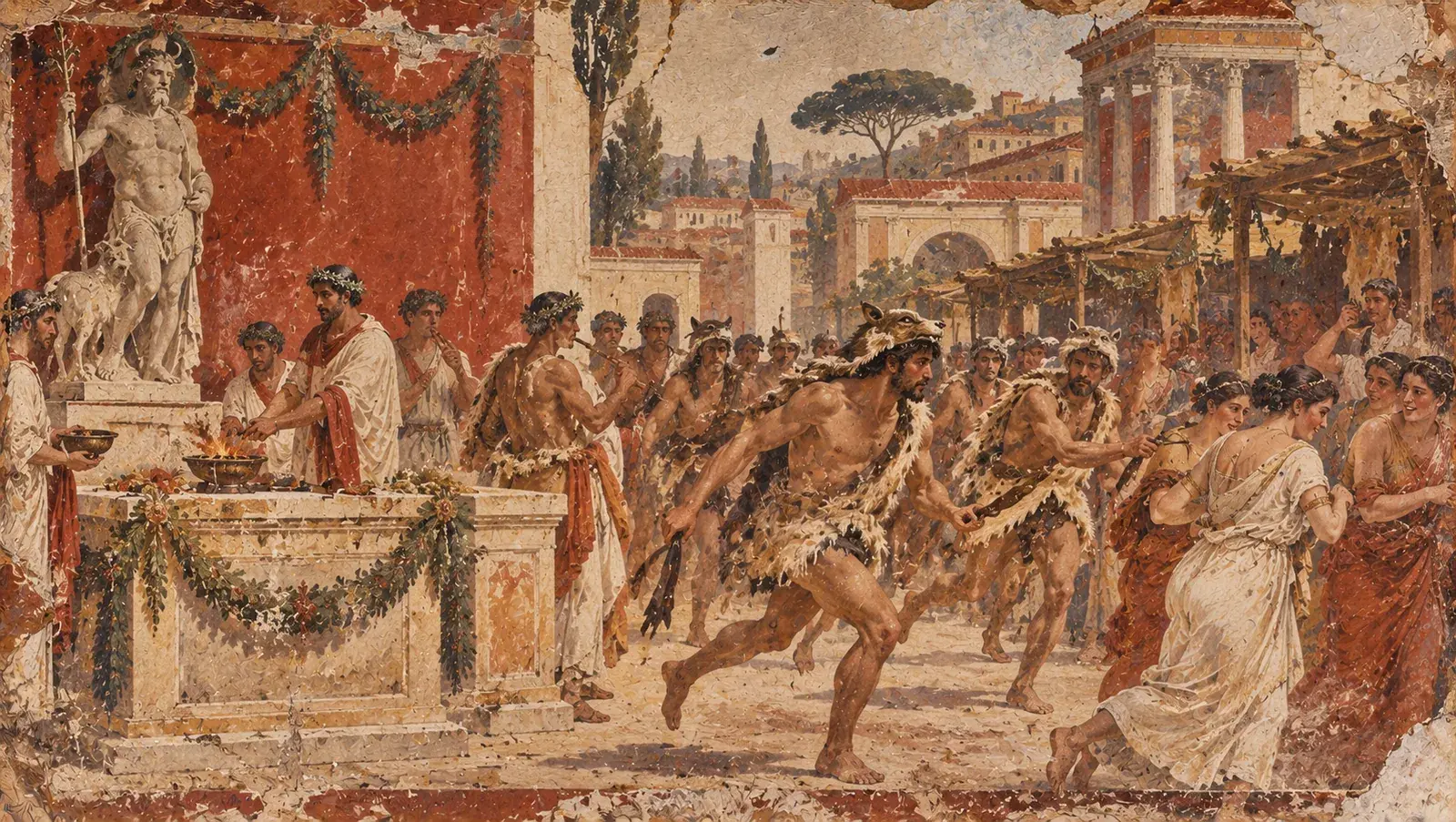
The Luperci, priests of Faunus, ran through the streets of Rome wielding strips of freshly sacrificed animal hide during the mid-February festival.
The Roman priests called Luperci sacrificed a goat and a dog to the god Faunus, and the Luperci cut the animal's skin into pieces. There is a suggestion that priests used animal hides soaked in blood to drive away evil spirits. Women who believed in superstitions were excited and pleased to feel the blows of the hides on their shoulders because they believed this would help them conceive children. In addition, it is said that men and women participated in the festival in such a way that the names of girls were placed in an urn and boys drew them out and married them for the year — though many historians point out there is no reliable ancient evidence for this particular custom, and it may be a much later embellishment. Thus, many of the rituals of Lupercalia were related to the celebration of love and sexual intercourse, which were also reflected in the Feast of St. Valentine.
There is no surprise that the Christian church could not accept such a pagan holiday. When Rome was Christianized, the church struggled with pagan traditions and gradually replaced them with Christian holidays and festivals. Christmas, for example, was created by the early Christians in order to Christianize the Roman winter solstice – the birthday of the sun god Mithras. Since no official records of Lupercalia have survived in Rome, it is difficult to say exactly what the holiday looked like. However, we can be fairly confident that the Feast of St. Valentine was most likely held in early February to replace Lupercalia.
Love, Marriage, and Valentine's Day in Ancient Rome
The concept of love and marriage is familiar to us all, but the Roman view of love and marriage was different from ours. For the Romans, love between a man and a woman was not considered a prerequisite for marriage. The Roman view of marriage was also different from the modern one in other ways. First, the Romans did not consider marriage to be a sacred union – it had a civic significance and aimed to strengthen the family and increase wealth. Second, the Roman girl was not obliged to love the man her parents chose for her.
Married men in ancient Rome took a second wife much more easily than in Europe at the time. Women had the right to inherit property and manage it at will, but the main feature of marriage was still the duty to have children. In Rome, love and passion were thought to appear suddenly without warning and, like lightning, quickly disappeared. There are many literary sources that describe love as an illness, for example, the first-century BC poet Catullus described his feelings for a married woman, who subsequently drove him to despair.
The same Catullus and later Shakespeare wrote about love broken by social norms and the impossibility of being together – themes that were also reflected in Romeo and Juliet. It was the ancient Roman understanding of love and marriage that was gradually transferred to the Middle Ages and Renaissance. Therefore, if someone has the idea that St. Valentine's Day is a day of love and friendship, then they are not mistaken — but they are about a thousand or so years late.
Geoffrey Chaucer and the Birds

Chaucer's Parlement of Foules, written around 1382, contains the first known literary link between Saint Valentine's Day and romantic love.
The name St. Valentine itself does not appear in Chaucer's work, however, the Parlement of Foules, written around 1382, contains the first recorded reference to the day of love. In the poem, St. Valentine's Day is depicted as “a day of love when every single bird goes to look for a love match.” The reference might seem random, but modern scholars argue that it can explain the very essence of the holiday. Chaucer talks about the mating habits of birds, but it seems that he does not reflect actual facts. On the contrary, there is a possibility that he created the idea of St. Valentine's Day as a day of romantic love. If so, then one of the greatest holidays in the history of humanity was created by a medieval writer based on his observations of the animal world.
| Popular story | What the evidence shows | |
|---|---|---|
| Who was St. Valentine? | One heroic priest-martyr | Possibly up to three different martyrs named Valentine, later conflated into one legend |
| Claudius II and marriage | Banned marriage to keep soldiers unattached | No contemporary Roman source confirms this; likely a later embellishment |
| Lupercalia's matchmaking lottery | A direct pagan ancestor of Valentine's Day, names drawn from an urn | No reliable ancient evidence for the lottery; the Lupercalia link itself is debated |
| Chaucer and the birds | Accurately described birds mating on 14 February | Birds don't typically mate that early in England; likely poetic invention that came to define the holiday |
How Cupid Invented St. Valentine's Day
Cupid is the most uninvited guest at the festival of love — an ancient Roman god who has very little to do with modern notions of love and friendship. Cupid is the son of Venus and Mars, and according to mythology, he is an androgynous youth who falls in love with everything he sees. But mythology describes him as a mischievous character who delights in making people suffer. Cupid is portrayed in various ways in different myths — in one, he is a grumpy old man who hits people with arrows to make them fall in love, and in the other — he is a cute little angel with wings. In all of Cupid's stories, however, the god falls in love with himself and causes himself the sharpest pain.
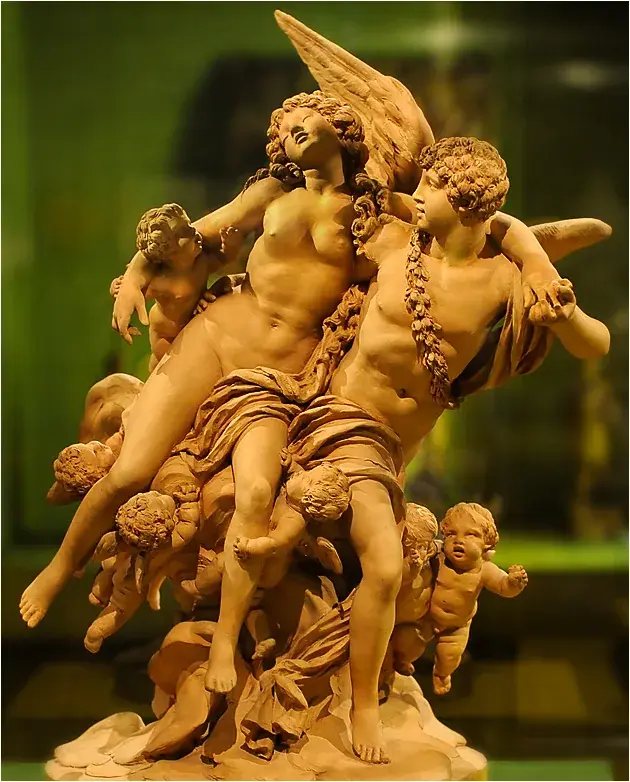
The Cupid and Psyche myth, the god's own famous love story, long predates his role as Valentine's Day's best-known symbol.
Image Credits: Barry Green, via Wikimedia Commons (CC BY-SA 2.0 uk)
The Cupid-Psyche myth is the most famous, telling of the young god's passion for the maiden Psyche and his attempts to convince his mother Venus that he is capable of finding love. Cupid falls in love with Psyche at first sight, but conceals his identity from her, forbidding her from looking at him. However, he wounded himself with an arrow and fell in love with Psyche, who had rejected him. In one of the versions of the story, St. Valentine ordered Cupid to carve his likeness on an amethyst ring so that lovers could recognize him and help them find each other. Cupid was a symbol of earthly love long before St. Valentine's Day. As the Roman Empire was Christianized, pagan gods were gradually forgotten, but the symbols associated with them continued to live in the myths and folklore of the Christian world. Cupid's cruelty was forgotten, and his image became associated with the love of God and man.
Valentine's Day around the World
Today, St. Valentine's Day is celebrated in most countries around the world, although it is celebrated differently everywhere. For some people, it is a purely Christian holiday, a day of remembrance of a Christian martyr. For others, it is a completely profane invention that has nothing to do with Christianity. St. Valentine's Day was celebrated in Europe for hundreds of years and gradually became popular outside of Europe. Over the past century, the Feast of St. Valentine has become a truly global holiday, bolstered by both European cultural dominance and the rapid development of the modern world and information and telecommunications technologies.
During the holiday, stores are full of Valentine cards, roses, and heart-shaped balloons. In many ways, the popularity of the holiday has been due to the use of media and especially modern social networks. However, there are also people who do not want this holiday to be associated with love. In particular, in many Muslim countries, this holiday is not celebrated by anyone and is sometimes even boycotted as an expression of local patriotism.
Perhaps the Feast of St. Valentine is no longer a Christian holiday and perhaps it never was. Whatever it is, this day has lived for more than 1700 years, having survived centuries of wars, revolutions, and social changes. If St. Valentine was real, then the memory of him lived and still lives in the hearts of people for over a thousand years after his death, which is impressive enough.