Hanukkah is, in all but the purest religious sense, a minor Jewish holiday. There is no prohibition on work, no Biblical basis for it and it was instituted some two centuries after the completion of the Hebrew Bible. And yet in a great many places it has become one of the most visible Jewish festivals of the year, lit in public squares, marked at the White House and is a vital expression of identity for many secular Jews.
How that has happened involves a revolt against an empire, a miracle story which only appeared in writing some six hundred years later, an argument between two schools of rabbis about which way to light candles, and a very modern confrontation with Christmas.
Hanukkah begins on the 25th of Kislev on the Hebrew calendar and lasts eight nights, or days. It is the only Jewish holiday which begins in one month, Kislev, and ends in another, Tevet.
What the Word Hanukkah Means
It derives from the Hebrew root meaning "to dedicate" as the holiday marks the rededication by the Maccabees of the Temple in Jerusalem after recapturing it.
Jewish tradition has added other interpretations of the word, splitting it in two, which can read as "they rested on the twenty-fifth," referring to the day the fighting stopped. The same root gives chinuch, the word for Jewish education, and the letters form an acronym for a phrase meaning "eight candles, and the law follows the House of Hillel."
That refers to a genuine dispute about how the candles should be lit. The House of Shammai held that eight candles should be lit on the first night, counting down to one on the last night because the miracle was greatest at the start, while the House of Hillel held that they should begin with one and add a candle each night, because the miracle grew greater each day. Jewish law followed Hillel and thus the menorah fills up rather than empties.
| School | First night | Last night | Reasoning |
|---|---|---|---|
| House of Shammai | Eight candles | One candle | The miracle was greatest at the start |
| House of Hillel (the accepted law) | One candle | Eight candles | The miracle grew greater each day |
In English the most common spellings are Hanukkah and Chanukah. The difference reflects how the first Hebrew letter is pronounced, the throaty "ch" of modern Hebrew as opposed to something closer to an "h" in Classical Hebrew. Hanukkah is the spelling preferred by Merriam-Webster, the Oxford Style Manual and The New York Times.
The holiday is also known as the Festival of Lights, a name which traces back to the first century historian Josephus.
Judea Under the Seleucid Empire
Following the death of Alexander the Great in 323 BCE Judea came under the Ptolemaic Kingdom of Egypt. In 200 BCE Antiochus III of the Seleucid Empire defeated Egypt at the Battle of Panium and claimed Judea for Syria.
At first the Seleucids ruled Judea fairly lightly, for Antiochus III, having conquered his new territory, wanted to win over his new Jewish subjects and guaranteed their right to live according to their ancestral customs and to continue practising their religion in the Temple at Jerusalem.
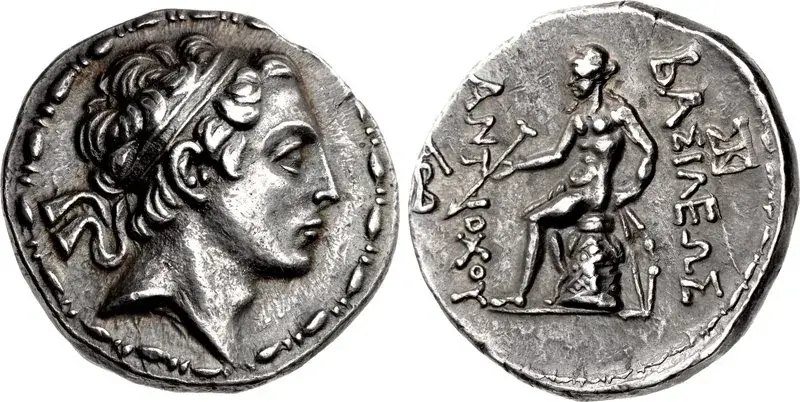
Antiochus IV Epiphanes reversed his father's light-touch policy toward Judea and set the stage for the Maccabean revolt.
Image Credits: CNG, via Wikimedia Commons (CC BY-SA 2.5)
His son, Antiochus IV Epiphanes, reversed this policy and what appears to have been either a dispute over the control of the Temple and the office of High Priest or a revolt, the details of which have been lost, led the Tobiad family, who led the Hellenising faction in Jerusalem, out of Syria and back into the city around 170 BCE, encouraged by Antiochus to retake the city from the high priest, Onias, and his pro-Egyptian supporters, who drove them out.
The fighting which followed saw many supporters of Egypt killed and the Temple plundered and its daily sacrifices ended.
The Maccabean Revolt Against Antiochus IV
In the traditional account things went from bad to worse: the Temple was looted, services stopped and Judaism was effectively outlawed. In 167 BCE Antiochus had an altar to Zeus erected in the Temple, circumcision was banned and pigs were ordered to be sacrificed to the Olympian gods on the altar.
This provoked resistance and Mattathias, a Jewish priest, and his five sons, Jochanan, Simeon, Eleazar, Jonathan and Judah, led an uprising. This began, according to 1 Maccabees, when Mattathias killed a Jew who was about to comply with the order to sacrifice to Zeus and the Greek official enforcing it.
Judah became known as Judah Maccabee, "Judah the Hammer." Following Mattathias's death around 166 BCE Judah Maccabee took up leadership of the rebellion and by 164 BCE the revolt had succeeded, the rebels having recaptured Jerusalem and Judah ordered the Temple to be cleansed and a new altar built to replace the defiled one, and new holy vessels made. Hanukkah was instituted to celebrate that rededication.
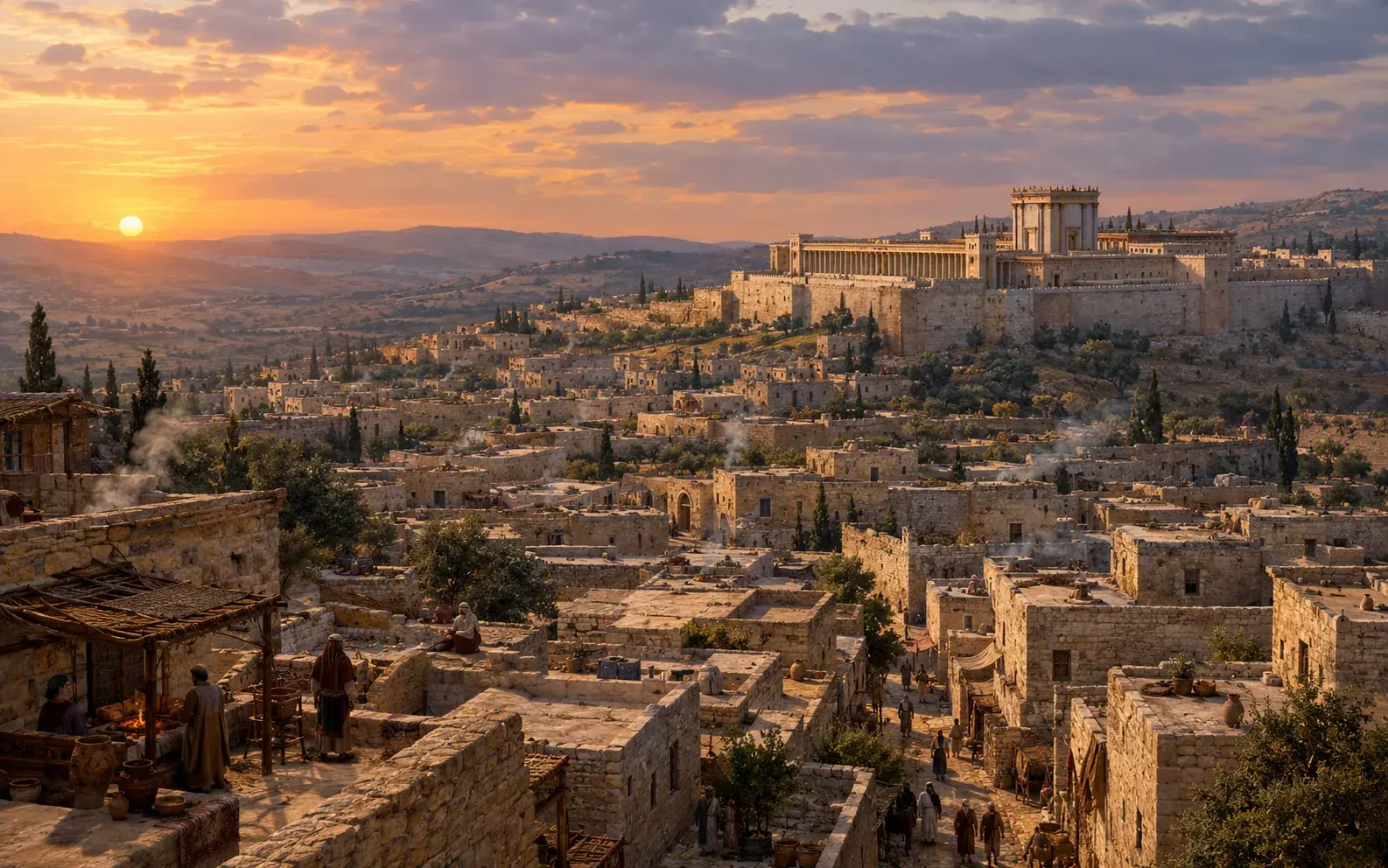
The Maccabees recaptured Jerusalem and rededicated the Temple, the event Hanukkah was instituted to celebrate.
The fighting did not end there. The Maccabees won at Emmaus with a surprise night attack, beat Lysias at Beth Zur and lost at Beth Zechariah where Judah's brother Eleazar was killed by a war elephant, before Judah himself died at Elasa, his brothers Jonathan and then Simon continuing to struggle and by 142 BCE Judea effectively independent under Simon, beginning the Hasmonean kingdom which lasted until Rome's general Pompey took Jerusalem in 63 BCE.
What Historians Think Actually Happened
Modern scholarship gives a conflicting account, mainly based on 2 Maccabees.
Several historians see the revolt as, in large part, a Jewish civil war, as traditionalists with Hebrew or Aramaic names such as Onias fought Hellenising high priests with Greek names such as Jason and Menelaus over who would hold the offices of the High Priesthood and, according to some scholars, Jason's attempted Hellenistic reforms were a major impetus. Some put socioeconomic causes alongside religious ones.
In this account the Seleucid king intervened on the side of the Hellenisers, and as the conflict escalated he banned the practices which the traditionalists had rallied around, and so that would explain something which has always been puzzling: banning a local religion is completely out of character for Seleucid rule elsewhere.
These are not necessarily simply conflicting accounts. The traditional one emphasises persecution by a foreign power, the academic one emphasises division from within which a foreign power exploited and both agree on the outcome: a successful revolt and a rededicated Temple.
The Miracle of the Cruse of Oil
The best known part of the Hanukkah story is also the latest to appear in writing.
According to the Talmud when the Maccabees reclaimed the Temple they found that almost all the ritual olive oil had been defiled and only one container remained bearing the High Priest's seal, containing oil expected to keep the Temple's menorah burning for a single day. They lit it and it burned for eight days, the time it took to press and prepare the new pure oil.
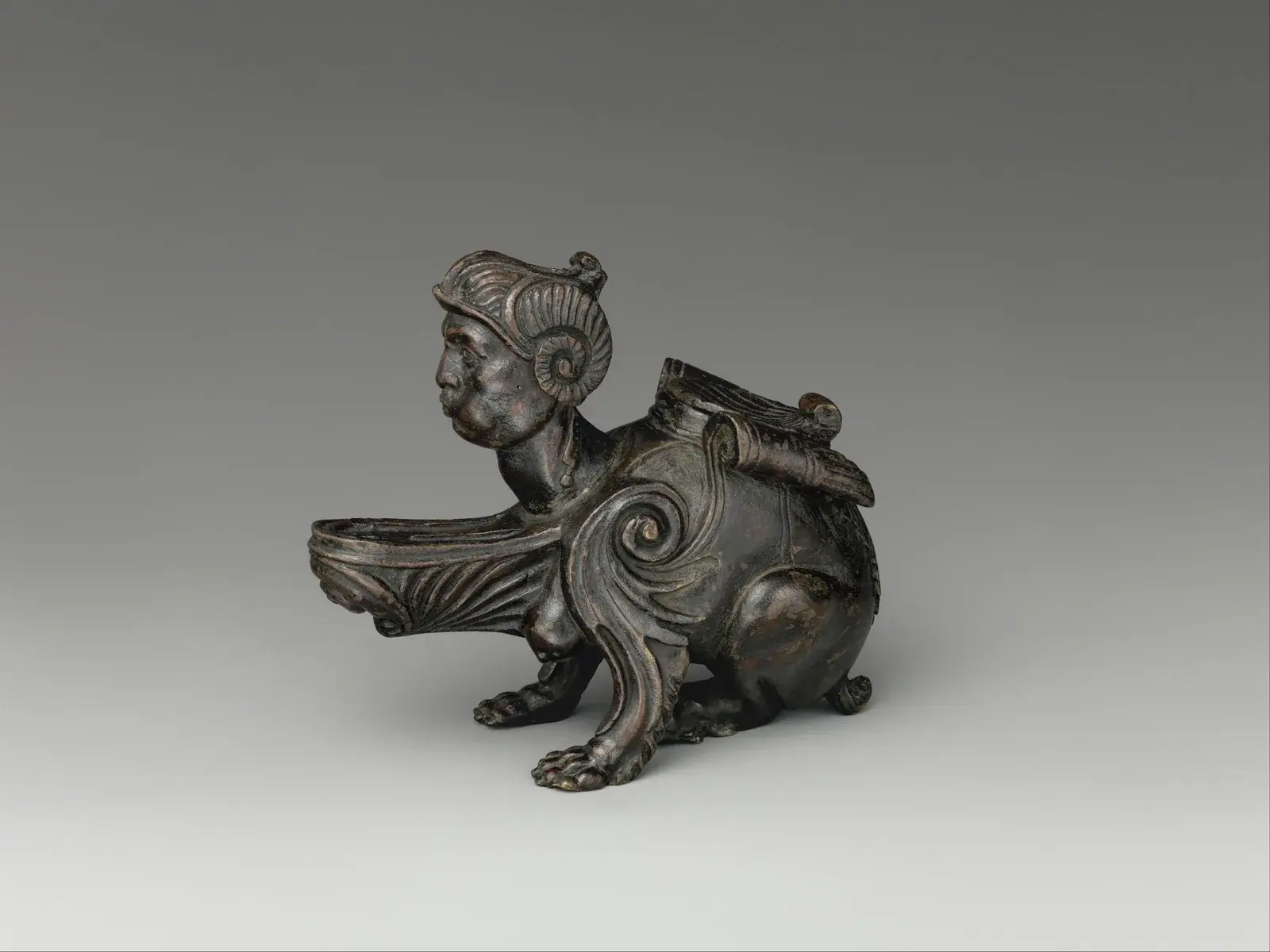
Olive oil lamps like these lit homes and sanctuaries in ancient Judea; the Talmud tells of one day's oil burning for eight.
Image Credits: Andrea Briosco, called Riccio, via The Metropolitan Museum of Art (CC0)
The Talmud recorded this roughly six hundred years after the events. The books of Maccabees, written much closer in chronological terms, describe the rededication for eight days but do not mention the oil at all, instead presenting the festival as a delayed celebration of Sukkot, the eight-day Feast of Booths, which the rebels had been unable to observe during the fighting. A version of the story of the oil appears in Megillat Antiochus, probably composed around the second century.
The miracle has long been regarded as legend and questioned as far back as the Middle Ages. But the sixteenth-century authority Joseph Karo famously asked why Hanukkah lasts for eight days if the miracle was only for seven days, since there was enough oil for one day. That question only makes sense if he regarded the event as historical, and because his Shulchan Aruch is a central code of Jewish law, most of Orthodox Judaism has followed that view.
Josephus does not call the festival Hanukkah at all. He says the Jews called it Lights and implies the name reflected the freedom to worship that had returned to them beyond all hope. The New Testament mentions it too: the Gospel of John describes Jesus walking in the Temple during the Feast of Dedication in winter.
Lighting the Hanukkah Menorah
The central ritual is the lighting of each night's menorah, one light on the first night, two on the second and so on up to eight on the last, following the House of Hillel.
A ninth light, the shamash or attendant, is lit each night and placed apart from the others, either higher or lower and to one side. Its purpose is practical. The Talmud forbids the use of the Hanukkah lights for anything except contemplating the miracle, unlike Sabbath candles, which are intended for illumination. The shamash is there if you need actual light. Many Ashkenazim light it first and use it to kindle the rest, the Sephardic custom is to light it last. Counting the shamash, a full Hanukkah uses forty-four candles.
The lights are supposed to be seen. The intention is not to light the inside of the house but the outside, to remind passersby of the miracle which is why menorahs traditionally go in a window facing the street, or by the door. It was only in times of danger that they were hidden; under Zoroastrian rule in Persia, or in parts of Europe before and during the Second World War.
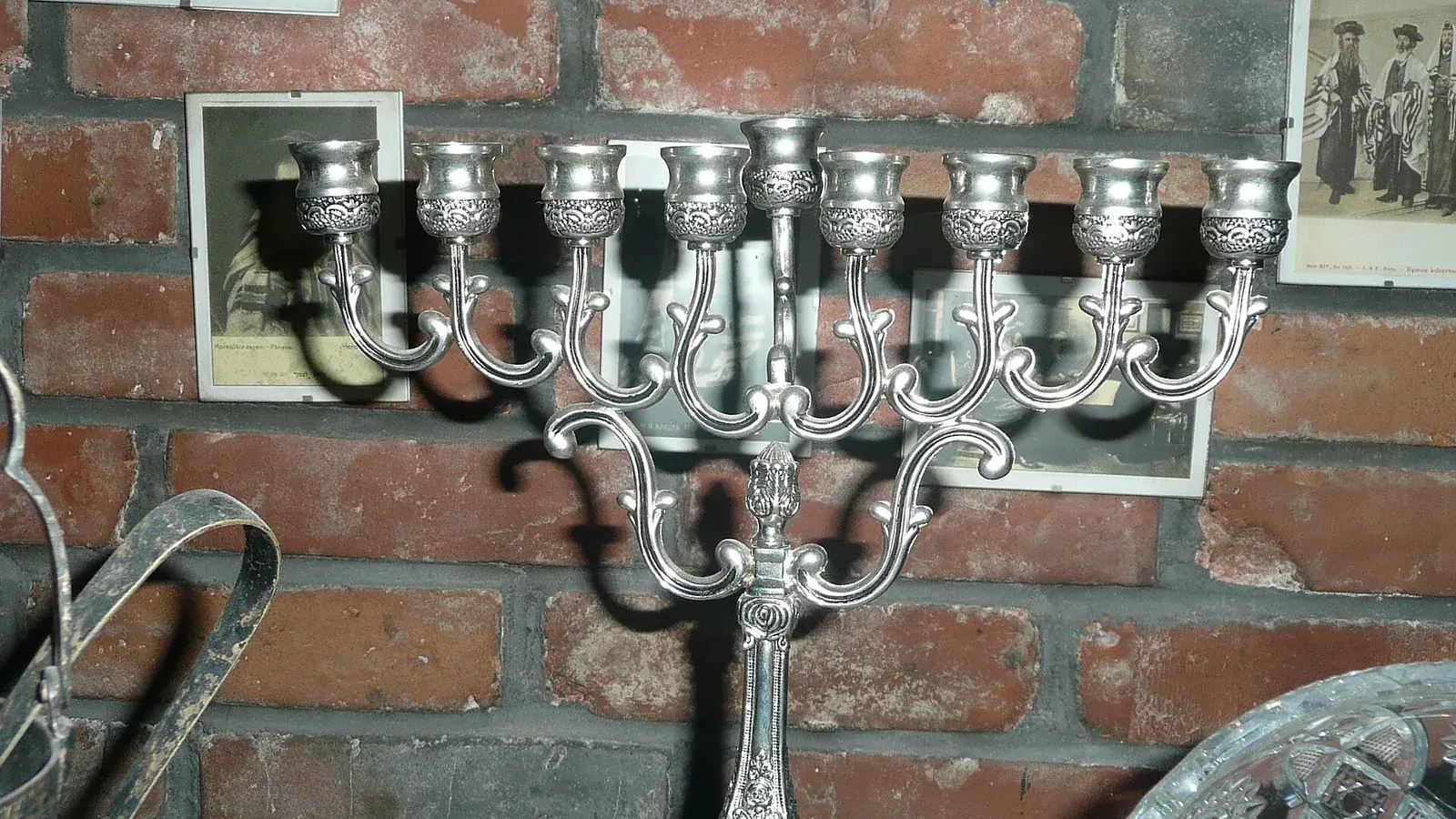
Menorahs traditionally stand in a window or by the door so that passersby can see the lights.
Image Credits: Brücke-Osteuropa, via Wikimedia Commons (Public domain)
Customs vary. Among Orthodox Ashkenazi Jews each male member of the household traditionally lights his own menorah, and in many families women do too; most Sephardi households light one set for everyone. The Talmud specifically requires women to participate in lighting because they too were involved in the miracle.
The lights should burn for at least half an hour after dark. Friday is the tricky night as candles cannot be lit on the Sabbath, so the menorah is lit before sunset with larger candles, and the Sabbath candles lit afterwards.
Two blessings are said each night, with a third added on the first night. Afterwards, many Ashkenazi communities sing "Ma'oz Tzur," a thirteenth-century hymn the author of which is known only in an acrostic spelling the name Mordechai. Its familiar tune probably derives from a German folk song or Protestant hymn.
Latkes, Sufganiyot, Dreidels and Hanukkah Gelt
As oil lies at the heart of the story fried foods are traditional. Ashkenazi families make latkes, potato pancakes. Sephardi, Polish and Israeli families eat jam-filled doughnuts called sufganiyot, and fritters called bimuelos. In Israel sufganiyot have largely displaced latkes, and bakeries fill them with chocolate, caramel and cappuccino cream.
Dairy is traditional too, connected with the story of Judith, who the deuterocanonical Book of Judith says fed the Assyrian general Holofernes salty cheese and wine until he fell into a drunken sleep and she beheaded him. The custom is a reminder that women played a role in the events Hanukkah recalls.
Regional dishes vary widely. Indian Jews eat gulab jamun, fried dough soaked in syrup. Italian Jews eat cassola, a ricotta pancake close to cheesecake. Romanian Jews make pasta latkes, and Syrian Jews make a pumpkin and bulgur dish.
- Ashkenazi: latkes (potato pancakes)
- Sephardi, Polish, and Israeli: sufganiyot (jam-filled doughnuts)
- Sephardi: bimuelos (fritters)
- Indian Jews: gulab jamun (fried dough soaked in syrup)
- Italian Jews: cassola (ricotta pancake close to cheesecake)
- Romanian Jews: pasta latkes
- Syrian Jews: pumpkin and bulgur dish
The dreidel is a four-sided top whose letters stand for "a great miracle happened there." In Israel many dreidels alter the last letter to read "a great miracle happened here."
Hanukkah gelt, small coins given to children, comes from an East European custom of children giving their teachers a little money at this time. Some families give it on the fifth day, as that night never falls on the Sabbath when handling money is forbidden.
Hanukkah, Zionism and Christmas
The modern prominence of Hanukkah has two main sources.
The first is Jewish nationalism. In the late nineteenth and early twentieth centuries Zionism recast Hanukkah as a national holiday about resisting foreign oppression and reclaiming independence, though it has always been present in the liturgy. It gave religious and secular Zionists common ground, as Rabbi Shmuel Mohilever proposed in 1881 making it the official holiday of the proto-Zionist Hovevei Zion movement. Writing in 1938, the scholar Joseph Klausner contrasted the modest candle-lighting of forty years earlier with the parades and national celebrations his generation had made of it, but none of it would have been possible had not previous generations kept those small candles burning.
The second is its closeness to Christmas, especially in North America. From the 1800s Jewish immigrants raised Hanukkah's profile as a child-centred alternative, and Reform leaders such as Max Lilienthal and Isaac Mayer Wise created synagogue celebrations for children with sweets and songs. By the 1900s Hanukkah gifts and decorations were appearing in shops. The historian Diane Ashton argues this allowed Jewish families to keep an identity distinct from mainstream Christian culture, but still feel fully American. Gift-giving grew alongside traditional gelt so Jewish children did not feel left out, and some families adopted a "Hanukkah bush," though most rabbis discourage it.
Public visibility has been raised sharply from the 1970s, when the Chabad movement under Rabbi Menachem Schneerson began organising public menorah lightings around the world. The White House link goes back to 1951 when David Ben-Gurion gave Harry Truman a menorah. Jimmy Carter joined the first public National Menorah lighting in 1979, and in 2008 George W. Bush used Truman's menorah at an official reception, with grandsons of both Ben-Gurion and Truman lighting the candles.
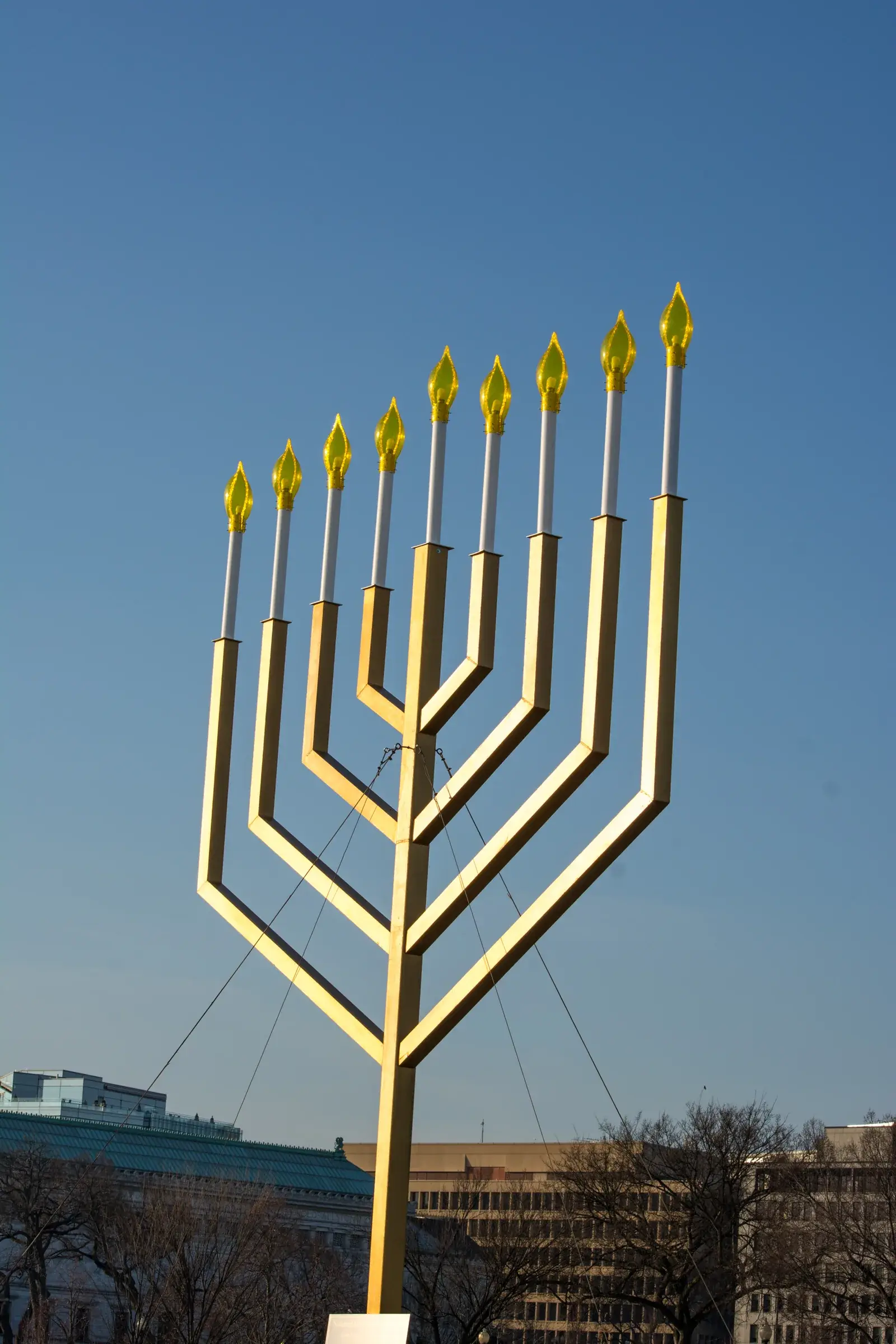
Public menorah lightings, pioneered by Chabad from the 1970s, now take place in town squares and outside the White House.
Image Credits: Tim Evanson, via Wikimedia Commons (CC BY-SA 2.0)
In 2013 the first day of Hanukkah coincided with American Thanksgiving for the first time since 1888, not likely to happen again in the foreseeable future, producing the word "Thanksgivukkah."
The last day of the festival carries its own meaning. Known as Zot Hanukkah, from the Torah reading for that day, it is regarded in Kabbalistic and Hasidic teaching as the final seal of the High Holy Day season which began with Rosh Hashanah and Yom Kippur — the last point at which judgment can be turned towards good.
That's a lot of weight for a holiday which is technically minor. But the logic is built into the ritual itself. The candles are meant to be placed in the window, where people outside can see them.