Halloween is one of the oldest surviving traditions in the western world because it's about the dead, and every recorded civilisation has developed rituals around death, where they go after they die, and how the living should treat the dead, or deal with the living who refuse to. Mexico's Day of the Dead and China's Tomb Sweeping Day are part of this same tradition.
The modern version of this old holiday which is most popular in the United States and Canada traces its roots to the Celtic festival of Samhain. Getting from Celtic New Year to trick-or-treaters in a space of two thousand years took a papal calendar switch, the Protestant reformation, an assasination attempt on the English Parliament, the Irish potato famine and a woman in Kansas fed up of her garden being wrecked.
It's also a holiday which has been sorely misunderstood, including those who sought to undermine it.
Samhain - the Celtic New Year
Samhain - pronounced roughly "Soo-when", "So-ween" or "Saw-wen" - was the Celtic New Year festival. The name means "summer's end" and signified the end of the harvest and of the season of growth.
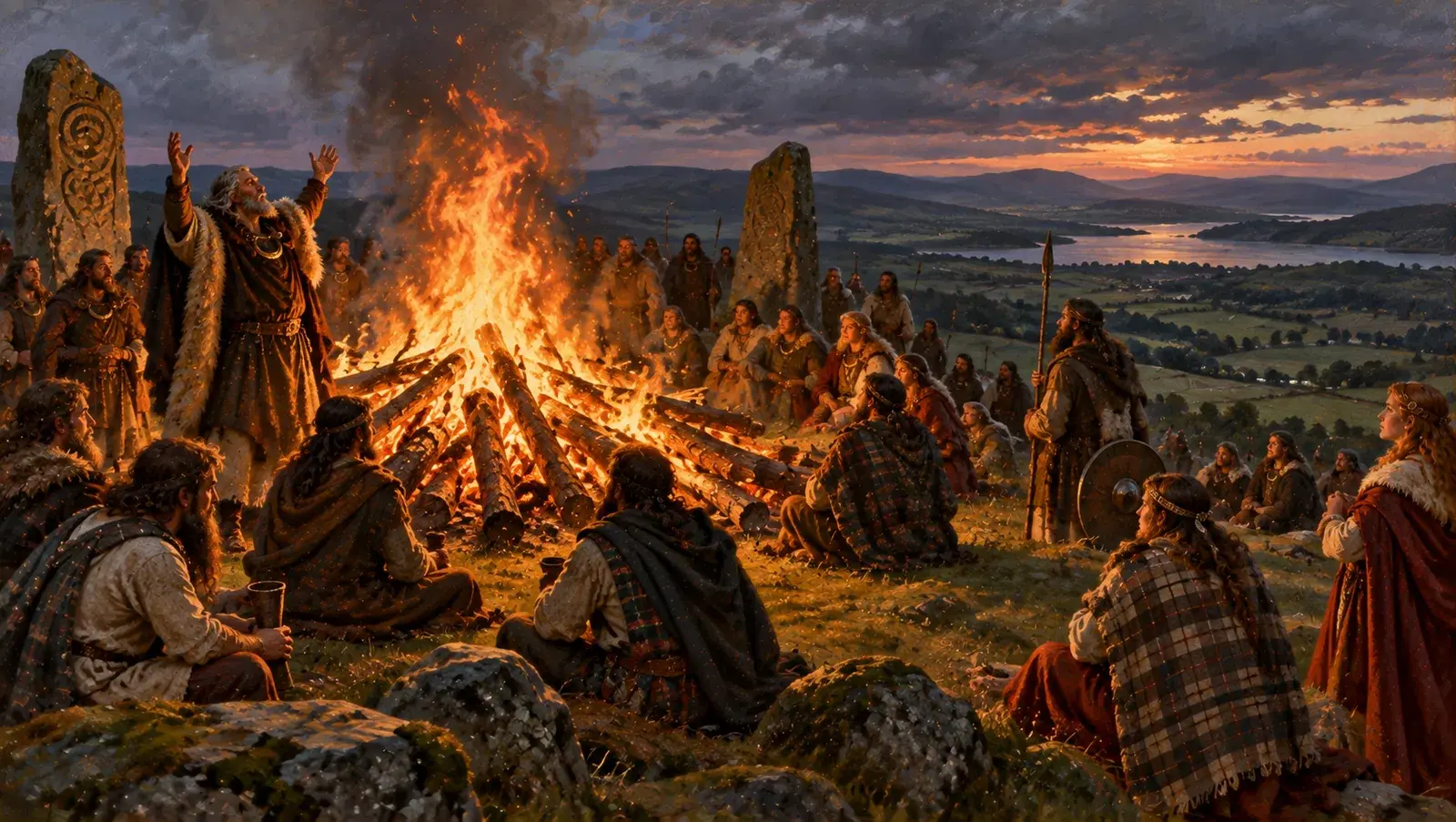
Samhain bonfires marked the turning of the year from the light half to the dark half, and gave the modern word "bonfire" its name.
The Celts thought that at this time the veil between worlds was at its thinnest, so the dead could return to their old world and walk among them. Those who had died in the previous year but who had not yet moved on could do so now, and might meet the living to say goodbye.
Little is known of the original rituals, because the Church later Christianised the festival and most of the information that remains is written by Irish monks recording their pre-Christian past or by Christian writers belittling pagan rites. It seems that the festival involved stockpiling against winter and the slaughtering of cattle, whose bones were disposed of in 'bone fires' the origin of the word bonfire. Communities gathered to feast and drink, but to be wary that this was the thin time of the year and otherworldly guests might turn up.
Spirits, Guising and the Origin of Halloween Masks
Departed loved ones were expected and welcomed. The practice of leaving out favourite foods for the dead may date back as far as two thousand years, although this is uncertain.
But not every visitor was welcome. Elves, fairies, the 'wee folk', sprites and darker forces - some of whom had never been human - could turn up alongside the people you missed. There was also a real danger that the spirit of someone you'd wronged would come looking for you.
So the living disguised themselves. They darkened their faces with ashes from the bonfires, a practice later known as 'guising' which developed into masks. The logic was sound - you'd be able to recognise the spirit of someone you loved and were able to reveal yourself to them, while being hidden from anything you'd rather avoid. This is the ancestor of the Halloween costume.
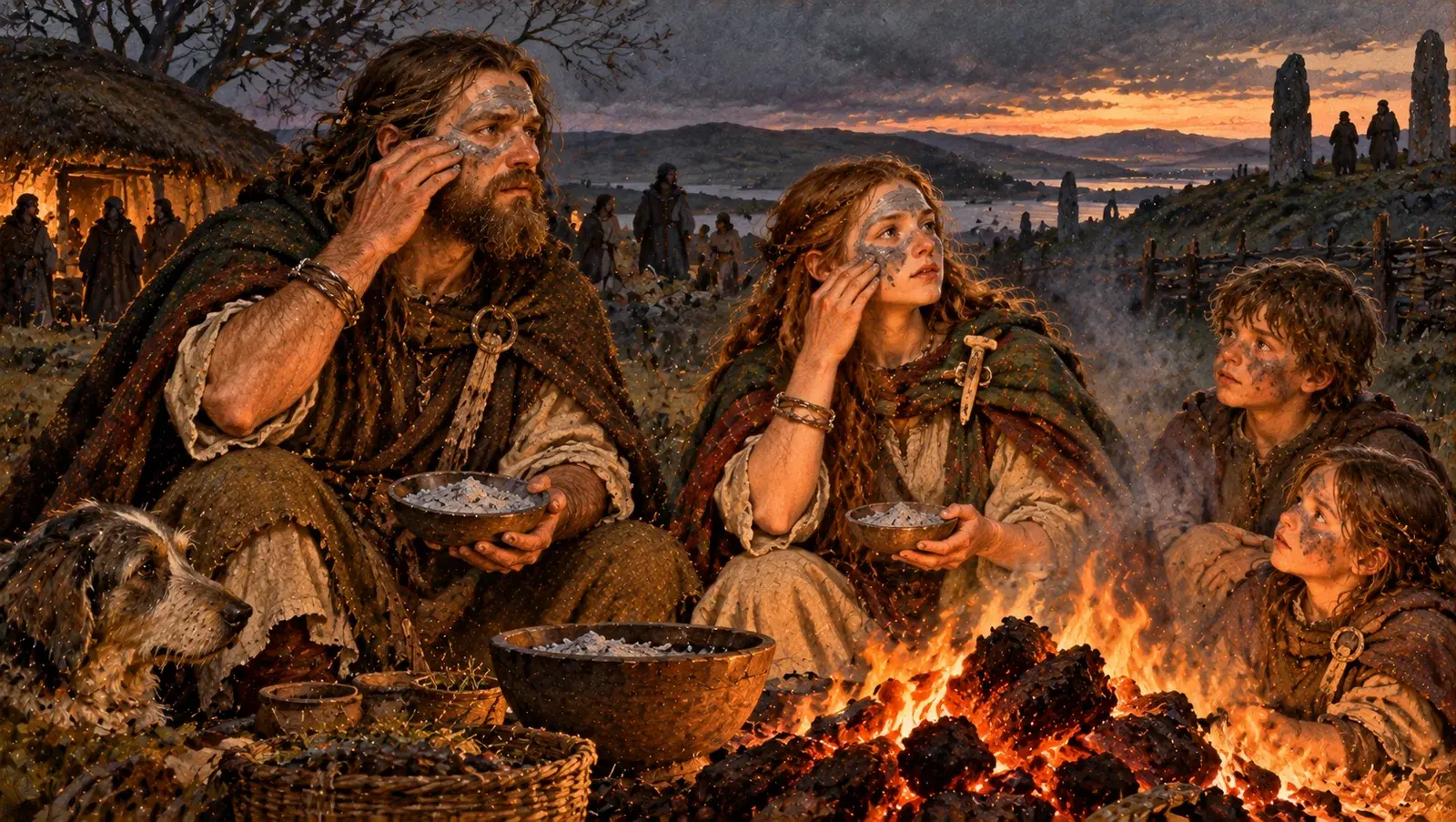
Guising began as a practical disguise: ash-darkened faces let the living hide from wandering spirits they'd rather avoid.
The Myth of Sam Hain God of the Dead
Christian opponents of Halloween have often claimed that Sam Hain was the Celtic god of the dead and that Halloween is his feast. There was no such god.
The error comes from British eighteenth century engineer Charles Vallancey who wrote about Samhain with poor grasp of the Celtic language and culture and his mistake has been uncritically repeated ever since.
The irony is that the Church itself is the reason Samhain survived at all. By absorbing and Christianising it the Church set a pagan Northern European festival on the path to becoming a worldwide secular holiday - now the most commercially lucrative of the year after Christmas.
The Hill of Tlachtga and the Fires of Samhain
Some version of these rituals was probably established by the time Christianity reached Ireland in the fifth century.
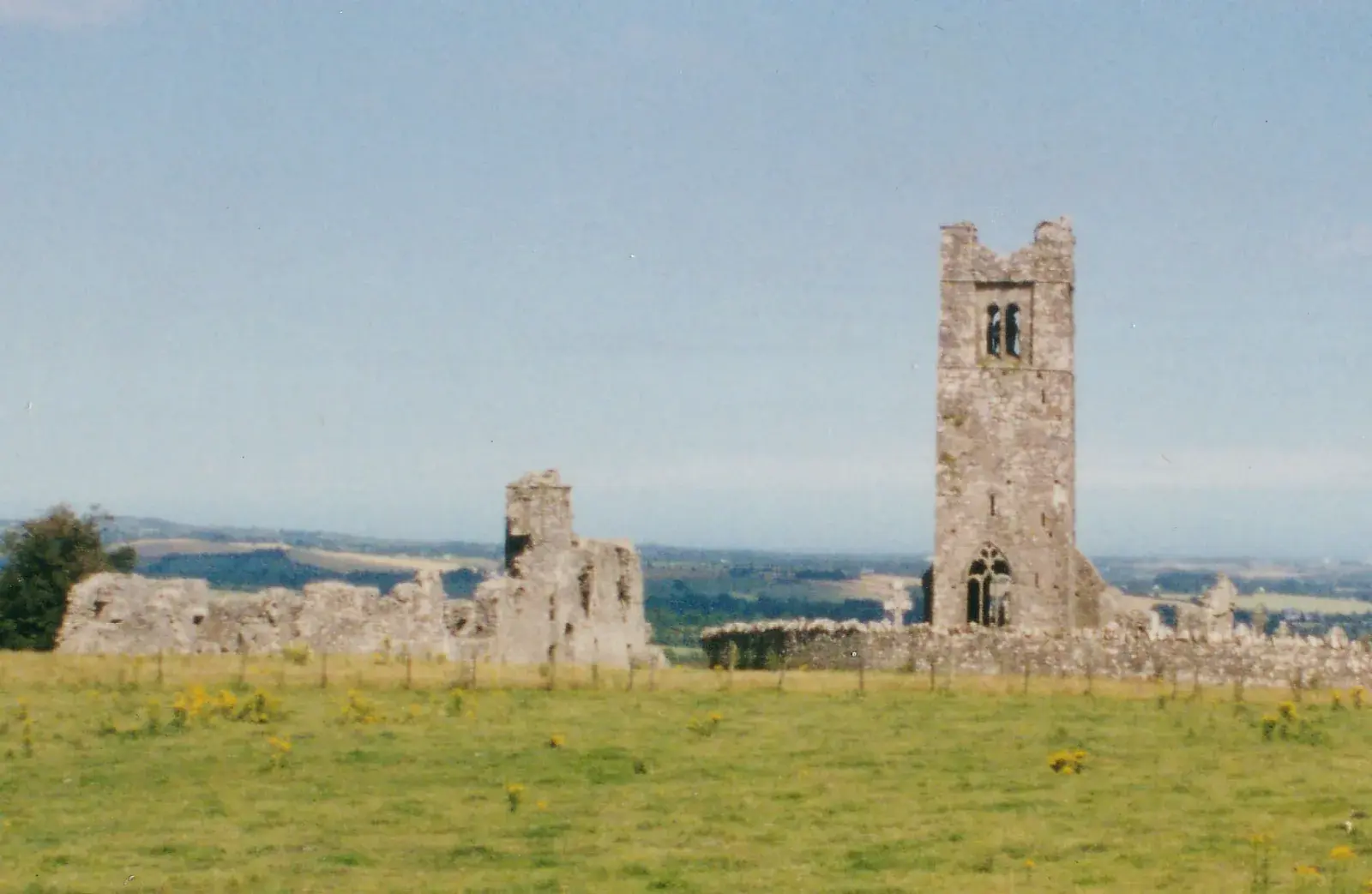
On the Hill of Tlachtga in County Meath a bonfire was lit on or around 31 October to open the Samhain, answered by a much bigger fire at the nearby Neolithic site of the Hill of Tara. (Archaeologists from University College Dublin have dated the excavated earthworks to around 200 CE, while noting that the site had been used for ceremonial fires for more than two thousand years.)
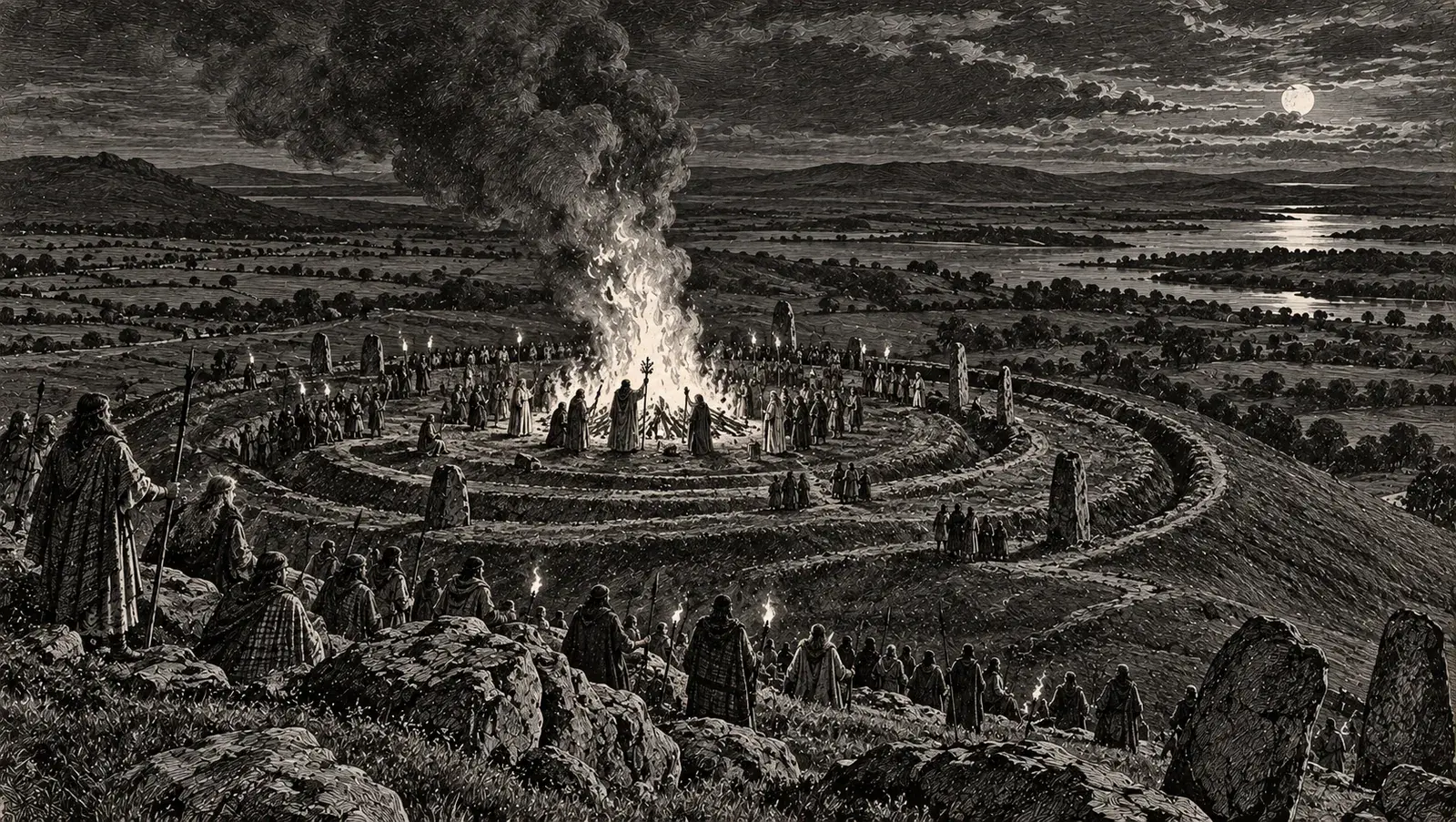
Excavations at Tlachtga have uncovered centuries of burnt material, evidence of the site's long use for ceremonial fires.
The hill is named for Tlachtga, a druidess and daughter of the powerful druid Mug Ruith. In the legend Tlachtga was raped by the three sons of Simon Magus - the sorcerer who confronts Saint Peter in the Book of Acts - and gave birth to triplets on the hill before dying there. The presence of a biblical villain dates that version firmly to the Christian era. Scholars think the story - like many Celtic legends - was Christianised after the arrival of Saint Patrick, with the Simon Magus episode grafted onto an older tale.
All Hallows' Eve and the Christianisation of Samhain
The Church had a long habit of assimilating pagan temples, festivals and symbols rather than simply suppressing them and Samhain followed suit.
In the seventh century Pope Boniface IV set 13 May as All Saints' Day (also known as All Hallows' Day) to celebrate saints which had no feast of their own when he consecrated the Pantheon in Rome to Saint Mary and the Christian martyrs. That date had previously been the last day of Lemuria, a Roman festival for placating the angry or restless dead. Lemuria was Rome's own May festival for the dead; a separate, earlier tradition existed for family dead each February, Parentalia, which closed with Feralia, when Romans visited graves and left offerings of grain, salt, bread soaked in wine and wreaths of violets.
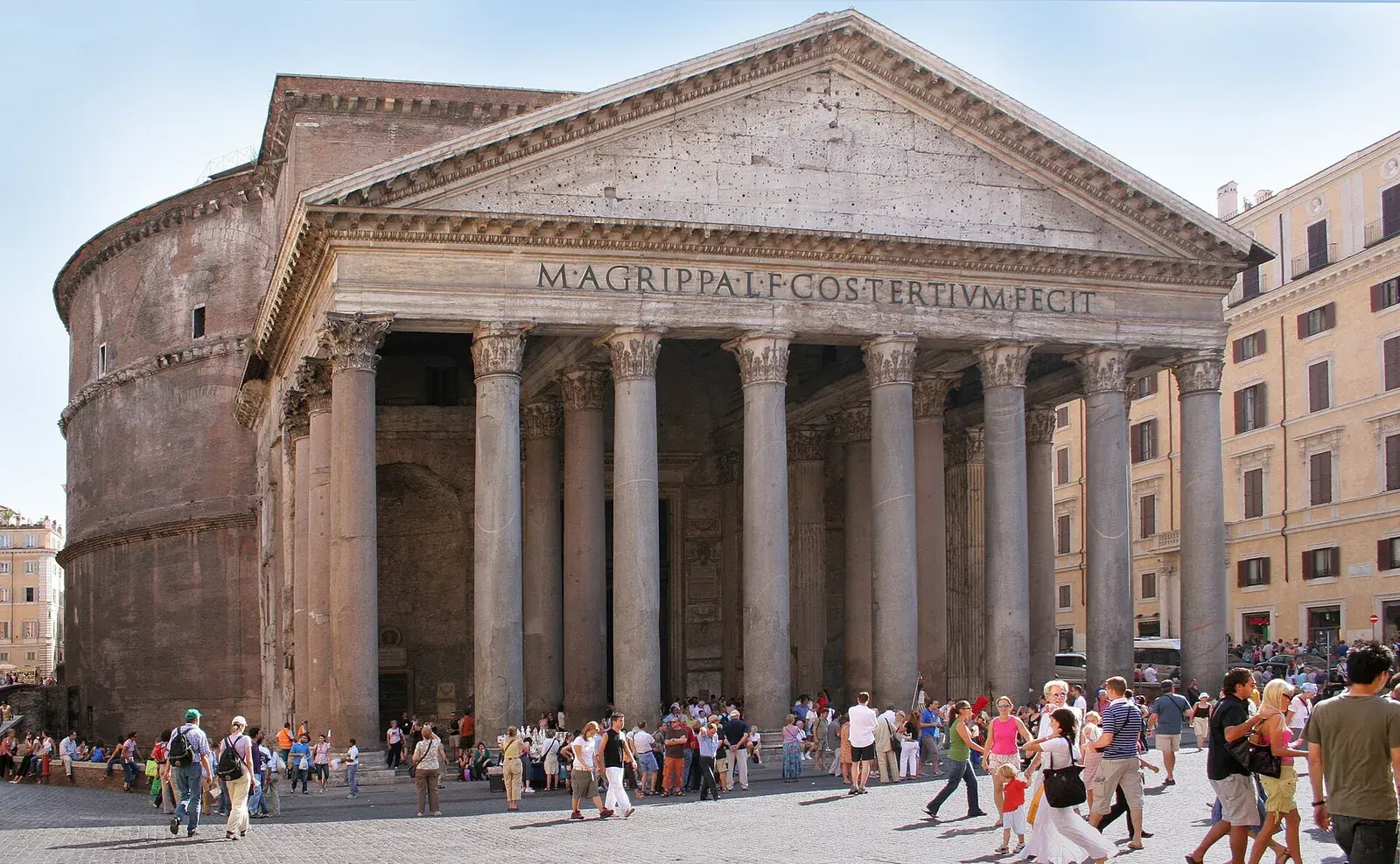
Pope Boniface IV rededicated the Pantheon to the Virgin Mary and all the martyrs, the first pagan temple in Rome converted into a church.
Image Credits: Roberta Dragan, via Wikimedia Commons (CC BY-SA 2.5)
In the eighth century Pope Gregory III moved All Saints' day to 1 November. The reason for the change remains debated, but many scholars think it's deliberate - turning the eve of the feast into All Hallows' Eve and thus Christianising Samhain fits the established practice of 'redeeming' pagan customs to aid conversion.
The character of the night changed. Samhain had been a celebration of the dead, the earth and the turning year. All Hallows Eve became a night of vigil, prayer and fasting before a much tamer feast which honoured the saints. But the old ways lingered. Bonfires were still lit, now in honour of Christian heroes, and the change of seasons marked, now to the glory of Christ.
Souling, Soul-Cakes and Guy Fawkes Night
By the sixteenth century the practice of 'souling' had become central. The poor would go door to door asking for a soul-cake in exchange for prayers. It is thought to have grown out of belief in purgatory, where souls lingered in torment unless helped along by prayer, and often by money paid to the Church. Following the Reformation souling continued in Britain with poor Protestant children offering to pray for the household and its loved ones rather than for souls in purgatory, while Catholics retained the older form.
The seventeenth century brought a very different addition. On 5 November 1605 a group of dissident Catholics tried to assassinate the Protestant King James I in the Gunpowder Plot. It failed and Guy Fawkes was caught with the explosives beneath the House of Lords. Although he had co-conspirators his name stuck to the plot.
Protestant Britain celebrated 5 November as a triumph over 'popery'. Officially it was in honour of Providence which spared the king but in practice it became an occasion for anti-Catholic sermons and attacks on Catholic homes and businesses. Bonfires were lit, unpopular figures (usually the Pope) hanged in effigy, and people drank, feasted and set off fireworks. Children and the poor went door to door, usually masked, pushing a Guy Fawkes effigy in a wheelbarrow and begging for money or treats while threatening damage if they were refused.
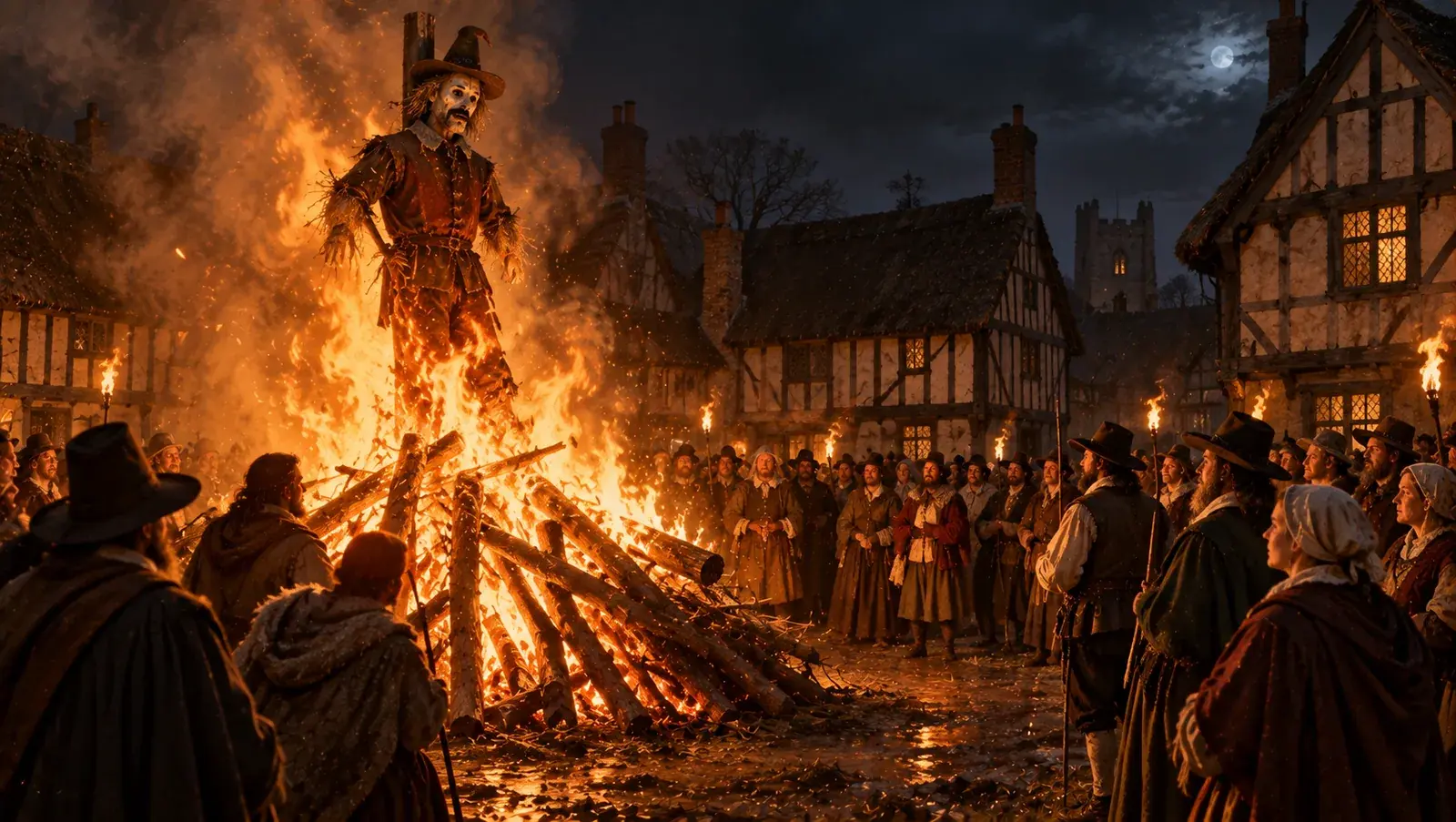
Bonfire Night mixed anti-Catholic politics with the same masks, door-to-door begging, and threat of mischief that already surrounded souling.
Put souling and Guy Fawkes Night side by side and most of modern Halloween is already visible - masks, door to door, treats and threat of mischief.
Stingy Jack and the Jack-o'-Lantern
British colonists brought the customs to North America. The Puritans of New England rejected any holiday with pagan associations, including Christmas and Easter, but retained Guy Fawkes Day as a reminder of their moral superiority to Catholics. It was celebrated until the American Revolution.
Samhain's traditions arrived less than a century later with the Irish fleeing the potato famine of 1845 to 1849. Largely Catholic, the Irish retained All Hallows' Eve, All Saints' Day and All Souls' Day, and souling - and folk traditions like the jack-o'-lantern.
The jack-o'-lantern is the result of the Irish tale of Stingy Jack, a clever drunk and con-man who tricked the devil into barring him from hell but whose sinful life also kept him out of heaven. After death he wandered the earth carrying a lantern made from a turnip, lit by a red-hot ember from hell. Scholars think it grew from sightings of will-o'-the-wisp, the glowing marsh gases seen at night. On All Hallows' Eve the Irish carved faces into hollowed turnips and put candles inside to protect themselves from spirits like Jack as they went souling.
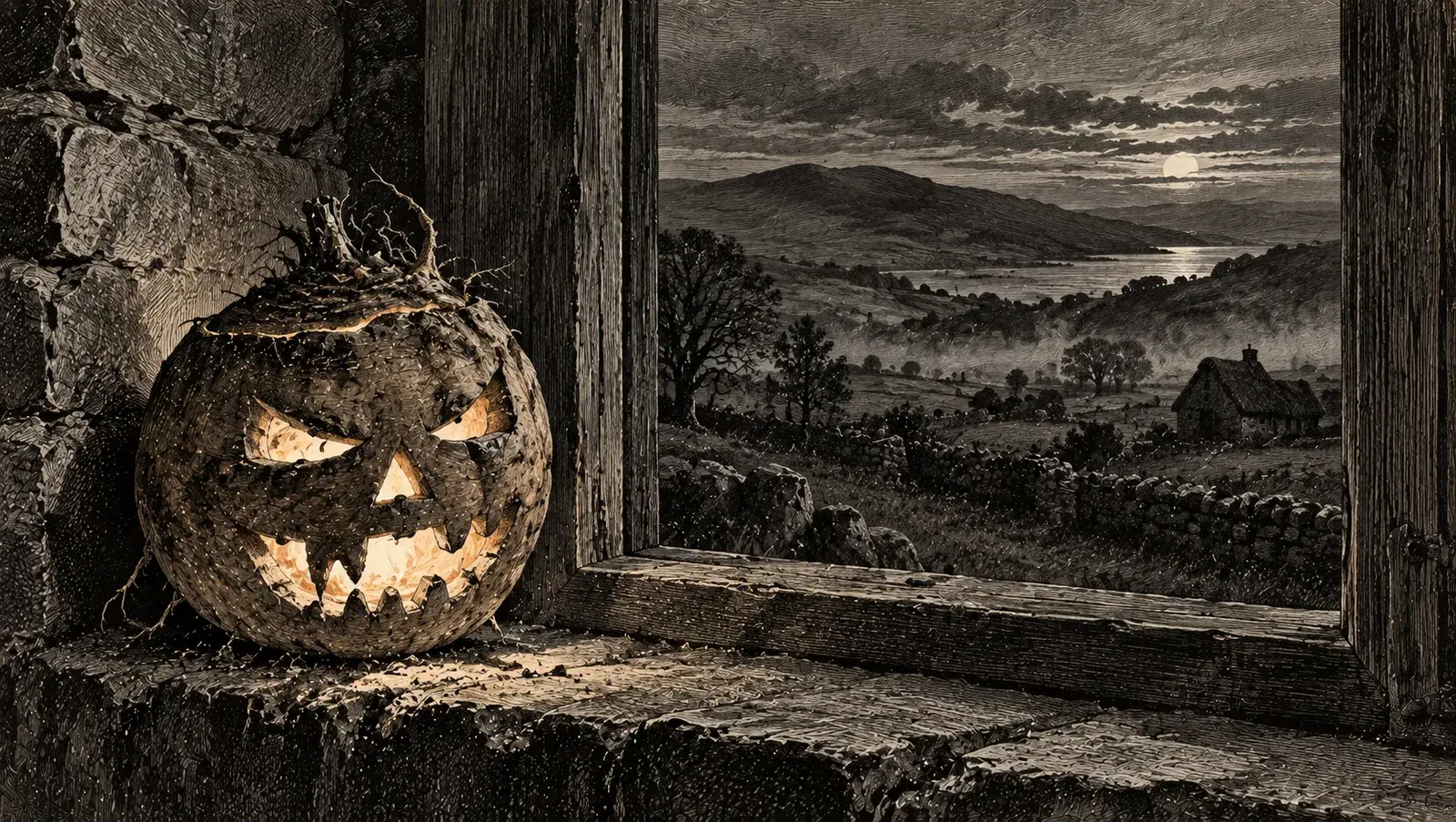
Before the pumpkin, the Irish carved faces into turnips and lit them with embers to keep wandering spirits like Stingy Jack away.
In America they quickly substituted the turnip for the pumpkin, which was much easier to carve. Guy Fawkes Day had faded, but its vandalism attached itself to the Catholic holidays of late October - now aimed at anyone's property, not just Catholics'.
Elizabeth Krebs and the Hiawatha Halloween Frolic
By the early twentieth century Halloween vandalism was a severe problem. In the small town of Hiawatha, Kansas a woman named Elizabeth Krebs grew tired of her garden, and the whole town, being wrecked every year by masked children.
In 1913, using her own money at first Krebs organised a party for the town's young people, hoping that they would be so worn out that they would have no energy left for destruction. It didn't work - the town was vandalised as usual.
In 1914 she tried again, with the whole town participating, a band, a costume contest and a parade. This time it worked and people of all ages enjoyed a festive Halloween. Word spread beyond Kansas and other towns and cities followed the model, with parties, parades, music, food, dancing and sweets surrounded by spooky decorations. The Hiawatha Halloween Frolic still runs every year.
Krebs is sometimes dubbed the mother of modern Halloween, which is to overstate her part - going door to door for treats was already centuries old when she held her first party. But her vision genuinely shaped the way Americans celebrate.
Trick-or-Treat and the Modern Halloween
Her party-as-distraction idea didn't spread throughout the country and by the 1920s 'mischief night' had become a serious problem in both the United States and Canada.
How destruction became children asking for candy in exchange for leaving a house alone isn't entirely clear but it was established in Canada by 1927 when a newspaper in Blackie, Alberta described children going door to door in exactly that manner - the first known mention in print of the phrase 'trick or treat.' The children got their candy and the householder was left in peace.
The practice continued through the 1930s, was interrupted by the Second World War with sugar rationing limiting the candy supply, and re-emerged in the late 1940s. The version familiar today dates to the 1950s and has since spread to other countries. Halloween is now largely secular, aimed mainly at children and very good business for anyone selling candy, decorations, or films and books about the paranormal.
Transformation, the Morrigan and the Meaning of Halloween
For many modern Pagans and Wiccans the holiday is still observed as closely as possible to the ancient form. And the central theme of Samhain survives even in its most commercial version - transformation.
At Samhain the year turned from light to dark, the dead crossed into the world of the living or moved on, people disguised themselves as other beings and other beings might appear as people, animals became food, harvests were stored for the winter and wood and bone went up as smoke.
Costumes do the same thing. For one night you become someone else - Darth Vader, a zombie, the Great Pumpkin. The most popular Halloween monsters are all about transformation - the werewolf who turns from human to beast, the vampire who becomes smoke or a bat, the ghost who was once a person.
In pre-Christian Ireland the goddess most strongly associated with Samhain was the Morrigan, a deity of war and fate who, in the Irish epic Cath Maige Tuired, leads her people, the Tuatha Dé Danann, to freedom against the Fomorians. In every one of her stories she is a figure of transformation, transforming her people from subjects of other powers into masters of their own fate.
Transformation can be frightening but it can also be empowering. The werewolf may have grown out of fear of animal attacks, the vampire out of fear of the angry dead but in both cases the monster could be killed and the legends also served to remind people of their own strength in dangerous times.
That's what the masks still do. Many costumes stand for the fear of death and the unknown and for one night you become the thing you'd normally dread and so take some of the fear out of it. At its root Halloween can be a triumph of hope over fear - which is very likely what Samhain meant to the Celts, standing by their bonfires at summer's end, waiting to see who would come back.