Think the Boston Tea Party was a protest against high taxes? Think again. Get the actual Boston Tea Party facts: why the tea was actually cheaper under the 1773 Act, how a corporate bailout sparked a revolution, and the exact cost of the 342 chests dumped into the harbor.
The Boston Tea Party is usually remembered as a revolt against high taxes, which it was most definitely not; tea was cheapest in 1773 in any case, the law which triggered the whole affair was all about that, and those men who climbed aboard those ships in that December night knew it.
What they objected to was harder to fit on a placard. A distant parliament they had no seat in had decided it could tax them anyway, had arranged the colonial tea market to suit a failing London corporation, and had quietly attached the salaries of their own governors and judges to the proceeds. Cheap tea with a principle buried inside it was still, to them, a trap.
Roughly ninety thousand pounds of that tea ended up in the harbor. Eighteen months later colonial militia and British regulars were shooting at each other at Lexington and Concord. The line between those two events is not as straight as school textbooks suggest, but it's real, and it runs through a series of decisions in London which nobody there thought were especially risky at the time.
The Destruction of the Tea on December 16, 1773
On the evening of December 16 somewhere between thirty and a hundred and thirty men gathered at Griffin's Wharf in Boston, armed with axes, some of them wearing rough Mohawk disguises. Over about three hours they boarded three vessels - the Dartmouth, the Eleanor and the Beaver - split open the chests stowed below, and tipped the contents into the water.
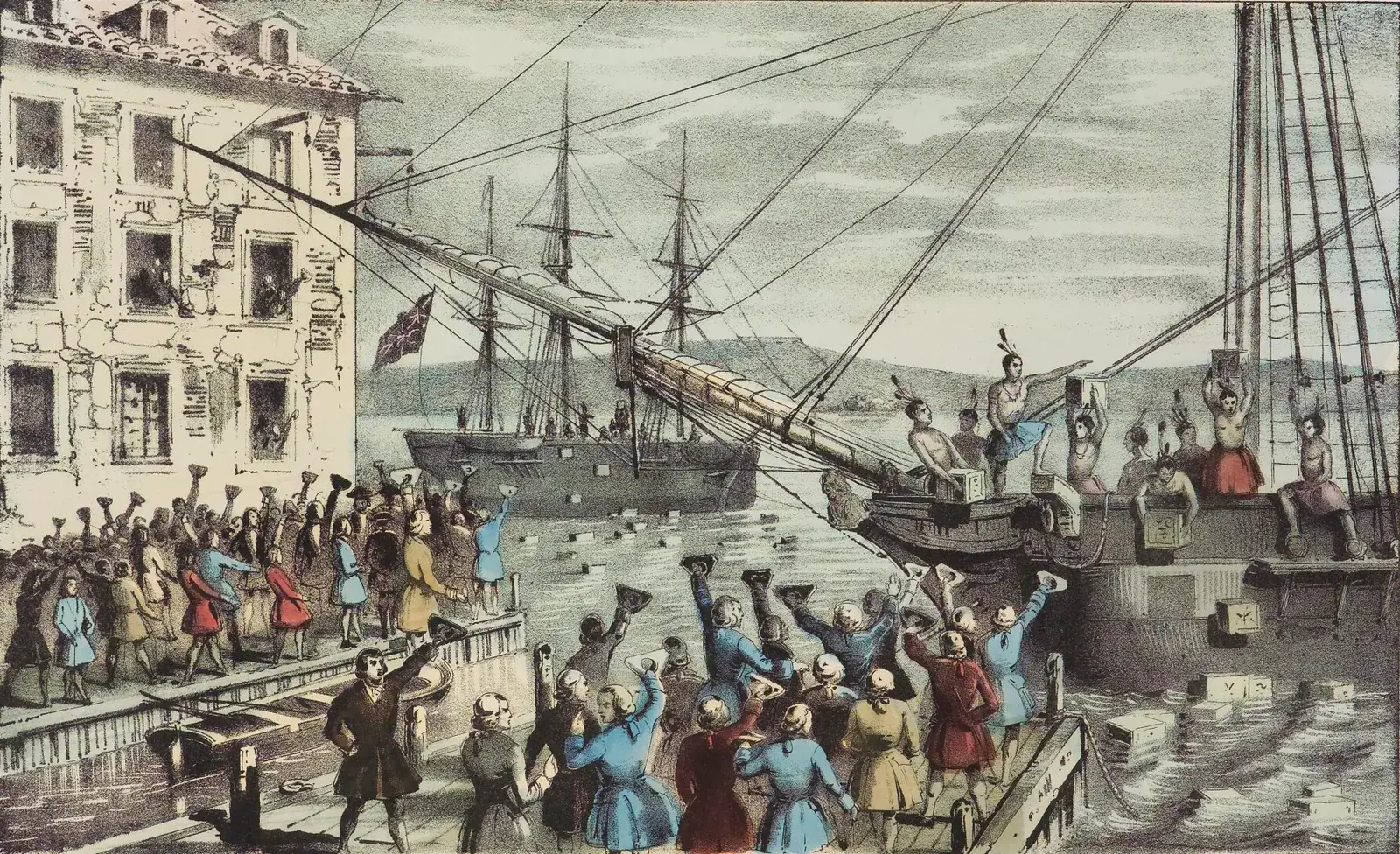
On the night of December 16, 1773, a crowd of men boarded three ships at Griffin's Wharf and spent about three hours splitting open tea chests and tipping their contents into the harbor.
Image Credits: Nathaniel Currier, via Wikimedia Commons (Public domain)
The disguises have been overinterpreted for two centuries. Covering your face made sense when the act was flatly illegal and the penalty potentially a treason charge. But dressing specifically as Mohawk warriors carried a message beyond anonymity: these men were declaring themselves as American rather than British subjects. Contrary to the famous Currier lithograph of 1846, only a minority actually bothered with the costume.
The property destroyed came to 92,616 pounds of tea, which the East India Company valued at £9,659 when it petitioned Parliament for reimbursement the following year. In modern terms that's roughly £1.28 million. Two of the three ships, the Beaver and the Dartmouth, belonged to the Rotch family, wealthy Quaker merchants out of Nantucket. The Eleanor was owned by John Rowe, a Boston merchant who also happened to be a smuggler.
The East India Company Tea Monopoly Before 1767
To understand why tea specifically you have to go back about seventy years. Parliament handed the East India Company a monopoly on tea importation in 1698, and in 1721 closed the loop with a requirement of the colonists to buy their tea only via Great Britain. The Company itself didn't ship to America, by law it auctioned its tea wholesale in England, British firms bought it there and resold it to merchants in Boston, New York, Philadelphia and Charleston.
Layered on top of that were taxes. The Company paid roughly twenty-five percent ad valorem on tea landed in Britain, and Parliament stacked further duties on tea sold for domestic consumption. Dutch tea carried no such burden, creating an obvious and immensely profitable opportunity. By the 1760s the East India Company was bleeding around £400,000 a year to smugglers in Britain alone, and Dutch tea moved into the American colonies in serious volume too, particularly through New York and Philadelphia.
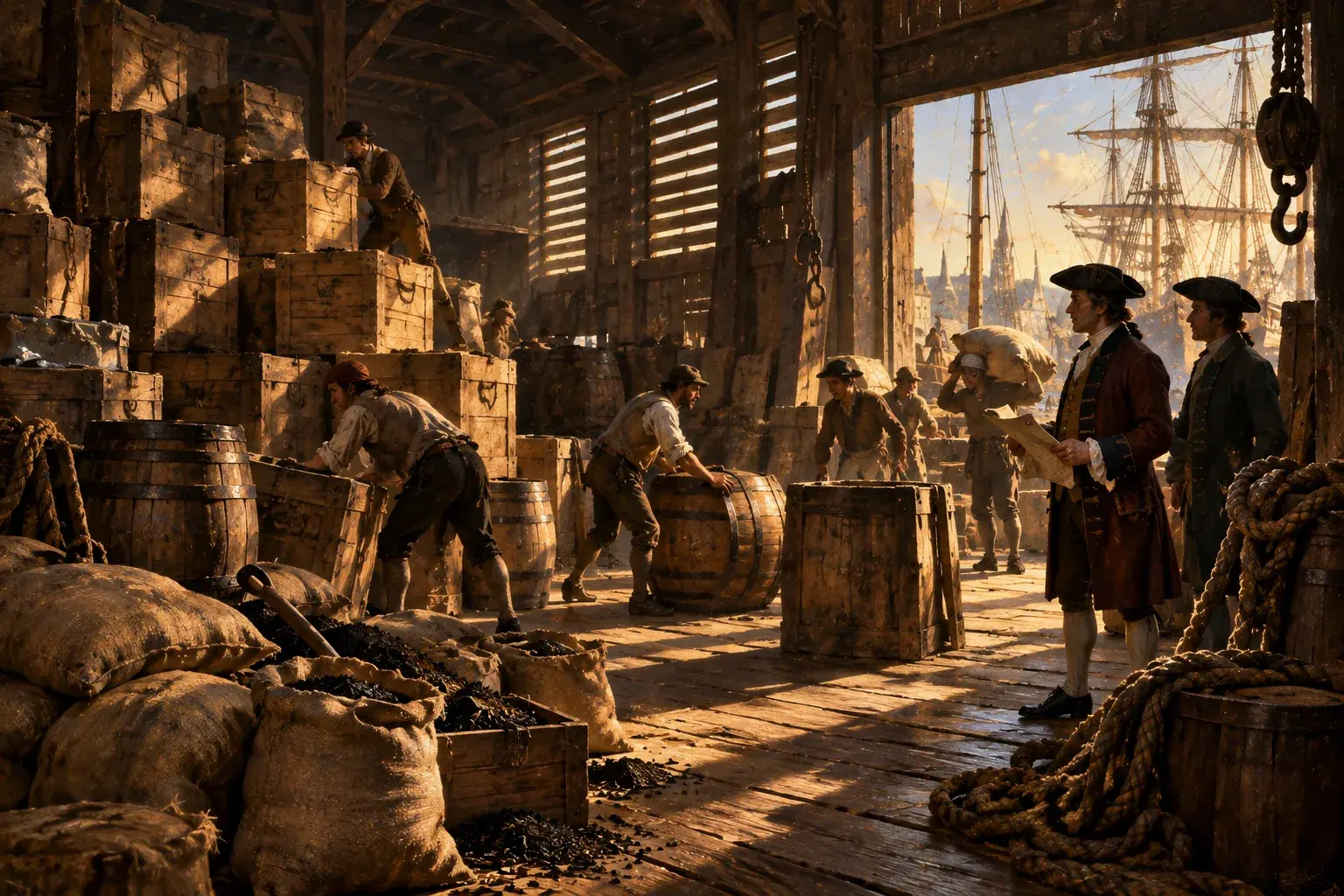
The East India Company's tea monopoly and layered taxes made smuggled Dutch tea far more attractive to colonial merchants, cutting deeply into the Company's legitimate sales.
Parliament's fix in 1767, the Indemnity Act, cut the domestic tea tax and refunded the Company its twenty-five percent duty on tea re-exported to America (this cost the Treasury money, so the same year Parliament passed the Townshend Revenue Act to make it back, with a new tax on tea, this time collected in the colonies).
The Townshend Acts and Taxation Without Representation
Here's where the constitutional argument sharpened. Britons and British Americans broadly agreed on the underlying principle: a subject could not be taxed without the consent of his elected representatives. In Britain that meant Parliament. Colonists elected nobody to Parliament, so American Whigs drew the obvious conclusion that only their own colonial assemblies could tax them. Parliament having repealed the Stamp Act in 1766, used the Declaratory Act that same year to insist it could legislate for the colonies in all cases whatsoever.
The Townshend duties provoked boycotts and non-importation agreements. New England activists promoted domestic substitutes like Labrador tea. Richard Clarke and the sons of Governor Thomas Hutchinson kept importing dutied British tea into Boston until Massachusetts Whigs made it impossible for them.
Lord North repealed most of the Townshend taxes in 1770 but deliberately kept the one on tea, at three pence per pound, to preserve the principle of taxing Americans. Partial repeal broke the boycott by October of that year, and from 1771 to 1773 British tea flowed back into the colonies in quantity. Boston became the largest legal importer in America while smugglers kept their grip on New York and Philadelphia.
Why the Tea Act of 1773 Backfired on Lord North
By late 1772 the East India Company was in genuine trouble. The 1767 refund had expired, a new act reduced it, famine in Bengal from 1769 to 1773 had gutted the Company's Indian revenues, and warehouses in London were stacked with tea nobody was buying. One of Britain's most important commercial institutions was close to insolvency.
Repealing the Townshend duty was the obvious solution and the North ministry refused to consider it, partly because retreat would look like conceding Parliament's right to tax, and more practically because that revenue paid the salaries of colonial governors and judges. That was always the tax's real function. Those officials had previously been paid by colonial assemblies; paying them from London made them answerable to London.
So the Tea Act, which received royal assent on May 10, 1773, did something different. It restored the Company's full refund on British import duties and allowed it, for the first time, to export directly to America on its own account, cutting out the London middlemen entirely. Consignees would be appointed in each colonial port to sell on commission. Bohea, the common variety, had sold at about three shillings a pound in 1772; under the new arrangement consignees could offer it at two shillings, undercutting the smugglers' two shillings and a penny.
And the three-pence Townshend duty stayed. William Dowdeswell, a former Chancellor of the Exchequer, warned North directly that Americans would refuse the tea if the duty remained. The Company itself understood the political sensitivity well enough to try concealing the tax (paying it in London on landing, or having consignees settle it quietly after sale). None of that worked. The historian Benjamin Labaree's verdict is that a stubborn Lord North had unwittingly "hammered a nail in the coffin of the old British Empire."
Colonial Resistance in New York, Philadelphia and Charleston
Seven ships carrying Company tea sailed in September and October 1773 - four for Boston, one each for New York, Philadelphia and Charleston - with more than two thousand chests aboard, close to 600,000 pounds of tea. Americans learned the terms of the Tea Act while those ships were still at sea, and the campaign began before a single chest was landed.
The tactic borrowed directly from the 1765 Stamp Act crisis: force the consignees to resign. In Charleston they'd stepped down by early December and customs officials seized the unclaimed cargo. Philadelphia held mass meetings where Benjamin Rush urged resistance on the grounds that the cargo carried the seeds of slavery; the consignees there resigned, and in late December the ship went home still loaded. The New York vessel was delayed by weather and by the time it arrived its consignees had quit too, so it sailed back to England.
Merchants had their own reasons to join in. Smugglers of Dutch tea faced ruin from cheap legal tea. Legitimate importers who hadn't been named consignees faced the same. And a government-granted monopoly on one commodity raised the uncomfortable question of which commodity might be next.
The Standoff Over the Dartmouth in Boston Harbor
Every colony except Massachusetts managed to make the consignees fold. Governor Hutchinson wouldn't allow it - two of the Boston consignees were his own sons, and he persuaded them to hold firm.
When the Dartmouth docked in late November, Samuel Adams called a mass meeting at Faneuil Hall on November 29. So many people turned up that it had to move to the larger Old South Meeting House. British law gave the ship twenty days to unload and pay duties, after which customs officials could seize and land the cargo themselves. The meeting resolved to send the ship back unloaded and posted twenty-five men to watch it.
Hutchinson refused clearance to leave without payment. The Eleanor and Beaver arrived. On December 16, the final day of the Dartmouth's deadline, somewhere between five and seven thousand people packed around Old South - out of a town of roughly sixteen thousand. Word came that the governor had refused again, and Adams announced that the meeting could do nothing further to save the country.
Popular tradition turns that line into a prearranged signal. It almost certainly wasn't. The claim only appeared in print nearly a century later, in a book by Adams's great-grandson, who seems to have misread his evidence. Eyewitnesses put ten to fifteen minutes between the statement and people leaving, and Adams was actually trying to stop them (since the meeting hadn't finished).
How Many Chests of Tea Were Destroyed
The figure most textbooks, encyclopedias and US government sites give is 342 chests, a number traceable to a Boston Gazette issue printed days after the event. The UK National Archives and several historical societies say 340.
The lower number comes from the East India Company's own manifest in its 1774 compensation petition: 114 chests on the Dartmouth, 114 on the Eleanor, and 112 on the Beaver. That invoice breaks the cargo down by variety too - mostly Bohea, with smaller quantities of Singlo, Hyson, Congou and Souchong. Two chests either way hardly changes the history, but it's a neat illustration of how a number repeated for two centuries can sit awkwardly beside the paperwork.
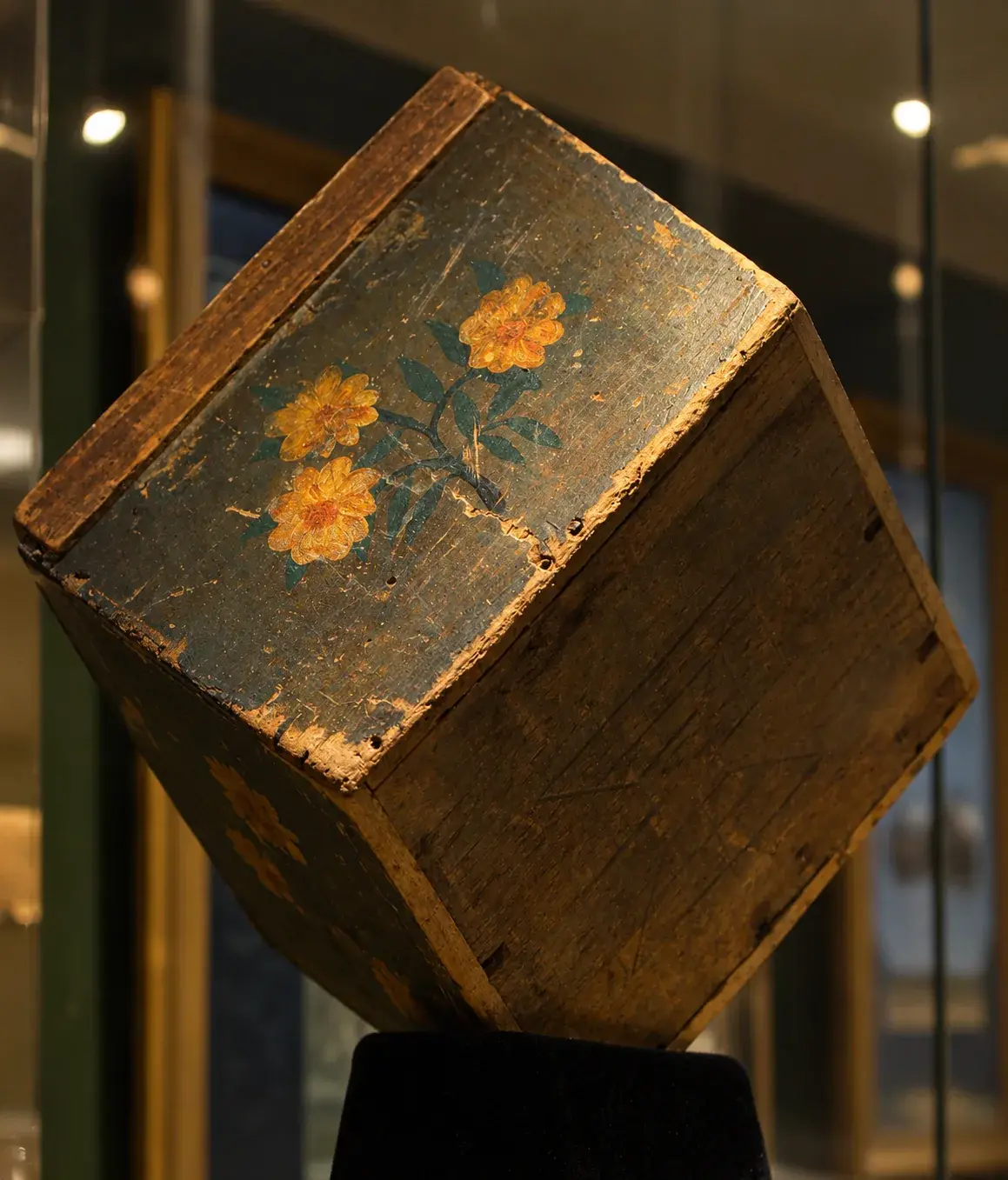
Of the roughly 340 chests dumped into the harbor, only two are known to survive today; one is on display at the Boston Tea Party Ships & Museum, the other at the Daughters of the American Revolution Museum in Washington, D.C.
Image Credits: Watson, Henry C. (Henry
There was a coda in March 1774. A fourth ship, the William, had run aground at Cape Cod and its tea was taxed and sold privately. When the Sons of Liberty learned some of it sat in a Boston warehouse, they destroyed what they found, then dressed as Mohawks again on March 7 and dumped the last of it from a shop into the harbor.
The Intolerable Acts and the First Continental Congress
London's reaction was close to unanimous. Even politicians sympathetic to the colonies were appalled, and the episode united British opinion against America in a way nothing previously had. North's position was that something had to be risked, because doing nothing meant losing everything.
Parliament closed the port of Boston and passed what colonists named the Intolerable Acts. The Boston Port Act, the Massachusetts Government Act and the Administration of Justice Act applied only to Massachusetts, but that was cold comfort elsewhere (if one colonial government could be rewritten by legislative fiat from London, any of them could). The acts were read as a violation of constitutional rights, natural rights and colonial charters at once, and they did more to unite the thirteen colonies than the tea ever had.
Benjamin Franklin thought the Company should simply be paid for its losses. Robert Murray, a New York merchant, went to Lord North with three others and offered to cover the damages. The offer was refused. Colonies responded instead with further protests, the burning of the Peggy Stewart among them, and by convening the First Continental Congress in Philadelphia, which petitioned the King and produced the Continental Association of October 1774.
Why the Name "Boston Tea Party" Only Appeared in the 1830s
For sixty years nobody called it that. The event was known as the Destruction of the Tea, which is an accurate and rather sober description of tipping someone's cargo into a harbor.
According to the historian Alfred Young, the phrase "Boston Tea Party" does not appear in print until 1834. His explanation is persuasive: American writers were uncomfortable celebrating the destruction of private property, so early histories of the Revolution tended to skip past it. What changed things in the 1830s was the publication of biographies of George Robert Twelves Hewes, one of the last surviving participants, whose recollections turned the night into a piece of national folklore.
The name itself is a small piece of accidental genius - it packs the place, the commodity and the ironic framing of a political gathering as a social "party" into three words. John Adams, writing in his diary the day after, had already reached for the language of historical epochs, calling the destruction bold, daring and inflexible, and predicting consequences that would last.
The Boston Tea Party as a Template for Modern Protest
The event's afterlife is arguably stranger than the event. When Gandhi organised a mass burning of Indian registration certificates in South Africa in 1908, a British newspaper immediately reached for the Boston comparison. Meeting the Viceroy of India in 1930 after the salt campaign, Gandhi produced duty-free salt from his shawl and joked that it was there to remind them of the famous Boston Tea Party.
American activists have claimed it from every direction. In 1973, on the bicentennial, a mass meeting at Faneuil Hall called for Nixon's impeachment and protested the oil companies during the energy crisis, then adjourned to a replica ship to hang the president in effigy and dump oil drums into the harbor. In 1998 two conservative congressmen loaded the federal tax code into a chest labelled "tea" and threw it in. A libertarian party took the name in 2006, a Ron Paul fundraiser on the 234th anniversary set a one-day record at $6.04 million, and the movement that followed shaped American conservative politics for years.
That flexibility is the tell. A protest against a monopoly arrangement and the constitutional question of representation has been repurposed as a straightforward anti-tax symbol, largely because "no taxation without representation" is memorable and the rest of the argument isn't. The 250th anniversary reenactment in 2023 put an original surviving tea chest on display - one of only two known to exist - which is a fitting artifact for an event we've spent two centuries remembering slightly wrong.