Some theories about human evolution are backed by fossils, genetics and decades of fieldwork. Others claim we evolved from swimming apes or got smart by eating magic mushrooms. This guide runs through both kinds, from persistence hunting and the Out of Africa model to the stoned ape theory and the bicameral mind, and is honest about which ideas have real evidence behind them and which are just good stories.
Theories about human evolution range from rock-solid science to ideas that sound like they were dreamed up around a campfire. Some explain why we sweat, why we lost our fur or why a few of us carry Neanderthal DNA. Others claim we evolved from swimming apes, got smart by eating magic mushrooms or only became conscious a few thousand years ago.
The fun part is that the weird ideas and the serious ones often start from the same questions. Why are humans so good at long-distance running? Why do our brains look the way they do? What happened to all the other kinds of humans who once shared the planet with us? Some answers have piles of evidence behind them. Others have almost none.
Persistence Hunting: Did Running Make Us Human?
The persistence hunting hypothesis suggests early humans caught prey by chasing it until it overheated and collapsed. The idea draws on the hunting methods of groups such as the San people of southern Africa, who have been documented running down antelope like kudu over several hours in intense heat.
Human bodies are unusually well built for this. We walk and run on two legs efficiently, and we cool ourselves by sweating through largely hairless skin. Humans have roughly ten times as many eccrine sweat glands as chimpanzees, which lets us shed heat while most animals have to stop and pant.
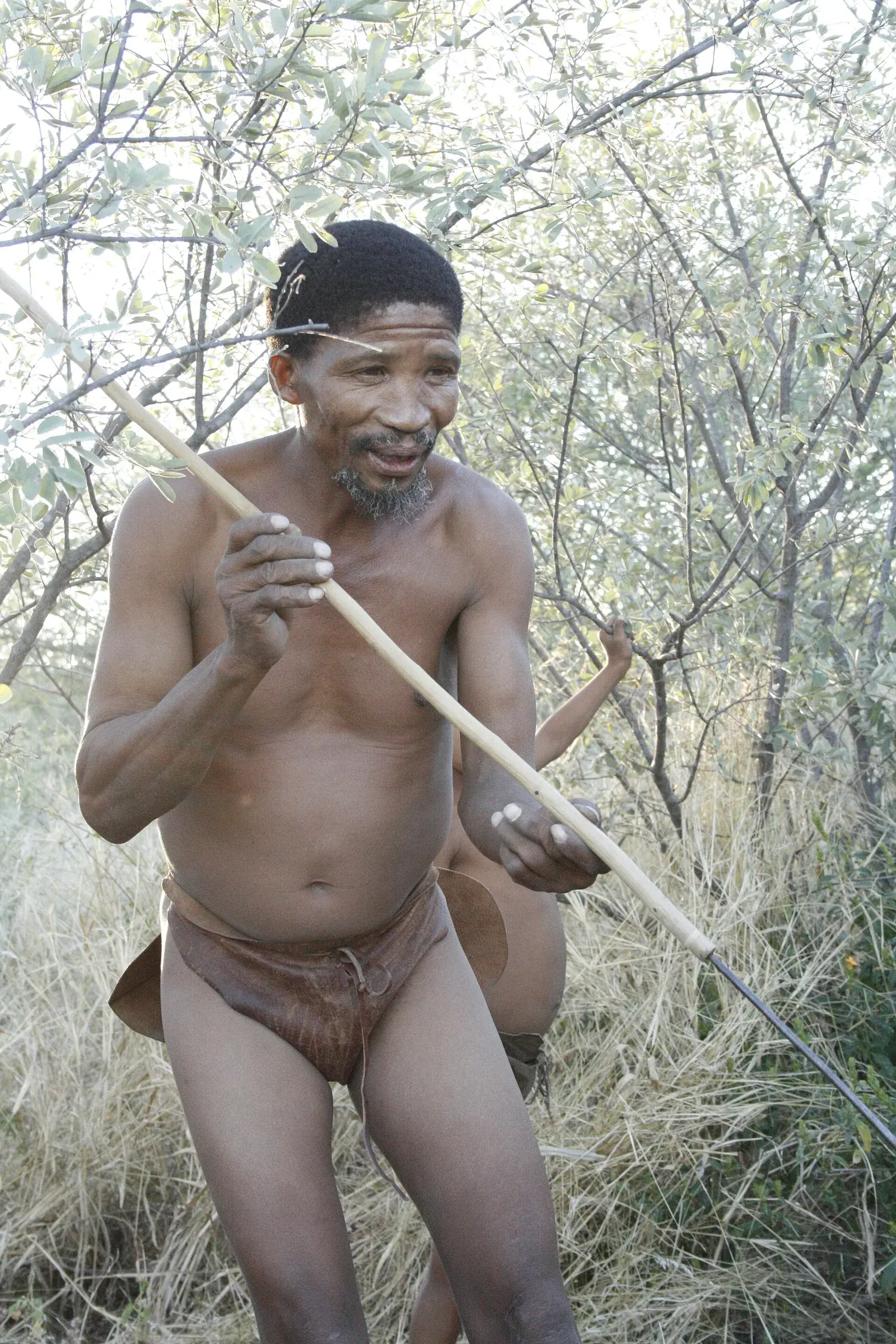
The persistence hunting hypothesis proposes that early humans could run prey animals to exhaustion in the heat, relying on efficient two-legged running and dense sweat glands most other mammals lack.
Image Credits: DVL2, via Wikimedia Commons (CC BY-SA 3.0)
The catch is evidence. Persistence hunting leaves almost nothing behind in the archaeological record, and critics point out that chasing an animal for hours burns a huge amount of energy compared with ambushing it. Most researchers accept that humans can hunt this way and sometimes did, but many doubt it was the main strategy that shaped our evolution.
Throwing, Meat and Cooking: Other "Made Us Human" Ideas
Several related theories try to pin human uniqueness on a single behavior. One focuses on throwing. Humans can hurl objects with speed and accuracy no other animal comes close to, and some researchers argue that accurate throwing gave early humans a way to hunt and defend themselves at a distance. It's a genuine human specialty, even if it probably wasn't the sole driver of our evolution.
Another points to meat. Research by paleoanthropologist Briana Pobiner and others shows that large predators often left usable meat, marrow and brains on carcasses. Early humans with stone tools could scrape off hard-to-reach flesh and crack bones that hyenas couldn't. That extra energy may have helped support bigger brains. Most scholars see meat-eating as important, though not the only factor.
A third, championed by primatologist Richard Wrangham in his 2009 book Catching Fire, argues that cooking made us human. Cooking softens food and makes more calories available, which could have fueled brain growth while shrinking our guts and teeth. The problem is timing. Evidence for early fire use is patchy, and clear signs of people regularly controlling fire mostly appear within the last few hundred thousand years, well after key changes in human anatomy had already happened.
Did Humans Wipe Out the Ice Age Megafauna?
Around the end of the last Ice Age, mammoths, giant ground sloths, saber-toothed cats and many other huge animals disappeared. In the 1960s, geoscientist Paul Martin proposed the "blitzkrieg" or overkill hypothesis: as humans spread into the Americas, they hunted these animals to extinction in a rapid wave.
Supporters note that big animals like mammoths reproduce very slowly, so even modest hunting pressure could push populations over the edge, especially if hunters targeted young animals or breeding females. Critics reply that relatively few kill sites have been found. The extinctions also coincided with dramatic climate swings, including the sudden cold snap of the Younger Dryas and the rapid warming that followed.
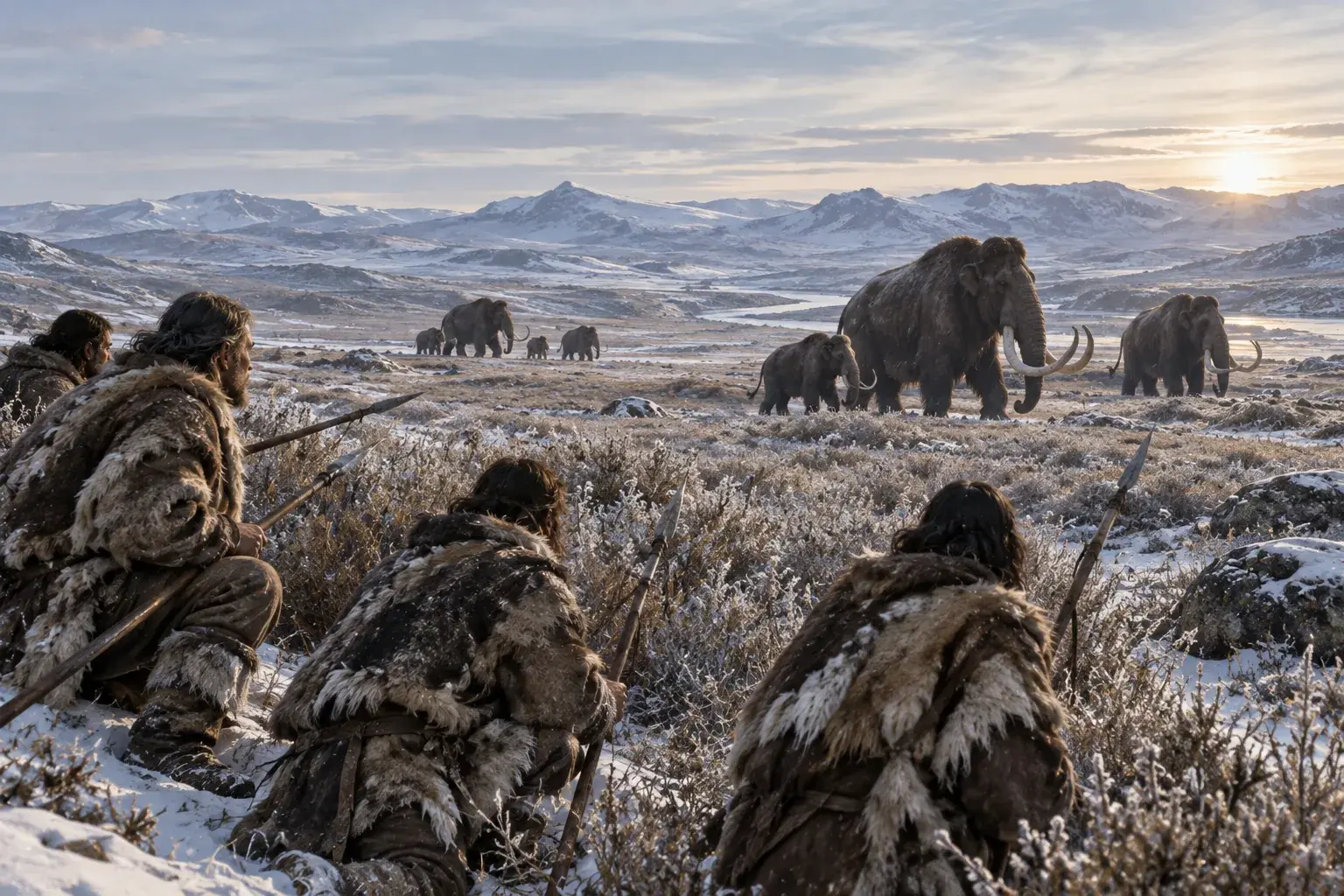
The overkill hypothesis holds that human hunters helped drive Ice Age giants like mammoths to extinction, though most researchers now see climate change as at least as important a factor.
Today, most researchers think both factors mattered, and the argument is mostly about their relative weight. Many lean toward climate as the bigger driver, with human hunting as a powerful extra stress on animals that had survived earlier climate shifts.
Out of Africa: Where Modern Humans Came From
Unlike some ideas on this list, the Out of Africa model is strongly supported. It holds that anatomically modern humans evolved in Africa, with the oldest fossils dating to roughly 300,000 years ago, and later spread across the rest of the world.
Humans left Africa more than once. Homo erectus spread into Asia around 2 million years ago, reaching as far as Indonesia. Early members of our own species also made brief journeys out. A skull fragment from Apidima Cave in Greece, dated to about 210,000 years ago, may be one of these early pioneers. But the migrations that left a lasting mark on living people happened later, after roughly 70,000 to 60,000 years ago.
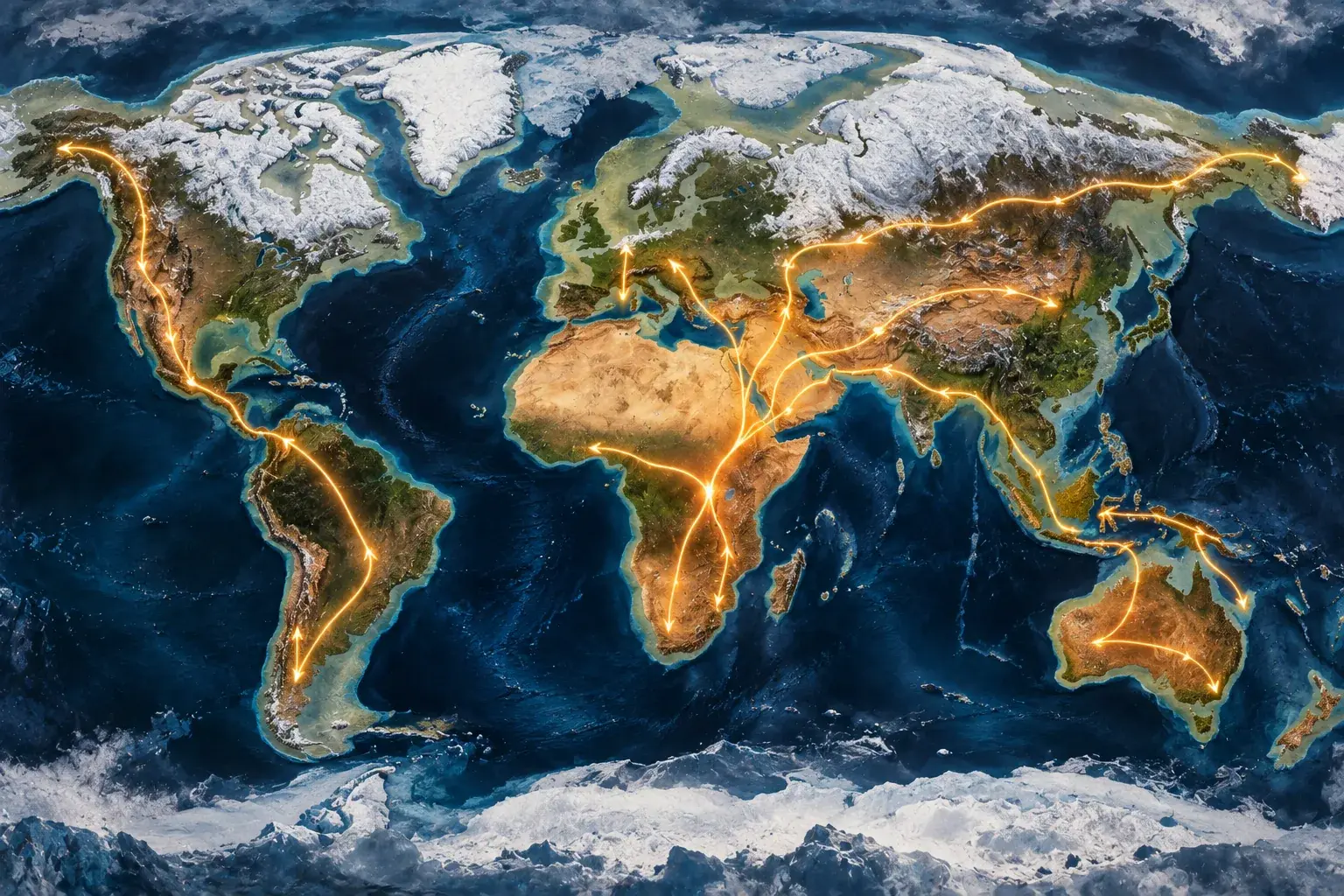
Genetic and fossil evidence both point to Africa as the origin of anatomically modern humans, who spread outward in multiple waves, with the most recent leaving a mark on nearly everyone alive today.
Genetics is the clincher. The mitochondrial DNA of all people with non-African ancestry traces back to branches of a single African lineage, haplogroup L3. The rival multiregional hypothesis, which argued modern humans evolved separately in several regions, has largely been set aside, although modern research shows our ancestors did interbreed with other human groups along the way.
Why Did Humans Lose Their Fur?
Humans are strikingly hairless for primates. The classic explanation links fur loss to cooling. Less hair makes sweating more effective, which would have helped active hunter-gatherers on hot savannas.
A second idea, proposed by evolutionary biologists Mark Pagel and Walter Bodmer, suggests we lost fur partly to reduce parasites like ticks and lice that carry disease. Bare skin makes pests easier to spot and remove. Most likely, several pressures worked together. Genetic studies of skin pigmentation suggest our ancestors had lost much of their body hair by around 1.2 million years ago.
The Stoned Ape Theory
Now for the far end of the spectrum. The stoned ape theory, popularized by ethnobotanist Terence McKenna in the early 1990s, claims early humans ate psilocybin mushrooms growing in animal dung, and that the experience sparked language, religion and advanced thinking.
McKenna argued that small doses might sharpen vision for hunting, while larger doses encouraged new ways of thinking. Modern neuroscience does show that psychedelics temporarily change how brain regions communicate. But there's no archaeological or chemical evidence that early humans regularly ate these mushrooms, and no mechanism by which a drug experience would be passed down genetically. The theory sits firmly outside mainstream science.
There is better evidence for later drug and alcohol use. Residue found at Raqefet Cave in Israel suggests people were brewing a kind of beer around 13,000 years ago, before farming. Some researchers have even wondered whether the desire for grain to brew with helped encourage early agriculture, though that remains debated.
Homo naledi: A Cave-Dwelling Human Species?
Homo naledi is one of the most puzzling discoveries of recent decades. Its remains come from the Rising Star cave system in South Africa and date to between about 236,000 and 335,000 years ago, surprisingly recent for a species with a brain roughly the size of a chimpanzee's.
The fossils were found deep underground, reachable only through a squeeze called Superman's Crawl and a narrow vertical chute about 12 meters tall that tightens to around 18 centimeters. Naledi had curved fingers and flexible shoulders, which might have helped it climb. Some researchers, including discoverer Lee Berger, argue that naledi deliberately placed its dead in the cave, used fire for light and even carved marks on the walls. Many other scientists strongly dispute these claims, arguing that the evidence for burial and symbol-making hasn't been demonstrated. The idea that naledi lived in caves remains speculation.
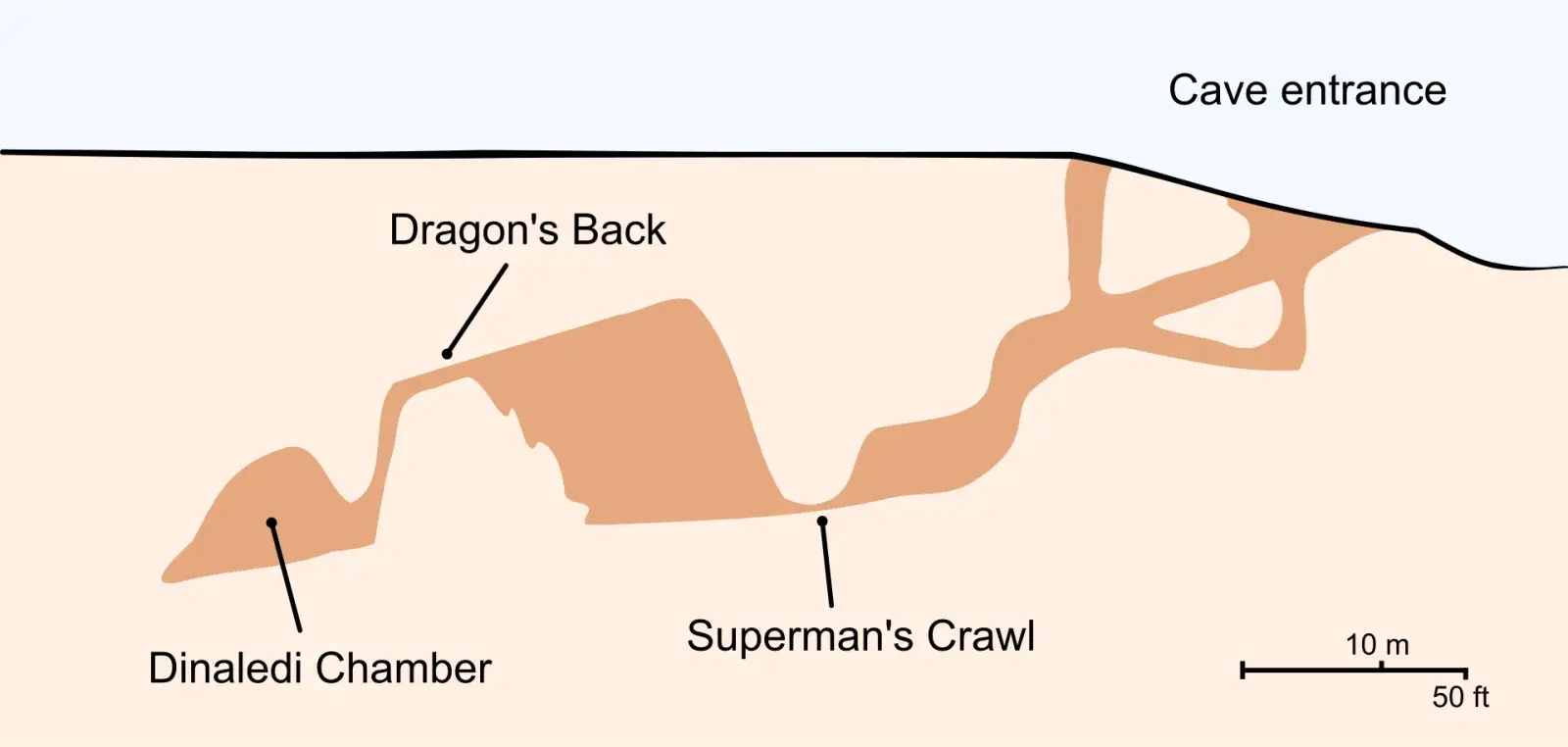
Reaching the Homo naledi fossils in South Africa's Rising Star cave system requires passing through Superman's Crawl and a chute that narrows to about 18 centimeters wide.
What Happened to the Neanderthals?
Neanderthals shared Europe and western Asia with our ancestors for thousands of years before disappearing around 40,000 years ago. Two broad explanations compete, and they aren't mutually exclusive.
The first is competition, possibly including violence. A Neanderthal known as Shanidar 3, found in Iraq, has a rib wound that some researchers think was caused by a thrown projectile weapon, possibly one used by modern humans, though that's far from certain.
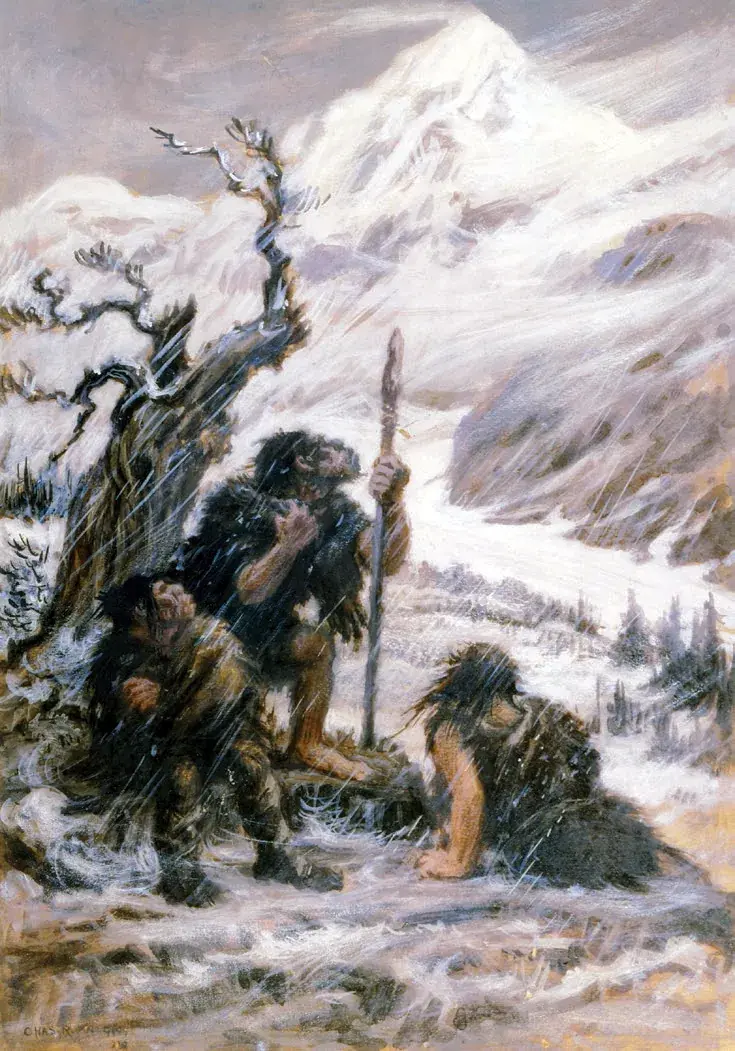
Neanderthals lived alongside modern humans in Europe and western Asia for thousands of years, and most non-African people today carry a small but measurable amount of their DNA.
Image Credits: Charles R. Knight, via Wikimedia Commons (Public domain)
The second is assimilation. When scientists sequenced the Neanderthal genome in 2010, they found that people with ancestry outside Africa carry roughly 1 to 2 percent Neanderthal DNA. Interbreeding happened repeatedly. Studies of dating evidence in France and northern Spain suggest the two species overlapped there for somewhere between about 1,400 and 2,900 years. Given much larger modern human populations, many researchers think Neanderthals were partly absorbed rather than simply wiped out.
The Aquatic Ape Hypothesis
In 1942 German pathologist Max Westenhöfer suggested humans had passed through an aquatic phase, and in 1960 marine biologist Alister Hardy independently proposed that early human ancestors foraged in shallow coastal waters. Supporters argued this explained hairlessness, fat under the skin, upright walking, breath control and even the way babies react to water.
The evidence doesn't fit. Early bipedal human relatives such as Australopithecus are found in land-based woodland and grassland environments, and the famous 3.6-million-year-old Laetoli footprints were made on dry volcanic ash. Hairlessness also appears in fully land-dwelling animals such as elephants and rhinos. And the infant dive reflex, often cited as proof, isn't special to humans at all. It's found across mammals. The idea got a popular boost from Animal Planet's 2012 mockumentary Mermaids: The Body Found, which was fiction, but mainstream science rejects the hypothesis.
The Bicameral Mind: Did Consciousness Come Late?
Psychologist Julian Jaynes proposed one of the boldest ideas about the mind in his 1976 book The Origin of Consciousness in the Breakdown of the Bicameral Mind. He argued that until about 3,000 years ago, people didn't experience an inner monologue. Instead, one part of the brain produced voices that the other part obeyed, and people understood those voices as gods.
Jaynes pointed to texts like the Iliad, where characters rarely deliberate and often act on divine commands. It's a fascinating read, but it relies heavily on literature rather than biological evidence, and most psychologists and neuroscientists reject it.
Are Human Brains Shrinking?
This one has some real data behind it, although its interpretation is disputed. Average skull volumes of Homo sapiens in the Upper Paleolithic were larger than today's, and modern average brain sizes are roughly 10 percent smaller.
The most popular explanation is that complex societies let people share mental work. Instead of every person knowing how to track animals, find water and make every tool, specialists could handle different tasks. Smaller bodies and the high energy cost of brain tissue probably play a role too. But researchers still argue over exactly when and how quickly the shrinking happened.
Humans Are Still Evolving
Evolution didn't stop when civilization began, and some of the best examples are recent. Lactase persistence, the ability to digest milk as an adult, evolved independently in several dairy-herding populations in Europe, Africa and the Middle East. In parts of Africa, carrying one copy of the sickle cell gene protects against malaria, while in the Mediterranean, thalassemia gene variants offer similar protection.
Some adaptations are dramatic. Tibetans carry a variant of the EPAS1 gene, inherited from Denisovans, that helps them cope with high altitude without dangerously thickening their blood. The Bajau sea nomads of Southeast Asia have spleens roughly 50 percent larger than those of neighboring populations, which helps them stay underwater longer during free dives. Communities in the Andes have adapted to process naturally occurring arsenic in their drinking water more efficiently.

The Bajau sea nomads of Southeast Asia have evolved unusually large spleens, letting them free-dive for longer while fishing and gathering along coral reefs.
Image Credits: Ernie Dingo, via Wikimedia Commons (CC BY-SA 2.0)
Not every unusual trait is an adaptation, though. The famous "Blue Fugates" of Kentucky carried a rare recessive condition called methemoglobinemia. It spread through a small, isolated community after Martin Fugate and Elizabeth Smith, both carriers, settled there in the early 1800s. That's a classic example of genetic drift in a small population, not natural selection. The condition was eventually treated with a dye called methylene blue.
The Gay Uncle and Grandmother Hypotheses
Two evolutionary ideas try to explain traits that seem to reduce direct reproduction. The kin selection hypothesis, sometimes nicknamed the "gay uncle" hypothesis, suggests that people who don't have children of their own might still pass on shared genes by helping raise nieces and nephews. It remains debated and difficult to test.
The grandmother hypothesis tries to explain menopause, which is rare in the animal kingdom. It suggests that older women improve their genetic legacy by helping raise grandchildren rather than risking late pregnancies. This idea has substantial support from studies of hunter-gatherer societies.
Early Seafarers and the Ghost Hominins in Our DNA
Some of the most exciting discoveries involve other human groups. On the Indonesian island of Flores, stone tools suggest early humans arrived around a million years ago, even though reaching the island required crossing open sea. Whether they used rafts or simply drifted there is still debated.
Genetic research has also revealed Denisovans, an archaic human group known from only a few fossils but visible in the DNA of living people. Some populations in Papua New Guinea and nearby islands carry around 4 to 6 percent Denisovan ancestry, suggesting significant interbreeding in the region.
Stranger still, researchers have detected signs of "ghost" populations known only through DNA. A 2020 study by Arun Durvasula and Sriram Sankararaman found evidence that some West African populations carry a small share of ancestry from an unidentified archaic group that split from our lineage even before Neanderthals did. Estimates vary, but a figure of around 6 to 7 percent is commonly cited. We still have no fossil to put a face to that ancestry.
Near-Extinction: Did Human Ancestors Almost Disappear?
A controversial 2023 study suggested human ancestors went through a severe population bottleneck between about 930,000 and 813,000 years ago. By its estimate, the breeding population fell to roughly 1,300 individuals and stayed small for more than 100,000 years. Some researchers support this, while others think the statistical methods may overstate how small the population really was.
A second, better-established genetic bottleneck affected the small groups of modern humans who left Africa tens of thousands of years ago. The popular idea that the Toba supervolcano eruption around 74,000 years ago nearly wiped out humanity has lost support, since archaeological sites in Africa and India show people continued living through the eruption.
Self-Domestication and Neoteny
Two more ideas suggest humans shaped their own biology. The self-domestication hypothesis, promoted by Richard Wrangham and others, argues that human groups gradually weeded out highly aggressive individuals, favoring cooperation. Supporters compare modern humans to domesticated animals, noting our flatter faces, smaller teeth and lighter skeletons, and point to bonobos as another primate that may have gone through a similar process.
Neoteny, the idea that humans keep juvenile traits into adulthood, is related. Our flat faces and round skulls resemble young apes more than adult ones, and our long childhood gives our brains an extended window for learning. But we're not simply overgrown babies. Our long legs, for example, are distinctly adult traits.
Separating Science From Speculation
The best-supported ideas on this list share one thing: evidence from several independent directions. Out of Africa, Neanderthal interbreeding and recent human adaptations like lactase persistence are backed by fossils, archaeology and genetics working together. Ideas like the aquatic ape, the stoned ape or the bicameral mind remain popular because they make great stories, but they depend on a handful of suggestive clues rather than hard evidence.
That doesn't make the strange theories worthless. Many of them raised questions that forced scientists to look more carefully. The real story of human evolution turns out to be strange enough on its own: other human species, interbreeding, near-extinctions and adaptations that are still happening inside us today.