Early Muslim conquests explained: within a century of Muhammad at Medina, Arab armies shattered the Sasanian Empire, stripped Byzantium of its wealthiest provinces, and pushed Islam from the Indus to the Atlantic. Examine the debated causes behind this lightning expansion.
The early Muslim conquests produced one of the fastest territorial expansions in recorded history, and historians have been arguing about why ever since. Within roughly a hundred years of Muhammad establishing a community at Medina in 622, armies from the Arabian Peninsula had destroyed the Sasanian Empire outright, stripped the Byzantines of their richest provinces, and carried Muslim rule from the Indus valley to the Atlantic.
At its greatest extent the territory under caliphal control is estimated at around thirteen million square kilometres — from Sind in the east to Septimania in the southwest of France. The Scottish historian James Buchan's comparison is to Alexander the Great, with the observation that the Arab conquests proved considerably more durable.
The frustrating part is that explaining the speed is genuinely hard. Only fragmentary sources survive from the decades in question, and much of what does survive was written later by people with obvious stakes in how the story came out. What follows is the reconstruction most historians work with, along with the places where they still disagree.
Arabia Before Islam: The Ghassanids, Lakhmids and Himyar
Pre-Islamic Arabia was not the empty backwater it sometimes gets described as, but it was a fragmented one. Society divided along tribal and clan lines, with the largest fault line running between southern and northern tribal associations, and a mix of urban settlements and nomadic Bedouin populations.
Both great empires projected influence into the peninsula through clients rather than direct rule. The Lakhmid kingdom, covering parts of what is now southern Iraq and northern Saudi Arabia, worked for the Persians; the Ghassanids served the Byzantines. Their job was to act as buffers against nomadic incursion and to fight proxy wars against each other. Arabian tribes played the same game in reverse, courting imperial patronage to advance their own ambitions.
Then both empires decided they'd rather manage their frontiers themselves. In 602 the Persians deposed the Lakhmids and took over southern frontier defense directly, which left them exposed and overextended — a decision that looks catastrophic in hindsight. The Byzantines dispensed with the Ghassanids on similar logic. The only other significant military power in the peninsula, the Himyarite Kingdom of South Arabia, had already dissolved by the middle of the sixth century under a combination of military, climatic and economic pressures.
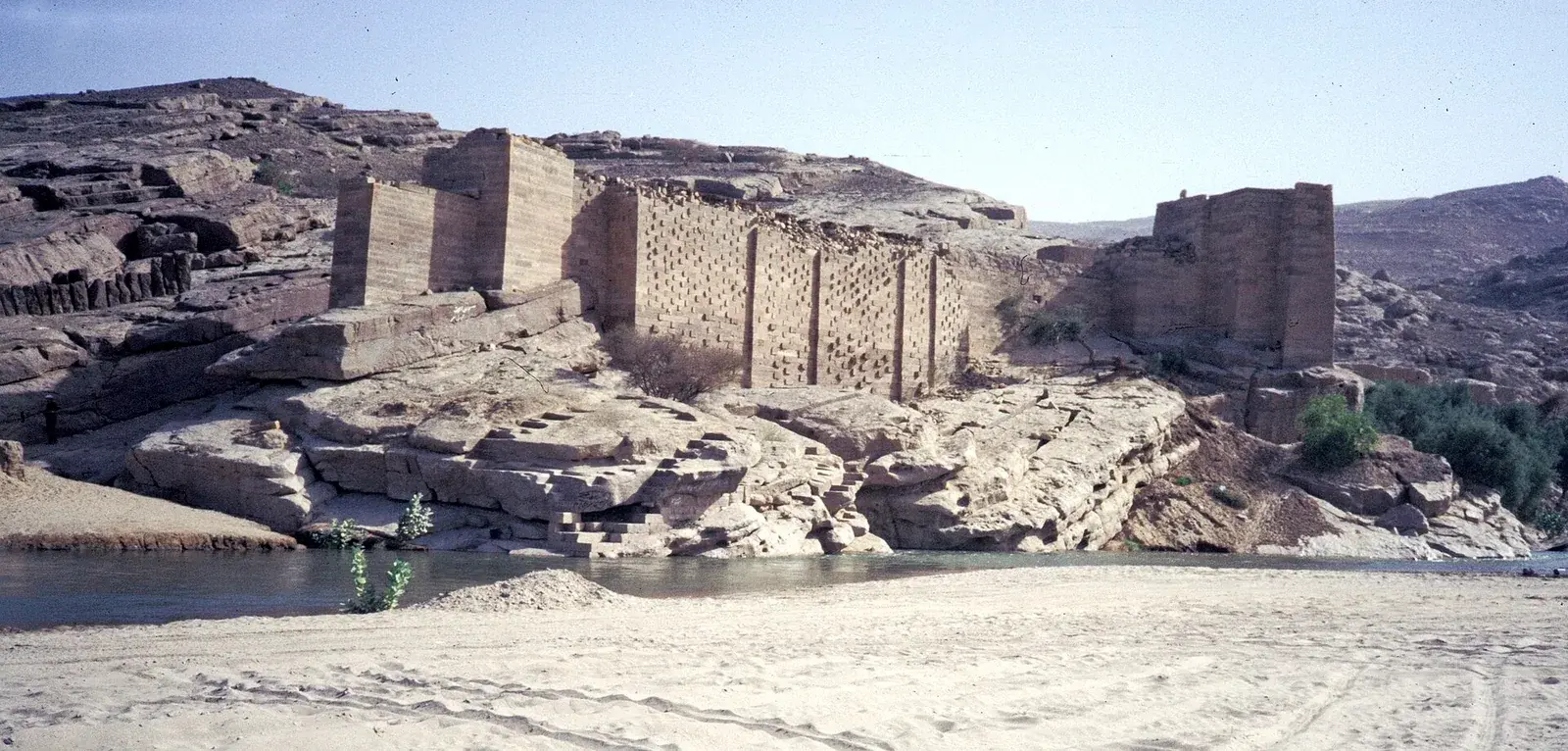
An earthquake-damaged breach around 450 AD was one of several blows to Marib's irrigation system, decades before the dam's final collapse.
Image Credits: By H. Grobe - Own work, CC BY-SA 3.0, https://commons.wikimedia.org/w/index.php?curid=13283317
Southern Arabia's economic decline is worth noting because it shaped perceptions. Yemen had sat at the center of an international trading network for millennia, with skilled sailors running up the Red Sea to Egypt and across the Indian Ocean. The Marib Dam collapse in an earthquake around 450 AD damaged its irrigation. More decisively, the Mediterranean world's conversion to Christianity collapsed demand for frankincense and myrrh, which had been central to pagan religious ceremony. The resulting slump helped create an impression of Arabia as backward.
The Byzantine–Sasanian Wars and the Plague of Justinian
The single most important precondition was that both target empires had just spent thirty years destroying each other. The Byzantine–Sasanian wars of the sixth and early seventh centuries, compounded by recurring outbreaks of bubonic plague, left both powers exhausted in manpower, revenue and morale.
Heraclius technically won. He recovered every lost territory and restored the True Cross to Jerusalem in 629, having framed the whole struggle as a holy war against Zoroastrian "fire worshipers" — an all-out effort that succeeded and cost more than the empire could afford.
Neither side got time to recover. James Howard-Johnston's description of what followed is that the Arab advance "can only be likened to a human tsunami." George Liska put it more analytically: an unnecessarily prolonged Byzantine–Persian conflict opened the way for Islam.
The peninsula was meanwhile moving in the opposite direction. Muhammad, a Meccan merchant, faced persecution from the Meccan elite, migrated to Yathrib — Medina — and established a state there, and by 630 had taken Mecca. First contact with Byzantine forces came at Mu'tah in 629. When he died in 632, Abu Bakr succeeded him and unified the peninsula through the Ridda Wars.
By the mid-630s the timing was as favourable as it would ever get: Arabia united under single leadership for the first time, the two empires at their weakest in generations, and military energy previously spent on inter-tribal skirmishing available to point outward. There's a reasonable argument that if the Arabs were ever going to conquer an empire, this was the only window in which it was possible.
It's worth correcting the picture of a Near East caught entirely by surprise, though. Arab raiding was a constant anxiety through the 600s and 610s, the Romans had signed a treaty paying tribute to Arab kingdoms as early as the mid-sixth century, and somewhere between 604 and 611 the Banu Bakr confederation beat the Sasanians at Dhi Qar and weakened Persian control over Eastern Arabia.
The Conquest of Syria and the Battle of Yarmuk
Syria fell first. Arab raids following the Ridda Wars provoked the Byzantines into sending a major expedition into southern Palestine, which Khalid ibn al-Walid defeated at Ajnadayn in 634. Khalid, who had converted around 627 and become one of Muhammad's most effective commanders, had been campaigning in Iraq before leading his force across the desert to hit the Byzantines from behind.
Another victory followed at the Battle of the Mud, fought near Pella and Scythopolis in the Jordan Valley in December 634 or January 635. Damascus fell after a six-month siege and was then retaken by Heraclius. The decisive engagement came at Yarmuk in 636, where Khalid appears to have been the real commander under someone else's nominal authority. Heraclius, according to tradition, bid Syria a bitter farewell and abandoned it.
Damascus fell again in 636, with Baalbek, Homs and Hama following. But fortified towns kept resisting individually even after the field army was gone — Jerusalem held out until 638, Caesarea until 640, others into 641.
Jerusalem's surrender came with terms. Caliph Umar promised tolerance for the city's Christians and undertook not to convert churches into mosques, and by all accounts kept his word, praying on a rug outside the Church of the Holy Sepulchre rather than inside it. Caesarea Maritima held out longer because it could be resupplied by sea, and had to be taken by assault.
Anatolia was a different problem entirely. The Byzantines adopted what amounted to shadowing warfare: refuse pitched battle, move the population into fortified towns, then ambush raiding parties on their way home loaded with plunder. In the frontier zone between Anatolia and Syria they went further and evacuated the whole population, laying waste to the countryside so no invading army could feed itself. Christian guerrillas kept fighting in the hills of northwestern Syria for decades with Byzantine backing, and Byzantine naval raids on caliphal coastlines forced the Muslims to tie down troops defending them. Syria's plains suited offensive warfare; Anatolia's mountains suited defense, and for centuries afterward the frontier sat exactly on that geographic line.
Amr ibn al-As and the Muslim Conquest of Egypt
Egypt mattered for grain, naval yards and access to Africa. Amr ibn al-As began the campaign in 639 on his own initiative, which tells you something about how these operations actually worked.
Byzantine forces there were mostly locally raised Coptic troops functioning closer to a police force than an army — reasonable, given that almost everyone lived in the Nile valley with desert on both sides. Amr entered Sinai in December 639, took Pelusium, and beat a counter-attack at Bibays. Rather than heading for Alexandria as expected, he struck at the Babylon Fortress near modern Cairo, aiming to cut the Nile valley in half.
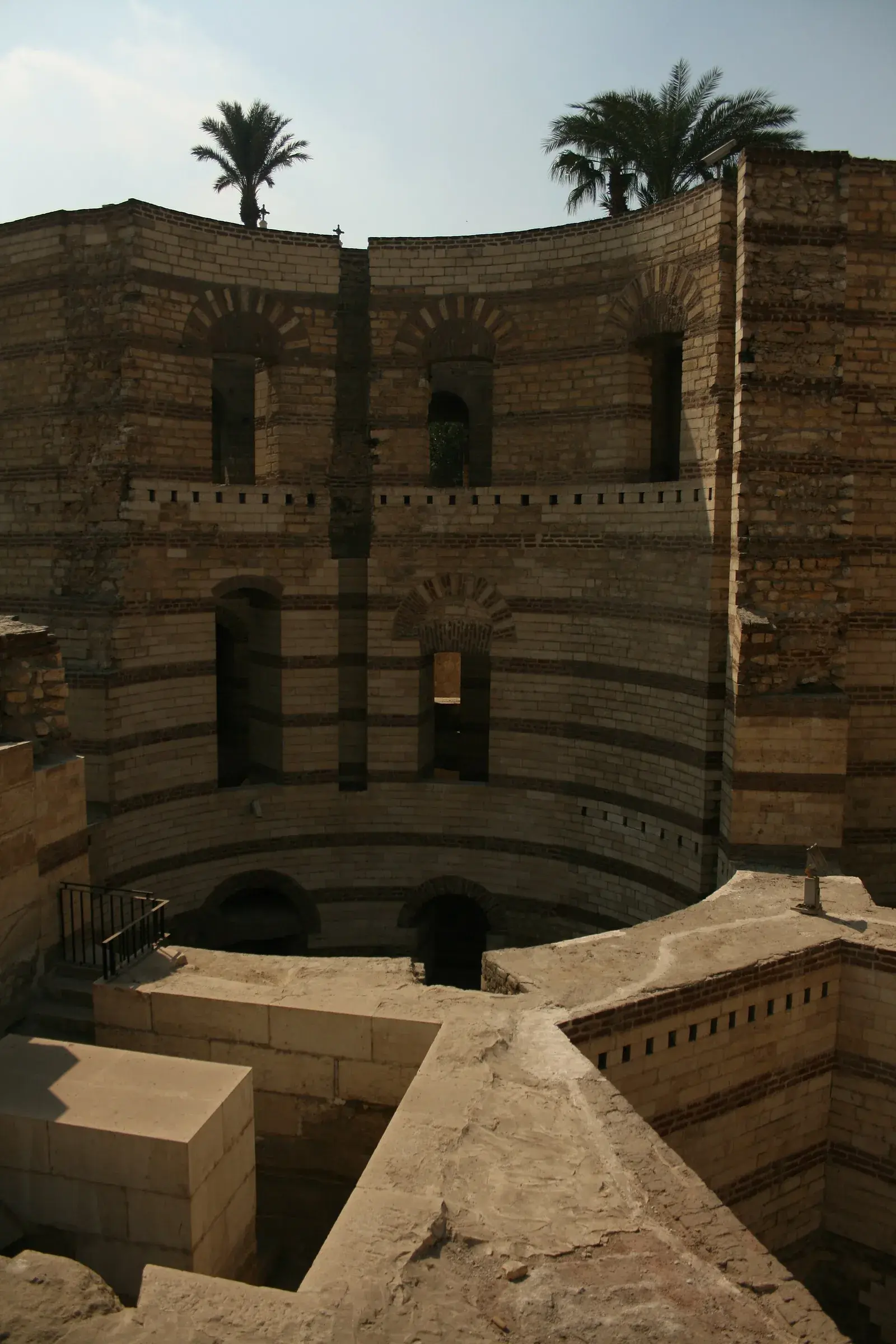
Amr ibn al-As struck at this fortress rather than Alexandria, aiming to split Byzantine Egypt's defenses down the Nile valley.
Image Credits: Diego Delso, via Wikimedia Commons (CC BY-SA 3.0)
A major victory at Heliopolis followed in 640, but progress stalled: Delta cities were protected by water and Amr had no siege machinery. Babylon's starving garrison surrendered on 9 April 641. When Heraclius died that same year, hope of reinforcement from Constantinople died with him. Alexandria capitulated in September 642.
Hugh Kennedy calls Egypt the swiftest and most complete of all the early conquests, and notes how rarely a political change that massive has happened that fast and lasted that long. The Byzantines did briefly retake Alexandria in an amphibious attack after a Muslim army was wrecked by Khazar cavalry near the Caspian in 644, but it didn't hold. Control of the Delta's farmland meant the caliphate could ride out droughts without famine, which underwrote everything that came later.
Al-Qadisiyyah, Nahavand and the Fall of the Sasanian Empire
Persia collapsed more completely than Byzantium, and more permanently. Yazdegerd III had only just taken the throne when the raids began, and many of his *marzbans* simply declined to help.
Al-Qadisiyyah in 636 was the catastrophe. Little is known about it beyond that it ran for several days near the Euphrates and ended with the Persian army annihilated. Abolishing the Lakhmid buffer state had forced the Persians to garrison the desert frontier themselves, and the overextension told.
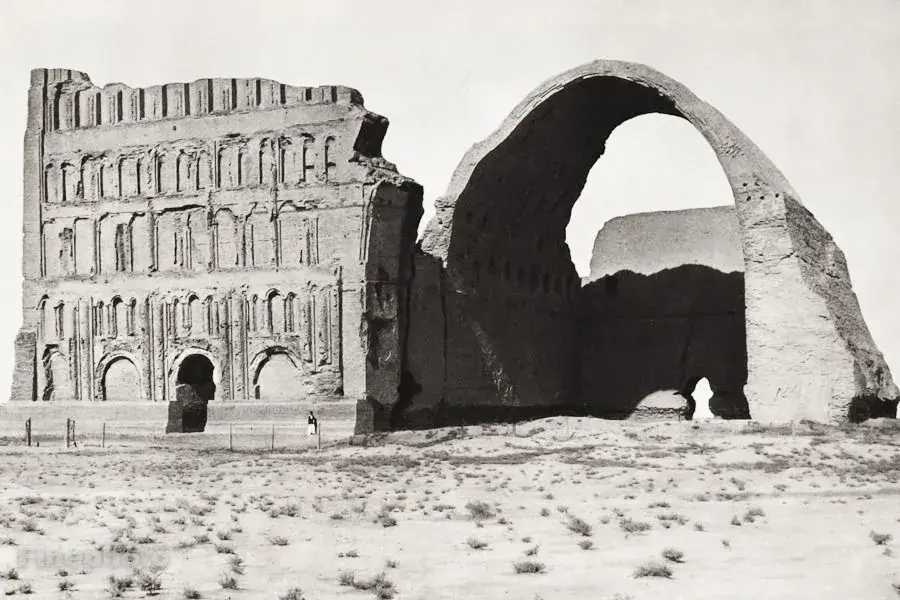
Ctesiphon, the Sasanian capital, fell to the Arabs along with the rest of Iraq once the field army was destroyed at al-Qadisiyyah.
Image Credits: PersianDutchNetwork, via Wikimedia Commons (CC BY-SA 4.0)
Iraq went with the battle, Ctesiphon included. Having lost the best of their army, the Persians lacked the forces to hold the Zagros passes, so the Arabs pursued them onto the Iranian plateau. Nahavand in 642 finished it — known in Muslim tradition as the Victory of Victories. Yazdegerd fled east, his governors surrendered piecemeal, and he was finally assassinated by a local satrap in Khorasan in 651.
Beating the imperial army wasn't the same as controlling the country. Dozens of militarily weak but geographically inaccessible principalities took decades to subdue. In what is now Afghanistan, where the Shah's authority had always been contested, Muslim forces met fierce guerrilla resistance from militant Buddhist tribes.
There's a nice irony in the aftermath: despite crushing the Sasanians completely and only partially defeating Byzantium, the caliphate borrowed far more heavily from Persian administrative models than Byzantine ones. The Persian memory was less warm. Four centuries later Ferdowsi, in the *Shahnameh*, has Yazdegerd curse the world and the fate that brought uncivilized Arabs to make him a Muslim, and tells his audience to count Iran a ruin and a lair for lions and leopards.
Arab–Byzantine Naval Warfare and Greek Fire
Byzantium had dominated the Mediterranean and Black Sea for centuries from bases at Constantinople, Acre, Alexandria and Carthage. That ended faster than it should have.
The first Arab naval victory came off Alexandria in 652, followed by the conquest of Cyprus. Yemeni sailors — Yemen having been a maritime trading center — were brought to Alexandria to crew a new Mediterranean fleet, while Iranian and Iraqi shipwrights built the hulls. The fleet worked out of Alexandria with forward bases at Acre, Tyre and Beirut. At the Battle of the Masts off Cape Chelidonia in 655, the Muslims took the Byzantine fleet apart in a series of boarding actions.
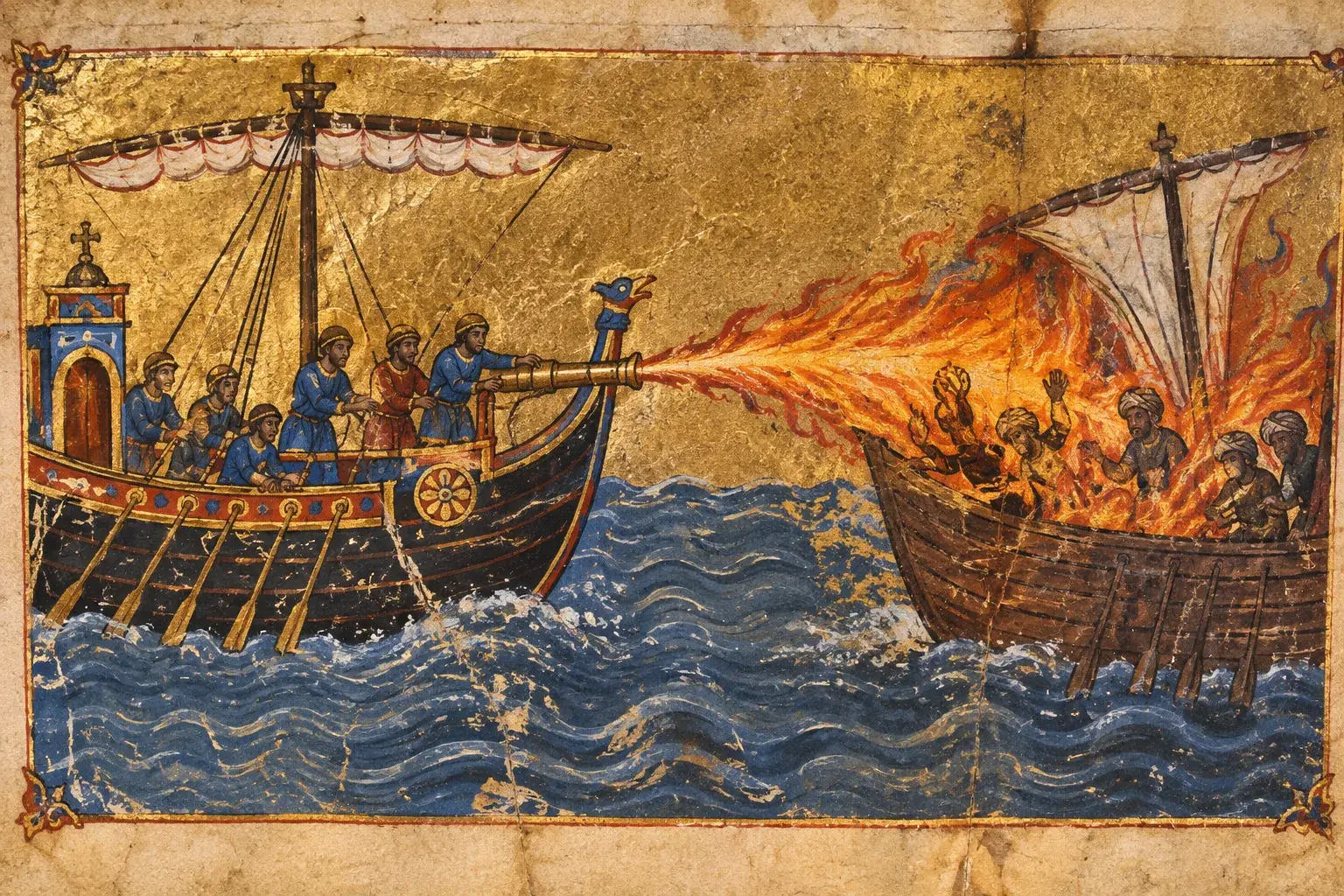
The Byzantines answered growing Arab naval power with Greek fire, a closely guarded incendiary weapon sprayed from ship-mounted tubes.
What followed was a straightforward arms race. The Byzantines expanded their navy, the Arabs matched it, and from the early eighth century Muslim fleets raided the Anatolian and Greek coasts annually. Muslim warships carried larger forecastles mounting stone-throwing engines. The Byzantines answered with Greek fire, and the Muslims responded by covering their ships in water-soaked cotton. Chronic timber shortages pushed Muslim shipwrights toward quality over quantity — bigger vessels — and toward the cheaper frame-first construction method in place of hull-first.
Tariq ibn Ziyad, Hispania and the Battle of Tours
The Maghreb came first and took nearly a century. Raids into Cyrenaica began soon after Egypt fell, against a Byzantine presence largely confined to the coastal plains while Berber kingdoms held the interior. Qayrawan, founded in 670, gave the Arabs a forward base. Uqba ibn Nafi is credited with reaching the Atlantic coast, though that looks like a temporary incursion. The Berber king Kusayla and a figure remembered as Kahina — prophetess or priestess — mounted effective if short-lived resistance late in the seventh century. Carthage fell in 698, Tangiers by 708, after which large numbers of Berbers joined the Muslim army.
Spain is notorious for how bad the sources are. The Visigothic kingdom fractured after King Wittiza died in 710, with the nobility split between his followers and his successor Roderic. Wittiza's son Akhila fled to Morocco after losing the succession fight, and Muslim tradition claims he invited the invasion.
Tariq ibn Ziyad, a Berber commander stationed at Tangiers, crossed the Strait in 711 with about seven thousand men, mostly Berbers with Arabs as an elite core. He landed at the Rock that now carries a corruption of his name on 29 April and beat Roderic at the Guadalete on 19 July. Cities fell one after another, Toledo surrendering peacefully, several negotiating tribute arrangements that left local aristocracies with real influence. Musa ibn Nusayr crossed in 712 to link up at Talavera, and by 713 nearly all of Hispania was under Muslim control.
The whole thing appears to have been Tariq's own initiative — the caliph al-Walid in Damascus reacted with surprise, summoned him in 714 to explain himself, and Tariq took his time getting there, eventually being imprisoned by al-Walid's successor on arrival.
The Battle of Tours in 732 gets more weight than it deserves. Charles Martel's victory over 'Abd al-Rahman al-Ghafiqi has been sold for centuries as the battle that saved France, but the Umayyad force was raiding Aquitaine with an eye on churches and monasteries rather than attempting conquest. The battle itself is shadowy, described in poetic terms that frustrate historians, climaxing with an attack on the Muslim camp that killed al-Ghafiqi and a withdrawal at nightfall. Whatever plans existed for conquering France died there, but successive Berber revolts in North Africa and Spain against Arab rule probably did more to rule out expansion beyond the Pyrenees.
Transoxiana, Qutayba ibn Muslim and the Battle of Talas
Central Asia was the hardest fighting of all. David Nicolle calls the Turkic peoples the most formidable enemies the Muslims faced, with the Khazar Khaganate fielding powerful heavy cavalry and the region divided among five khanates whose rulers variously acknowledged the Shahs of Iran or the emperors of China.
Initial crossings of the Oxus toward Bukhara in 673 and Samarkand in 675 produced nothing more than tribute promises. Ubayd Allah ibn Ziyad's attack on Bukhara in 674 ended with the Sogdians recognizing Mu'awiya I as overlord and paying up.
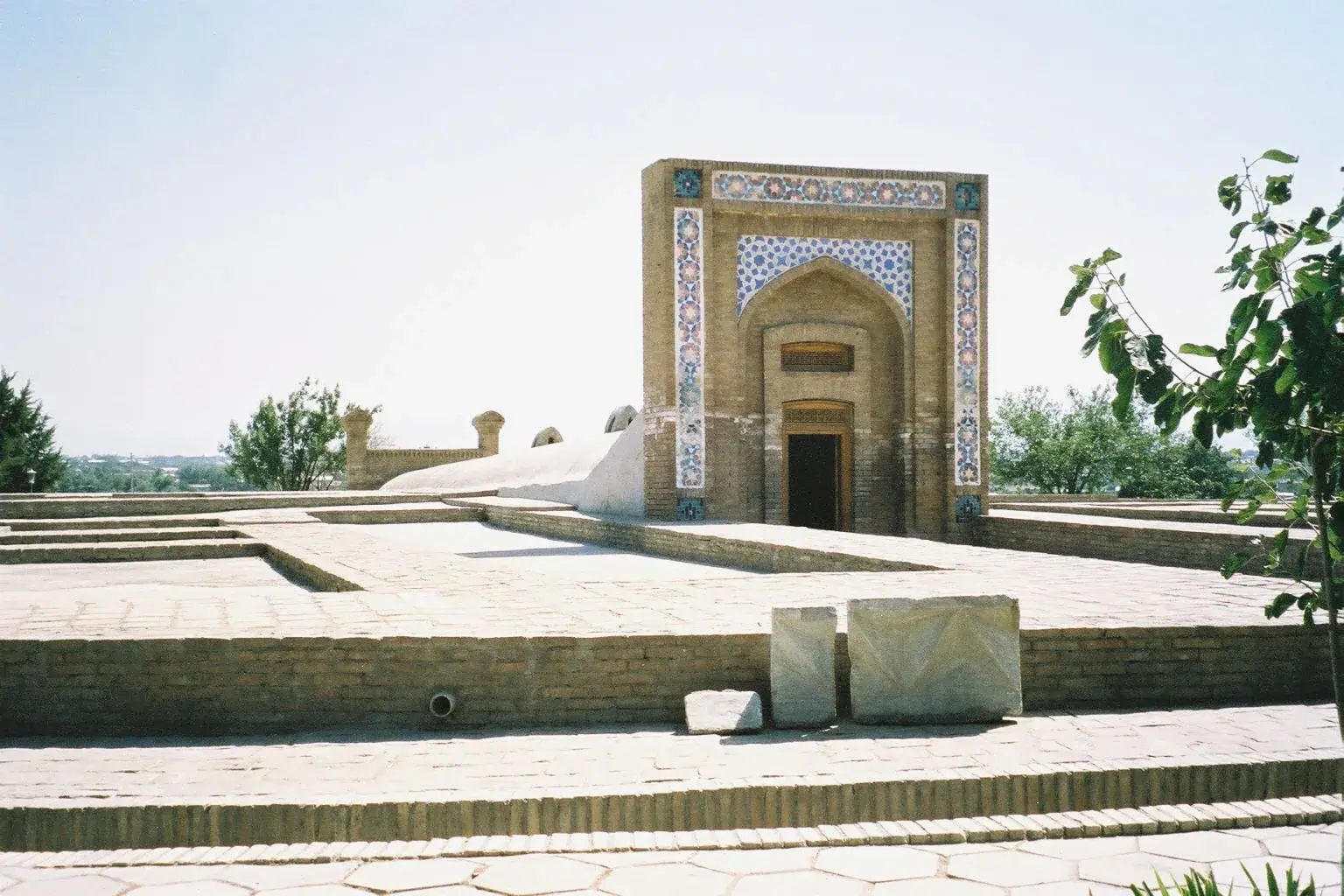
Samarkand and Bukhara anchored the Sogdian trading world that Qutayba ibn Muslim spent years subduing.
Image Credits: Michel Benoist, via Wikimedia Commons (CC BY 2.5)
The Buddhist Turkic peoples resisted hard, and China — which regarded Central Asia as its own sphere because of the Silk Road — backed the defenders. Political upheaval inside the Umayyad caliphate stalled progress for twenty-five years before Qutayba ibn Muslim, as governor of Khurasan, took Bukhara and Samarqand between 706 and 712. Momentum collapsed when Qutayba was killed in an army mutiny, and a Sogdian–Türgesh alliance with Tang support put the Arabs on the defensive. Syrian reinforcements turned it around, most lost ground was recovered by 741, and Muslim control was settled in 751 when a Chinese-led army lost at Talas.
The long-term consequence was not what anyone at the time would have predicted. Turkic heavy cavalry reshaped Muslim tactics and weaponry, and the Turkic peoples — mostly Buddhist at the point of conquest — converted, eventually displacing the Arabs as the dominant military people of the Dar al-Islam.
Afghanistan stayed stubborn. Medieval Muslim geographers split the region into Khorasan, containing Balkh and Herat, and Sistan, containing Ghazna, Zarang, Bost, Qandahar, Kabul and Zabulistan. Kabul and Zabulistan housed Indic religions, and the Zunbils and Kabul Shahis resisted for two centuries until the Saffarids and Ghaznavids. Umayyad claims of overlordship there were mostly nominal, though Qutayba forced tribute payments in 711.
Why the Muslim Armies Won: Competing Explanations
The explanations on offer have always reflected who was offering them. Contemporary Christian writers read the conquests as divine punishment for Christian sin. Early Muslim historians read them as proof of religious zeal rewarded by divine favor. The early-twentieth-century theory that this was an economically driven Arab migration has largely fallen out of favor, particularly among historians who separate the migration from the conquests that made it possible.
There are indications the whole thing began as disorganized pillaging in the wake of the Ridda Wars, partly by non-Muslim Arab tribes, before the Rashidun caliphs converted it into a war of conquest. Other scholars argue it was a planned military venture already in motion during Muhammad's lifetime. Fred Donner's position is that Islam revolutionized both the ideology and the political structures of Arabian society, producing for the first time a state capable of an expansionist movement. Chase F. Robinson suggests Muslim forces were frequently outnumbered but were faster, better coordinated and more motivated than their opponents.
The structural factors are less contested. Both empires were wrecked from fighting each other. Plague had hit densely populated areas and crippled imperial conscription while Arab armies drew on nomadic populations untouched by it. The Sasanians, having lost the last round, suffered a crisis of confidence in which elites suspected the dynasty had lost divine favor. Christianized Arab tribes who had served as imperial auxiliaries switched sides. Arab commanders used generous surrender terms freely, sparing lives and property and exempting groups who provided military service from tribute. And Byzantine persecution of non-Chalcedonian Christians in Syria and Egypt had alienated exactly the populations now being asked to resist, once it became clear the new rulers would leave their worship alone in exchange for tribute.
Robert Hoyland's explanation for why Persia never recovered is that it was too geographically and politically disconnected to coordinate a response once central rule failed. The Byzantines faced the inverse problem: Anatolia's terrain made large-scale counterattack impractical, so their offensive effort reduced to sponsoring guerrilla operations in the Levant.
Jizya, Kharaj and the Taxation of Conquered Populations
The conquests settled into a pattern common to nomadic conquests of settled regions: the conquerors became the new military elite and struck a bargain with the old elites, who kept local political, religious and financial authority. Peasants, workers and merchants paid; elites old and new collected. For peasants the burden could reach half the value of their produce, and it carried social stigma as well as cost.
Umar's reign established two governing principles — Bedouin were not to damage agricultural production in conquered lands, and the leadership would work with local elites. Arab armies were settled in segregated quarters or purpose-built garrison towns like Basra, Kufa and Fustat, the latter two becoming the administrative centres of Iraq and Egypt. Soldiers drew stipends and were barred from seizing land, while Arab governors supervised tax collection and otherwise left the existing order intact.
Whether taxes actually got lighter is disputed. John Esposito argues they effectively fell. Bernard Lewis reads the evidence as suggesting many subject peoples welcomed the change as a lighter yoke. Norman Stillman disagrees in part, arguing that while the Jewish burden stayed roughly comparable, Byzantine Christians and Iranian Zoroastrians carried a noticeably heavier load immediately after conquest.
The terminology took a century to settle, with *jizya* and *kharaj* used loosely for individual tax, land tax and collective tribute alike. Regional systems initially mirrored whatever had been there before: the Sasanian land tax plus a wealth-graded poll tax with an aristocratic exemption, which the new Arab elite simply inherited; Byzantine collective tribute on population centres, with collection delegated to local communities on condition the burden be divided equitably.
Collection problems appeared almost immediately. Egyptian Copts, expert at tax evasion since Roman times, entered monasteries, which were initially exempt, or left their registration districts — prompting taxes on monks and controls on movement. In Iraq, indebted peasants converted to Islam and fled to garrison towns hoping to escape taxation, until al-Hajjaj ibn Yusuf forced them back onto their land and taxed them again, effectively forbidding conversion.
An Islamic state penalizing conversion to Islam was not a stable arrangement. Umar ibn Abd al-Aziz is traditionally credited with fixing it, though modern historians doubt the tidy version, and some governors invented new requirements — circumcision, the ability to recite Quranic passages — to slow conversions down. Grievances of this kind among non-Arab Muslims fed directly into the Abbasid Revolution. Under the system that eventually emerged, *kharaj* meant land tax regardless of the owner's religion and *jizya* narrowed to the poll tax on *dhimmis*, with the treasury losing little since converts paid *zakat* instead.
How much the poll tax actually drove conversion is still argued. Julius Wellhausen thought it too small to motivate anyone. Thomas Arnold called it too moderate to be burdensome, pointing out that it exempted non-Muslims from the military service Muslims owed. Daniel Dennett shifted the emphasis to other factors, particularly the desire to hold onto social status.
Where the Conquests Stopped and What They Left Behind
By the Abbasid revolution in the middle of the eighth century, the armies had run into a combination of natural barriers and genuinely powerful states. The economics had turned too. Wars were producing diminishing personal returns, fighters were drifting into civilian occupations, and rulers had shifted their attention from taking new land to administering what they had. There were later gains — Sicily, Crete — but the era of rapid centralized expansion was over, and the further spread of Islam passed to local dynasties, missionaries and traders.
Some ventures had simply failed. Despite the naval win at the Masts in 654, the follow-up attempt on Constantinople was broken by a storm, and the later sieges of 668–669 and 717–718 were defeated with the help of Greek fire. Kabul held out against repeated invasion until the Saffarids took it three centuries later.
What the conquests produced, in Nicolle's assessment, was effectively a new civilization: an Islamicized, Arabized Middle East. Islam went from an Arabian religion to a world religion, and the synthesis of Arab, Byzantine and Sasanian elements generated new styles of art and architecture. Edward Gibbon, surveying an empire stretching from the confines of Tartary and India to the Atlantic, noted that it lacked the easy obedience of Augustus and the Antonines but observed that the Quran's language and laws were studied with equal devotion at Samarcand and Seville.
Society in the new Arab settlements stratified quickly by wealth and power, reorganizing into units that kept clan and tribal names while only loosely tracking real kinship. Settlers moved into civilian work and became a landed aristocracy in the east. In Iran they assimilated heavily, adopting Persian language and customs and marrying Persian women. Non-Arab converts entered Arab-Muslim society through *mawali* clientage, an adaptation of an older Arabian institution trading protection for loyalty — clients and their heirs counted as virtual clan members, though the clans themselves stratified sharply, with noble lines acquiring Persian cavalry as clients while others held slave labourers.
Mass conversion in the immediate aftermath is a myth. The first converts were Christian Arab tribes, some of whom kept their religion into the Abbasid era while serving in caliphal armies, followed by former Sasanian elites for whom conversion ratified existing privileges. Only as non-Muslim elites weakened and old communal ties broke down did the incentives really bite.
The religious settlement was pragmatic rather than principled. The conquerors avoided the mistake both predecessor empires had made of imposing an official religion on unwilling subjects, opting instead for the traditional Middle Eastern pattern of pluralism — not equality, but dominance by one group with the others tolerated beneath it. Ira Lapidus notes that before Muslims had mosques in Syria they treated Christian churches as holy places and shared them, and that churches were repaired and built during the Umayyad period.
The turn came under Umar II. The disastrous failure at Constantinople in 718, with massive Arab casualties, produced a spike in hostility toward Byzantium and Christians generally, at the same moment many Arab soldiers were leaving the army for civilian life and wanting their social superiority made visible. The restrictions introduced then drew, according to Hoyland, on Byzantine precedents for treating Jews and on Sasanian rules prescribing distinctive dress for different classes. Islamic law followed the Byzantine model of sorting subjects by religion rather than the Sasanian emphasis on social rank, and in practice extended *dhimmi* status to most non-Abrahamic communities in former Sasanian territory by classing them as possessors of scripture.
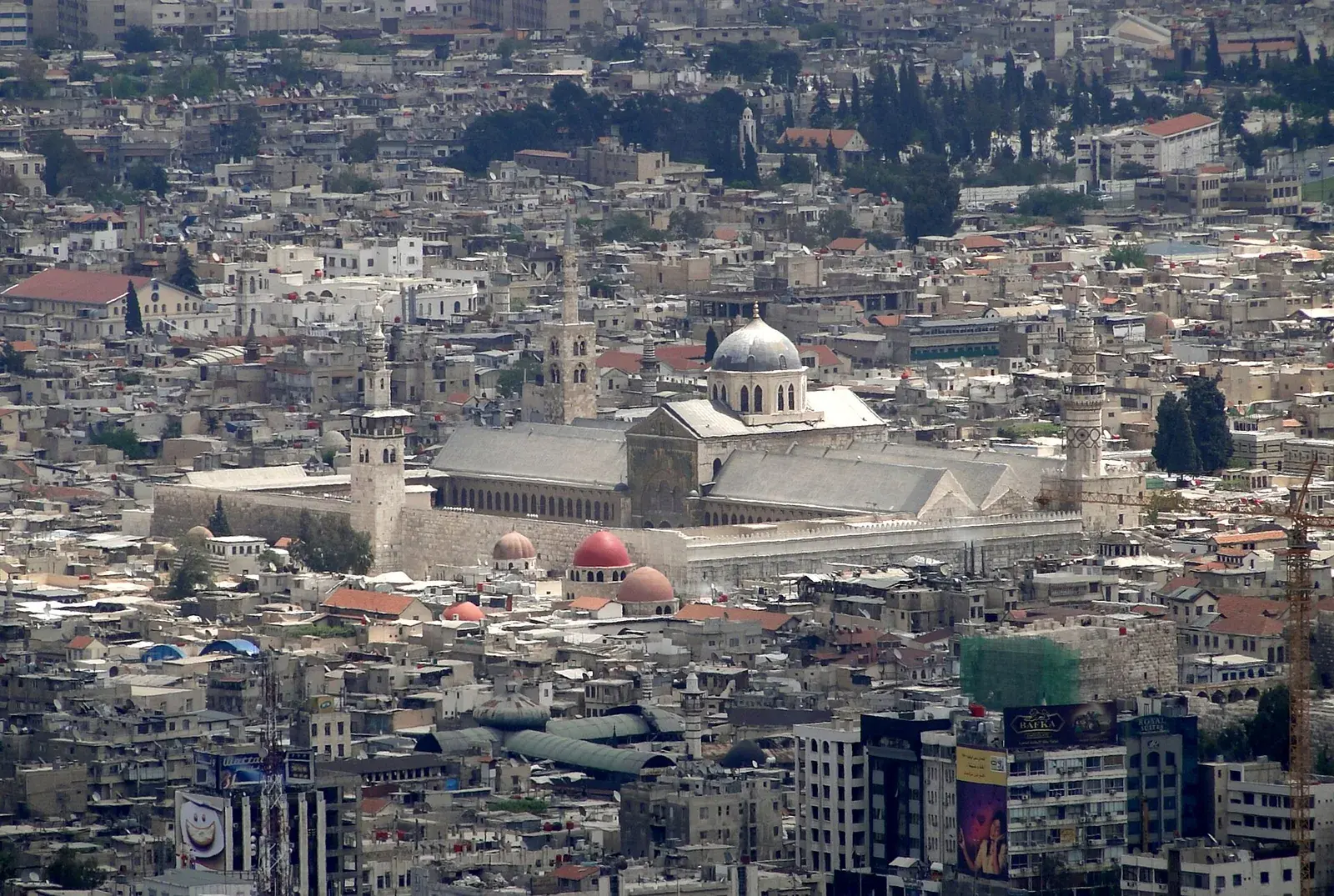
Built on the site of a Byzantine church in the former Roman East, the Great Mosque of Damascus embodies the Arab, Byzantine and Sasanian synthesis the conquests left behind.
Image Credits: Bernard Gagnon, via Wikimedia Commons (CC BY-SA 3.0)
Mark Cohen's comparative point is worth ending on. The *jizya* paid by Jews under Islamic rule, he argues, bought a surer guarantee of protection than anything available in the Latin West, where Jews paid numerous arbitrary taxes for official protection and lived under charters each new ruler could rewrite or decline to renew. The Pact of Umar, obliging Muslims to defend *dhimmis* and to burden them no more than they could bear, was violated often enough — but it stayed a fixed reference point of Islamic policy into the early modern period, which is more than most such documents manage.