Iblis's story sounds simple at first: God creates Adam, orders the angels to bow, and one refuses. But for over a thousand years, Muslim scholars have argued fiercely over what that refusal actually means, whether Iblis was an angel or a jinn, whether his fall was predestined by God or a genuine act of free will, and whether his stubborn refusal to bow to anyone but his Creator makes him, paradoxically, the story's purest monotheist. This is a tour of that debate, from Quranic exegesis and Sufi poetry to Persian miniature painting and modern film.
Iblis occupies a stranger place in Islamic thought than most people outside the tradition expect. The basic story is familiar enough and has a rough parallel in Christian tradition: God creates Adam, orders the angels to prostrate themselves, one being refuses, and that refusal gets him expelled and condemned. What comes later, however, is where things become genuinely interesting.
Due to Muslim scholars having argued about him for well over a thousand years, and not just about the details. They've disagreed about what he actually is - angel or jinn - which is a question of angels' capacity for sin, free will and divine decree. Whether he introduced evil into the world at all. And a serious strand of Sufi thought, including some very well-regarded names, has argued that the being that refused to bow to anything but his Creator was, in a certain uncomfortable sense, the purest monotheist in the story.
None of that makes him a sympathetic figure in mainstream Islam. He is still the tempter, the enemy, the one Muslims are told to seek refuge from. But the debate around him is one of the richest in Islamic theology and runs straight through kalam, Quranic exegesis, Persian poetry and modern film.
Iblis, Shaytan and the Names of the Devil
Iblis is the head of the devils, the shayatin, and the figure Islamic tradition identifies with ash-Shaytan, "the Devil", frequently attached to the epithet ar-Rajim, the Accursed. The two words are not merely interchangeable. Iblis functions as a proper name for the specific Quranic figure; shaytan describes a role and an unambiguously evil force, and is applied to him when the emphasis is on tempting.
The tradition has given him plenty of other titles. He's Abu Murrah, father of bitterness, from murr, meaning bitter. He's 'aduww Allah, the enemy of God. Abu al-Harith, father of the plowmen. In the reading Ibn Manzur records as the majority view among Arab scholars, Iblis is an epithet rather than a name at all, derived from the root b-l-s, carrying the sense of remaining in grief - with his actual personal name having been Azazil before the fall.
Not everyone accepts that derivation. Al-Jili connected the name to talbis, confusion, on the grounds that God's command left him confused. Another line of scholarship proposes a foreign origin altogether, tracing it through Syriac back to the Greek diábolos, the same word that gave English "devil". The name doesn't appear in Arabic literature before the Quran which does suggest it wasn't part of the pre-Islamic Arabian vocabulary.
The Quranic Account of Iblis Refusing to Prostrate
Iblis is named eleven times in the Quran and nine of those relate directly to the same episode. The fragments are scattered rather than told in one continuous passage, but assembled they run like this.
God creates Adam and commands the angels to bow before the new creation. Every one of them complies except Iblis who refuses, and his stated reason matters: he was made from fire and Adam from clay-mud, so he considers himself the superior creature and the command beneath him. God banishes him from heaven for that arrogance and condemns him to hell. Iblis asks permission to spend his existence leading Adam's descendants astray and God grants it - a detail that puts God clearly behind both angels and devils rather than presenting a contest between rival powers.
Exegetes have found him implicitly elsewhere too. Surah 21:29 warns that anyone claiming divinity apart from God will be requited with hell, and Tabari, Suyuti, al-Nasafi and al-Maturidi among others read that as pointing at Iblis who invites both humans and jinn to follow their egoistic desires, their nafs. Sijjin, the prison mentioned in Surah 83:7, is described by Quranic commentators including Tabari, Tha'labi and Nasafi as a place in hell where Iblis sits chained at the very bottom, dispatching his demons upward to the surface.
Angel or Jinn: The Dispute Over Surah 18:50
One verse generates most of the trouble. Surah al-Kahf, in describing the refusal, says of Iblis that he was one of the jinn - and the grammar leaves genuine room for argument.
Read one way, the phrase is a nisba, an attributive construction pointing to Iblis's heavenly origin, contrasting him with the earthly Adam and with the jinn who preceded humanity. Read the other way, it distinguishes him from the angels entirely and he is the progenitor of the jinn, a being who lived in paradise until his fall in a way that mirrors Adam's sin and expulsion.
This split goes back to the formative period of Islam, with the two readings traced to Ibn Abbas and Hasan al-Basri respectively, and both eventually gathered substantial scholarly support.
The stakes aren't linguistic. The real question underneath is whether angels are capable of sin. Scholars who hold that they aren't have to conclude Iblis was a jinni, since only jinn and humans can disobey - the general position among the Qadariyah and most Mu'tazilites, and one that recurs among many Salafis. The Islamist writer Sayyid Qutb rejected angelic readings of Iblis on exactly these grounds.
The other camp points out that early Islamic usage applied malak, angel, broadly to celestial beings, and that the whole context of the command assumes Iblis was among the angels addressed. Tabarsi's argument is neat: a mere jinni couldn't have been one of the custodians of Paradise. Ash'ari, Suyuti and al-Tha'labi all preferred the heavenly-origin reading of 18:50.
Predestination, Divine Decree and the Mu'tazilite Objection
Sunni theology, with al-Razi as a notable exception, generally holds to predestination - everything in the universe happens by divine decree. Applied to Iblis, that produces a careful formulation: he acts in obedience to his own inner nature and to God's plan, while disobeying God's explicit command.
Hanbalites and Ash'arites developed this further, arguing that Iblis was ignorant, that he failed to grasp God's will, and his unbelief was ultimately caused by God. Al-Maghribi offers a vivid version: when the angels questioned the wisdom of creating Adam, God opened their eyes to Adam's real qualities but deliberately kept Iblis's eyes closed, so that he would persist in resistance. On that reading Iblis was created as a disobedient angel precisely in order to function as God's tempter. Al-Maturidi approached it differently, arguing that humans and jinn face their testing on earth while angels face theirs in heaven, otherwise the Quran's praise of angelic obedience would be praise for nothing.
The Mu'tazilites wanted none of this. Holding that God cannot possess negative attributes, they rejected the idea that God initiated Iblis's role as tempter at all. Al-Zamakhshari attacked the Sunni position directly as ascribing ugly qualities to God. When Iblis blames God for leading him astray in Surah 15:39, the Mu'tazilite reading is that those are Iblis's words and Iblis's alone, not a divine confirmation of anything.
Whether Iblis Originated Evil in Muslim Thought
Mainstream Muslim thought does not treat Iblis as the origin of evil. Though there are exceptions. The Qadariyah argued that evil entered the world through disobedience and Iblis simply disobeyed first. This is sometimes attributed to Hasan al-Basri.
A more extreme Qadari view claimed Iblis wasn't created by God at all. That was widely rejected as an intolerable limitation on divine power and, more pointedly, as an import from Zoroastrian cosmic dualism - the "magicians", majus, as the sources put it. Al-Maturidi argued that dualistic worldviews of that kind simply cannot be reconciled with tawhid. Some scholars pushed the point so far as to call the belief that actions occur uncaused by God a form of shirk, association, since it implies a second power operating independently.
What Iblis does represent is a warning aimed at the thaqalan, the two classes of creature accountable for their deeds. Read as predestined, his fall becomes a demonstration of the full spectrum of divine attributes, including God's makr or wiliness, and a lesson in consequences. Read as example, he's a standing caution against transgression, arrogance, and above all qiyas - measuring yourself against another of God's creatures which is exactly what fire-versus-clay was.
He is, in any case, the father of the devils, Abu ash-Shayatin, progenitor of the tempters. Hadith literature tends to treat these beings as influences rather than personalities, and Muslims are advised to seek refuge from them and to recite protective supplications.
Tawhid-i Iblis: Satan's Monotheism in Sufi Tradition
Sufi thinking on Iblis splits into two distinct interpretations which both grew out of the same kalam debates.
The first is the provocative one. Iblis refused to prostrate before Adam because he would not bow to anything except his Creator - which makes him a true monotheist, bested only by Muhammad. This is tawhid-i Iblis, Satan's monotheism. On this reading he's indifferent to reward and punishment, acting out of pure love and loyalty, disobeying the explicit command while obeying the hidden will of God, and finding in his own banishment a strange proximity to the one who banished him.
The idea is illustrated in a story attributed to Wahb ibn Munabbih, in which Moses encounters Iblis on the slopes of Sinai and asks why he disobeyed. Iblis answers that the command was a test. Al-Hallaj recorded the story in his Kitab al-Tawasin and became one of Iblis's most famous defenders; Ahmad Ghazali and Attar of Nishapur took it up afterward. Ghazali presented Iblis as a model of devotion and self-sacrifice and put it bluntly: "Whoever doesn't learn monotheism from Satan is a heretic." His student Sheikh Adi ibn Musafir added a theological argument - Iblis's disobedience must have been willed by God, since a God who could be defied against his will would not be God.
The second Sufi interpretation rejects all of that. Adam, as a mirror of the divine names, is more complete than the angels. Iblis, blind to that hidden reality, refuses out of spiritual ignorance rather than purity.
Rumi, Ibn Ghanim and the Case Against Sympathy for Iblis
The rebuttals are worth taking seriously as much as the defense. Ibn Ghanim argued that Iblis invokes God's predetermined judgment as a convenient cover for his own unbelief. Along with Ruzbihan Baqli, he went further and identified sympathy for Iblis as itself a subtle deception - a trap laid to seed doubt about the divine message.
Rumi's treatment is the most fully developed. He rejects determinism as an excuse for one's own failure and draws the contrast through Adam and Iblis directly: both were destined to fall but Iblis and his offspring blamed God while Adam asked for forgiveness. Rumi tells his readers to behave like Adam. His verdict on the faculty involved is memorable - cunning intelligence comes from Iblis, love comes from Adam.
The Mu'awiya story in Book 2 of the Masnavi dramatizes the deception argument. Iblis wakes Mu'awiya for the dawn prayer, which looks like an act of pure benevolence. Mu'awiya can't out-argue him and eventually stops trying, taking refuge in God's protection instead - at which point Iblis admits the whole thing was a trick. Rumi's point to the reader is that the Quran calls Iblis the enemy of humanity and no clever theology changes that.
Iblis as the Cosmic Veil in Sufi Cosmology
The subtlest Sufi treatment abandons the moral question and makes Iblis structural. In this cosmology the al-Insan al-Kamil, the perfected human being, manifests God's attributes - not by incarnation but as a mirror reflecting them. Iblis, whose spiritual sight is defective, cannot perceive the immanent divine aspect within Adam, so he refuses.
The irony gets sharp. In trying to avoid treating Adam as an idol, Iblis becomes the supreme idolater, because he can only see the exterior surface of things and never the immanence behind them. Unable to perceive God's immanent aspect, which is love, he can reflect only the transcendent aspect, which is wrath. He becomes the veil itself - the visible universe, hiding the Godhead from those unworthy of seeing it, hovering over the surface of things and dragging everyone he misleads onto that same surface.
Ibn Arabi and Jami identified those who cannot grasp divine unity, who split God off from creation, as Iblis's disciples. 'Ayn al-Quzat mapped the whole thing onto the Shahada: la, "no", is the circle of negation, and you must step into it but never stay there. Those who halt at la end up worshipping the nafs; only those who go on to illa 'llah, "except God", get past Iblis, the divine chamberlain. Sana'i, Ruzbihan, Attar and Rumi all arrived at comparable images independently.
The functional resemblance between Iblis's web and the Hindu concept of maya was noticed early. The seventeenth-century Mughal prince Dara Shikoh built on it in his attempt to reconcile the Upanishads with Sufi cosmology.
The Serpent, the Peacock and the Stories of the Prophets
The Qisas al-anbiya tradition, which assembles coherent narratives out of scriptural and hadith material, fills in the biography considerably.
In one widely repeated account, the jinn - offspring of al-Jann - lived on earth before Adam. They began obedient, drifted into immorality, and when they fell into unbelief God dispatched an army of angels led by Iblis to defeat them. These particular angels were created from nar as-samum, unlike the rest who came from light and the jinn who came from smokeless fire. Tabari and al-Tha'labi connect this to Surah 2:30-34, where the angels worry about humanity's capacity for bloodshed - they'd seen it before and feared humans would go the same way as the jinn.
Later traditions sometimes flip his origin. The Tarikh Khamis has Iblis as the one jinni among masses of unbelievers who devoted himself to worship, withdrawing to a mountaintop until the angels noticed and raised him to heaven, where he became indistinguishable from them in devotion.
The strangest episode concerns Adam's creation as an inanimate body, told by Muqatil, Tabari, Mas'udi, Kisa'i and Tha'labi among others. The angels passing the body were frightened and Iblis most of all. To master his own fear he entered it and moved through it, concluding that this was hollow clay while he himself was fire - and since fire destroys clay, he vowed to destroy Adam.
Then there's the question of how he got back into the Garden. Tha'labi, Tabarsi and Diyarbakri offer versions in which an angelic guardian is evaded with help from a peacock and a serpent. Iblis persuades the peacock with the promise that the fruit of immortality will preserve its beauty forever; the peacock, unable to carry him, recruits the serpent, who smuggles Iblis in inside its mouth. From there Iblis speaks to Adam and Hawwa.
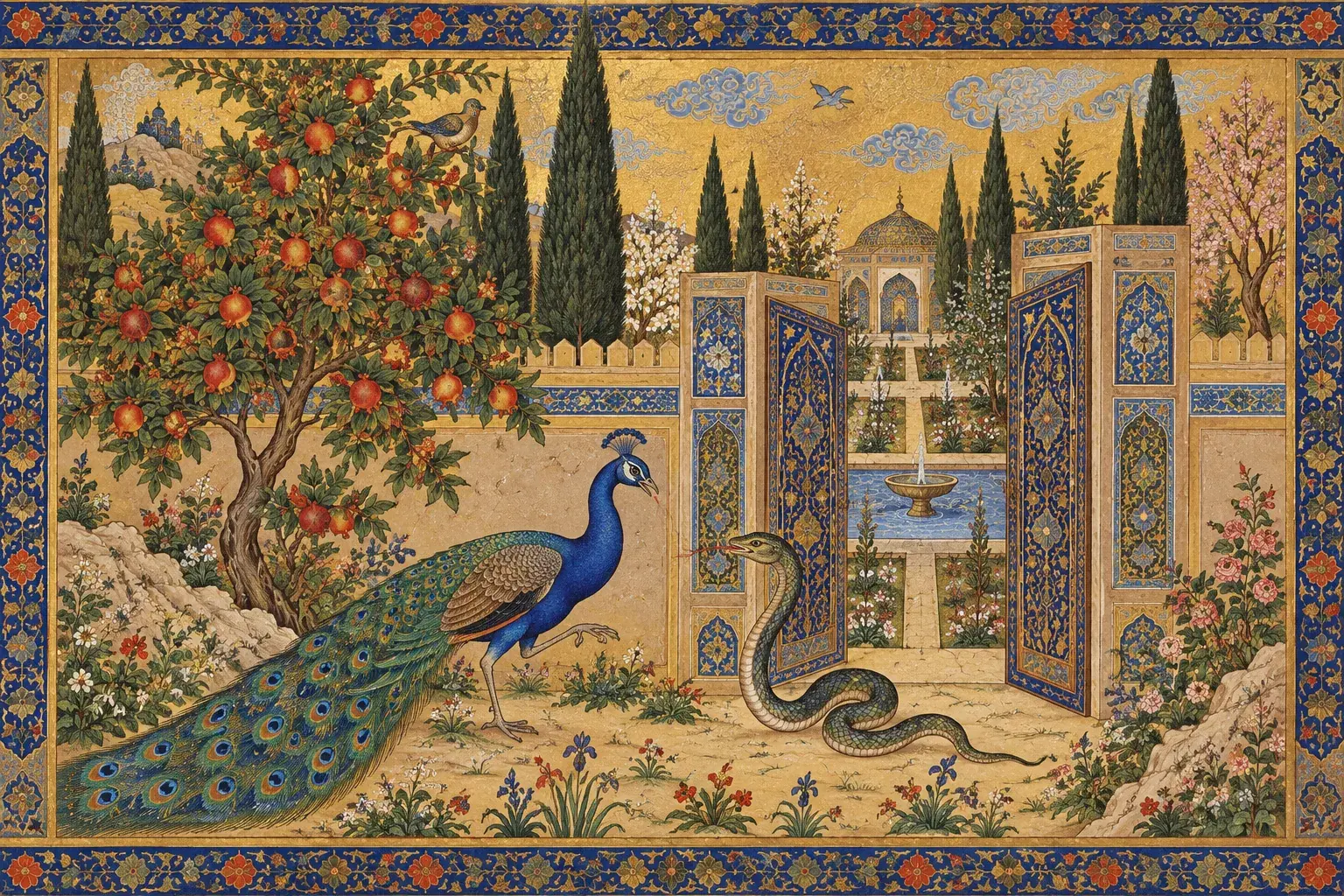
Later storytelling traditions describe Iblis persuading a peacock and a serpent to smuggle him back into Paradise, a scene illustrated in several historical manuscripts of the Qisas al-anbiya, or Stories of the Prophets.
Iblis in Persian Miniatures and Islamic Visual Art
Iblis is probably the most widely depicted individual supernatural figure in Islamic tradition, appearing across manuscripts including Bal'ami's Tarjamah-i Tarikh-i Tabari.
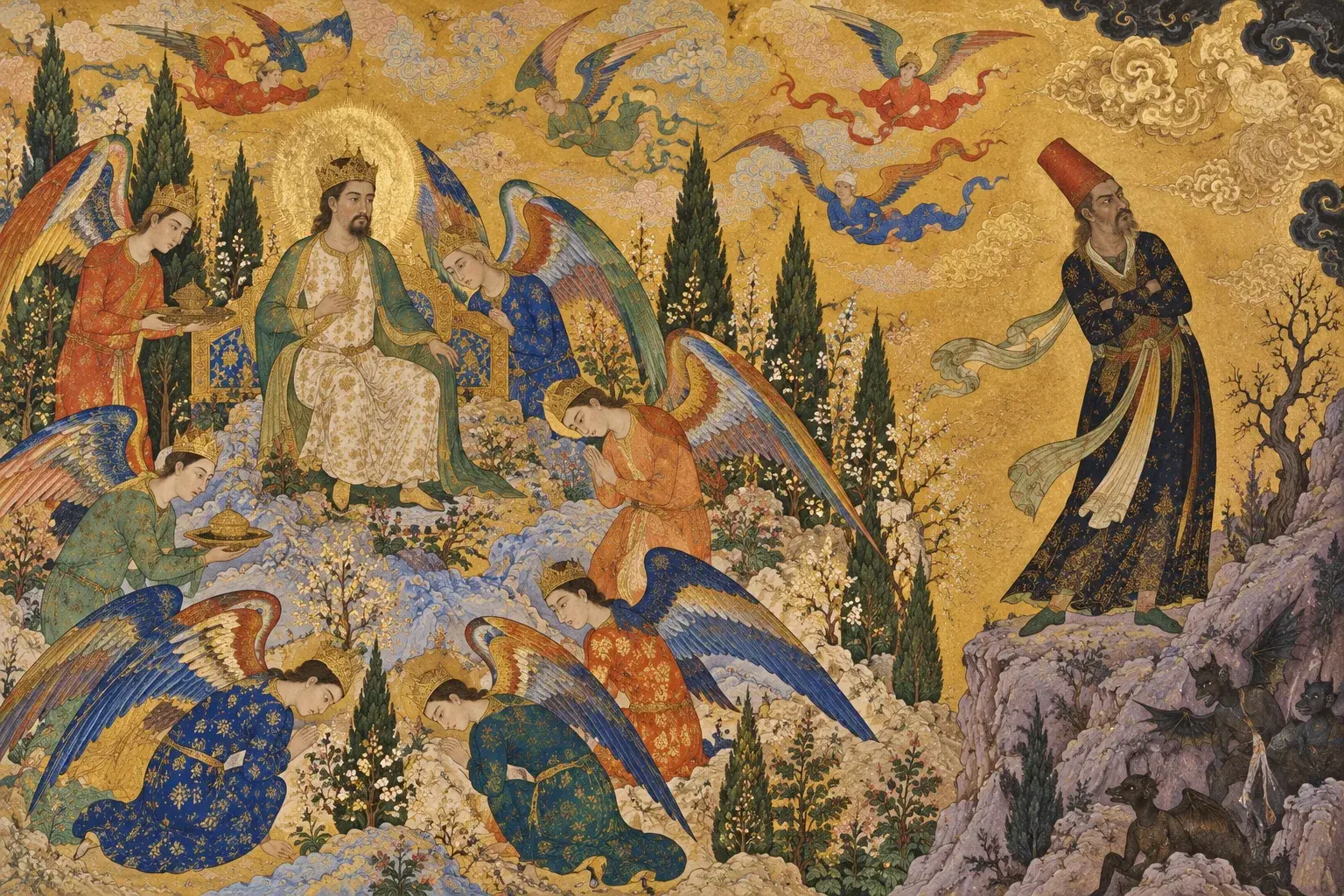
Historical manuscripts illustrating the story of Adam's creation, such as versions of Bal'ami's Tarjamah-i Tarikh-i Tabari, repeatedly show the same moment: the angels prostrate while Iblis alone remains upright.
Francesca Leoni, writing on the monstrous in Islamic visual tradition, describes a recurring physical type: roughly human-bodied, with flaming eyes, claws, a tail, large horns and a grossly oversized head. Painters frequently gave him a black face, a convention which later became shorthand for satanic or heretical figures generally, and a black body to signify corrupted nature.
A second convention shows him in human form wearing a distinctive head covering, deliberately unlike the traditional Islamic turban, paired with long sleeves marking long devotion to God. In only one known image does he wear conventional Islamic headgear. Most pictures capture the same instant - the angels prostrate, Iblis alone upright. In the Bal'ami manuscripts he's typically placed beyond a rocky outcrop, wings burned, face already transformed into something envious and demonic. In fully demonic form he resembles his cohorts in Turko-Persian art as div, bangled creatures with flaming eyes wearing little more than a short skirt. Just as European artists dressed their devils in the traits of pagan gods, Islamic painters often gave theirs features borrowed from Hindu deities.
Hafez, Muhammad Iqbal and Iblis in Modern Literature and Film
The literary afterlife is where the theological ambiguity proves most productive.
Iblis, regarded as an angel by Hafez, is condemned to act the role of imposter, one who performs love but is in fact consumed by envy of humanity's exalted position. The advice to the reader is not to reveal the secrets of divine love to such a person.
Muhammad Iqbal's Javid Nama gives Iblis a constructive role closer to Goethe's Mephistopheles, as a necessary obstacle to test whether humans can learn to overcome their selfish tendencies. Only by resisting and defeating Iblis can a person finally prostrate properly and reach salvation.
The Egyptian novelist Tawfiq al-Hakim took the idea of Iblis's repentance furthest in ash-Shahid (1953), where Iblis repents, then goes looking for absolution - to the Pope, to a Rabbi, to the head of al-Azhar, finally the angel Gabriel. Every one of them turns him down, and in the denial he understands why; without his evil, good cannot exist. His closing line is that he is a martyr.
The 2008 Turkish horror film Semum draws upon both Iblis and his offspring, blaming God for abandoning demon-kind once humanity was created and vowing to destroy the newer creatures. Iblis himself never appears, but his presence saturates the film - described by his followers as master of the World of Fire, and by the exorcist as a prisoner in the lowest pit of hell. The metaphysics are recognizably Sufi: the demon's dualistic claim that hell belongs to Iblis collapses when God intervenes there, proving that Iblis produces only the illusion of divine absence.
Pavel Nosachev has argued that the Lucifer of Supernatural's fifth season, despite obviously Christian roots, resembles the Quranic Iblis more closely - an angel who said he loved God above everything, was ordered to bow before a newly created species, and answered that he could not.
That's a remarkably durable story for a figure who's only appeared eleven times in scripture. What keeps it alive is the question, which nobody has ever closed: how a creature operating within a universe wholly determined by God could rebel at all, and what it means that the story insists he did.