During the Lizzie Borden trial 1893, a Fall River jury took just ninety minutes to acquit her of hatchet murders. Between those two facts sits a hatchet head nobody could tie to the killings, a burned dress, and an inquest ruled inadmissible. Here is what the evidence actually showed.
Lizzie Borden was acquitted. That is the one piece of information that seems to have been buried by some skipping-rope rhyme that not only gets the weapon wrong, but also the number of blows and the verdict itself.
On 4 August 1892, Andrew Borden and his second wife Abby were found murdered in their home in Fall River, Massachusetts, by an unknown assailant who used a hatchet. Within the approximately ninety minutes in which the killings occurred, thirty-two-year-old daughter Lizzie Borden was in or around the house. She was arrested, indicted, tried, and found not guilty by a jury in June 1893, after less than two hours deliberating.
No one else was ever accused. Lizzie went on to live out the rest of her years in Fall River, in relative isolation but great wealth. The local legend has since lived on in films, operas, ballets, a Broadway musical and at least one heavy metal band. What follows is the evidence, the proof of acquittal, and the reasons why the debate continues to this day.
The Borden Household at 92 Second Street
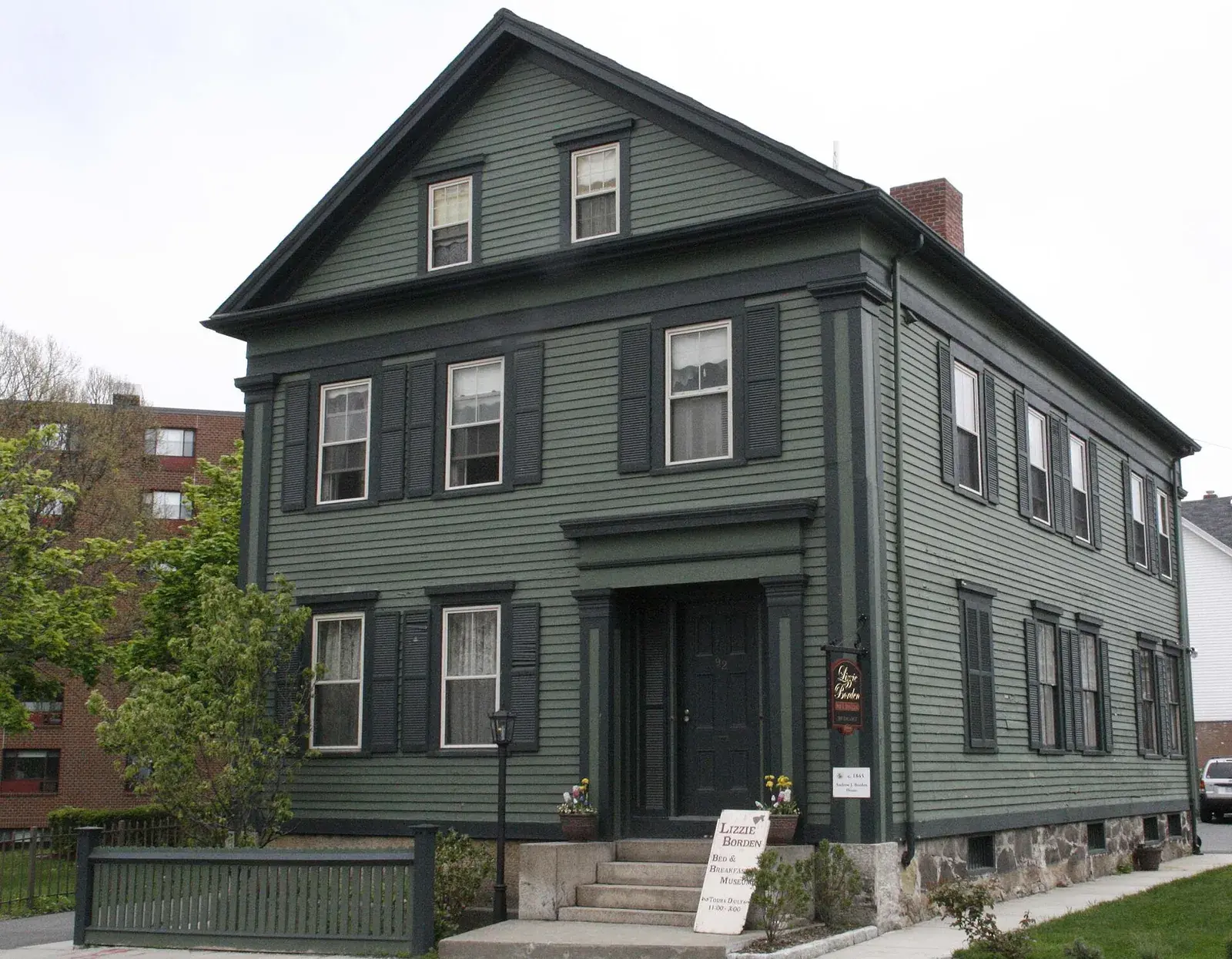
The Second Street house had no indoor plumbing, a conspicuous economy for a man worth roughly $300,000.
Image Credits: dbking from Washington, DC, via Wikimedia Commons (CC BY 2.0)
Andrew Jackson Borden came from a respected if poor family; he was forced into financial hardship as a young man, but managed to later make a fortune in the manufacturing and selling of furniture and coffins, as well as laying out property lots. He was a man of many business dealings, and in 1892 was a director of several textile mills, president of the Union Savings Bank, and director of the Durfee Safe Deposit and Trust Company. He owned several mills, as well as his own commercial properties, and his total worth at the time of his death was approximately $300,000 — roughly $10.8 million dollars in today's currency.
His frugality has been noted by historians, and it was part of the reason why his household on Second Street was considered odd by the locals. At the time, the house did not have any indoor plumbing, which was considered old-fashioned in a region where most homes had them. This area of Fall River was becoming increasingly desirable, as it was close to the local mills and other businesses. Still, Andrew's peers were choosing to live in the more prestigious part of town, The Highlands, and not in the neighborhood with the immigrants. A man of Andrew Borden's wealth and social standing should have been able to afford the luxury of the second floor in a house with a bathroom, but he did not.
Lizzie Borden was born on 19 July 1860, the third child of Andrew and his first wife Sarah. Her sister Emma was older, and Lizzie's other sister Alice died from hydrocephalus at the age of twenty-two months. When Sarah passed away, when Lizzie was two years old, her father married Abby Durfee Gray. Lizzie and Emma were raised to be pious, and spent their weekends at the Central Congregational Church, while Lizzie, as an adult, taught Sunday school to the local immigrants and was the secretary-treasurer of the Christian Endeavor Society.

Before the murders, Lizzie was best known in Fall River as a Sunday school teacher and temperance worker.
Image Credits: Anonymous Unknown author, via Wikimedia Commons (Public domain)
She was also a member of the Woman's Christian Temperance Union and the Ladies' Fruit and Flower Mission. This is in stark contrast to the woman described in the skipping rhyme, and shows that Lizzie Borden lived a life of service to others.
Lizzie's relationship with her step-mother Abby was strained at best. She claimed that she called Abby 'Mrs. Borden' and was unsure as to what to think of her. Lizzie believed that Abby married her father for his money, and that his decision to remarry was not well-received by the household. When Abby's sister received a house as a wedding gift soon after the marriage, Lizzie and her sister Emma purchased the house that they lived in for a dollar, and sold it back to Andrew for $5,000, about $179,000 dollars in today's currency.
In early August 1892, John Vinnicum Morse, the maternal uncle of the Borden sisters, visited the household. He was staying there for a few days, at the request of Andrew Borden. This has led to speculation that any conversation between him and the Borden family about Abby receiving property had contributed to the tensions between the men. It appears that the main instigator of the impending drama was Andrew himself, who, upon his second wife's sister receiving a house as a gift, let Lizzie and Emma buy back, for one dollar, the house they had lived in until their mother died.
On 3 August, Morse arrived for his annual visit. He was invited to stay for a few days, as Andrew and Abby wanted to discuss several business matters with him. He spent the night in the house, with the Bordens, and left the next morning at around 8:48 a.m. for the purpose of buying a pair of oxen and visiting his niece, with the intention of returning for lunch at noon. Meanwhile, Andrew went for his morning walk some time after 9 a.m.
The task of cleaning the guest room usually fell to the Borden sisters, but on the morning of the murders, between 9 a.m. and 10:30 a.m., Abby went upstairs to make the bed. Forensic analysis later showed that she was facing her killer when she was attacked; the first blow to the side of her head just above the earlobes caused her to spin around and her face to hit the floor, resulting in her nose and brow being scraped and bruised. She received seventeen more blows to the back of her head.
Andrew returned home shortly before 10:30 a.m. His key did not open the door, so he knocked, and Sullivan noted that the lock was jammed and swore. She said that shortly thereafter, she heard someone laughing, although she did not see anyone as she was on the second floor. This statement, among other things, was used at the trial to suggest that Lizzie was upstairs at a moment when her stepmother was already dead; she claimed to be in the kitchen, but Sullivan said she heard the laughter at the landing at the top of the stairs. This means that if Sullivan was telling the truth, Abby's body would have been visible to Lizzie when she came downstairs. Lizzie said that her father asked her where Abby was, and she told him that a messenger had brought a note saying that she went to visit a sick friend.
Sullivan said that she took off Andrew's boots and helped him put on slippers before lying down on the sofa, but according to the crime scene photos, he was wearing boots when he was found. She was in her room on the third floor just before 11:10 a.m., when she heard the girl's voice calling out her father's name saying that he was dead and that someone had come and killed him.
Andrew was found slumped on the sofa in the sitting room, where he had been resting after his morning walk. He had received ten or eleven blows to the head, one of which split his eye open, possibly indicating that he was asleep when he was attacked. His wounds were still bleeding and the police estimated that he had been killed at approximately eleven o'clock. Dr. Bowen, the family physician, came from across the street and declared both victims dead.
Fall River Police Conducts an Investigation Into the Murders
Lizzie's statements to the police who arrived at the murder scene were confusing and inconsistent. She told them that she heard a groan or the sound of someone trying to get help before entering the house. Two hours later, she told the police that she did not hear anything and entered the building without knowing that anything was wrong. She said the same about her stepmother, that she heard a groan or a cry for help before going to the kitchen, but when asked where her stepmother was she said that she thought that Abby had returned and suggested that someone look upstairs. Sullivan and a neighbor named Mrs. Churchill were on their way up the stairs when they saw the body of Abby lying on her stomach in the guest room, where she was found.
Most of the officers who talked to Lizzie did not like what they heard, with many complaining that she acted far too composed for someone whose father and stepmother had just been murdered. In particular, Marshal Hilliard told reporters that Lizzie struck him as 'a very peculiar woman'.
Seaver thought the crime was committed by an insane person, while Judge Blaisdell said the key to unlocking the mystery was the thought that the killer could have been a woman. This could have been the most damaging part of the entire case, as the police did not bother searching Lizzie for signs of bloodstains. They later even agreed that they did not do a good enough search of her room, since she was not feeling well and they did not want to bother her.
They found two hatchets, two axes, and a hatchet-head with a broken handle in the basement, but none of these were removed from the house. The broken hatchet-head seemed to have been planted, as the break in the handle was recent, and the dirt and ash on it were probably there to make it look like it belonged in the house. The police also found a pail of bloody clothes or rags, which Lizzie blamed on her monthly periods, and neither the pail nor the rags were examined by anyone. Bridget Sullivan later wondered aloud why she had not seen this pail while doing the laundry earlier in the week, but by the time she thought to ask, it was gone.
The stomachs of both victims were removed and tested for traces of poison, since many people in the household, including Bridget Sullivan, had been violently ill for days. No poison was found.
The Burned Dress and the Prussic Acid
The two other pieces of evidence that could have linked Lizzie to the murders were not admissible in court, but they were both considered.
Alice Russell, the sister's favorite and a neighbor, stayed with the Borden family for several nights after the murder. According to her, on the morning of Sunday, she went to the house and found Lizzie in the kitchen, holding a skirt that she intended to burn because it was stained with paint. On the night of the murders, an officer outside the house saw Lizzie walking towards the cellar with a lamp in one hand and a pail in the other, but when he looked up, he saw Russell walking back out of the cellar. He also saw Lizzie walking to the kitchen, where she supposedly leaned over the sink, although he could not see what she was doing.
On 6 August, the police searched the house thoroughly, looking through the clothes of the sisters, and confiscating the broken hatchet-head. That evening, an officer and the mayor told Lizzie that she was a suspect in the murders. The next morning, Russell went to the kitchen and saw her tearing up a dress, explaining to the police that she wanted to burn it because it had paint on it. It was never officially confirmed which dress she burned, but it is possible that it was the one she had allegedly worn on the day of the murders.
The other piece of evidence that could have linked Lizzie to the murders was prussic acid, which was suspected to have been used to poison the victims. Residents of Fall River suspected that Lizzie tried to buy hydrocyanic acid, diluted in water, from a local druggist the day before the murders, but she claimed that she wanted to use it to clean furs. The local medical examiner testified that it had no antiseptic properties, but the judge ruled that this evidence was irrelevant to the trial because the attempted purchase was too remote in time to be connected to the killings.
The August 1892 Inquest and Lizzie Borden's Conflicting Testimony
Lizzie appeared before the inquest on 8 August, but the court refused to allow her family lawyer to be present since inquests were held in secret by state law. Lizzie was taking regular doses of morphine to calm her nerves, and her responses to specific questions were said to be affected by the medication.
It was mentioned several times, including by the court itself, that Lizzie was being deceptive, that she gave conflicting answers when she knew the truth, and was generally evasive. She told the inquest that she was in the kitchen reading a magazine when her father arrived, but then said she was in the dining room ironing. She was asked to describe what she did when her father was killed, but she said she was coming downstairs and that she heard her stepmother's voice.
Lizzie was placed in custody on 11 August. The newspapers noted that she acted surprisingly calm and composed during the hearings, describing her as stoic. It was written that she bit her lip and blushed when testifying in front of her lawyer, but her testimony in the inquest had convinced many who previously thought so that she was indeed capable of committing the murders. The Boston Globe published an article about it the next day, and it was widely circulated and read.
It is this testimony, as well as the testimony of others at the inquest, that formed the bulk of the arguments that ended up being presented to the jury at the trial. It was ruled inadmissible at her trial in June 1893. The grand jury was called on 7 November 1892 and voted to indict Lizzie on 2 December.
The New Bedford Trial of 1893 and Lizzie Borden's Acquittal
The trial began in New Bedford on 5 June 1893, and the prosecution team consisted of Hosea M. Knowlton and William Henry Moody, a future Supreme Court Justice. The defense team consisted of Andrew V. Jennings, Melvin O. Adams, and former governor of Massachusetts, George D. Robinson.
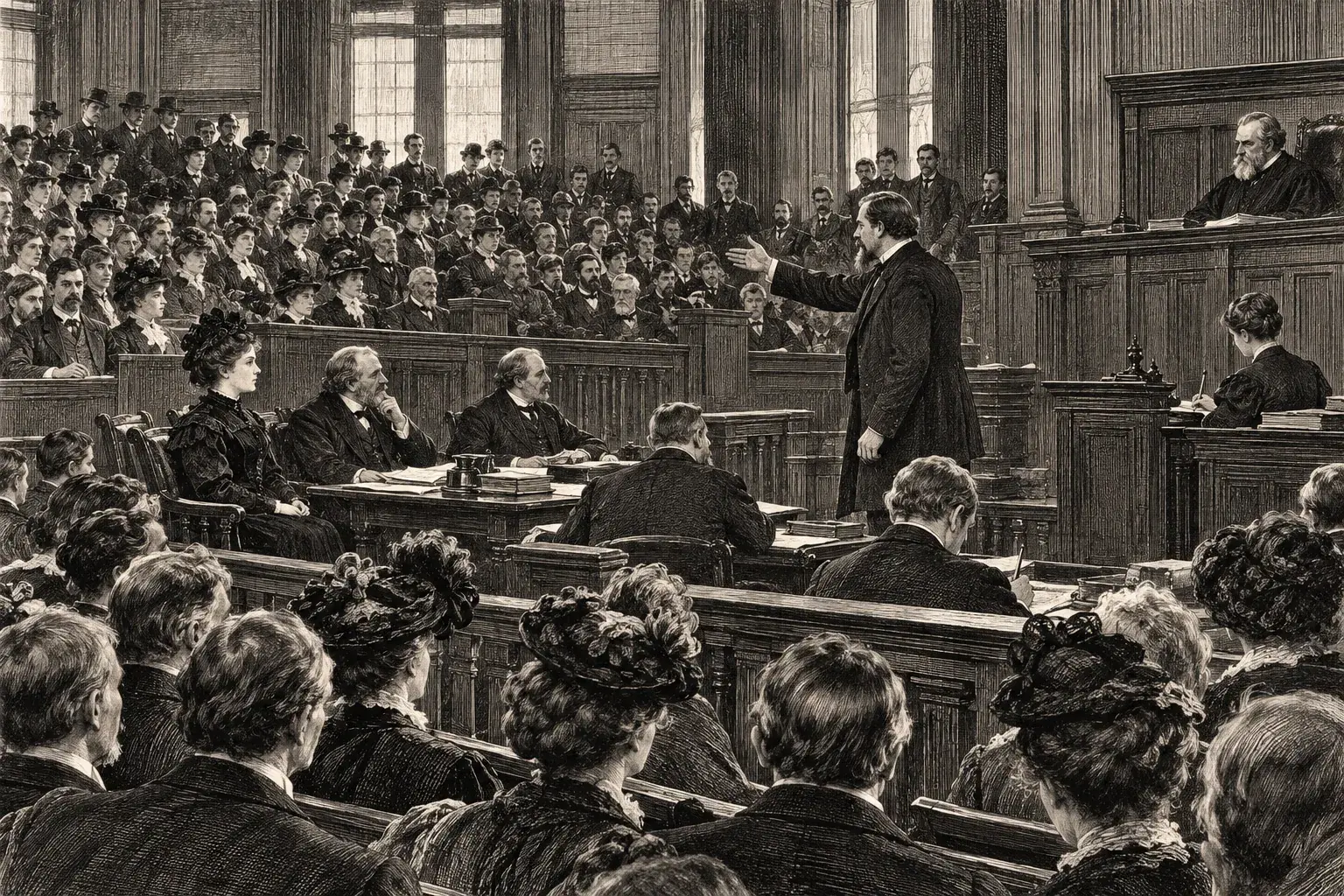
Fifteen days of testimony in New Bedford made the Borden case one of the most heavily reported trials of the century.
The prosecution made several key errors that could have damaged their case. This was mainly due to the fact that it was extremely difficult for them to prove definitively that the murder weapon was the broken hatchet-head that the police found in the basement. Their argument that the handle was cut off so that it would not be soaked in blood when the killer wiped it was weakened by the testimony of a police officer who stated that a hatchet handle had been found near the hatchet-head, a claim another officer contradicted. At trial, no bloody clothing was found at the scene, despite Lizzie's assertion that she did not kill her father and stepmother. The testimony of Russell about the dress was entered into evidence at trial, and the defense did nothing to refute it.
Lizzie's alibi was weak, as was her testimony about what she did in the early morning hours of 4 August. Sullivan testified that she went upstairs at around 10:58 a.m. to check on the second floor, leaving Lizzie and her father alone in the house, but she did not hear or see anything suspicious. Lizzie told several people that she went to the barn loft to look for old lead sinkers for a fishing trip and that she was gone for twenty minutes, perhaps half an hour, before she returned to the house. Hyman Lubinsky testified for the defense that he saw her walking back from the barn at 11:03 a.m., and that Charles Gardner confirmed the time. Lizzie called Sullivan down around 11:10 a.m. and told her that her father had been murdered. She ordered Sullivan to get a doctor and not to go near the room. Both of the victim's skulls had been removed for examination, and were presented to the court on 5 June, causing Lizzie to faint when she saw them.
There was also the matter of the other axe murder in Fall River. On 1 June, which was five days before the trial began, Bertha Manchester was found dead and mutilated in her own kitchen. The murders were similar, and the jurors must have been aware of this since the similarities were widely reported in the press. Jose Correa de Mello, a Portuguese immigrant, was convicted of the crime in 1894. He was also found to be nowhere near Fall River at the time of the Borden murders, but it is conceivable that this information did not reach the jurors, who were tasked with deciding whether a certain woman was guilty of two particularly heinous crimes.
Presiding Associate Justice Justin Dewey, who was appointed to the position by Robinson while in office as a governor, gave a long speech in favor of the defense before the jury was released on 20 June. The articles the next day report that it took the jury only forty minutes to decide on a verdict, but some later accounts claim that it took an hour and a half. Lizzie told reporters as she left the courthouse that she was 'the happiest woman in the world'.
It has since become one of the most spectacular trials in history, mentioned in the same breath as the trials of Bruno Hauptmann, the Rosenbergs, and O.J. Simpson as a landmark in the history of publicity and popularizing American courts.
Other Suspects: John Morse, Emma Borden and Bridget Sullivan
Lizzie was not the only suspect in the case, despite what the inquest and trial may have suggested. John Morse stayed overnight in the house on the night of the murders and was generally disliked by many of the local residents, but he provided an alibi for the time when Abby was murdered that was far too precise. He was mobbed by a group of people on his way out of the house the day after the murders, and had to be escorted back inside by the police.
Emma had an alibi, although it was not a strong one, as she was in Fairhaven, fifteen miles from Fall River, but crime writer Frank Spiering believes that she may have snuck back to the house, murdered her parents and returned before the telegram arrived. William Borden, a man who was rumored to be Andrew's illegitimate son, was mentioned as a suspect by the author Arnold Brown, who claimed that he was a failed blackmailer. Later in life, however, Leonard Rebello discovered that he was not Andrew's son at all.
Bridget Sullivan, for her part, is both the most likely suspect to have been acquitted and the most interesting. She later married a man she met while working as a maid in Butte, Montana, and died there in 1948. She was supposedly close to her sister, Sarah, and it is said that she confessed to her that she lied about seeing Lizzie at the second floor landing, after which she died. This was supposedly mentioned by the County Hospital, and not by any of her personal contacts.
Some Theories About Lizzie Borden's Possible Motives
The theories are roughly divided by the decades in which they appeared, and each one says more about the time in which it was written than about the events of 1892.
Victoria Lincoln wrote a book in 1967 suggesting that the murders were committed by Lizzie, but that she was in a fugue state when she did so. The most common theory about Lizzie's motivation for committing the murders is that she was abused by her father and killed him as a result. There is practically no evidence to support this, but it does not mean that it is not true. Sexual abuse of children was not spoken about openly in those days, and there was no forensic medicine as we know it today. It was mentioned in passing in local newspapers at the time, and again in an article by Marcia Carlisle in 1992.
The most notable work that mentions this theory is the book Lizzie by mystery writer Evan Hunter, who wrote under the pen name Ed McBain. He claims that the murders were the result of Lizzie and Bridget Sullivan spending the night together in the house. Abby supposedly discovers them and is horrified, and Lizzie kills Abby with a candlestick when she tries to leave. Lizzie then confesses to her father when he arrives home, but he reacts with the same horror and is also killed by Lizzie. Lizzie was reputed to be homosexual in her later years, but no such rumors ever surrounded Sullivan.
Maplecroft and Lizzie Borden's Aftermath
After being acquitted of the murders, the sisters bought a large modern house in the smart district of The Hill, which their father had refused to live in. Lizzie took to be known as Lizbeth A. Borden and employed live-in maids, a housekeeper, and a coachman at Maplecroft, her new home. Since Abby was ruled to have died before Andrew, her share of the property passed first to Andrew and then, on his death, to his daughters, and a considerable amount of money was paid to settle the claims of Abby’s heirs.
Nevertheless, despite being acquitted, Lizzie was never able to return to society. Not only was she ostracized by Fall River society, but her name also appeared in the newspaper again in 1897, this time in connection with an incident in Providence that involved alleged theft of goods. Moreover, in 1905, after a quarrel with her sister over a birthday party for the actress Nance O’Neil that Emma did not attend, the sisters became complete strangers to each other.
Lizzie died of pneumonia on 1 June 1927, having survived another year after surgery to remove her gallbladder. Details of her will were not published, and her funeral was private, as very few people attended it. Nine days later, in New Hampshire, Emma also passed away at the age of seventy-six. The two single women lived their lives in seclusion, and their bones were finally laid to rest next to each other at Oak Grove Cemetery.
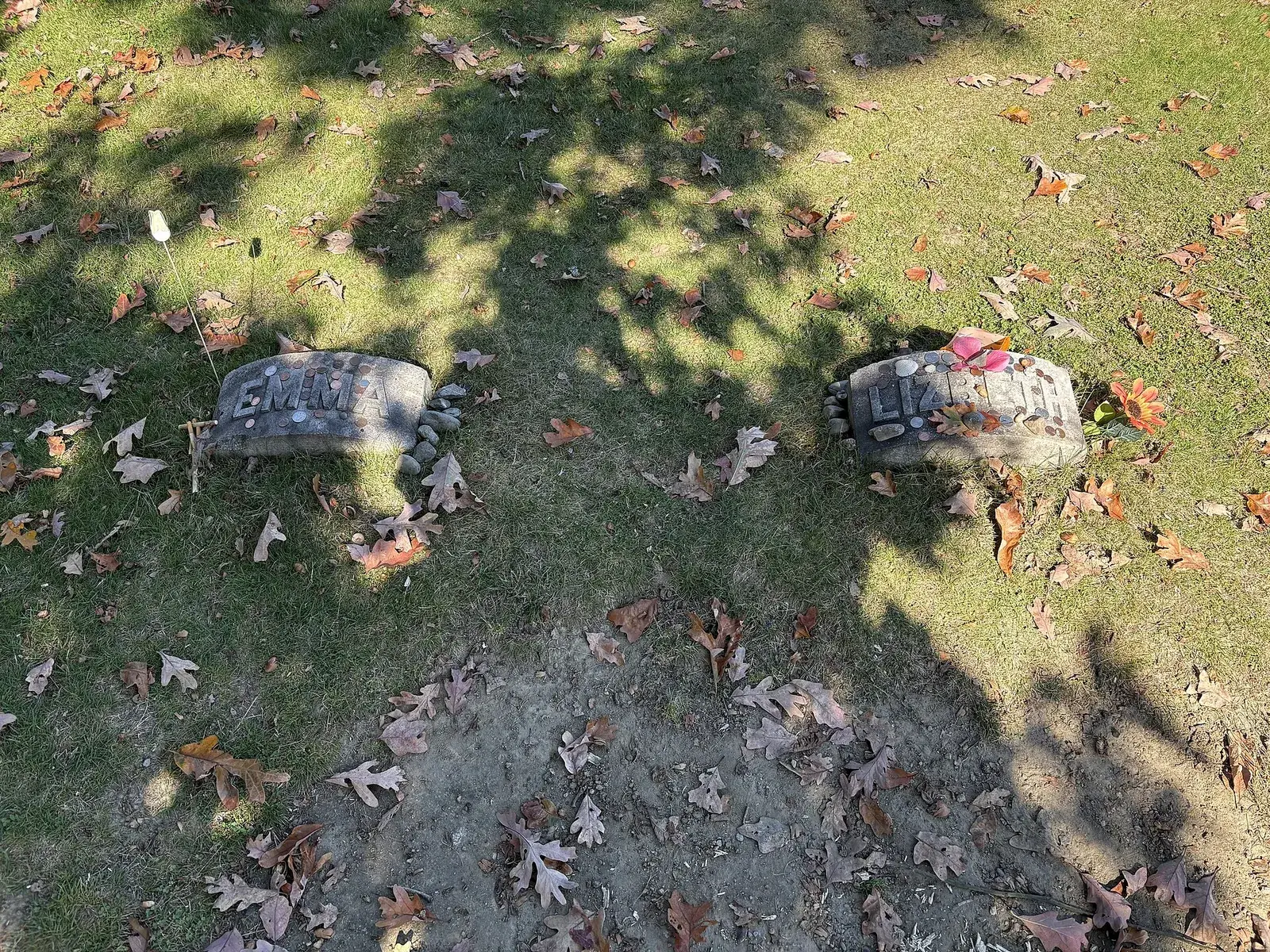
Lizzie and Emma were buried in the family plot, a few feet from the father and stepmother whose deaths defined them.
Image Credits: dbking from Washington, DC, via Wikimedia Commons (CC BY 2.0)
Her will turned out to be worth more than $250,000, about $6.2 million today, and she left $30,000 to the Fall River Animal Rescue League and $500 in trust for the perpetual care of her father’s grave.
The Skipping-Rope Rhyme and Its Inaccuracies
The skipping-rope nursery-rhyme verse was set to the tune of “Ta-ra-ra Boom-de-ay,” and it was the reason why people outside of Massachusetts even knew about the case, and it was wrong in almost every detail. In fact, Abby was Lizzie’s stepmother, not her mother, and the murder weapon was a hatchet, not an axe. In addition, there is an overstatement of the number of blows: Abby received eighteen or nineteen strokes, and Andrew received eleven blows.
Folklore tells of an unknown author who wrote the verse to create interest in the murder and for the sake of circulation, but some blame Mother Goose, also unknown. Interestingly, the second verse predicts that Lizzie will hang, which means that the author clearly believed in her guilt. Perhaps it was the author’s hope that the prediction would come true, but the first verse, significantly more famous, served as a model for fictional adaptations that followed.
Ann Schofield notes that the story of the Borden murders has taken on two fictional forms: the tragedy of the doomed love and the feminist revenge fantasy, making it a myth in its own right. It was depicted in a de Mille ballet in 1948 and a Beeson opera in 1965. The film star Elizabeth Montgomery played Lizzie in the television movie The Legend of Lizzie Borden in 1975. Meanwhile, a genealogist revealed that Montgomery and Borden were sixth cousins once removed. Finally, the movie Lizzie, with Chloë Sevigny and Kristen Stewart, was released in 2018, showing the Sullivan theory. Borden is also part of the fourth season of the Ryan Murphy series on Netflix, entitled Monster.
Today, the Borden house is taken care of as a museum where tourists can enjoy a visit to a 19th-century-style kitchen. However, the trial exhibits, including the hatchet, are in the Fall River Historical Society. This division seems to be the most remarkable because neither tourists nor investigators will get answers since the testimony was declared inadmissible in 1893, and after deliberations that most accounts put at about ninety minutes, the jury declared Lizzie Borden not guilty. The murder mystery will continue to captivate historians and jurists alike for many years to come.