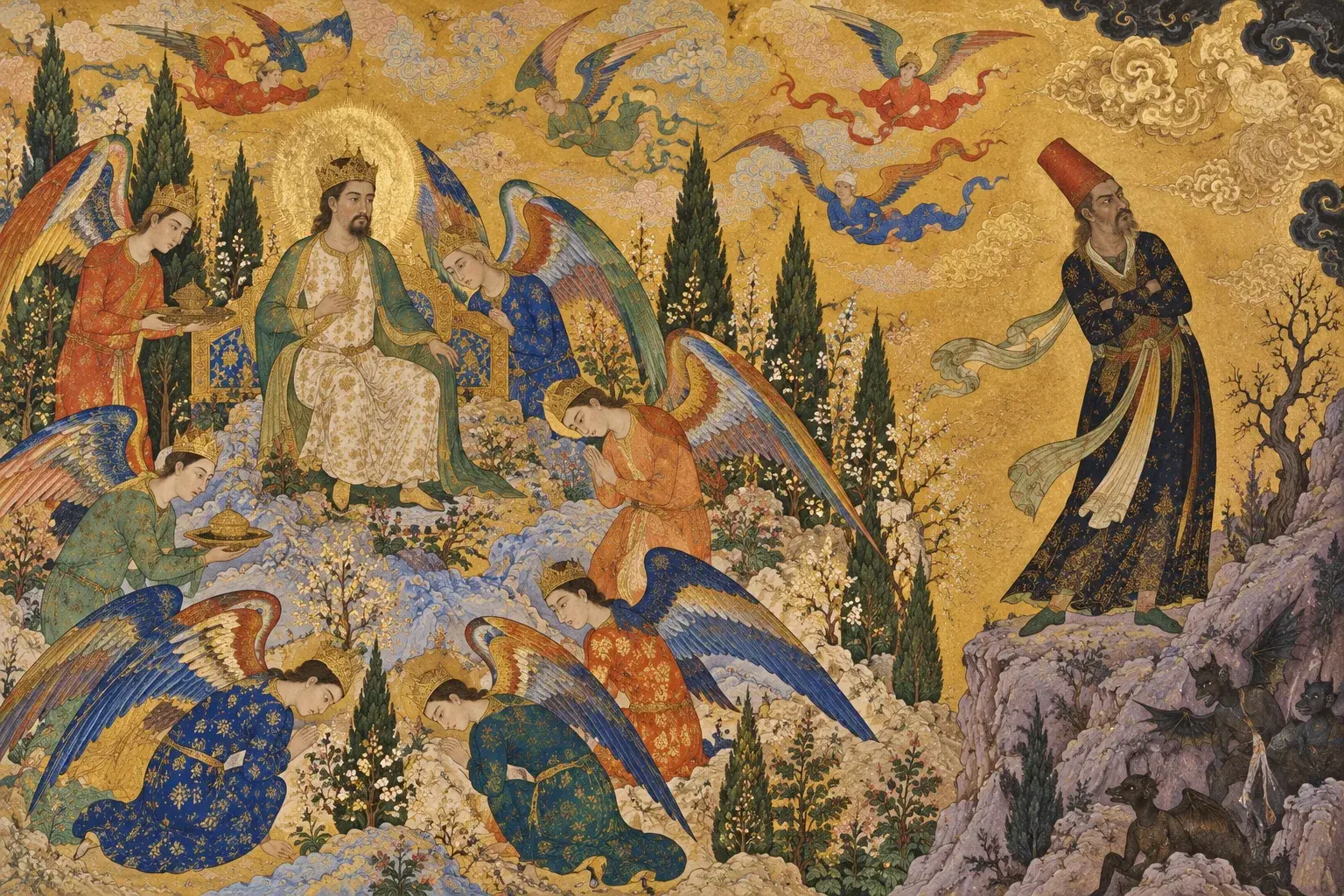
An eighty-year-old shepherd stood on the far side of a desert, looking at an impossible sight. There was a bush that was on fire, but the flames didn't consume it, leaving the leaves healthy and green.
Turning, the man looked toward the fire, and the voice that came out of it knew his name. From forty years of living in the wilderness, tending to another man's sheep, he had escaped the murder charge he knew was on his head. He didn't realize he was about to be given the most impossible task in all the scriptures - to return to the land of the king he fled, to enter his palace and demand the rights of an entire race of slaves.
A New Pharaoh And The Cruel Order
Time had passed since the days of Joseph, and his descendants had long since turned from the man who delivered Egypt from famine. The book of Exodus tells us that a new Pharaoh had risen to the throne, one that had no love for Joseph or his family.
The Israelites had multiplied, filling the land of Egypt, and the new king became fearful that they would grow stronger still. He ordered them to be enslaved, making them work, brick after brick, on his storehouses and palaces, under the cruelty of Egypt's taskmasters. The more they toiled, the more they grew in number, and the Pharaoh's orders grew harsh. When he ordered the Hebrew mothers to kill their sons at birth, the midwives refused, telling the king they were "untimely" births.
They did this in the face of the king's wrath, and so Pharaoh ordered all newborn sons to be cast into the river. A mother tried to hide her baby for three months, but when she could no longer protect him, she did something extraordinary. She made a basket of reeds, tarred it, placed her infant in it and laid it among the river plants.
It is notable that the author uses the same word in Hebrew for both the basket and for the boat in which Noah and his sons traveled the flood. Only two things in the Bible are referred to as "tevah" in the original language. It is the name of the vessel that saved humankind from the waters, and a mother placed her son in the same kind of basket to save him from certain death in the Nile.
The baby was placed in the river, and his sister watched from a distance. The Pharaoh's daughter came to the river for her bath, and she found the basket caught among the reeds. Inside, the infant was wailing and crying.
Pharaoh's daughter finds the infant Moses hidden among the reeds of the Nile, in a basket his mother built to save him from Pharaoh's order to kill Hebrew sons.
She took him and determined he was one of the Hebrew children, and so she resolved to adopt him, in spite of her father's orders. The sister, watching from a distance, was quick to suggest that she should find a Hebrew woman to nurse the child.
Her suggestion was well received by the princess, and so she fetched the mother, saying that she would care for the little one. The child's own mother would nurse him, and she would be paid for her time by the princess. As the baby grew, she would continue to care for him, and when he was a young man, she brought him to the princess's attention, and he was raised as her son.
The name Moses means "drawn from the water," and he grew in the palace of the man who ordered his murder. The boy was raised as an Egyptian, and though his skin may have been dark, he was treated as a son of Pharaoh himself.
From Prince To Slave On The Run
As an adult, Moses was treated as a prince of Egypt, but it didn't soften his heart towards his people - the Israelites.
One day he saw an Egyptian taskmaster beating a Hebrew man, and it filled him with such fury that he killed the man in cold blood. He had thought himself safe and sound behind the palace's walls, but the next day, he was accosted by two Israelites, demanding he give them a reason for intervening when he saw the beating. Moses had grown up in power, and he had no notion of diplomacy or softness in matters of race, caste, or creed. He killed the Egyptian and buried him in the sand when he was alone.
He went back to the palace, thinking himself safe, but Pharaoh quickly ordered his death, and Moses spent the rest of the night running from Egypt. He was fleeing eastward, and at a well in Midian, he defended a group of seven sisters from a group of abusive shepherds.
The women's father befriended him, and he married one of the daughters, Zipporah, with whom he had a son he named Gershom. He called him that because he said, "I have been a stranger in a strange land."
From here, the story of Moses takes a long, strange turn.
The Forty Years In The Wilderness
It was at a place called Horeb that God showed Moses the miracle that made him into something more important than a mere prince or murderer.
The shepherd took his flocks to the far side, where he glimpsed a bush that burned, but the fire had no power to consume even one leaf. He turned toward it, and the voice of God spoke to him from within the flames.
At Horeb, Moses sees a bush that burns without being consumed, and hears the voice of God calling him to lead Israel out of Egypt.
"Moses, Moses!" the Lord called, saying he should take off his sandals because the place he stood was holy ground, and then he said something that would change Moses's life. "I am the God of your father... the God of Abraham, the God of Isaac, and the God of Jacob." Moses covered his eyes, for it was too much for him to bear. It was a truth too great for one man to understand without seeing the power of God's mighty hand.
"I have seen," said the Lord, "the suffering of my people in Egypt, and I have heard their cries. It is time I went down and rescued them from the Egyptians. I will bring them up out of that land to a good, fertile land." Then God spoke the words that would call Moses to the task that was to define the rest of his life. "So go now. I will send you to Pharaoh so that you can bring my people out of Egypt."
What happened next was not unusual for the Bible. At first, Moses did not seem to think he was the right man for the task. The reasons were all very pious, but the fact remained that not even the most devout Israelite in all the land would have believed him when he said "God sent me." "Who am I," Moses asked, "that I should go to Pharaoh?" If the Lord had told Moses something that was untrue about himself, he might have accepted it, but God answered, "I will be with you."
Moses's next objection was that if they asked his name, he didn't know what he should say. The answer was not one Moses might have expected if he knew more about the nature of God. "I AM WHO I AM," God said. "Tell them I AM has sent you." It was the nearest thing the Creator had to an actual name, and it declared His glory in all the world, a name unpronounceable by the masses who made idols of everything they could find. It was the most perfect name Moses needed to convince his people that it was God who had brought them out of Egypt, not some young prince.
Moses had more objections, and God gave him reasons to stop doubting. "Even if I do come to them," he objected, "and they accept what I say, that they are God's chosen people, what if they ask for a sign?" "If they ask for a sign," God replied, "tell them the following signs shall happen, and I will make them." God told Moses to throw his staff upon the ground to make a snake, and then to pick it up so it would return to being a stick.
God gives Moses a sign to convince the Israelites: his shepherd's staff transforms into a snake, then back into a staff, when thrown to the ground.
But "I am not eloquent," Moses objected, "I do not speak well. I have a slow tongue." God became angry with him, but he gave him his last reason to believe he would get Moses to Egypt. "If I go to them," Moses said, "they will ask me to speak for them, but I have a slow tongue and a slow heart." God told Moses to return to Midian, and to take his brother Aaron, who would help him with his tongue.
All through this time, Moses kept doubting, and God kept assuring him that he would have whatever he needed to do the task. It was a long process, but he stopped being a proud shepherd, and he took up the staff to lead his people away from the hands of their oppressors.
The Forty Years In The Wilderness Are Important
They are the time in the scripture where Moses learned the skills of humility and patience. He learned that power without patience was a recipe for disaster, and that without humility, power became tyranny. The forty years of tending sheep for another man taught him all the lessons he needed to learn when it came to the position of leadership. He knew the wilderness, for it was going to be his people's home for the next forty years, and he was prepared to lead them into it.
Moses the Leader Is Chosen By God
The life of Moses is a series of improbable encounters.
A condemned slave becomes a prince's son, and after years of power and privilege, murders a man in a rage. He runs from the country to avoid his punishment and ends up as the hired hand of the princess who adopted him. He has children, works for a living, and lives the life of an ordinary Israelite, with one exception - he is still being prepared for a task that he doesn't yet know anything about.
The man who had the most power in all Egypt has to beg for mercy to his adopted father when his murder is discovered, and he spends the night on the run. When dawn breaks, he is somewhere far enough away to avoid immediate detection, but he is spotted anyway. Moses takes his flocks of sheep to the far side of a desert, where he finds the burning bush, and God speaks his name.
It is the voice of God that tells Moses what he is meant to do, and it is his last lesson in faith. If it wasn't for the forty years he spent in the wilderness, he would have taken his anger and the power of the Pharaoh's sons and tried to take Egypt by force instead of leading the people away from the slaver state. He was old when he finally got the message, but the truth was clear that he would never have been able to carry out his mission if he hadn't learned those lessons as a young man and a shepherd.
Why We Should Know About Moses
It is interesting that Moses wasn't given this assignment when he was young and eager to prove himself. We know from experience that those who seek power for its own sake rarely make good leaders, as they are willing to sacrifice the means for the ends. Moses had no illusions about himself when he said "who am I that I should do this?"
Even so, we can't take this statement out of context, for the Lord told Moses, "I will be with you."
It is important to remember that all of this happens before Moses agrees to go to Egypt and before God begins showing him the miracles he can work in the face of his people. It is the speech and actions of power and might that will bring the Israelites their freedom. Everything changes when Moses hears the voice from the burning bush in the wilderness, but most importantly, it is the promise of divine presence that makes it possible.