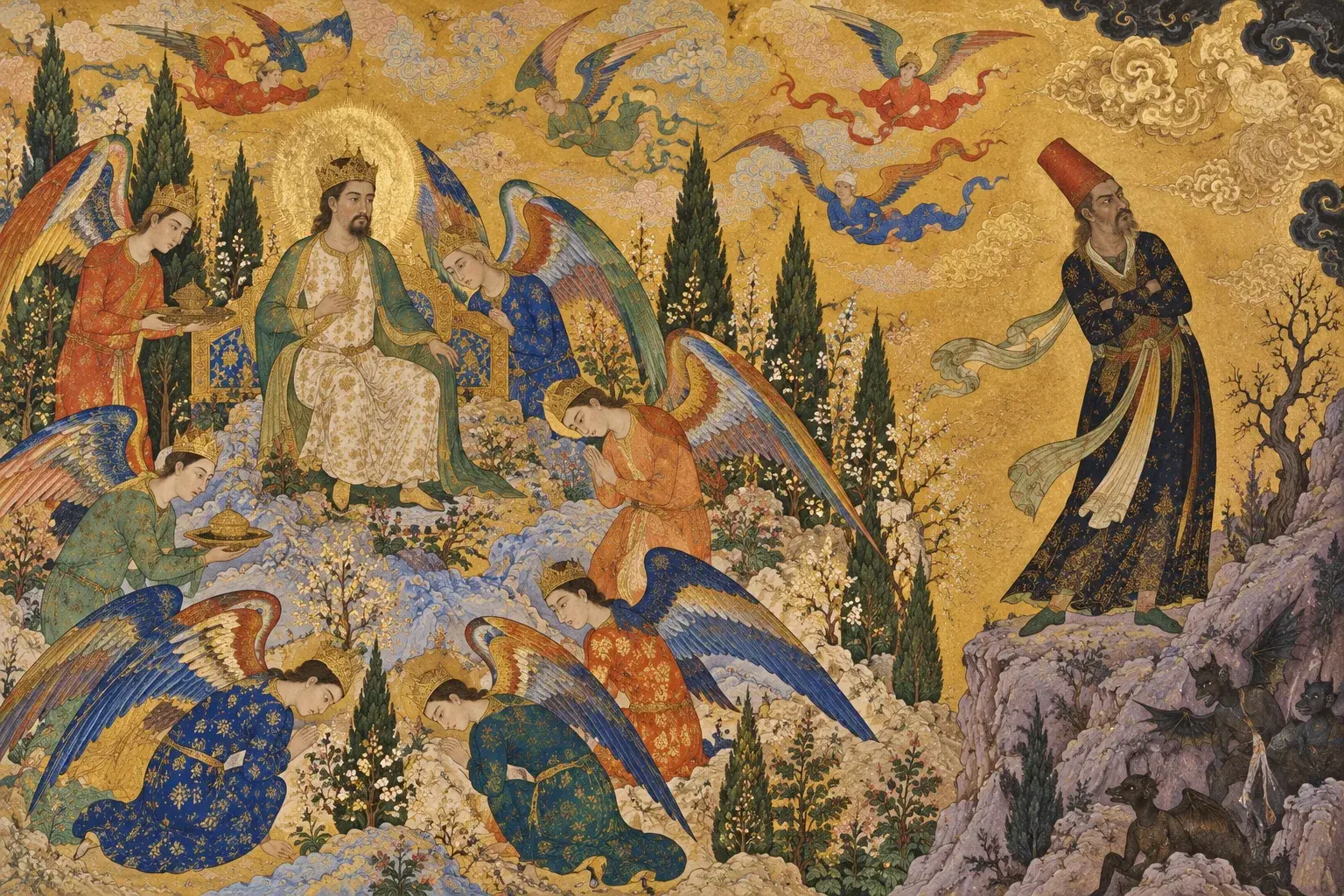
In Zecharia Sitchin's 1985 book The Wars of Gods and Men is titled 'The Pyramid Wars,' and it describes something no Egyptologist has ever found evidence for: a literal, weapons-grade conflict between rival factions of the Anunnaki for control of the Giza pyramids and a facility Sitchin places in the Sinai Peninsula and calls a spaceport. The chapter belongs to the third volume of Sitchin's Earth Chronicles series, which reinterprets Sumerian, Akkadian, Egyptian, and biblical material as a record of real historical events involving an extraterrestrial species rather than as mythology. Real archaeology tells a different story about the Great Pyramid, built up over more than a century of excavation at Giza: a royal tomb constructed for the pharaoh Khufu around 2560 BCE, raised and maintained by a large, organized, and reasonably well-fed Egyptian labor force rather than by warring gods. The Pyramid Wars chapters build directly on claims laid out earlier in the Earth Chronicles about the Anunnaki mining gold on Earth and genetically engineering the first humans, and they carry the same underlying pattern: a chain of real ancient texts, real archaeological sites, and real modern scientific findings, connected by an interpretive leap that the specialists best equipped to check it have not been able to verify. This piece looks at what Sitchin's Pyramid Wars narrative actually claims, and at what Egyptologists have found inside and around the pyramid itself.
Sitchin's Enki-Enlil Rivalry
Sitchin's starting point is a succession dispute he places among the Anunnaki: Enki, whom he describes as the firstborn son of the chief god Anu, is passed over in favor of his half brother Enlil, born to a half sister who held the higher status of principal wife. Sitchin treats this arrangement, in which a son born to a half sister outranks a firstborn son born to a lesser-status mother, as the template behind a range of ancient royal succession customs, and argues that the resulting rivalry between the lines of Enki and Enlil is the underlying cause of repeated conflict across Egyptian and Mesopotamian mythology. In his framework, Enki's descendants become identified with Egypt and with gods such as Ptah, Ra, and Osiris, while Enlil's line is tied to Mesopotamia and to warrior gods such as Ninurta. Sitchin reads the mythological conflict between Osiris, Seth, and Horus, together with a separate body of later Mesopotamian poetry describing battles between the god Ninurta and an enemy referred to as Azag or Ashar, as chapters in one continuing war between these two divine dynasties over territory and, above all, over control of the Giza pyramids and the Sinai facility he calls the spaceport.
The 'First' and 'Second Pyramid Wars'
According to Sitchin's account, the First Pyramid War broke out when Horus, avenging his father Osiris, fought Seth for control of Egypt and, by extension, for control of the pyramids and the Sinai spaceport; Sitchin dates this conflict to roughly 8670 BCE by his own chronology and treats an inscription from the Egyptian temple at Edfu, describing a battle between Horus and his enemies, as a direct account of it. He goes on to describe a Second Pyramid War fought centuries later, in which Enlil's warrior grandson Ninurta leads an assault against the same Enki-aligned gods after they take control of the Giza pyramids and a site Sitchin identifies with Jerusalem. For this second conflict, Sitchin draws on a genuine body of Sumerian and Akkadian poetry, known to scholars as the Lugal-e and related 'Myths of Kur,' which describe Ninurta's battles against a mountain-dwelling adversary; Sitchin reads these poems as a literal account of an assault on the Great Pyramid itself, ending with Ninurta entering the structure and dismantling equipment he describes as crystal 'stones' used for space navigation and defense. These Myths of Kur are genuine, long-studied compositions in the history of Sumerian literature - the pioneering Sumerologist Samuel Noah Kramer worked on several of them decades before Sitchin wrote - but mainstream translators read them as praise poetry describing Ninurta's mythic combat in a mountainous underworld realm, not as a field report from a war over Egyptian real estate. No such equipment, inscription, or corroborating record of either conflict has been identified by Egyptologists or Assyriologists working from the same body of texts.
Sitchin read the Edfu temple's account of a battle between Horus and his enemies as a record of a literal war over the Giza pyramids; Egyptologists read the same inscriptions as ritual and mythological text.
What Archaeology Has Actually Found Inside the Great Pyramid
Modern Egyptology dates the Great Pyramid to the reign of the pharaoh Khufu, in the early twenty-fifth century BCE, and identifies it as a royal tomb built as the centerpiece of a wider funerary complex that included smaller pyramids for royal women, a mortuary temple, and a causeway down to the Nile floodplain. Its interior passages and chambers have all been surveyed and mapped in detail: a descending passage leads to an unfinished subterranean chamber, an ascending passage branches off to a room conventionally called the Queen's Chamber (a nineteenth-century label rather than a description of its original use), and a soaring corbelled corridor known as the Grand Gallery climbs to the granite-lined King's Chamber, where Khufu's empty sarcophagus still sits. Above the King's Chamber, a series of small relieving chambers reduce the weight of stone bearing down on the roof, and stone portcullises originally sealed the passage leading to the burial chamber after the king's interment. None of this construction, according to Egyptologists who have studied it for more than a century, resembles guidance or communications equipment, and no ray-emitting crystal 'stones' of the kind Sitchin describes have been recovered from the pyramid or from any other site in Egypt.
Exactly how blocks weighing up to several tons apiece were moved into place remains one of the genuinely open questions in Egyptology, and it is a question mainstream researchers actively argue about rather than treat as settled. Proposed solutions include straight external ramps, spiraling ramps built up around the pyramid's faces, and internal ramps threading through the core masonry, and each has real evidence and real objections behind it. What virtually no working Egyptologist proposes, however, is that the disagreement has anything to do with alien technology; the debate is conducted using the same kind of quarry marks, tool fragments, and settlement remains that identified the workforce in the first place.
One of the more significant discoveries bearing on this question is not inside the pyramid at all, but just to its south: a purpose-built settlement, excavated from the late 1980s onward by the archaeologist Mark Lehner working alongside Zahi Hawass, that once housed the workforce that built the pyramids at Giza. The site, known as Heit el-Ghurab, included bakeries, food-storage facilities, barracks-style housing, and a nearby cemetery, and the animal bones recovered from it point to a workforce fed on beef and other provisions well beyond subsistence rations. That evidence, along with worker graffiti naming organized labor gangs and inscriptions documented above the King's Chamber logging rotating shifts, has led Lehner, Hawass, and other Egyptologists to conclude that the pyramids were built by a large, rotating force of conscripted and salaried Egyptian laborers rather than by slaves, foreign or otherwise, and certainly not by warring gods. It is a considerably less dramatic story than a battle for control of alien space technology, but it is also one backed by physical remains that can be, and regularly are, examined directly.
Bakeries, barracks, and a workers' cemetery at the Heit el-Ghurab site have shaped the modern understanding of who actually built the Giza pyramids.
How Scholars Have Assessed Sitchin's Reading
The same body of critique that applies to Sitchin's Anunnaki material generally applies to the Pyramid Wars chapters specifically. Michael S. Heiser, whose doctoral training was in Hebrew Bible and ancient Semitic languages, examined the full cuneiform record for the term Nibiru, central to Sitchin's chronology of the wars, and found it used only for the planet Jupiter, occasionally Mercury, the god Marduk, or a star, with no textual link to the Anunnaki or to any hidden planet; he laid out this evidence, checkable against standard reference works such as the Chicago Assyrian Dictionary, in a lengthy published critique. The historian Ronald H. Fritze's survey of pseudohistory, Invented Knowledge, places Sitchin's Earth Chronicles alongside other well-known ancient astronaut and lost-civilization theories precisely because its central claims cannot be verified against the primary sources it cites. Egyptologists, for their part, have not needed to engage with the Pyramid Wars chapters in any specialized way, since the chapters rest on a chronology and a set of translations that mainstream Assyriology already rejects on independent grounds; the wars Sitchin describes do not appear as events anywhere in the corpus of texts he draws them from, only as the poetic and mythological material those texts actually contain.
The Grand Gallery, King's Chamber, and relieving chambers shown here are well documented by Egyptologists; no equivalent of Sitchin's guidance 'stones' has ever been found among them.
Why the Pyramid-as-Spaceport Idea Persists
Part of the appeal of Sitchin's account is that the Great Pyramid genuinely is an engineering puzzle in certain respects, and a narrative that turns open construction questions into evidence of alien technology, and turns a scattered, thematically related set of Egyptian and Mesopotamian myths into one continuous war story, offers a kind of closure that piecemeal archaeological research rarely can. The idea has also had a long afterlife outside Sitchin's own books, echoed in documentaries and online communities that treat the pyramid's interior as a decommissioned machine rather than a tomb, and folded into the wider ancient astronaut theory that Sitchin's Earth Chronicles helped popularize alongside the earlier work of Erich von Daniken. Whatever draws readers to that version of events, the physical pyramid has been surveyed, mapped, and excavated around more thoroughly than almost any other structure on Earth, and the settlement of the people who actually built it sits a short walk from its base, open to the same kind of scrutiny as the monument itself.
Sitchin died in 2010, but the Pyramid Wars have outlived him in the same venues as the rest of his work: cable documentaries, self-published sequels by other authors, and online forums that treat the Great Pyramid's unresolved construction questions as an opening rather than a settled matter of engineering history. That afterlife says something real about how people relate to ancient monuments they cannot fully explain from the outside, even when the explanation offered in its place has already been checked against the sources it claims to rest on and found wanting. The Great Pyramid does not need an alien war to be remarkable; a twenty-year construction project, carried out with copper tools and no wheels, that still stands after four and a half thousand years is a fairly extraordinary claim on its own, and it happens to be one that can be walked through, measured, and checked against a written and physical record rather than taken on faith.