The Cambodian–Vietnamese War resulted in one of the most ironic outcomes in recent diplomatic history. Vietnam invaded Democratic Kampuchea in December 1978, overthrew the Khmer Rouge after two weeks and stopped a genocide that left between 13 and 30 percent of Cambodia's population dead since 1975.
For Vietnam, participating in this campaign meant spending the next ten years being pariah state. The Khmer Rouge retained legitimacy in the UN, China invaded Vietnam's northern provinces, ASEAN, the US, Japan, and even Sweden, opposed Hanoi, and an insurgency emerged around the deposed Cambodian king and prime minister.
Two communist states fighting it out over a region and national prestige was not supposed to happen, especially so soon after both have seized power in their respective revolutions with the help of the other. That it happened, and that Vietnam's intentions were not as noble as stopping a genocide, is what ultimately makes the second Indochina war so fascinating.
Khmer Rouge and Vietnamese Communists Before 1975
The term Khmer Rouge refers to the Communist Party of Kampuchea, which had broken away from the Indochinese Communist Party that was dominated by Vietnamese communists. Relations between the two branches were subordinate at best, and the Cambodian communists never forgave Vietnam for their role in Indochina.
In 1951, Cambodian and Vietnamese communists were allies, fighting the French colonial rulers. The Cambodians led the Khmer Issarak movement while their Vietnamese counterparts formed the Viet Minh. Both had mixed results, but the Geneva Accords of 1954 gave the Vietnamese communists everything they wanted while giving the Cambodians nothing. The agreement stipulated that Vietnam would be separated at the 17th parallel with the north becoming a communist state while the south remained anti-communist. This angered Cambodian communists who fought Lon Nol soon after coming to power in 1960.
When the Geneva Accords of 1954 came due for implementation, and North Vietnam was to withdraw its troops from Cambodia, approximately five thousand communist officials from the PAVN left as well. This was because the Cambodian communist party was staffed with Vietnamese or Cambodians who were under Vietnamese tutelage. The void was filled with a younger generation of revolutionaries who had studied in France. The group around Saloth Sar, also known as Pol Pot, with the support of Ieng Sary and Khieu Samphan, became the new Cambodian communists and formed the Khmer Rouge, adopting Mao Zedong's ideology.
Khmer Rouge and Vietnamese communists were allied once more during the Vietnam War, fighting the Republic of Vietnam and the Khmer Republic. Relations between the two parties were formally friendly until 1975, but Pol Pot always believed that Vietnam wanted to create an Indochinese federation under Hanoi's leadership. The Khmer Rouge had its own designs on Vietnam, as it claimed the Mekong Delta as its territory. The PAVN's support of the Khmer Rouge began to wane in 1973, and open hostilities broke out in 1974. In 1975, Pol Pot signed a treaty of friendship with China, and as Lon Nol's government began to collapse, Khmer Rouge began to purge Vietnamese people from their ranks.
Vietnamese Influence in Cambodia From Century to Century
None of this happened in a vacuum, as Vietnam's relationship with Cambodia has been complicated for centuries. Since the thirteenth century, the Khmer Empire has been influenced by Vietnamese, and direct annexations took place as early as the seventeenth century. The Nguyen lords of Cochinchina helped the Cambodian prince Nak Ong Chan to depose the only Cambodian Muslim king, Ramathipadi I. Later, when another prince from the same dynasty, Nak Ong Chan became king with the help of the Nguyen lords, the latter began to consider Cambodia their possession.
Nak Ong Chan ruled Cambodia as a puppet monarch, and his son-in-law, Min Mang later annexed the country outright and made it a Vietnamese province. He ruled Cambodia until his death in 1834, during which time the Vietnamese tried to assimilate the Cambodians and eradicate Khmer culture, which was perceived as an Indian invention unsuitable for Vietnam. French colonization later transferred this obsession to the French authorities, who annexed the southern part of Cambodia, including Saigon, the Mekong Delta, and Tay Ninh, to Cochinchina. The Khmer Rouge later used this historical revisionism to justify their own invasion of Vietnam.
Lon Nol later added another layer of hostility to these historic territorial disputes. His forces massacred thousands of Vietnamese-Cambodians in March 1970, throwing their bodies in the Mekong River. Another 310,000 Vietnamese people left Cambodia, and those who stayed were later killed by the Khmer Rouge.
Khmer Rouge's Policies Toward Vietnam
The Khmer Rouge government did not have an official ideology before 1975. The state apparatus called itself Angkar (the organization), and the public only knew the names of its leaders from 1977. Khieu Samphan was the nominal leader of the state, but Pol Pot and Ieng Sary held real power.
The objective of the Khmer Rouge policy was to de-royalize and “depetty-bourgeoisie-ize” Cambodia. In other words, the Khmer Rouge wanted to destroy the Cambodian state because it was feudalistic and had a bourgeois economy that served the interests of the monarchy and imperialism. The Khmer Rouge wanted to replace it with a classless society of worker-peasants. The problem was that the Cambodian people had no interest in this revolution, so the Khmer Rouge turned to nationalism, fascism, and anti-Vietnamese propaganda to rally support for their policies. This nationalist Maoism was a distinct feature of the Khmer Rouge, which set them apart from other communist movements after the Sino-Soviet split. It also explains the Khmer Rouge's policy toward Vietnam, which was the driving force behind the genocide.
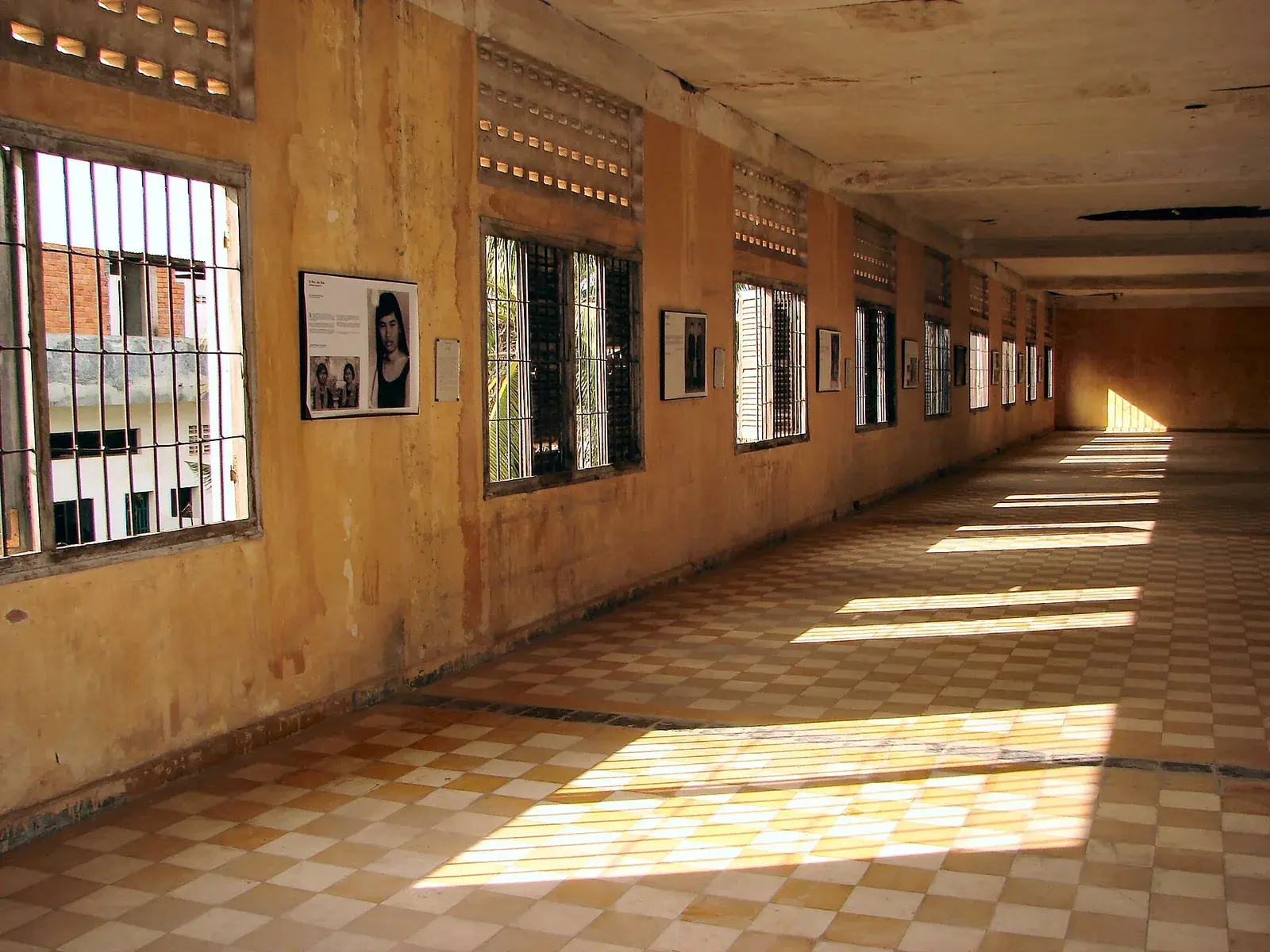
Tuol Sleng, a former Phnom Penh school converted into a Khmer Rouge interrogation and execution center, stands today as a genocide museum.
Image Credits: Bjørn Christian Tørrissen, via Wikimedia Commons (CC BY-SA 4.0)
Phu Quoc, Tho Chu Islands and the First Confrontations of 1975
In April 1975, Phnom Penh fell to the Khmer Rouge on 17 April and Saigon fell to the PAVN on 30 April. The two communist states were supposed to be natural allies, but the honeymoon period was short-lived. Democratic Kampuchea (DK) immediately expelled all Vietnamese troops from Cambodia, and on 1 May, only twenty-four hours after the fall of Saigon, the Kampuchean Revolutionary Army (KRA) invaded the Vietnamese island of Phú Quốc (Koh Tral). On 10 May, the KRA invaded the Thổ Chu Islands and murdered five hundred Vietnamese residents.
Vietnam responded by attacking Phú Quốc and Tho Chu and re-conquering these territories. Vietnam also captured the Cambodian island of Koh Poulo Wai. On 1 June, Cambodia's leader Pol Pot suggested a friendship treaty and talks on the territorial dispute, but these meetings never took place, as Vietnam accused Cambodia of having refused to hold them. Vietnam returned Koh Poulo Wai to Cambodia in August 1975, recognizing DK's sovereignty over it.
This friendly rhetoric continued throughout 1976. Vietnam's officials expressed solidarity with the new Cambodian leadership, congratulating Samphan, Nuon Chea, and Pol Pot on their “elections” in April 1976. Vietnam even accused the US of planning an attack on Siem Reap, which increased the credibility of its accusations against Cambodia. Phnom Penh Radio even announced that “ties of friendship and solidarity between the two brotherly peoples continue to grow stronger and more blossoming,” and an air service between Hanoi, Saigon, and Phnom Penh began operating on 1 September. The Vietnamese premier even told his Cambodian counterpart in October that there were “many difficulties and obstacles between the two countries.”
Vietnam's Border Massacres, the Ba Chuc Massacre and Growing Tensions
This public friendship masked the worsening bilateral security situation. Vietnam considered itself to be the regional leader and thought that it had the right to influence Cambodia and Laos. Vietnam's support for the Khmer Rouge in the 1970–75 struggle against Lon Nol and the Khmer Republic meant that Vietnam continued to regard Cambodia as a Vietnamese satellite state. However, this view was undermined by the fact that DK rarely demonstrated loyalty to Hanoi. The Khmer Rouge even deliberately killed Vietnamese soldiers in border clashes as early as 1973, and the PAVN could not tolerate such behavior from a state that was supposedly its ally. Moreover, the Cambodian communists continued to expel Vietnamese people from Cambodia, which made Hanoi suspicious that Cambodia pursued expansionist ambitions in Vietnam.
On 30 April 1977, the second anniversary of the fall of Saigon, the KRA invaded An Giang and Châu Đốc provinces killing hundreds of Vietnamese. Vietnam responded by calling for consultations, but Cambodia replied that Vietnam should withdraw its troops from Cambodia and respect a demilitarized zone. Six Cambodian divisions invaded Tay Ninh in September 1977, killing over a thousand Vietnamese residents of Tân Biên district.
Vietnam mobilized eight divisions numbered around sixty thousand soldiers and invaded Cambodia on 16 December 1977. The KRA was driven back, and the PAVN closed in on Phnom Penh by early January 1978. Realizing that military action was futile, Vietnam withdrew its forces, claiming that it had achieved its goal of convincing Cambodia to change its policies. Many prisoners and refugees, among them future prime minister Hun Sen, were evacuated.
Phnom Penh proclaimed a great victory over Vietnam. This conclusion was based on the assumption that one Cambodian soldier was equal to thirty Vietnamese soldiers, so that two million Cambodian soldiers could oppose fifty million Vietnamese people and leave six million Cambodians alive. In reality, Vietnam possessed almost twice as many soldiers, 615,000 compared to Cambodia's 70,000, and much greater combat potential – 900 tanks, 300 combat aircraft, and other military equipment. In addition, Vietnam had vast manpower reserves since millions of Cambodians were dying of starvation, disease, and executions.
| Vietnam (PAVN) | Democratic Kampuchea (KRA) | |
|---|---|---|
| Regular troops | about 615,000 | about 70,000 |
| Tanks | about 900 | far fewer, mostly light armor |
| Combat aircraft | about 300 | a small, mostly obsolete fleet |
The Cambodian military setbacks fueled domestic pride and anger, and the DK leadership accused Vietnam of aggression. In April 1978, two KRA divisions invaded An Giang province, but Vietnam rejected Cambodia's conditions for negotiations. On 18 April 1978, Cambodian forces killed more than 3,157 Vietnamese residents in the Ba Chuc district. Pol Pot ordered the Eastern Military Zone to liquidate the Viet Cong, but in reality, it was the units of the Southwest Military Zone that pursued this order. Their commander, So Phim, had secretly been preparing to liberate Cambodia with the help of Vietnam, but committed suicide when his plans failed. His deputy, Heng Samrin, was dismissed and then defected.
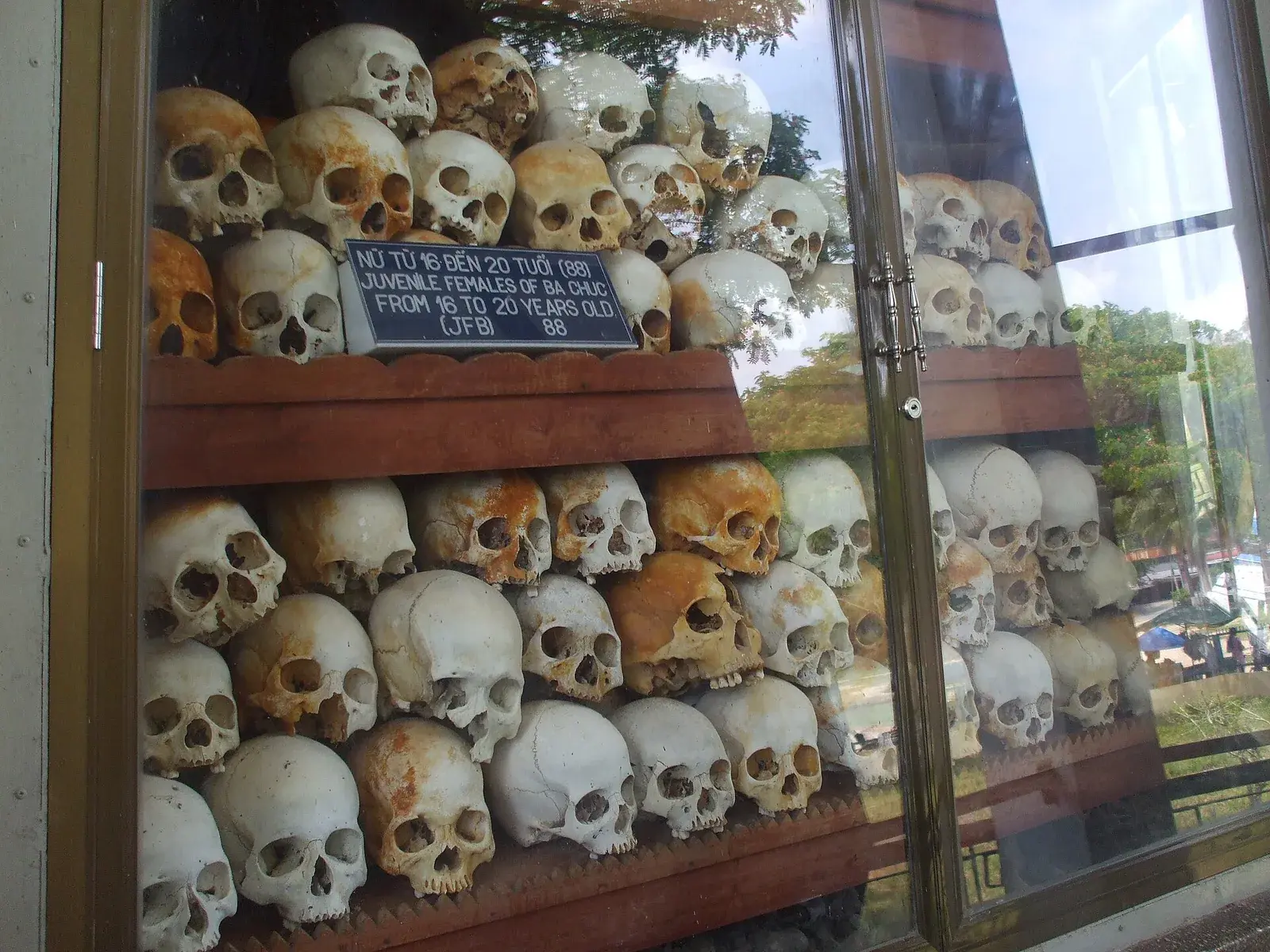
The Ba Chuc memorial in An Giang province holds the remains of villagers killed by Khmer Rouge forces in April 1978, an attack that helped push Vietnam toward invasion.
Image Credits: PIetrusewsky, via Wikimedia Commons (CC BY-SA 4.0)
Vietnam's Politburo concluded that Cambodian communism had become a Chinese instrument of expansion and therefore had to be defeated by military means. A treaty of friendship with the USSR was signed on 3 November 1978, and it was assumed that if China attacked Vietnam it would receive military assistance from the Soviet Union. Vietnam mobilized 350,000 soldiers for the war and deployed thirteen divisions to the Cambodian border. On 13 December 1978, China warned Vietnam that it had only limited patience for Cambodian “provocations.”
December 1978 Invasions and the Fall of Phnom Penh
On 21 December 1978, the invasion began when two divisions of the PAVN crossed the border and advanced towards Kratie while other units cut off the KRA's supply lines. On 23 December, ten of the nineteen Cambodian divisions began a general attack on PAVN positions along the border, targeting the Vietnamese provinces of Đong Thap, An Giang, and Kieng Giang. On 25 December, the PAVN launched an all-out invasion of Cambodia with thirteen divisions and about 150,000 soldiers.
DK responded to this attack with a confrontation rather than a mobilization. This decision may have been due to the fact that the majority of the Cambodian leadership was weak, and half of the KRA was lost in the first weeks of fighting. Many Cambodian leaders fled Cambodia to the west. The PAVN entered Phnom Penh on 7 January 1979, together with the members of the Cambodian United Front for National Salvation, and the People's Republic of Kampuchea (PRK) was established the next day. Heng Samrin was elected president of PRK and Pen Sovan – general secretary of the Cambodian People's Revolutionary Party.
The Khmer Rouge leaders fled to Thailand, where they were held in prison in Khao Larn, located in Trat province. In exchange for this “favor,” Deng Xiaoping provided economic assistance to the communist insurgents in Thailand.
The new government in Phnom Penh had to deal with a country ruined by years of war and a population that did not support Vietnam. Most Cambodian intellectuals had fled the country, so Vietnam faced the challenge of rebuilding the state apparatus. Vietnamese authorities facilitated the import of food into Cambodia to stop the genocide, but by the end of 1979, several resistance groups had already formed in western Cambodia.
Reactions to Vietnam's Annexation of Cambodia
The new government in Phnom Penh immediately called on the UN Security Council for an emergency meeting, which was held despite the Soviet Union and Czechoslovakia's objections. Sihanouk spoke out against the Khmer Rouge's human rights abuses while calling on UN members to cut ties with Vietnam and stop recognizing the new government in Phnom Penh. At the UN, a draft resolution calling for a ceasefire and withdrew all foreign forces was vetoed by the Soviet Union and Czechoslovakia and was initially supported by China, France, Norway, Portugal, the US, and the UK. Vietnam and Kampuchea signed a treaty of friendship and security in February 1979, guaranteeing the mutual support of the two states. The Soviet Union, the socialist countries of Eastern Europe (with the exception of Romania) and India recognized the new government.
At the UN General Assembly, both governments claimed to be the legal government of Cambodia. The Credentials Committee voted six to three for Democratic Kampuchea, and its representatives were seated with the support of China. By January 1980, twenty-nine countries had established diplomatic relations with the PRK, while almost eighty countries recognized the deposed Cambodian government.
Some of the strongest opposition came from Thailand, which shares an 800 km border with Cambodia and fears Vietnamese expansionism. This position was supported by Indonesia, Malaysia, the Philippines, and Singapore. At the same time, China accused Vietnam of pursuing a policy of turning Cambodia into an appendage of Vietnam as part of a policy of expanding influence in Southeast Asia. The United States, which had virtually no relations with Democratic Kampuchea, supported Cambodia's membership in the General Assembly. North Korea, which had given shelter to Sihanouk after 1970, did not recognize Vietnam. Romania was the only Eastern Bloc country that openly supported the Khmer Rouge – Ceaușescu warned Duong Minh that invading Cambodia would cause Vietnam to lose friends, and Romania did not want to repeat the mistake.
China's 1979 Invasion of Vietnam
China's invasion of Vietnam began on 17 February 1979 when PRC troops crossed the border and captured the capital of Vietnam's Cao Bang province. Local militias and regular troops slowed down the attack, but the Chinese captured Lao Cai and Cao Bang within three weeks. Lạng Sơn fell after a month, and on the next day, the People's Liberation Army declared that China did not intend to advance further and withdrew. Some analysts believe that Vietnam was significantly weakened and could not resist another attack.
China did not accomplish its goal of conquering Vietnam's border provinces and forcing Vietnam to withdraw its troops from Cambodia, but its invasion did have consequences for both countries. The Vietnamese government was forced to return some of its troops to Cambodia, creating a draft crisis in Vietnam. The draining of resources in Cambodia and Vietnam created an opportunity for the Khmer Rouge to resume hostilities. Analysts believed that China wanted to weaken Vietnam by exhausting its resources, especially since Vietnam has struggled to manage its territorial integrity after unification and faced numerous challenges in its wars with South Vietnam, Laos, Cambodia, and a devastating monsoon season.
At the diplomatic level, China became even more estranged from Vietnam. However, the rapprochement with ASEAN helped it to hold back Vietnam's regional dominance. Relations between Vietnam and ASEAN deteriorated, and many of its members turned to China instead of Vietnam. Thailand and Singapore in particular became important allies. Lee Kuan Yew, Prime Minister of Singapore, later reflected that although Vietnam's capture of Cambodia and China's reaction to it were portrayed by Western media as inconsequential events, he believed they changed the geopolitics of East Asia. Vietnam's regional isolation pushed it to look to the USSR for support, including the lease of the Cam Ranh Bay naval base to the Soviet Union. Henry Kissinger argued that the war demonstrated the limits of the Soviet Union's strategic prospects in Southeast Asia, and he believed that Vietnam's confrontation with China contributed to the USSR's decision to invade Afghanistan a year later.
The KPNLF, FUNCINPEC and the Coalition Government
Cambodians wanted to end the bloodshed and suffering, and the 1981 constitution of the PRK proclaimed Cambodia to be an independent and neutral state that respected human rights. In practice, it was the Vietnamese who wielded real power as they controlled the government and the military.
Every Cambodian ministry had its own Vietnamese advisory team, and by 1986 those advisers reached down to the level of each minister's deputies. It was also the Vietnamese who made major decisions, as the Cambodian ministers reported to them, and their approval was required for all decisions, including those related to the K5 plan for the fortification of the border with Thailand. Implementation of this plan, which began in 1981, involved the preparation of border defenses and the drafting of three hundred thousand people. Many of the young people drafted died of malaria. According to reports by MSF doctor Claud Malhuret, Vietnamese troops and KPRAF deliberately denied food to the inhabitants of Cambodia, and large quantities of food arriving in Kompong Som were wasted and given to Vietnamese troops instead of distributing them to Cambodians in need.
The Khmer Rouge appealed to patriotism, but many Cambodians thought that the only way to end the suffering was to expel the Vietnamese. Son Sann's Khmer People's National Liberation Front (KPNLF), a right-wing and anti-communist Cambodian insurgent group, was formed in October 1979. It was based in Thai border camps and had a peak strength of twelve to fifteen thousand fighters. FUNCINPEC, another Cambodian group, was the political wing of Sihanouk. It was formed in May 1979 when he left the Khmer Rouge. Sihanouk called for the abolition of the permanent seat of Cambodia at the UN General Assembly since neither the Khmer Rouge nor the PRK government had the legitimacy to occupy it. The group's goal was to expel the Vietnamese from Cambodia. In addition to Son Sann's KPNLF and Sihanouk's FUNCINPEC, there were also other Cambodian groups. They were united by the desire to expel the Vietnamese, but they were fragmented and unable to develop a common strategy, which led to internal clashes and corruption.
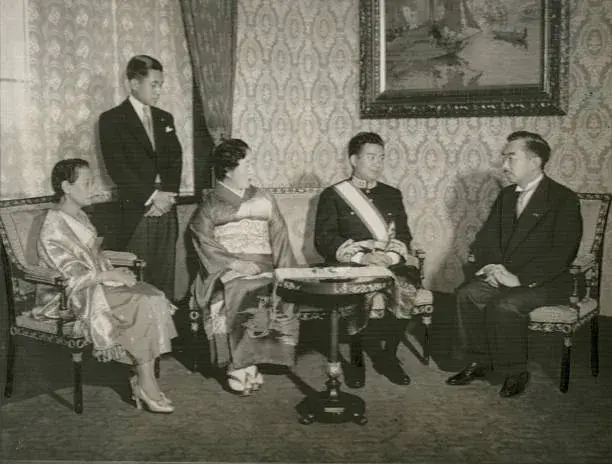
Sihanouk spent much of his exile between Beijing and Pyongyang, where North Korea's Kim Il Sung hosted him and backed his anti-Vietnamese coalition.
Image Credits: The Asahi Shimbun, via Wikimedia Commons (Public domain)
ASEAN pressured the Khmer Rouge to improve its image and establish relations with other Cambodian groups in 1980. This diplomacy failed as both sides presented unacceptable conditions to each other. However, Sihanouk realized that China would not support him unless he changed his tactics. At a meeting in Phnom Penh in December 1981, the Khmer Rouge agreed to change the name of the Communist Party of Kampuchea to the Party of Democratic Kampuchea to adopt democratic socialism, which did not explicitly mention Marxism-Leninism, so as not to contradict the goals of FUNCINPEC and KPNLF.
On 22 June 1982, the three groups signed a Thai-sponsored agreement on the formation of the Coalition Government of Democratic Kampuchea. Son Sann was elected Prime Minister, Sihanouk – President of the new government, and Khieu Samphan – Vice President for Foreign Affairs. In practice, however, this government represented neither Cambodian nor Vietnamese interests as it lacked popular support among Cambodians and had few resources. By 1987, Democratic Kampuchea continued to occupy the seat in the United Nations, but had none of the four attributes of a state: a population, territory, government, and a supreme power within the borders of a country.
The K5 Plan and the Vietnamese Withdrawal
Kampuchea proved an economic and diplomatic liability to Vietnam long before it became a military one. Vietnam's allies pressured the UN to expel Vietnam and the PRK from the World Bank, the Asian Development Bank and the IMF, while Japan terminated all economic assistance to Cambodia in 1979. Even Sweden, Vietnam's closest ally in the West, considered doing the same as other nations swiftly disengaged, with few exceptions.
Domestic political issues also intensified pressure on Vietnam, as the Soviet-style command economy failed to prioritize food production and nationalization of the reunited nation's economy caused chaos. At the same time, Vietnam was the world's fifth largest military power with 1.26 million regular troops and 180000 stationed in Cambodia in 1984, with one-third of the national budget going to the defense sector.
The disengagement process officially started in 1982, but none of the evacuations were publicly verifiable, as they were considered to be part of routine rotations. The true plan was announced in 1984 – the five-step K5 Plan devised by General Le Duc Anh called for withdrawing from “resistance bases” in western Kampuchea and along the Thai border, closing the Cambodian border, eliminating domestic resistance, securing the population, and rejuvenating the Kampuchean armed forces. The completion of the first phase was unofficially confirmed in 1985 following the dry season offensive.
The Vietnamese government was also losing its patience with Cambodia. Vietnam's economic aid peaked at $1.7 billion between 1981 and 1985, with ninety percent of raw materials and seventy percent of Vietnam's grain imports coming from the USSR. At the same time, Soviet officials grew increasingly frustrated at the burden and at Hanoi's incompetence in dealing with the Cambodian issue. During these years, Gorbachev reduced Vietnam's economic aid by twenty percent and military aid by thirty percent in 1986.
At the same time, Vietnam came to the conclusion that it was an economic burden to its allies and that reform was necessary to end its international isolation. Nguyen Van Linh initiated Đổi Mới reforms in December 1986, with the Politburo passing a resolution on “reviewing the foreign policy and international relations” in 1987 and a resolution on “ending international obligations” in 1988. The latter included the withdrawal of 600000 soldiers, the abolishment of embargoes, and the invitation to foreign investors. Thus, Vietnam abandoned its bellicose stance toward the U.S. and China, viewing them as existential threat.
The last contingent of 26000 Vietnamese troops withdrew on September 26, 1989, ending the ten-year occupation which has cost 15000 Vietnamese soldier's lives and 30000 injuries. However, the Vietnamese still maintained limited military presence in Cambodia, as the resistance groups claimed that Vietnamese troops continued their operations. The Khmer Rouge insurgents even reported that Vietnamese troops had entered the Kampot province in March 1991 in response to a Khmer Rouge attack.
The timing of this operation was suspicious as Khmer Rouge groups launched an attack on Pailin on September 17, 1989, during the Vietnamese withdrawal. They captured the town of Pailin with tanks and artillery in mid-October 1989, thwarting the hopes of many Cambodians that the Vietnamese withdrawal would lead to an improvement of the situation.
The Paris Peace Agreement and Cambodia After 1991
Prime Minister of the PRK Hun Sen, who took office in January 1985, negotiated with the coalition several times, meeting with Sihanouk in France in December 1987. He proposed him the post of the head of state upon his return to Cambodia, but Sihanouk refused despite Phnom Penh preparing to welcome him.
The First Jakarta Informal Meeting in July 1988 saw the representatives of the CGDK and the PRK come to terms for the first time, although no agreements were reached. At the second meeting in February 1989, Australian Foreign Minister Gareth Evans put forward a Cambodian Peace Plan, which provided for a ceasefire, peacekeeping forces, and a national unity government that would ensure the sovereignty of Cambodia until the elections. In April, the National Assembly of Cambodia adopted a new constitution, changed the name of the country back to Cambodia, returned Buddhism to the status of the state religion, and confirmed the right to private property. In February 1990, the third meeting of the Conference established the Supreme National Council.
On October 23, 1991, the factions of the Supreme National Council, as well as Vietnam and fifteen other nations of the International Peace Conference on Cambodia, signed the Paris Peace Agreement. To guarantee the rights of the Khmer Rouge, the agreement did not use the term “genocide” for the crimes committed by the Khmer Rouge from 1975 to 1979 – a formulation that Hun Sen criticized as an attempt to cover up Cambodia's past. In addition, the agreement provided for the establishment of the United Nations Transitional Authority for Cambodia (UNTAC) with a broad mandate to manage Cambodia.
The return of Khieu Samphan in November was proof of how little Cambodia had changed, as he found himself caught in a nationalist frenzy. Samphan, expecting to be welcomed with open arms, was greeted with a barrage of abuse and insults, pelted with stones on the road to the capital, and nearly lynched in front of the Royal Palace, managed to escape to the second floor of his offices, where he was chased again. He was later forced to flee Cambodia via an escape ladder, bleeding, and left Cambodia the same day.
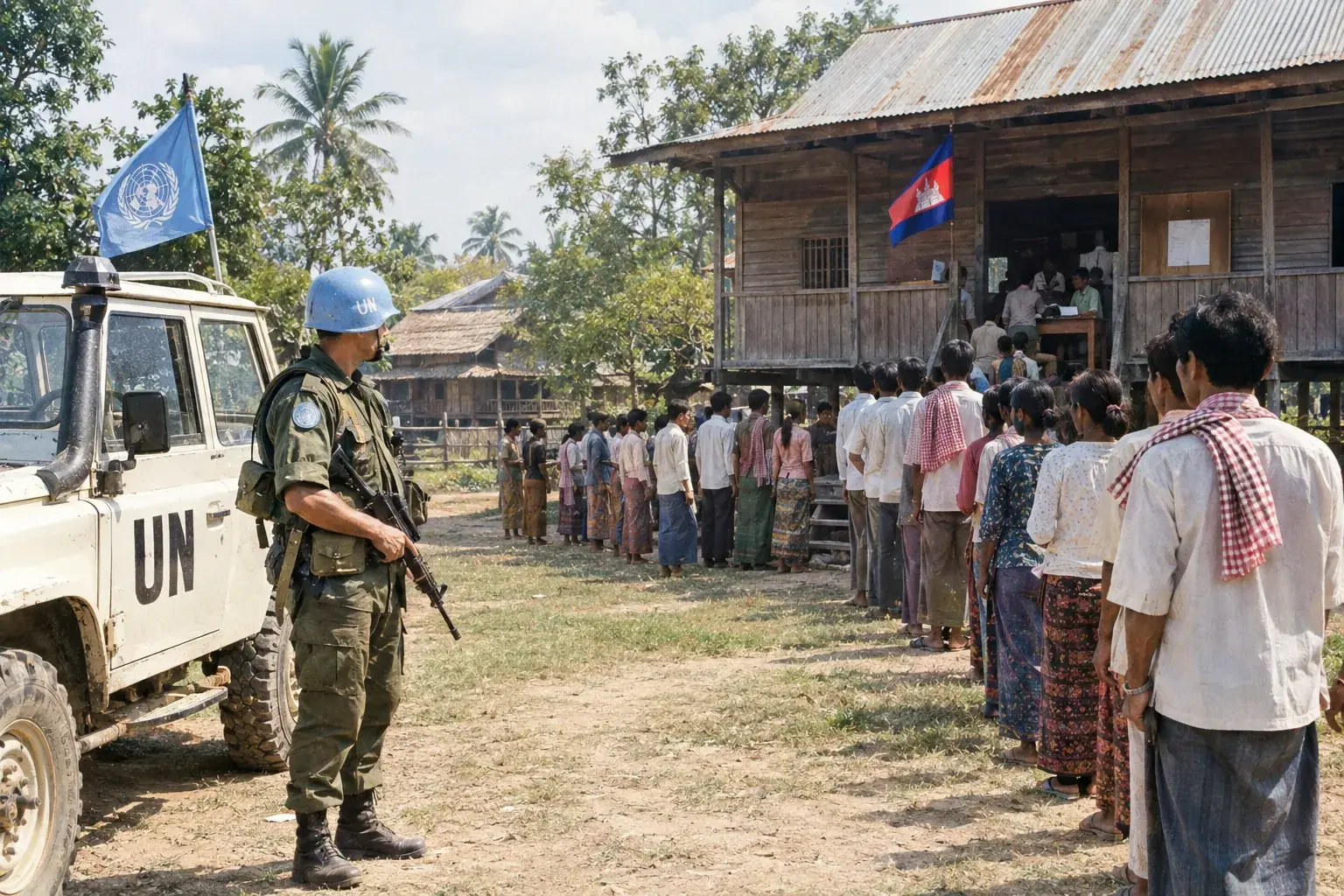
UNTAC deployed some 22,000 peacekeepers from twenty-two nations starting in March 1992 to disarm factions and organize Cambodia's first postwar elections.
The mission of the United Nations Transitional Authority for Cambodia (UNTAC) began its work in March 1992, with 22000 peacekeepers from twenty-two nations entering Cambodia. The Khmer Rouge refused to register voters for upcoming elections or to give up weapons, massacring entire Vietnamese communities to prevent them from voting. At the same time, they turned to violence against UN peacekeepers. FUNCINPEC won the elections with 45,47 percent of votes against 38,23 percent of the Cambodian People's Party, but Hun Sen refused to surrender and announced the separation of the eastern provinces of Cambodia, leading to the agreement for the coalition government for national salvation, with Ranariddh as the First Prime Minister and Hun Sen as the Second Prime Minister. In September of the same year, the new constitution of Cambodia was adopted, and the monarchy was re-established, with the King Sihanouk returning to power two days later.
The government of Cambodia banned the Khmer Rouge in July 1994 and recognized the genocide committed by them. The Khmer Rouge as a political party soon ceased to exist, with the last few members of the group disbanding in 1998 and officially surrendering their weapons on February 9, 1999 and being absorbed into the Cambodian army three days later.
How Cambodians and Vietnamese Remember the War
Public opinion in Cambodia is divided: while some consider Vietnam to have saved Cambodia from the Khmer Rouge and continued to support it despite the embargo, others see it as an imperialist aggressor, and the latter view has gained ground since 2010. This has led to an increase in Cambodian nationalism and anti-Vietnamese sentiment, which has led to attacks on Vietnamese civilians, partly justified by pro-government voices. Anti-Vietnamese sentiments have been exacerbated by historical disputes with Vietnam dating back to the seventeenth century, however, China is now seen as an ally countering potential Vietnamese aggression. Among Cambodians, the pro-Vietnamese also remained, arguing that Vietnam had intervened in Cambodia on a humanitarian basis, and distrustful of China's growing influence in Cambodia.
In Vietnam, there is no doubt about the justice of the war, and both the government and the anti-communist opposition pay great attention to this. Although some criticism concerns the alliance with the Khmer Rouge, many Vietnamese believe that Vietnam was wrong not to oppose China's interference in the affairs of Cambodia. Thus, although both Vietnam and China participated in the Cambodian conflict, neither of them has officially recognized the other's role in the war. At the same time, international public opinion has changed: if in the 80s it was largely critical of Vietnam, in recent years it has been more inclined to accept Vietnam's arguments, partly because of its improved relations with the West and international institutions.
Vietnam's relations with China and North Korea remained strained for years afterward. North Korea's Kim Il Sung had aligned with China in continuing to back the ousted Khmer Rouge coalition against the Vietnamese-installed government in Phnom Penh, and diplomatic contact between Hanoi and Pyongyang cooled as a result. It was not until 2007 that a Vietnamese leader – Communist Party General Secretary Nong Duc Manh – paid a visit to North Korea, the first by a Vietnamese leader since Ho Chi Minh's trip in 1957.
Rebuilding Vietnam's international prestige turned out to be a long and difficult process after ten years of occupation. Vietnam established relations with China in November 1991, became a member of ASEAN in July 1995, and upgraded the US liaison office in Hanoi to the level of an embassy in August 1995, after President Bill Clinton declared the normalization of relations. The war, which stopped a genocide, has made Vietnam sixteen years in the shadows, and the agreement put an end to it, allowing the Khmer Rouge to remain in power by not naming the crime that Vietnam ended.