Pre-Columbian America was not an empty wilderness waiting to be discovered. Long before Christopher Columbus reached the Caribbean in 1492, the Americas were home to millions of people and hundreds of distinct cultures. There were great cities and small hunting camps, stone pyramids and portable tipis, powerful empires and independent villages.
Some societies built cities that rivaled any in the world, developed writing and tracked the movements of the planets with extraordinary accuracy. Others lived by hunting, fishing and gathering, following the seasons across vast territories. Many were peaceful for long periods, while others fought wars and practiced human sacrifice.
The First Peoples of the Americas
Most researchers agree that the ancestors of Native Americans came from northeastern Asia across Beringia, a broad land bridge that connected Siberia and Alaska during the last Ice Age. Beringia wasn't a narrow strip of ice. It was a vast region home to animals such as mammoths, horses and bison, and people may have lived there for a long time before moving farther into the Americas.
When exactly people arrived is still debated. For decades, many archaeologists believed the first Americans arrived around 13,000 years ago. That picture has changed. Sites such as Swan Point in Alaska show human activity around 14,000 years ago, and fossilized human footprints at White Sands in New Mexico have been dated to roughly 21,000 to 23,000 years ago, although some researchers continue to question those dates.
The first Americans may have arrived in more than one wave, and some probably traveled along the Pacific coast by boat as well as through inland routes. By around 13,000 years ago, people were spread across both North and South America.
Ice Age America and the Megafauna
The world these first Americans entered was very different from today. Great ice sheets covered much of northern North America. Mammoths, mastodons, giant ground sloths, saber-toothed cats, dire wolves and the giant short-faced bear roamed the land.
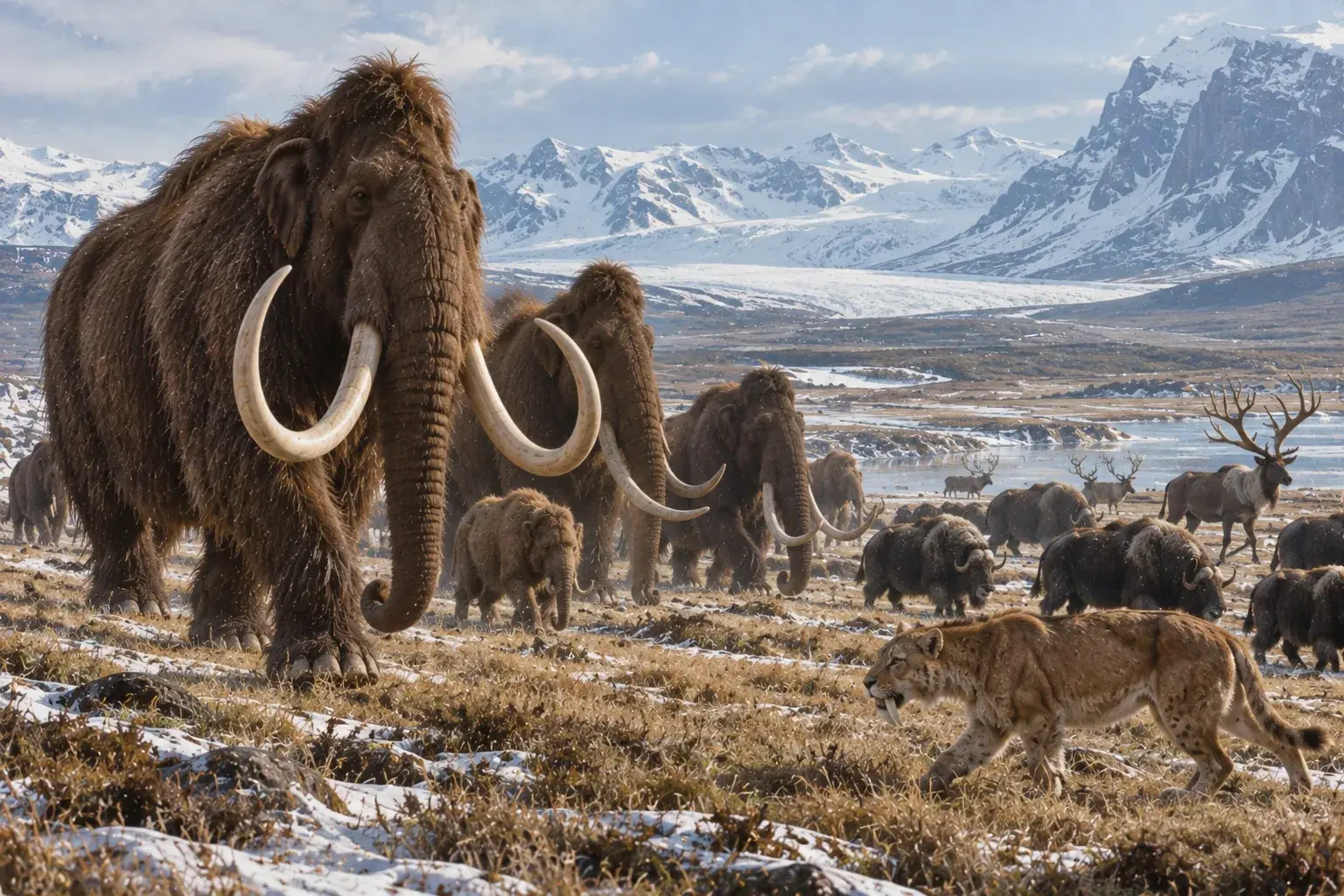
Mammoths, giant ground sloths and saber-toothed cats shared the landscape with the first Americans before most megafauna died out at the end of the Ice Age.
Most of these animals disappeared at the end of the Ice Age, roughly 13,000 to 11,000 years ago. Scientists still debate why. Rapid climate change certainly played a role, and many researchers believe human hunting added pressure on animals that reproduced slowly. The balance between those two causes remains one of the big open questions in North American archaeology.
Ancient Mound Builders of North America
Some of the earliest monumental construction in North America was built by people who didn't farm. In Louisiana, the site of Watson Brake contains a ring of earthen mounds built around 5,400 years ago by hunter-gatherers. That makes it older than Egypt's Great Pyramid of Giza.
Later cultures took mound-building much further. The Mississippian culture, which flourished from roughly 800 to 1600 CE, built large towns with plazas and platform mounds across the Mississippi Valley and southeastern United States. Its greatest center, Cahokia near modern St. Louis, may have held more than 10,000 people at its height and was topped by Monks Mound, one of the largest earthworks in the Americas.
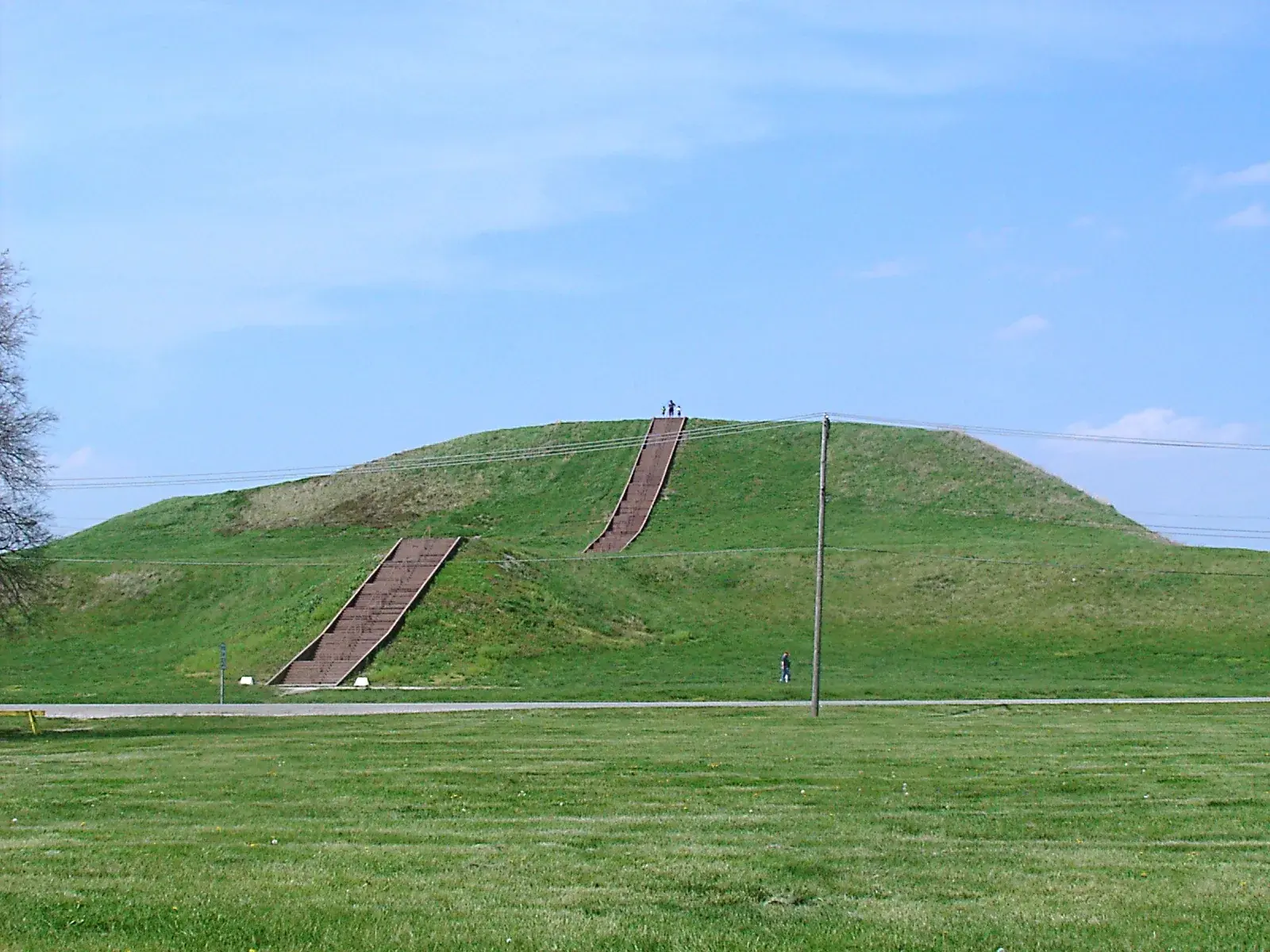
Monks Mound at Cahokia is one of the largest earthworks in the Americas, built by the Mississippian culture near modern St. Louis.
Image Credits: Skubasteve834, via Wikimedia Commons (CC BY-SA 3.0)
The Olmec: An Early Mesoamerican Civilization
Mesoamerica, the cultural region stretching from central Mexico into Central America, gave rise to some of the most complex societies in the Americas. One of the earliest was the Olmec civilization, which flourished along Mexico's Gulf Coast from roughly 1600 BCE to around 400 BCE.
The Olmec built major centers at San Lorenzo and later La Venta. They're famous for their colossal stone heads, 17 of which have been discovered. Each head has a unique face and headdress, and many archaeologists believe they portray Olmec rulers, some possibly wearing helmets associated with the Mesoamerican ballgame.
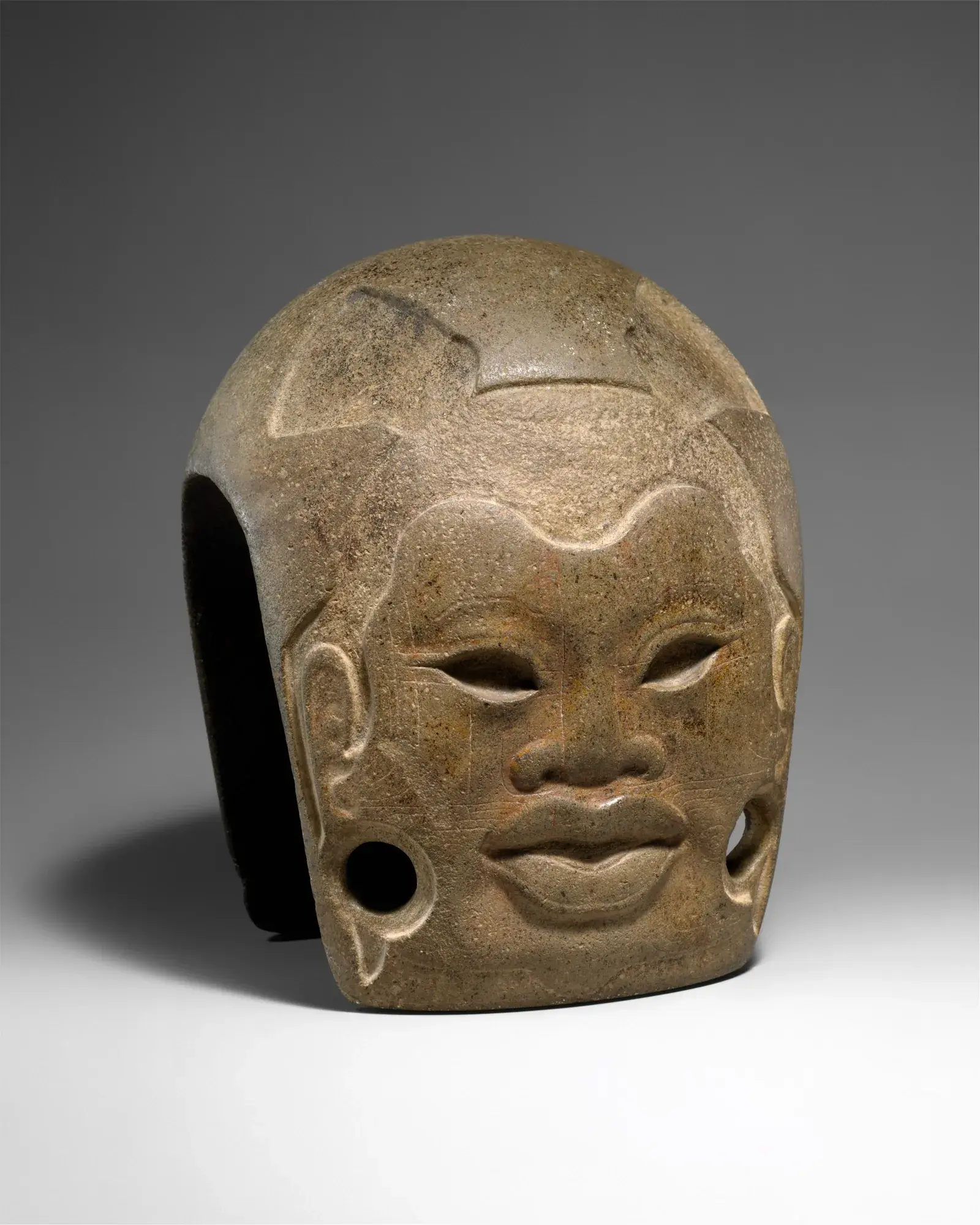
Seventeen Olmec colossal heads have been discovered so far, each with distinct facial features that many scholars believe portray individual rulers.
Image Credits: Olmec artist(s), via The Metropolitan Museum of Art (CC0)
Olmec artists created striking jade figurines, masks and ceramic sculptures. Their religious symbols, including jaguar imagery, influenced later Mesoamerican cultures. At the waterlogged site of El Manatí, archaeologists found wooden sculptures, rubber balls and infant remains, which some interpret as offerings, though the circumstances of the infants' deaths are uncertain.
The Mesoamerican ballgame, played with a heavy solid rubber ball, was one of the region's most important traditions. Its origins may even predate the Olmec, but the Olmec were among the earliest cultures closely associated with it.
Teotihuacan and the Great Cities of Central Mexico
Mesoamerican history wasn't one civilization after another in a single line. Many powerful cultures rose and fell over thousands of years. Teotihuacan, near modern Mexico City, was one of the largest cities in the world between roughly 100 and 550 CE, with its massive Pyramid of the Sun and Pyramid of the Moon. Its influence reached across Mesoamerica, including the Maya region.
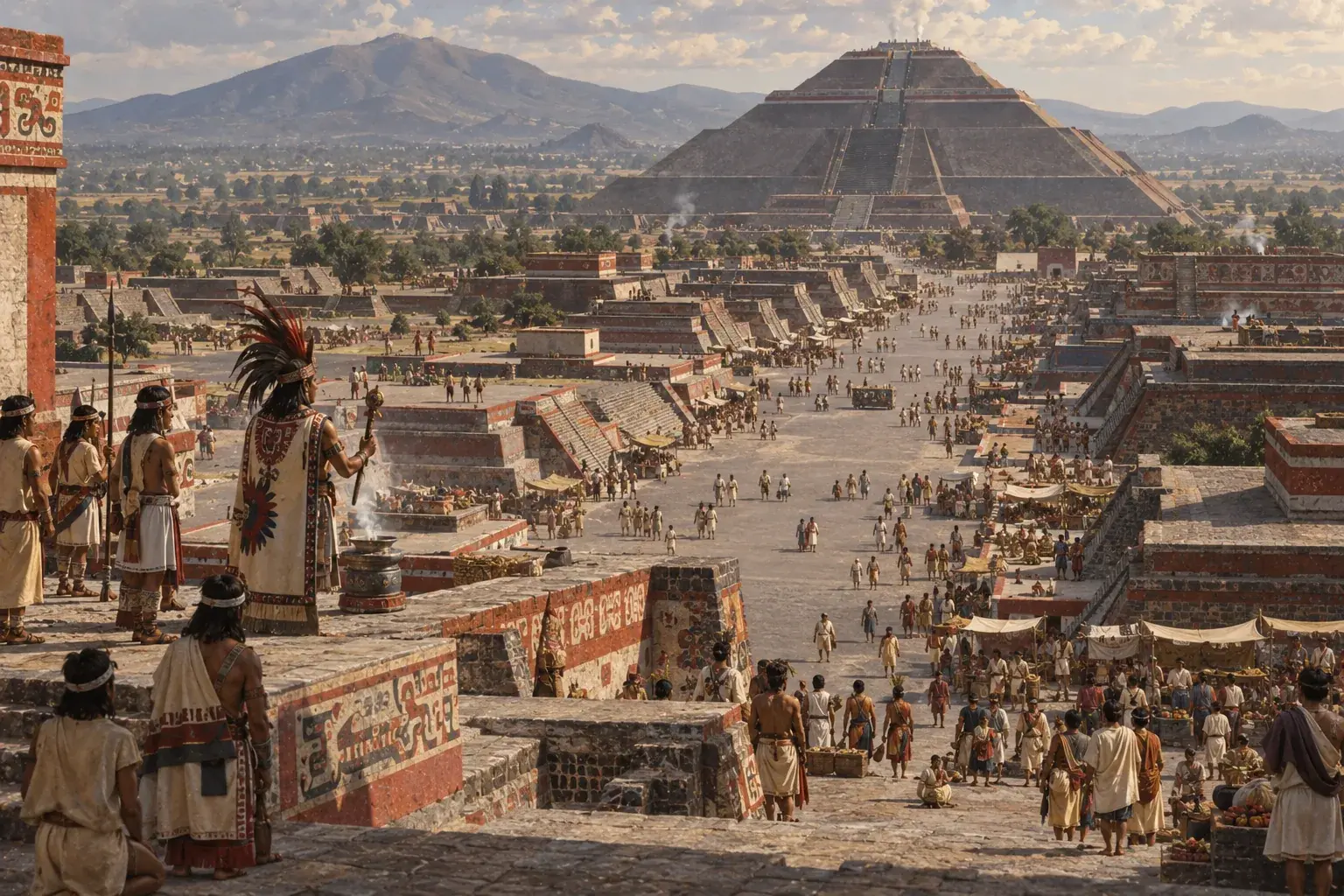
Teotihuacan's Pyramid of the Sun dominated one of the largest cities in the ancient world, with influence that reached as far as the Maya region.
The Toltec culture later dominated parts of central Mexico, centered on the city of Tula. By the time the Aztecs rose to power, Teotihuacan had already been abandoned for centuries, and the Aztecs regarded it as a sacred place associated with the creation of the world.
The Maya: City-States, Writing and Astronomy
The Maya lived across southern Mexico, Guatemala, Belize and parts of Honduras and El Salvador. Farming villages appeared in the region thousands of years ago, and Maya civilization reached its peak during the Classic period, roughly 250 to 900 CE.
The Maya were never a single unified empire. They lived in independent city-states such as Tikal, Calakmul, Palenque and Copán, each ruled by a king who claimed a sacred connection to the gods. These cities formed shifting alliances and rivalries, much like the city-states of ancient Greece or Renaissance Italy. The largest may have held tens of thousands of people.
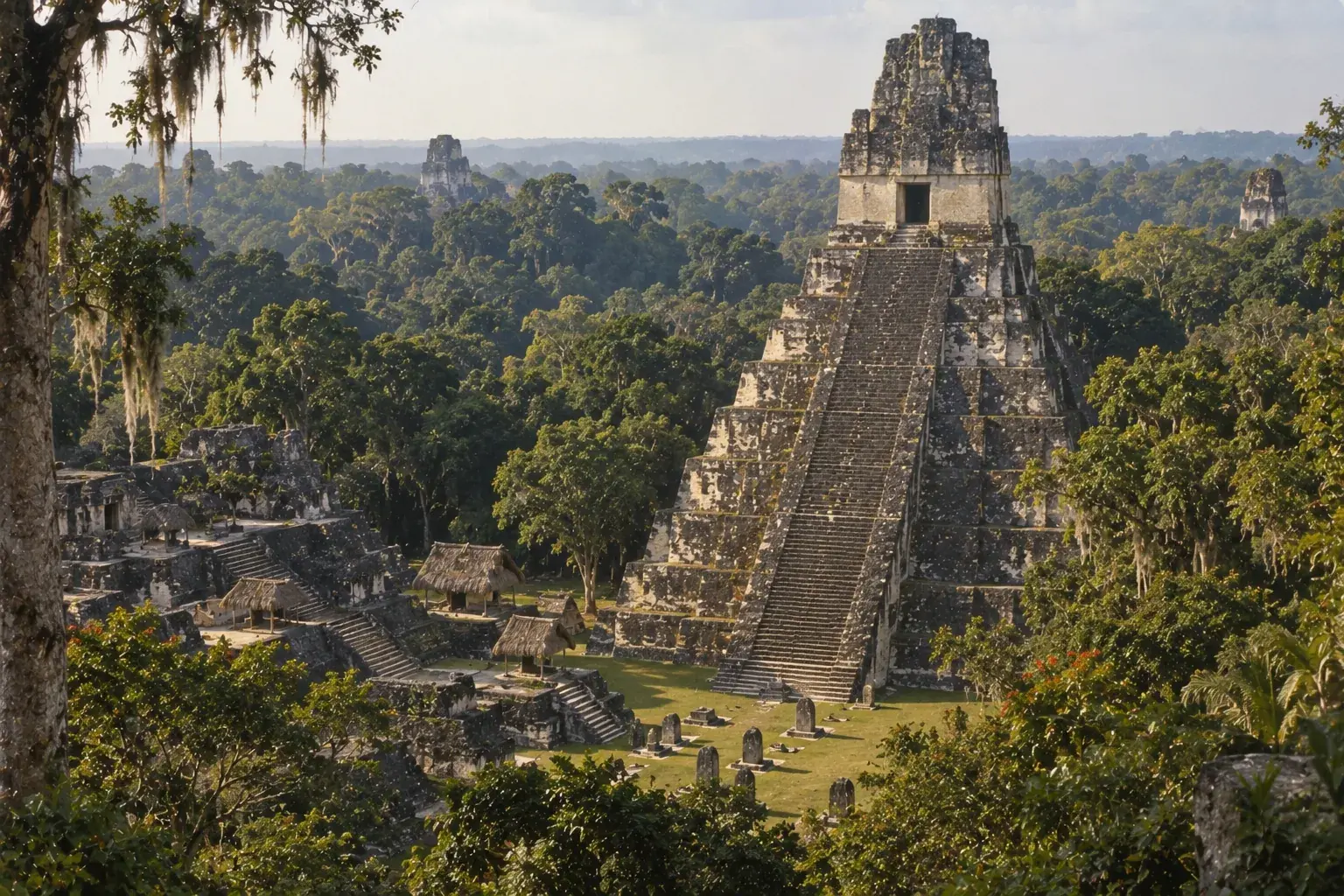
Tikal was one of the largest and most powerful Maya city-states, one of many independent kingdoms that never united into a single empire.
Maya kings led important rituals, including bloodletting ceremonies in which royal blood was offered to the gods. Warfare was common and often aimed at capturing high-status prisoners, some of whom were sacrificed. Some cities were destroyed in war. Aguateca in Guatemala was attacked and burned around 810 CE and never reoccupied.
The Maya developed one of the most sophisticated writing systems in the ancient Americas, recording history, royal lineages and religious ideas in hieroglyphs. Their mathematics included the concept of zero, and their calendars tracked solar and lunar cycles, eclipses and the movements of Venus with impressive precision. Astronomy for the Maya was deeply connected to religion, prophecy and the timing of ceremonies.
Many southern lowland Maya cities declined during the 9th and 10th centuries, while other Maya centers, such as Chichén Itzá and later Mayapán, continued to flourish in the north. Maya peoples still live across the region today, and millions speak Mayan languages.
The Aztec Empire and the Triple Alliance
The Aztec Empire rose much later than the Classic Maya. The Mexica people founded Tenochtitlan on an island in Lake Texcoco around 1325. In 1428, Tenochtitlan formed the Triple Alliance with the cities of Texcoco and Tlacopan, and together they built a powerful empire across central and southern Mexico.
Tenochtitlan became one of the largest cities in the world, with a population often estimated at 200,000 or more. It was connected to the mainland by causeways, filled with canals, markets and temples, and supported by chinampas, raised farm fields built in shallow lake waters.
At the center of the city stood the Templo Mayor, a great twin temple dedicated to Huitzilopochtli, the god of war and the sun, and Tlaloc, the god of rain. It was rebuilt several times, reaching a height of roughly 45 to 60 meters.
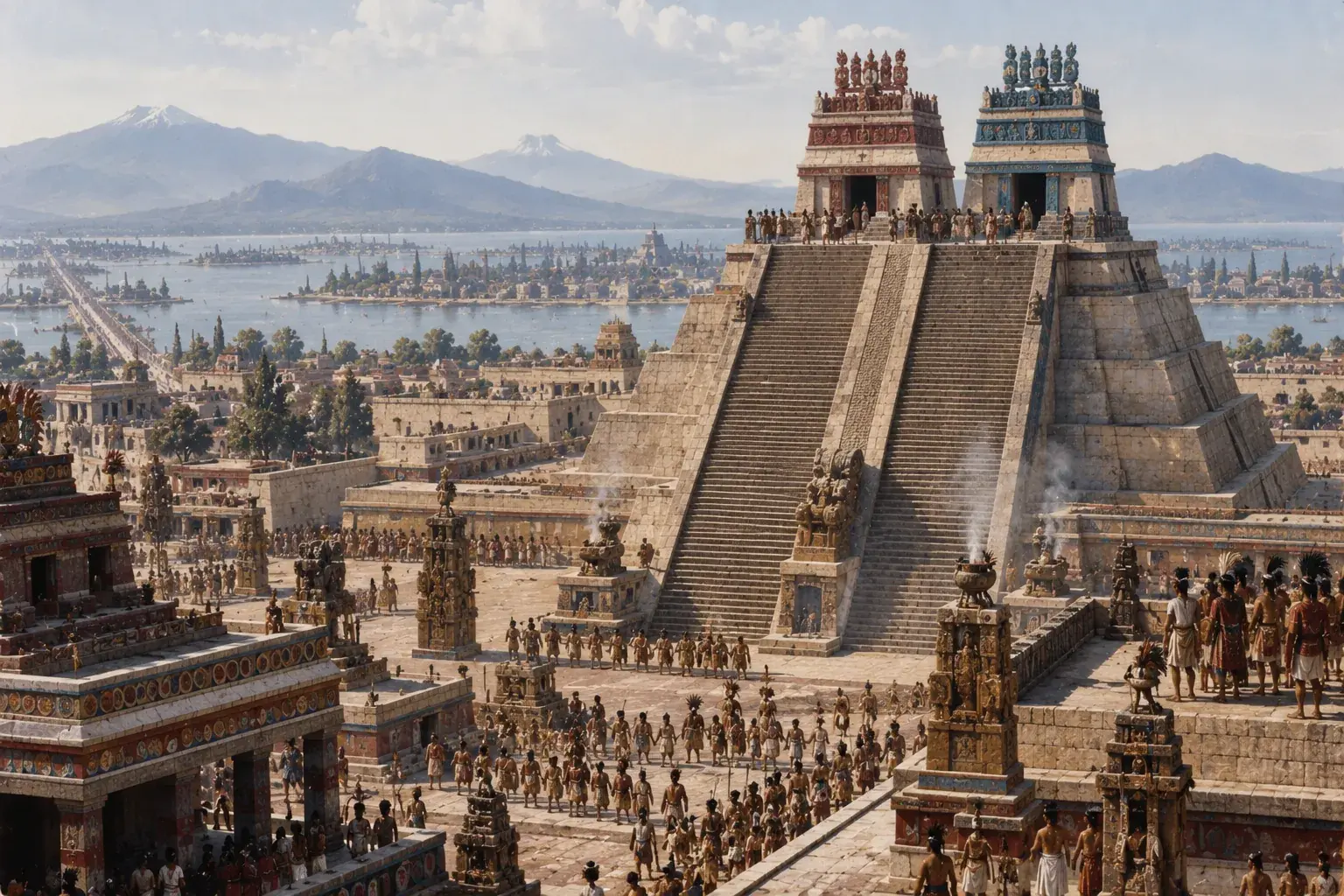
The Templo Mayor stood at the center of Tenochtitlan, rebuilt several times and topped by twin shrines to Huitzilopochtli and Tlaloc.
The Aztec Empire mainly ruled by collecting tribute rather than directly governing conquered peoples. Many subject cities kept their own rulers as long as they paid tribute in goods such as food, cloth, feathers and precious materials.
Human Sacrifice in Aztec Religion
Human sacrifice was an important part of Aztec religion. The Aztecs believed the gods had sacrificed themselves to create the world and that human blood helped sustain the sun and the cosmic order. Prisoners captured in war were among the most common victims, and so-called "flower wars" were sometimes fought partly to obtain captives.
The scale of sacrifice is difficult to determine. Some Spanish and later accounts claimed that tens of thousands were killed at the rededication of the Templo Mayor in 1487, but many historians consider those numbers exaggerated. Archaeological discoveries, including a massive skull rack near the Templo Mayor, do confirm that sacrifice happened on a large scale. Estimates of annual numbers vary widely and remain controversial.
The Inca Empire: The Largest State in the Americas
In South America, the Inca Empire became the largest state in the pre-Columbian Americas. Its heartland was Cusco in the Andes of Peru. According to Inca tradition, the dynasty was founded by the legendary ruler Manco Cápac.
The empire expanded dramatically under Pachacuti, who came to power around 1438, and his successors. At its height, the Inca state stretched roughly from modern Ecuador to central Chile, including parts of Bolivia and Argentina. The Inca called their empire Tawantinsuyu, meaning "the four parts together," because it was divided into four regions that met at Cusco.
The Inca built a road network of around 40,000 kilometers, with suspension bridges, storehouses and relay runners who carried messages across the empire. They kept records using quipus, systems of knotted cords. Machu Picchu, probably built as a royal estate for Pachacuti, is the most famous example of their mountain architecture.
Inca stonemasons fitted massive blocks so precisely that no mortar was needed, and many walls have survived centuries of earthquakes. Andean surgeons also practiced trepanation, cutting holes in the skull. Studies of ancient skulls show that many patients survived, with healing rates in Inca times often estimated at around 75 to 90 percent.
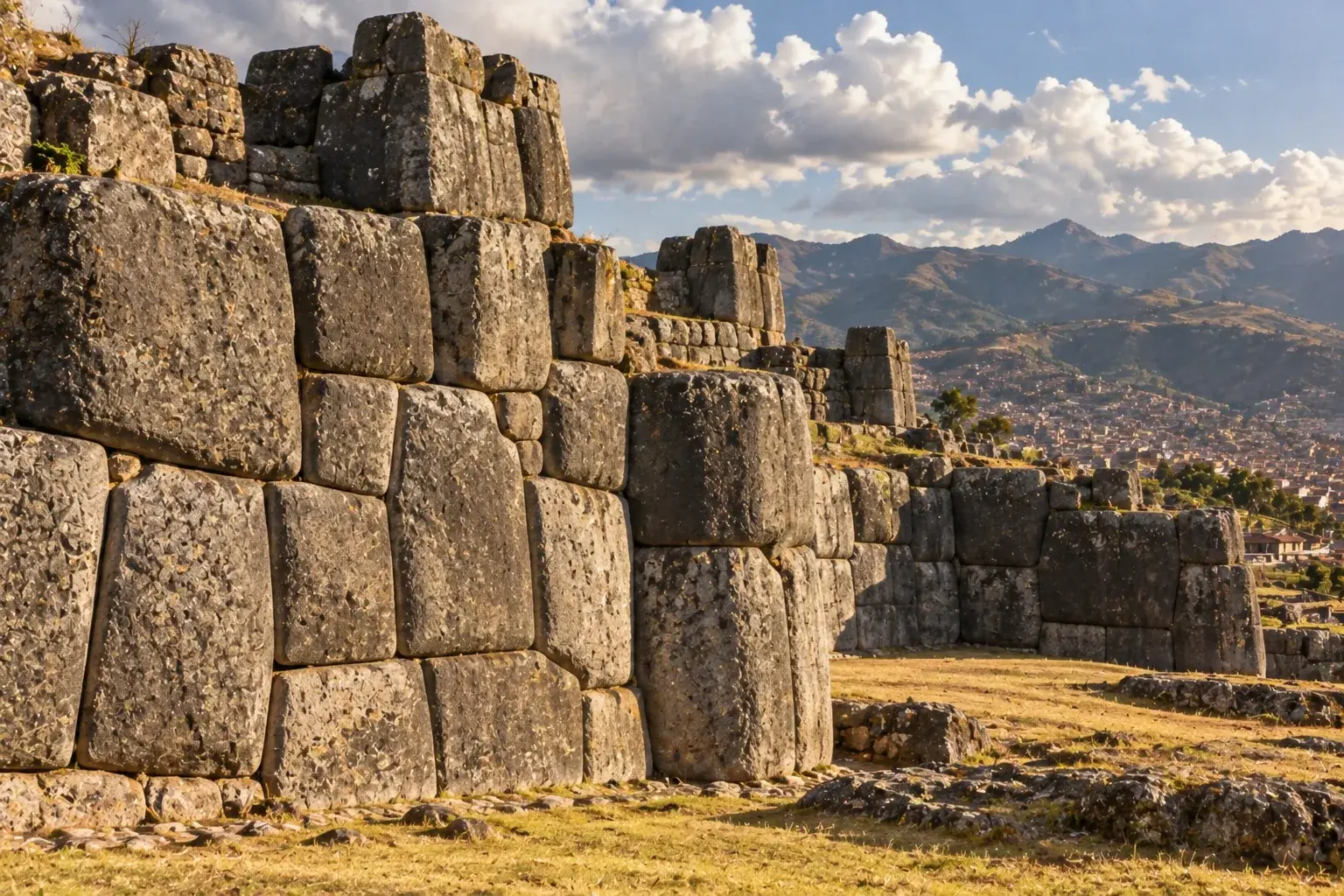
Inca stonemasons fitted enormous blocks so precisely that no mortar was needed, and many of their walls have withstood centuries of earthquakes.
The Inca had bronze as well as gold and silver, but their armies relied mostly on weapons such as clubs, slings, spears and axes. Their military strength came from organization and the ability to raise large forces.
The Haudenosaunee Confederacy
In what is now the northeastern United States and southeastern Canada lived the Haudenosaunee, often called the Iroquois. They were originally a confederacy of five nations: the Mohawk, Oneida, Onondaga, Cayuga and Seneca. The Tuscarora joined later, making six.
According to Haudenosaunee tradition, the nations were once locked in destructive wars until a figure known as the Peacemaker, with the help of Hiawatha, brought them together under the Great Law of Peace. The date of the confederacy's founding is debated, with proposals ranging from the 12th century to around 1450 or later.
The confederacy was governed by a Grand Council of 50 chiefs. Clan mothers played a powerful political role, including choosing and removing chiefs. Some historians argue that Haudenosaunee political ideas influenced the framers of the United States Constitution, though the extent of that influence is debated. The Haudenosaunee were powerful farmers growing corn, beans and squash, known as the Three Sisters, and they also fought wars with neighboring peoples.
The Sioux and the Changing Plains
Many popular images of Native Americans, including mounted warriors and tipis, come from the Plains nations of the 18th and 19th centuries. But those images reflect life after European contact. Horses had disappeared from North America at the end of the Ice Age and returned only with the Spanish.
The Dakota, Lakota and Nakota peoples, often grouped as the Sioux, originally lived in the woodlands and lake country of the upper Mississippi region, including present-day Minnesota. They gathered wild rice, hunted deer and bison, fished and traveled by canoe. Pressure from other nations, including the Ojibwe, gradually pushed many groups westward onto the Plains, where horses later transformed their way of life. Their religion centered on sacred powers and ceremonies such as the Sun Dance.
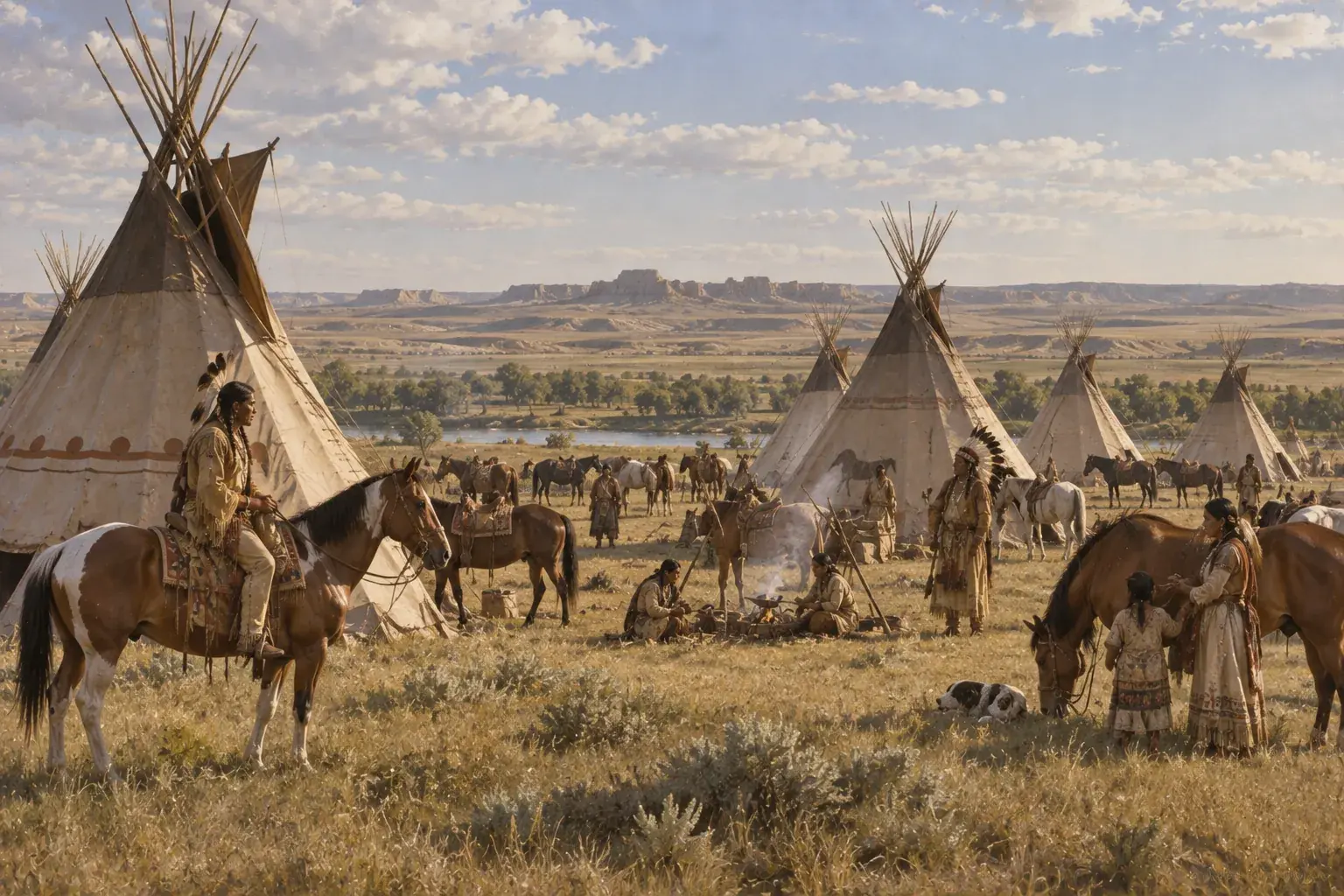
Horses returned to North America only with the Spanish, later transforming the way of life of Plains nations like the Dakota, Lakota and Nakota.
The Muscogee and the Southeastern Mound-Building Heritage
The Muscogee, or Creek, peoples of the Southeast descend in part from the Mississippian mound-building societies. Many Mississippian chiefdoms were still powerful when Spanish explorer Hernando de Soto traveled through the region in the 1540s, but disease, warfare and political upheaval brought major changes afterward. Over time, several peoples joined to form the Muscogee Confederacy. Some Muscogee and other groups who moved into Florida later became part of the Seminole people.
Peoples of the American Southwest
The Southwest was home to many distinct cultures. The ancestral Pueblo peoples built multistory homes of stone and adobe, cliff dwellings such as those at Mesa Verde, and the great houses of Chaco Canyon. Pueblo peoples farmed corn, beans and squash, crops that originally came from Mesoamerica thousands of years before the Aztec Empire existed. The name "Pueblo" comes from the Spanish word for town.
The Apache and Navajo, or Diné, speak Athabaskan languages related to languages of western Canada and Alaska. Their ancestors migrated into the Southwest several centuries before European contact. The word "Apache" likely comes from a Zuni word meaning "enemy," while both Apache and Navajo peoples traditionally called themselves by words meaning "the people."
The Navajo lived in hogans, dwellings whose doors traditionally face east to greet the rising sun. Their creation stories describe a journey through several worlds before emerging into the present one. After Spanish colonization, many Navajo became skilled sheepherders and weavers, and in the mid-1800s they learned silversmithing from Mexican silversmiths, developing a world-famous jewelry tradition.
The Great Basin and the Pacific Northwest
The Great Basin, covering much of Nevada, Utah and neighboring states, is a dry region where farming was difficult. Peoples such as the Ute, Paiute and Shoshone lived by hunting, fishing and gathering wild plants, moving seasonally to use resources across the landscape. The Paiute believed in a sacred power called puha, and spiritual practitioners sought it at special places such as mountains and caves.
In the Columbia Plateau of the Pacific Northwest, the Nez Perce lived in villages along rivers rich with salmon. Each year, huge salmon runs provided food that could be dried for winter. Obsidian from Obsidian Cliff in what is now Yellowstone National Park was traded widely across North America, reaching as far as the Hopewell culture in Ohio. Many Native nations maintain historic connections to the Yellowstone region.
The Amazon and Other Overlooked Societies
Not all complex societies left stone pyramids. In the Amazon, archaeologists using LiDAR and other methods have discovered earthworks, roads, raised fields and settlement networks that show large populations lived there before European contact. Because homes were built from wood and plant materials that decay quickly, much of this history remained hidden for centuries.
The Arrival of Europeans
Christopher Columbus reached the Caribbean in 1492, beginning a period of devastating change. European colonization brought violence, slavery, land seizures and, above all, diseases such as smallpox and measles, which killed enormous numbers of Indigenous people who had no prior exposure.
The Spanish conquest of the Aztec capital in 1521 and the Inca Empire in the 1530s marked the collapse of the two largest states in the Americas. Across both continents, Native nations faced catastrophic population losses and profound disruption.
A Rich and Continuing Story
The history of the Americas before 1492 is as varied and complex as that of Europe, Africa or Asia. It includes great cities, sophisticated astronomy, engineering feats, democratic confederacies, trade networks and countless local traditions.
These cultures weren't simply lost civilizations. Many Native nations survive today, keeping languages, ceremonies and traditions alive despite centuries of hardship. Understanding pre-Columbian America means recognizing both the achievements of its peoples and the fact that their story is still being written.