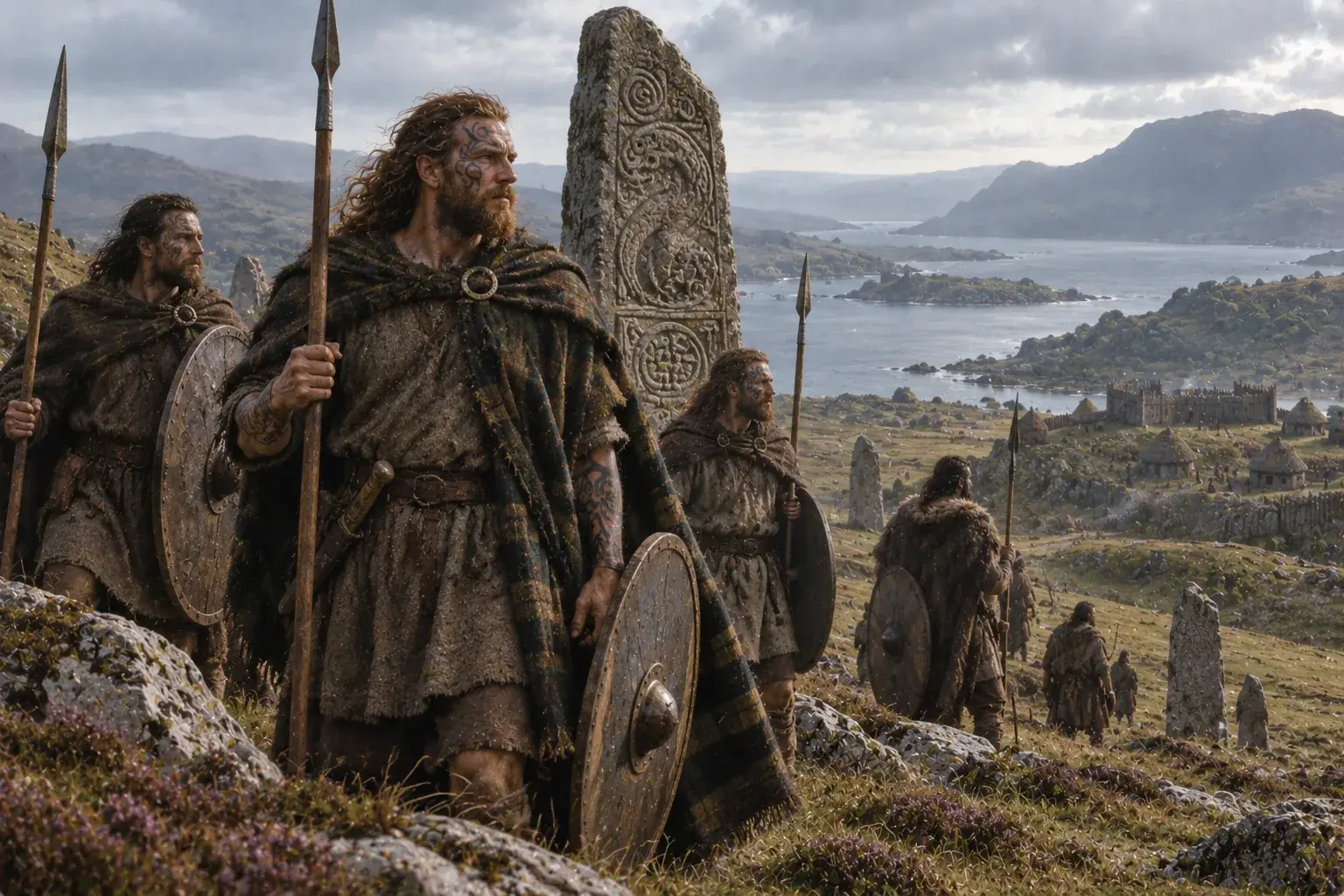
The Picts were the people of northern Scotland who held off the Roman Empire, broke the power of Northumbria and then disappeared around year 900. For centuries this disappearance was a mystery. They were allegedly wiped out, or conquered and absorbed by invading Scots, or they simply faded away like a lost tribe.
Modern historians tell a much less dramatic and much more interesting story, however. The Picts never left. They were merged with their Gaelic-speaking neighbors into a new kingdom, Alba, which later became Scotland. Their descendants are still living on the same land.
The problem is the Picts left almost no writing of their own. What we know of them comes from Roman authors, Irish annals, the Northumbrian monks and later medieval chroniclers, most of whom had their own reasons for representing the Picts the way they did. The only record the Picts left in their own hand was carved into stone: hundreds of standing slabs with strange symbols, animals and crosses that still dot the Scottish landscape.
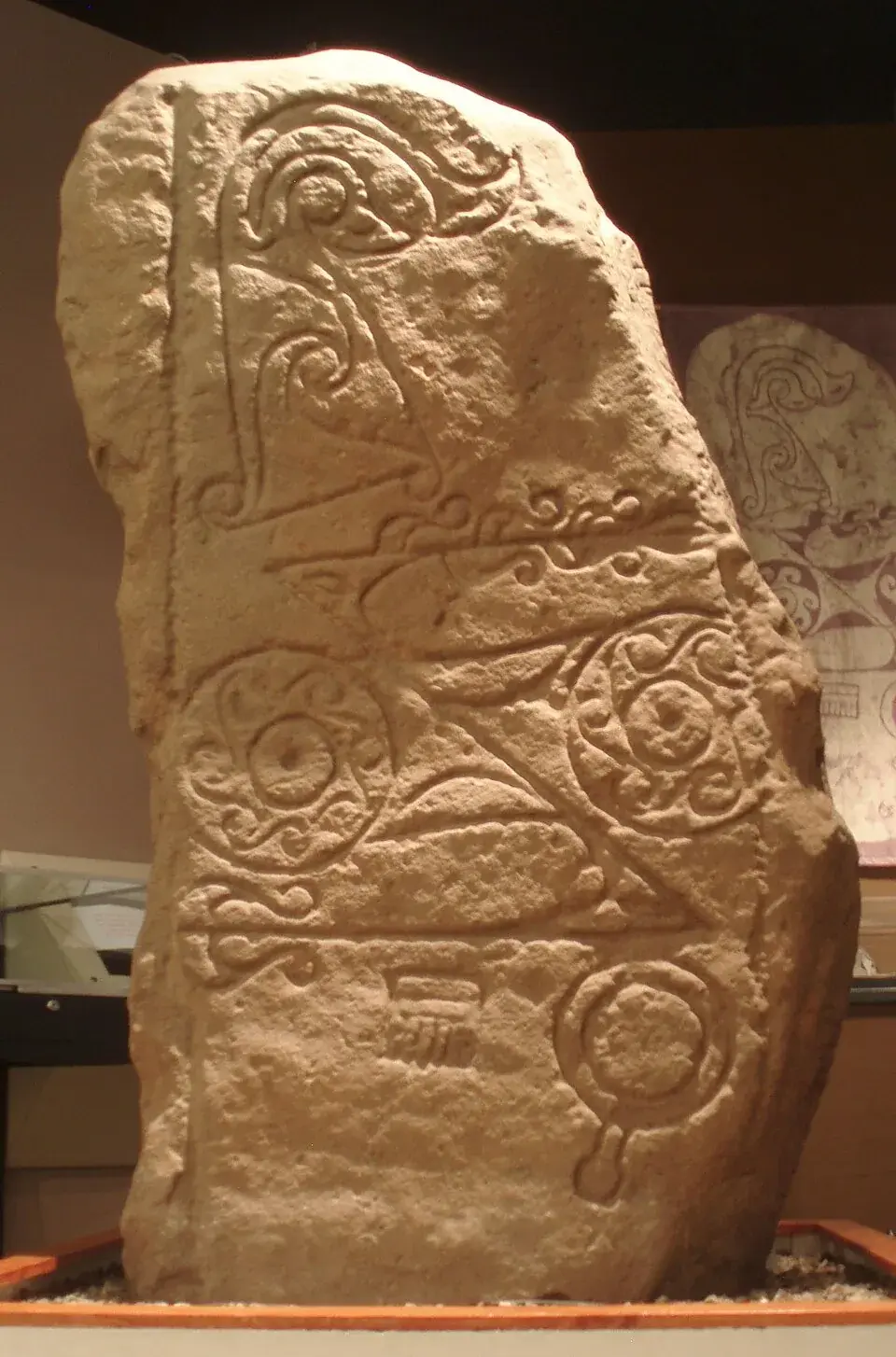
Hundreds of these carved stones are the closest thing the Picts left to a written record of their own.
Image Credits: By Catfish Jim and the soapdish - Own work, CC BY-SA 3.0, https://commons.wikimedia.org/w/index.php?curid=11788797
Who the Picts Were
Picts were not a single tribe, and probably not a single people either. Historian Stuart McHardy describes them as a confederation of tribal groups whose main reason for acting together was the need to stand against common enemies. Their territory stretched across northern Scotland, from the Firth of Forth in the south to Orkney in the north.
Daily life revolved around small, closely-knit communities. Families belonged to a clan, and each clan obeyed a chief. Men were warriors when their clan needed defending, but for the most part they farmed and fished. Women farmed, fished and raised children. Houses were mostly made of wood, which is presumably why so little of Pictish settlement survives compared with their extraordinary carved stones.
Clans acted in their own interests and regularly raided each other for cattle. When an outside threat appeared, however, they could come together and pick a single war leader to command the whole coalition. This tendency to unite only when needed would set the template for virtually all the major events in Pictish history.
Where the Name "Picts" Comes From
The name first appears by being written down in 297 CE by the Roman orator Eumenius who referred to the tribes of northern Britain as Picti. In Latin this means "the painted ones", and the traditional explanation is that this was a name the Roman soldiers gave them because of their habit of painting or tattooing their bodies.
This explanation has been challenged. McHardy and other scholars point to the Scots word Pecht, a longstanding term for "the ancestors." Place-name scholar W.F.H. Nicolaisen noted that the Latin Picti closely resembles the Old Norse Pettir and the Old English Pehtas and suggested they did not derive from each other but from a common source; a possible explanation is that the name Romans applied to the people was borrowed by the people themselves. Not everyone, however, accepts the argument, and the painted-body theory still has defenders. Earlier Roman writers did not use the word Picts at all. Tacitus, writing about the first century, referred to the northern peoples as the Caledonians, although in fact that was just the name of one tribe.
Did the Picts Come From Somewhere Else?
An older history often describes a "Pictish invasion" of Scotland shortly before the Romans arrived. The medieval writer Bede also passed on a legend that the Picts had sailed from Scythia (a vague ancient term for the lands north of the Black Sea), landing first in Ireland and then settling in northern Britain.
Modern scholarship has largely abandoned this idea. The Collins Encyclopedia of Scotland argues the Picts never came at all, because they were descended from the first people to live in what became Scotland. Archaeologist Gordon Noble of the University of Aberdeen, who has led major excavations at Pictish sites, agrees that all the evidence indicates the Picts were indigenous to northern Scotland. In his view they began coming together as a discernable people during the late Roman period and went on to build some of the most powerful kingdoms in early medieval Britain.
McHardy goes further and links the Picts to the Neolithic monuments of Scotland such as the Ness of Brodgar in Orkney. This is a much bolder claim. These sites were built around 5,000 years ago, thousands of years before anyone called the Picts by that name, so the connection is one of deep ancestral roots rather than the Picts actually building them.
Clans, Chiefs and the Pictish Kin
The clans that later writers associated with northern Scotland included the Caledonii, Caerini, Cornavii, Lugi, Smertae, Decantae and Carnonacae. Many of these names come from the Roman geographer Ptolemy, and some lists also add the Selgovae and Votadini, though those two lived in southern Scotland and probably were not Pictish at all.
The chief of a clan held great authority. Historians Peter and Fiona Somerset Fry describe him as a father figure to everyone in the kin, even distant relations. He had rights over the clan's land and cattle and his quarrels became theirs, to the extent that his people were expected to fight and die for him.
This reverence for ancestry and father figure is one further reason some scholars favor the Pecht explanation of the name. A people who called themselves "the ancestors" would be making a clear statement: they belonged to the land, and they had been there for a very long time.
Rome Comes North: Agricola and the Battle of Mons Graupius
Rome's conquest of Britain began in earnest under Emperor Claudius in 43 CE. By 79 or 80, the governor Gnaeus Julius Agricola had pushed into the north, reaching a line between the rivers Clyde and Forth by 82. He marched north again the following year.
In 83 or 84, he met a huge army of northern tribes at a place called Mons Graupius – the exact location of which is still unknown. Leading them, according to Tacitus, was a man named Calgacus. Tacitus does not call him king or even chief but only one of the many leaders, and he was a man of outstanding courage and noble birth. That fits neatly with the Pictish pattern of picking one war leader when the tribes united in their opposition to Rome.
Tacitus claims Calgacus commanded about 30,000 men, and gives him one of the most famous speeches in ancient literature. Calgacus condemns the Romans as robbers of the world, plundering rich and poor alike, but he finishes with the line that "they make a solitude and call it peace." It's often quoted as "they make a desert," which is how many translators render it. Most historians suspect it's Tacitus's invention, a way to criticize Roman imperialism through the mouth of a barbarian. Tacitus was also Agricola's son-in-law, which is worth remembering whenever he describes the general's victories.
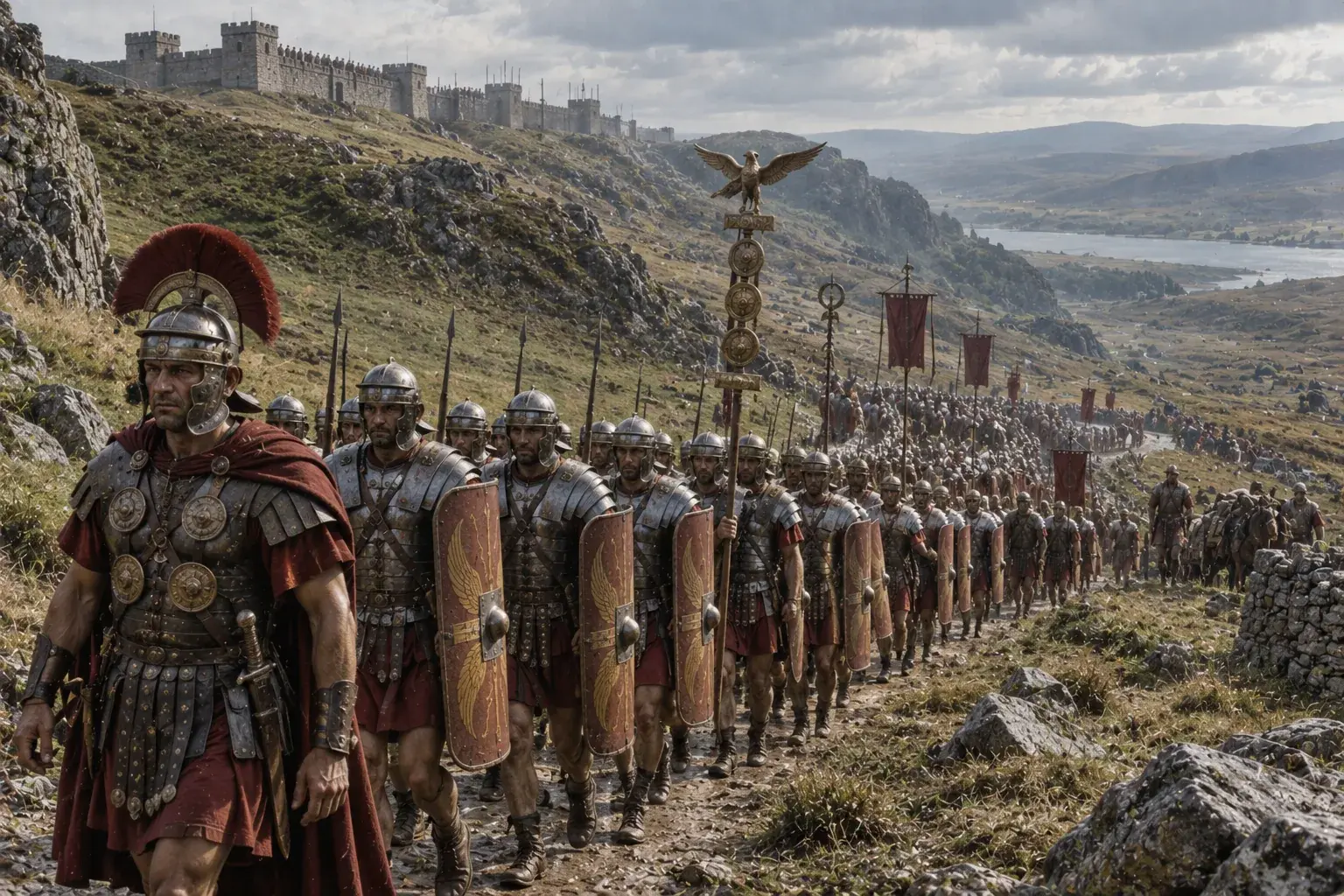
Agricola's legions pushed deep into Pictish territory before the two sides met at Mons Graupius.
Victory or Strategic Retreat? Rethinking Mons Graupius
By Tacitus's account, it was a crushing Roman win. Agricola sent in his auxiliary troops (around 8,000 infantry and 3,000 cavalry) and kept the legions in reserve. The tribes fought in the style they were used to from their clan warfare, the Romans held their formation and pushed back, and the northern army eventually broke and fled into the hills. Tacitus gives a figure of around 10,000 dead.
McHardy reads the same events completely differently. What Tacitus saw as a rout, he argues, may in fact have been the tribes deliberately scattering back to their communities to regroup. He points out that no Roman source describes another pitched battle like Mons Graupius in the north for the rest of the Roman period. The northern warriors seem to have learned quickly that facing a disciplined Roman army head-on was pointless. Instead, they went back to the fast, small-scale raiding they knew, akin to guerilla warfare, and they kept it up for centuries.
The Somerset Frys raise the same point. If Mons Graupius was so much a victory, why did Agricola head south immediately afterwards. When he finally left Britain, the Roman frontier lay far south of the battlefield, and over the following years Rome's grip on Scotland steadily weakened.
Why Rome Never Conquered Scotland
Part of the answer lies in how the north was organised. Rome had a highly-practised way of conquering: capture the cities, take the centres of power and control the farmland. Northern Scotland had no cities to capture and no single capital to seize. The tribes could move swiftly, lived off the land and were not tied to any one settlement.
After Mons Graupius they also refused to meet Rome in the open field. Roman legions struggled against this type of enemy elsewhere too. The Goths under Athanaric used the same tactics against Emperor Valens between 367 and 369.
Rome responded with walls. Emperor Hadrian ordered the building of a wall running about 73 miles across northern England from coast to coast, in 122 CE. Twenty years later, under Antoninus Pius, the Antonine Wall was built further north across central Scotland, although it was abandoned within a generation. Neither wall stopped northern raids. As the Somerset Frys note, both were as much psychological boundaries as physical ones, marking the line between "civilised" Roman territory and the lands beyond.
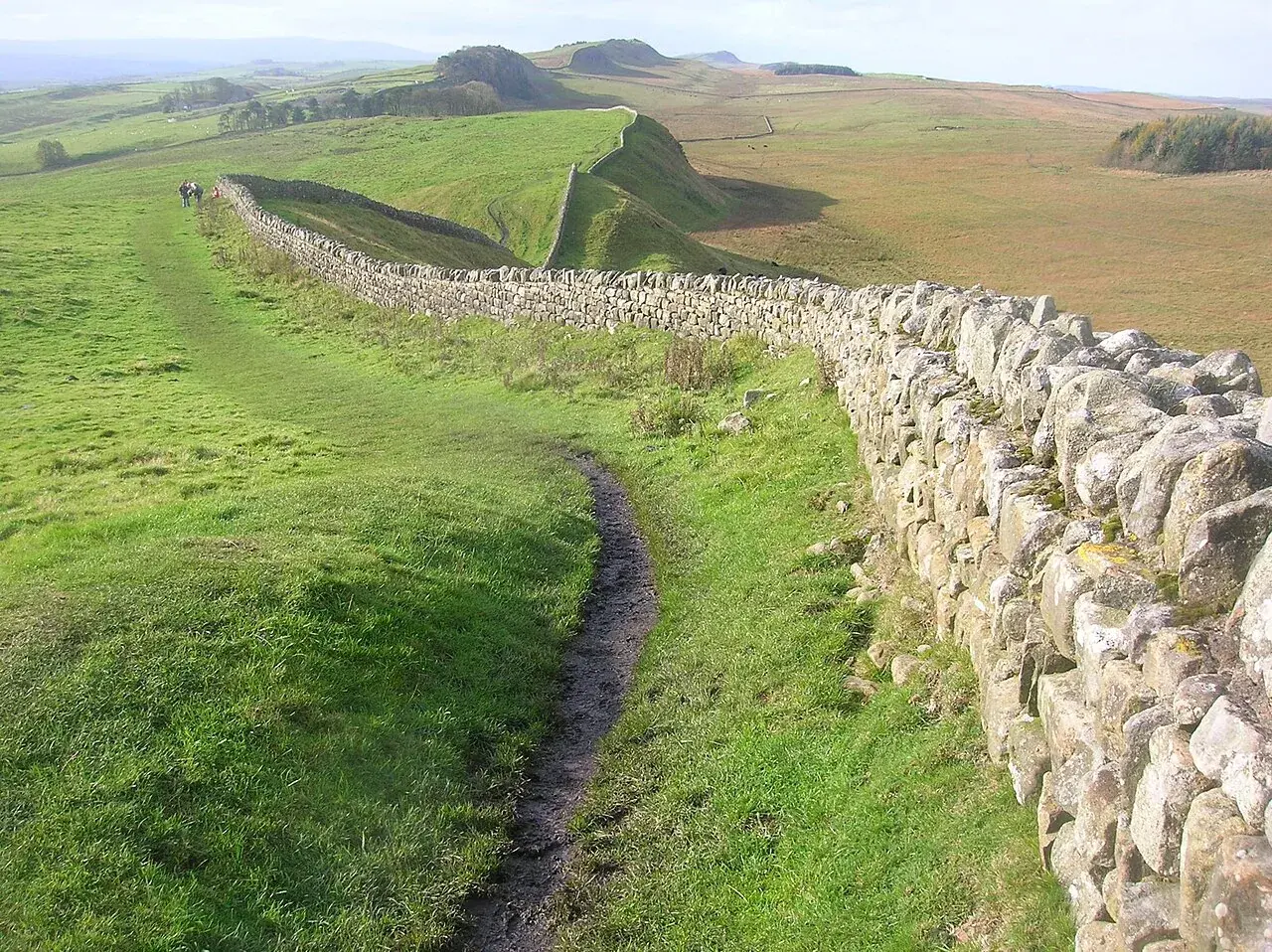
Hadrian's Wall marked the edge of Roman control, but it never stopped Pictish raiders from crossing it.
Image Credits: By quisnovus from Gloucester, England - Hadrian's Wall, CC BY 2.0, https://commons.wikimedia.org/w/index.php?curid=101730445
Raids continued throughout the Roman period, including the great concerted attack in 367 known as the Barbarian Conspiracy, in which Picts, Scots, Attacotti and Saxons struck Roman Britain at the same time. When Rome finally withdrew from Britain around 410, the Picts were still living north of the wall, as they always had.
Their carved stones suggest their way of life hardly changed between the arrival of the legions and their departure.
Pictish Religion, Women and Matrilineal Succession
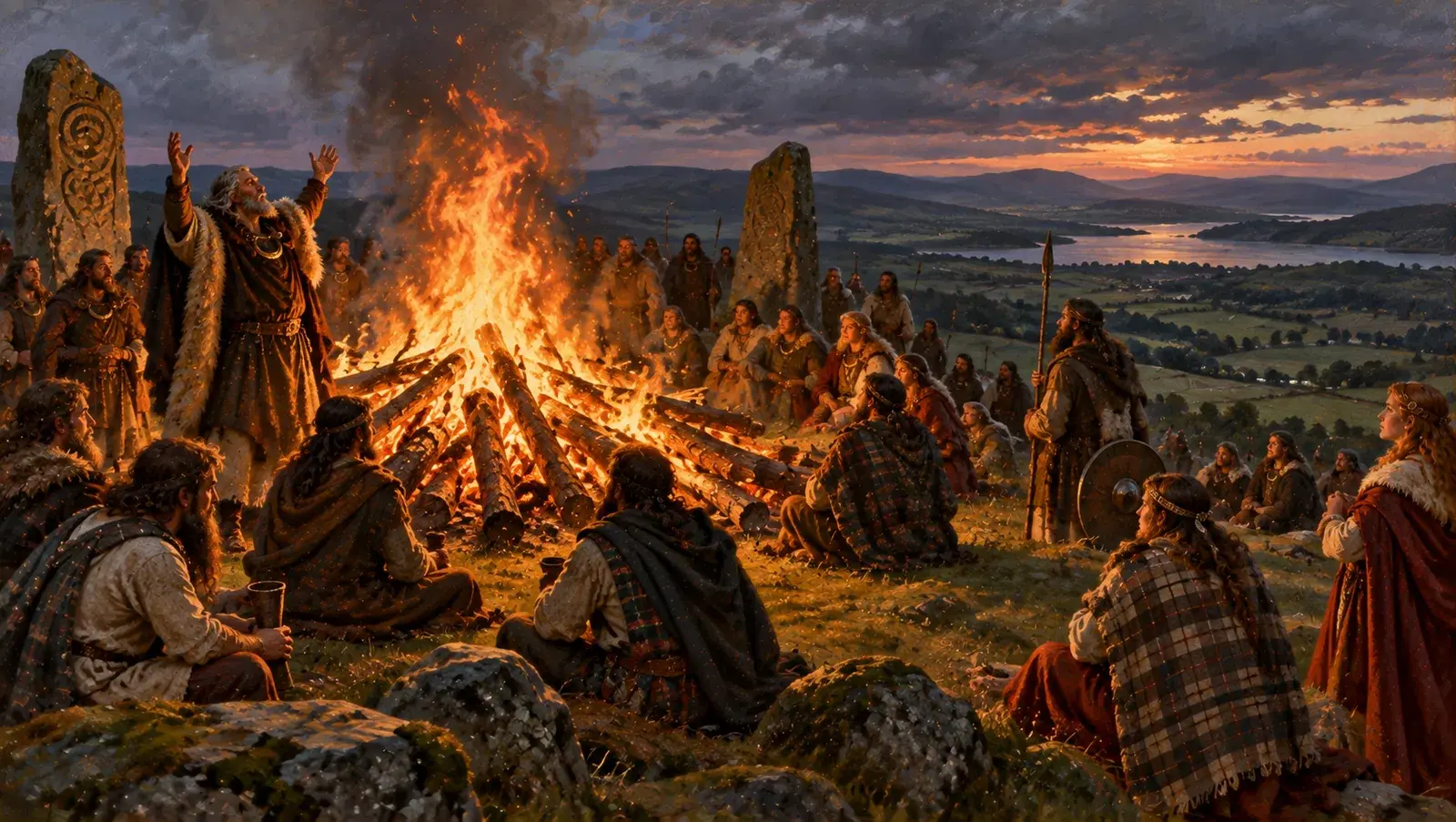
Before Christianity, the Picts followed their own form of tribal paganism. McHardy argues this centred around goddess worship and a deep reverence for the natural world, with particular places in the landscape regarded as holy because a goddess lived, walked or worked miracles there.
He also argues women in Pictish society held a status at least equal to men, and leadership passed through the female line. Under this system a king would be succeeded by his brother or possibly a sister's son, not his son. Bede recorded a version of this idea, and it became a standard feature of Pictish history.
It is important to note that matrilineal succession is one of the most disputed areas in Pictish studies. Some historians, including Alex Woolf, have argued the evidence is much weaker than once thought, and that Bede may have been repeating a legend. The pattern of brothers and cousins succeeding each other can also be explained in other ways.
What remains clear is that Christianity brought a markedly different world-view. As McHardy puts it, the old goddess lived in the landscape, whereas the new God lived in a distant heaven. Ideas of sin, and particularly the idea of women as sinners, would have been a marked change for a society that may have venerating a mother goddess.
Saint Ninian, Saint Columba and the Conversion of the Picts
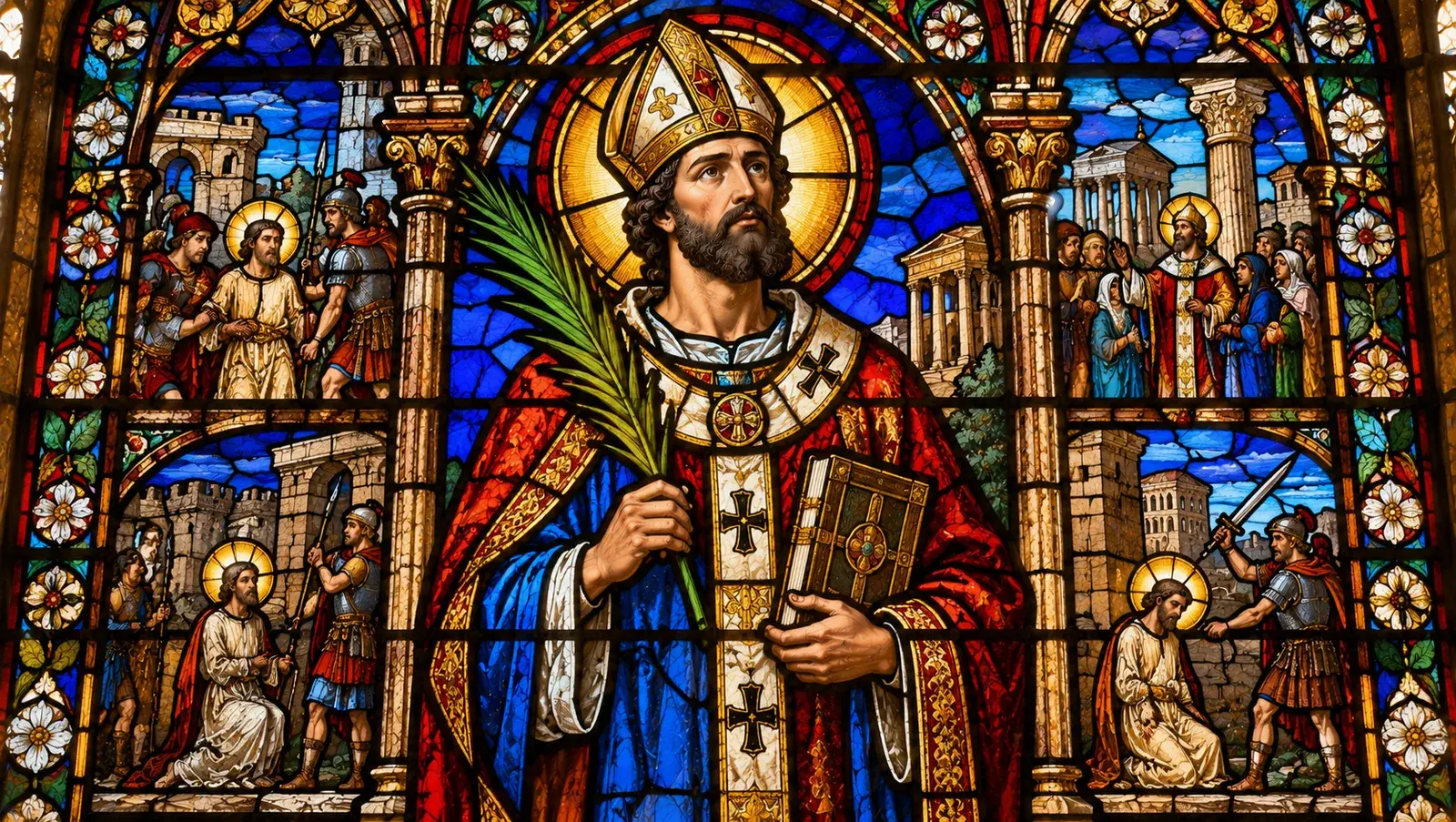
Christian missionaries began working among the Picts early on. Tradition credits Saint Ninian with bringing Christianity to the southern Picts around 397, although the details of his life are uncertain and the dates of the Pictish kings of that era are more legend than history. McHardy neatly sums up the long-term effect: where the Roman Empire failed to conquer the Picts, the Church succeeded.
The big breakthrough came with Saint Columba, who sailed from Ireland around 563 and founded his famous monastery on Iona. At the time the powerful Pictish king Bridei son of Maelchon ruled the north from a stronghold near Inverness. Sources disagree on whether Bridei converted after meeting Columba or was already Christian. Columba came from a powerful Irish royal family and had been embroiled in dynastic warfare in Ireland, and this experience may have made dealing with kings and warriors easier.
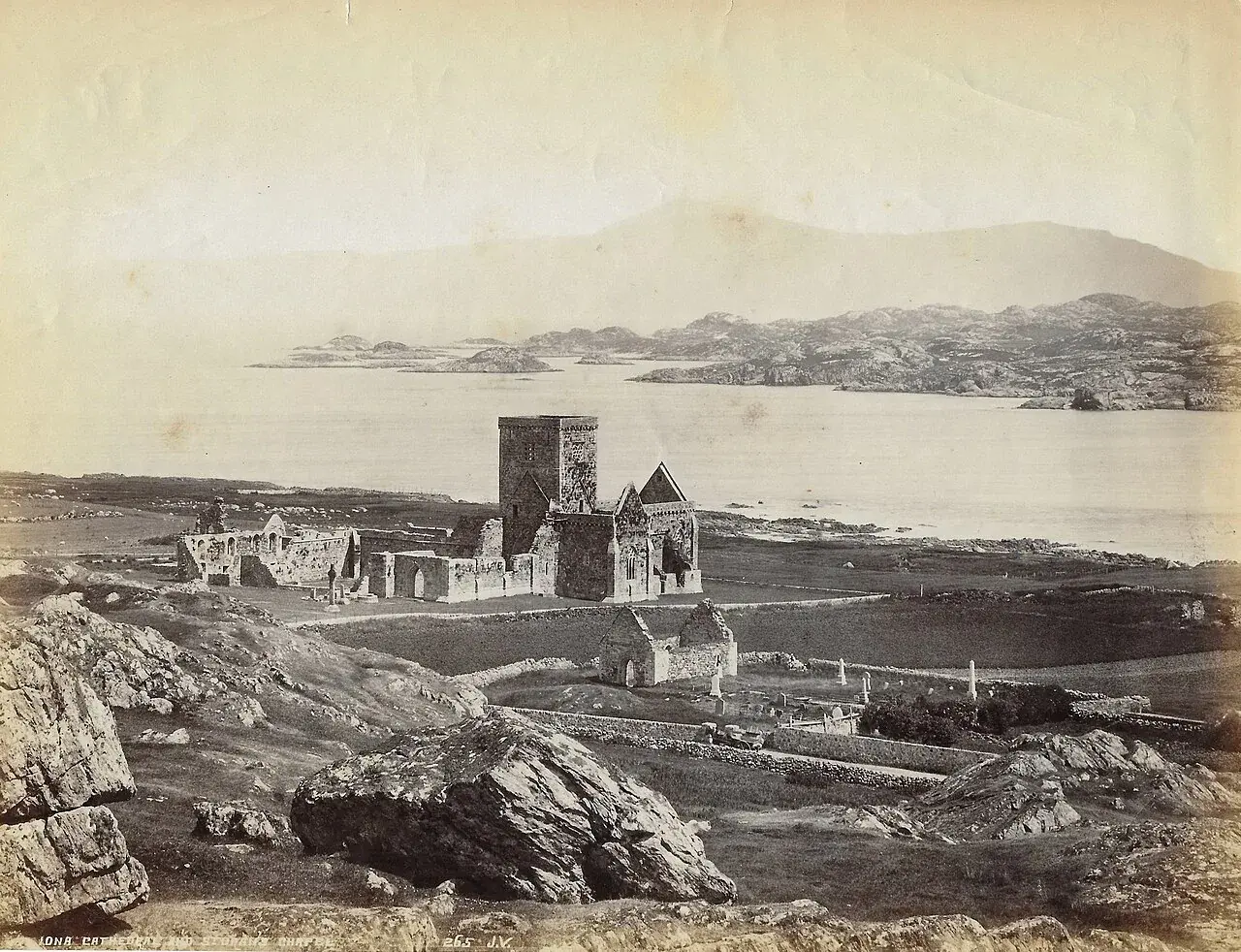
Columba's monastery on Iona became the launching point for the Christian conversion of the Picts.
Image Credits: By Anonymous, marked 'Iona Cathedral and St Oran's Chapel' 265 J.V. - Single old late Nineteenth Century sepia photograph, scanned in, Public Domain, https://commons.wikimedia.org/w/index.php?curid=74128707
Saint Columba and the Origins of the Loch Ness Monster
One of Columba's most famous stories has since taken on a life of its own. In his Life of Saint Columba, written about a century later, Abbot Adomnán of Iona describes a monster living in the River Ness that had already killed a local man. When the creature went after one of Columba's companions, the saint made the sign of the cross and ordered it away in God's name. Adomnán says the terrified beast fled as if pulled back with ropes.
The story takes place in the River Ness, not the loch itself, but it is widely regarded as the earliest ancestor of the Loch Ness Monster legend. In Adomnán's version it also impressed the local Picts, as did Columba's contests with Pictish magicians, a series of stories that closely follow the account of Moses facing Pharaoh's priests in the Book of Exodus.
Resistance to Christianity among the Picts
By the time Columba died in 597 much of Pictland had turned Christian. The conversion was not nearly as smooth as church writers like Adomnán and Bede suggest, though. Around 617 Saint Donnan and more than fifty companions were killed on the island of Eigg, an attack traditionally blamed on the Picts, although some sources point to pirates. Irish annals also record the burning of a monastery on Tiree in 673. In short, the old beliefs did not disappear overnight.
The Rise of Northumbria and a New Kind of Pictish King
In the 7th century a new threat arose in the south. The Anglo-Saxon kingdom of Northumbria was expanding rapidly, taking land from the Britons of Strathclyde, the Scots of Dál Riata in the west, and the Picts themselves. Northumbrian kings installed rulers in the conquered territory and demanded tributes.
This pressure seems to have prompted the Picts to pursue a new political model. Instead of a number of chiefs coming together temporarily under one war leader, they increasingly started to look at one king who ruled over all the tribes. It may be that they saw how effectively Northumbria's kings had organised their conquests and decided to do the same in their turn.
Bridei son of Beli: The Greatest Pictish King
The ruler who turned the tide was Bridei son of Beli, often written Brude mac Bile. He was widely considered the greatest of all Pictish kings. He was related to the Northumbrian king Ecgfrith, and one theory is that Ecgfrith aided his accession expecting a loyal, tribute-paying ally. Another suggests Bridei emerged after Northumbria had defeated the northern Pictish king Drest son of Donuel at the Battle of Two Rivers in the early 670s.
Either way, Northumbria expected tribute, and Bridei had other ideas. He may have paid cattle and grain at first, but when he had secured his position these payments ceased. Worse, from Ecgfrith's point of view, Pictish raiders were crossing south into his territory.
Bridei spent the early 680s consolidating his position. The Irish annals record him besieging Dunnottar in 681 and sending a fleet to devastate Orkney in 682. In 683 he besieged Dunadd, the stronghold of the Scots of Dál Riata. By then his flanks were secure and the only real danger remained a direct attack from the south.
The Battle of Dun Nechtain (685)
This came in the spring of 685. Ecgfrith ignored advisers, including churchmen, who urged him not to go to war, and marched north into Pictish territory. Bridei drew the Northumbrian army further into the north before finally turning to fight at a place the English sources describe as Nechtansmere, the Welsh sources as Linn Garan and the Irish annals as Dun Nechtain. The Northumbrians found themselves trapped between the Pictish army and a lake with marshy ground. Bede, the most detailed source, claims the Picts pretended to retreat and lured the king into narrow mountain passes where he was killed along with most of his army on May 20, 685. Ecgfrith was 40 years old, and in the fifteenth year of his reign.
Bede, a natural Northumbrian, understood the significance. From that day, he wrote, the hopes and strength of the English kingdom began to ebb. The Picts recovered their lost lands, and the Scots and many of the Britons re-established their freedom. Many Northumbrians in Pictish territory were killed, enslaved or forced to flee.
The impact of the battle is hard to overestimate. It ended Northumbrian expansion into the north and roughly fixed the frontier between what would become England and Scotland. Bridei ruled until his death in 693, leaving his kingdom secure.
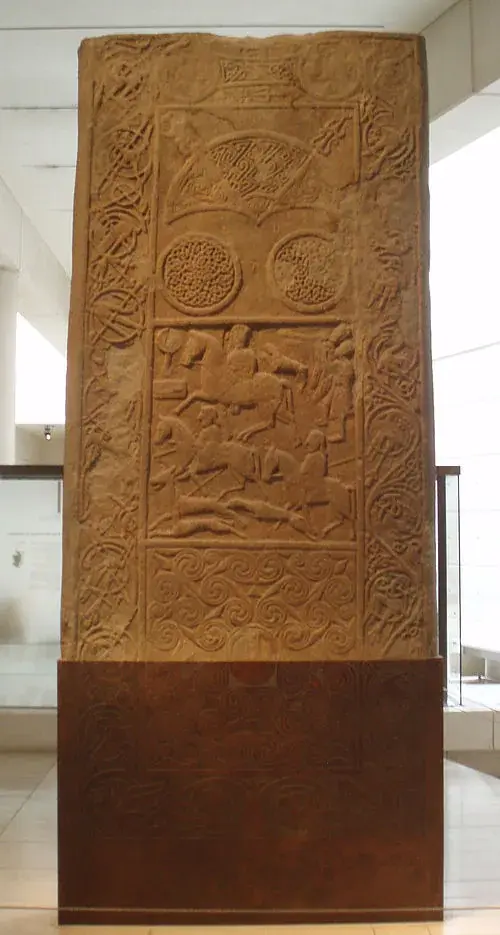
Stones like this one at Aberlemno are thought to depict the very battle that broke Northumbria's power in the north.
Image Credits: By Catfish Jim and the soapdish - Own work, CC BY-SA 3.0, https://commons.wikimedia.org/w/index.php?curid=11056571
The Law of the Innocents and Pictish Kingship after Bridei
Bridei's successor, Taran, proved unpopular and was deposed after a few years. The next king, Bridei son of Der-Ilei repelled another Northumbrian invasion in 698.
He is also associated with one of the most remarkable legal documents of early medieval Europe. In 697 Abbot Adomnán of Iona gathered the leading kings and churchmen of Ireland and northern Britain together at Birr in Ireland to agree the Law of the Innocents (or Cáin Adomnáin). The law aimed to protect women, children and clergy from violence in war. It was Adomnán's initiative, but he was one of the few rulers who guaranteed the law – which shows how closely Pictland was now tied into the wider Christian world.
Nechtan, Easter and the Pictish Religious Wars
Bridei son of Der-Ilei died in 706 and was succeeded by his brother, Nechtan. Nechtan made a decision that fractured his lands, ordering that the churches of Pictland follow the Roman practice, rather than the older Columban Irish tradition. The issue was far bigger than calculating Easter or cutting hair, for the Columban church was rooted in local communities and the Roman practice bound the Church more closely to Rome and, to many Picts, the Anglo-Saxon south. We do not know exactly why Nechtan favoured Rome, and his reform seems to have been widely resented. In 724 he gave up his throne, entering a monastery. What then followed were years of fighting between rival kings, which later commentators often refer to as a religious civil war (but was also very much a power-struggle). Nechtan himself briefly tried to return.
Óengus son of Fergus and the Conquest of Dál Riata
The man who eventually put an end to the chaos was Óengus son of Fergus, and he had defeated his rivals by the early 730s. He united the Picts by focussing their aggression outwards, and in particular against the Scots of Dál Riata in the west. He attacked the west in the 730s, capturing the fortress of Dunadd in 736, and by the 740s had brought Dál Riata under Pictish control. He was not unstoppable, and when he turned his forces on the Britons of Strathclyde his men were defeated at the Battle of Mocetauc in 750, and his brother Talorgan killed.
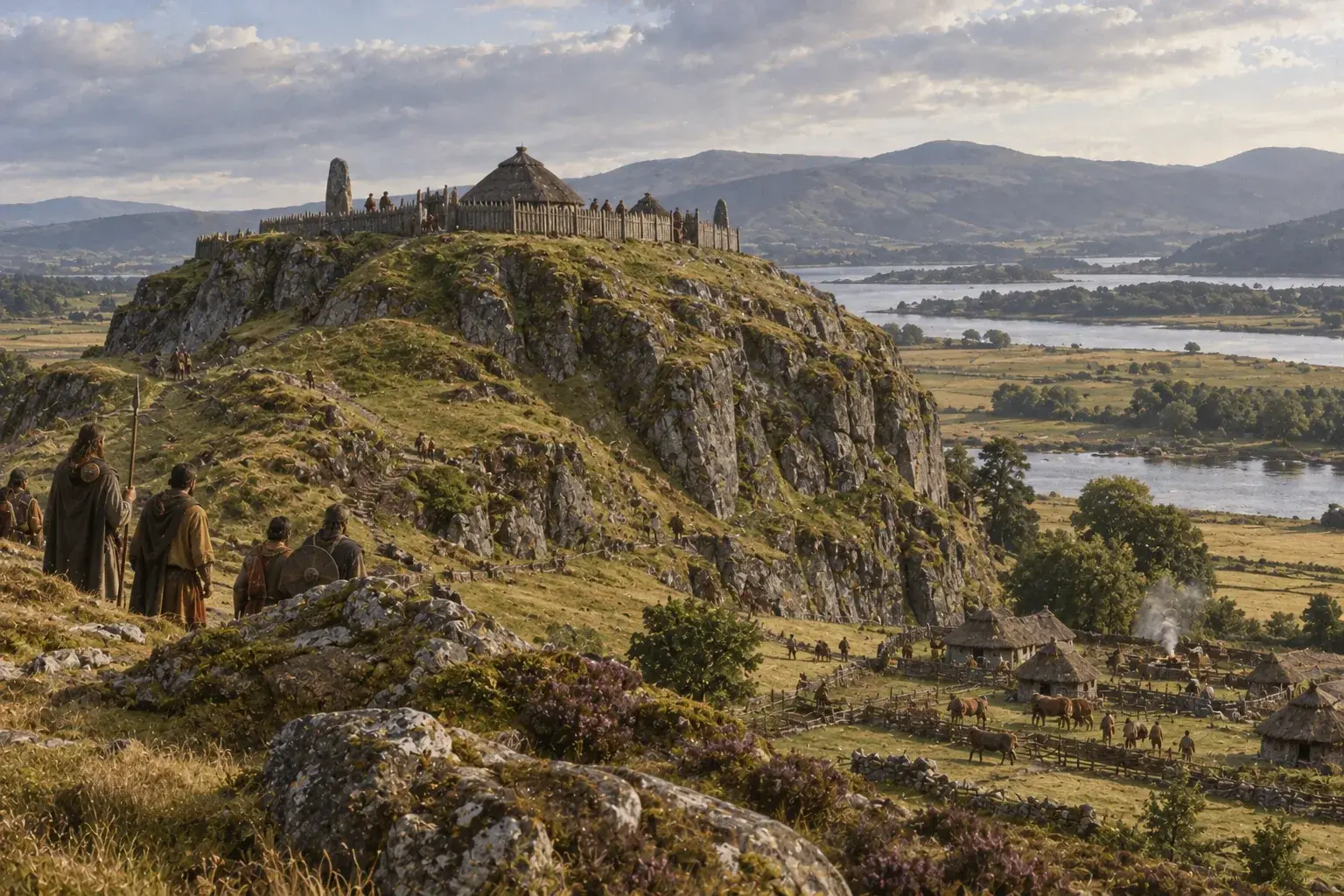
Dunadd, the seat of the Scots of Dál Riata, changed hands more than once as Pictish kings fought to control the west.
Constantín, Óengus II and the Legend of the Saltire
Toward the end of the eighth century, Constantín son of Fergus came to power, ruling from around 789 until his death in 820. He seems to have been king of both Picts and Scots, and is perhaps seen by some historians as the beginnings of the merged kingdom that was to follow. His brother Óengus son of Fergus (sometimes called Angus II) succeeded him, and reigned until 834.
Óengus II is central to one of the most well-known legends of Scotland, the origin of the Saltire. The tale goes that before a battle against an invading English army, the saint Andrew appeared to the king in a dream, telling him that he would win the battle. The following day, white clouds formed an X-shaped cross against the blue sky, and the Picts and Scots won the day, and the white cross on blue became the flag of Scotland.
It's a wonderful legend, but only a legend. It survives only in much later medieval sources, and the English leader mentioned, Athelstan, is not appropriate to the time of Óengus. What is certain is that Óengus's family did promote the cult of Saint Andrew, whose church at St Andrews became Scotland's most important religious centre.
Kenneth MacAlpin and the Myth of the Pictish Massacre
Most history books give credit for bringing the Picts and Scots together to Kenneth MacAlpin (or Cináed mac Ailpín). Stories that have survived for centuries tell of Kenneth, a Scottish king, who swindled the Pictish nobility, murdering them at a banquet and taking over their kingdom.
Modern historians will reject such a view. The earliest sources refer to Kenneth as king of the Picts, not king of the Scots. McHardy points out that stories of him swindling or slaughtering the Picts appear only in much later medieval manuscripts, without previous source material. There was no Pictish court as imagined by later writers, and Kenneth's background is so uncertain that some think he might have had Pictish connections himself.
Kenneth came to power around 843, and died in 858. His reign was troubled by fighting with the Britons and the Anglo-Saxons, and he spent much of his time dealing with a new threat - the Vikings. He moved relics of St Columba from the vulnerable Iona to Dunkeld, further inland. Later traditions also link him with the Stone of Destiny at Scone, the ancient inauguration stone of Scottish kings.
Here's the thing. Scotland's borders were a very long way from where they are today. Lothian in the east was still Northumbrian territory, Strathclyde was an independent British kingdom, and much of the far north and islands would fall under Norse control for centuries.
Viking Raids and the Birth of Alba
The threat presented by the Viking Age did more than anything else to finish what Northumbria had begun. McHardy describes the brutal raids reported year upon year in the Irish and English annals, often by a handful of longships and some years by much larger fleets. Eventually the raiders began to settle. The Norse took over most of Scotland north of Inverness, as well as the Hebrides, Orkney and Shetland, and came close to conquering the Picts completely at least once.
In the face of that threat, the Picts and Scots drew together. Gordon Noble has described the period as one of increased amalgamation between the two peoples, probably due to the Viking attacks on the kingdoms of northern Britain. The last kings to be referred to as kings of the Picts were in the late ninth century. Around the year 900, the Irish annals begin to refer to the kingdom as Alba, and Donald II, who died in 900, is the first ruler recorded with that title.
What Really Happened to the Picts
So the Picts didn't disappear, and they were not exterminated. As McHardy puts it, the tribal people of Pictish and Scottish origin combined to form the new kingdom of Alba, which in time became Scotland. The Pictish language gave way to Gaelic, the name Pict dropped out of the written record, and the history of one people just folded in to another's.
Taking a long look backwards, it's a remarkable journey, from a loose confederation of clans that outlived Rome by refusing to fight on Rome's terms, through to standing off Northumbria at Dun Nechtain then quietly becoming the foundation of a new nation. And the mysteries of the Picts were really never about where they went, but why so many later writers should assume they'd gone anywhere at all.