A mountain in the desert was on fire at its peak, veiled in smoke and lightning, and shaken to its roots with such force that the camp could hardly withstand the trembling. The sound of a trumpet was heard, growing immeasurably loud, although no one was there to play it. And right there, in the shadow of this mountain peak, stood a nation of free slaves, forbidden to approach the fire, waiting for their God to speak to them.
What the God spoke to them, announcing his laws, was written on two tablets of stone. These ten short sentences will shape the laws, the judiciary, and the moral principles of many nations in the future. One of the most influential texts in history was created.
Three Months to a Mountain
It had been three months since the Jews left Egypt. They found themselves in the desert of Sinai, having settled down in a camp facing the mountain. Their lives had changed significantly – they were free people now. However, this freedom was not complete, as they did not yet have a clear law, a guiding principle, a constitution. The people were a huge social group with no unity or identity.
God told Moses that he wants to make a covenant with the people of Israel, that is, to establish a friendship between them. He would give them his law if they obeyed him and faithfully followed all his ordinances. In return, they would become his peculiar treasure, a holy people. Moreover, the Lord warned Moses to tell the people to prepare themselves for three days, for on the third day, he would come down to the mountain in their presence to speak to them. The people were told to sanctify themselves and not approach the mountain, which was surrounded by a special fence. On the third day, a fire blazed on the mountain, smoke rose from it, the mountain trembled, and the sound of a trumpet, the like of which the people had never heard, was heard.
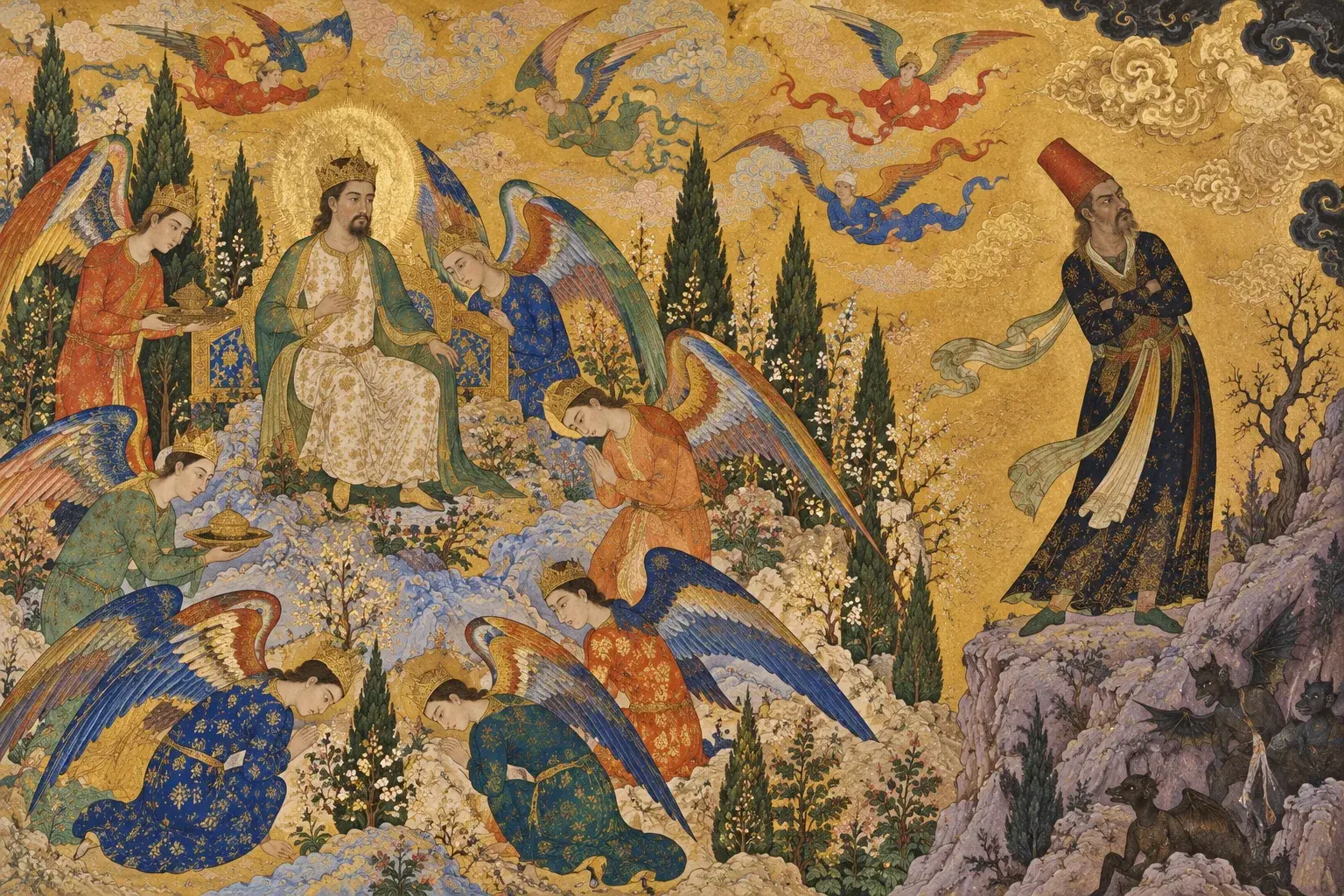
Three months after leaving Egypt the Israelites camped at the foot of Sinai as the mountain erupted in fire, smoke, and the sound of a trumpet growing impossibly loud.
The First Four: How to Love God
The Lord gave the people ten commandments, which were to regulate their lives. The first four commandments were focused on the relationship between the people and God.
The first commandment is the basic principle of the entire Torah: "You shall have no other gods before me." The second commandment says: "You shall not make for yourself carved images, or any likeness of anything that is in heaven above, or that is on the earth beneath." The reason for this is given in the third commandment: "You shall not take the name of the Lord your God in vain." The fourth commandment talks about observing the Sabbath day: "Remember the Sabbath day to keep it holy."
These four commandments, the Lord pointed out, were to unite the people of Israel and form a nation of holy people. Observing these commandments was essential to living in a society of free slaves who had just been freed from centuries of oppression.
God delivers the first four commandments on Mount Sinai, all concerned with how the people of Israel are to relate to Him — the foundation upon which the remaining six would rest.
The Last Six: How to Love People
The other six commandments were related to relationships within society. Many of these commandments and their consequences are familiar to modern people: Honor your father and your mother … You shall not murder … You shall not commit adultery … You shall not steal … You shall not give false testimony against your neighbor … You shall not covet your neighbor's house … You shall not covet your neighbor's wife or his manservant or his maidservant and anything that belongs to him.
The first five commandments are addressed to each of us individually. The sixth one seems most remarkable of all, it goes beyond interpersonal relationships. It is about not desiring what belongs to other people. Although it is not explicitly stated that one should not covet, this commandment covers a wide range of sins associated with greed and jealousy. Six commandments, and a fairly detailed explanation of some of them, and all the requirements of the law were written on two tablets of stone. These are all fundamental principles of human life and the basis of law, without which it is impossible to imagine society.
Written on Two Tablets
The fact that these commandments were written on two tablets is significant. It is interesting that the first four and the last six commandments are related to two different areas of life. The first four relate to the relationship between people and God, and the last six describe the relationship between people and people. Some scholars believe that the division of the commandments into two parts is connected with the two commandments of love, which were subsequently formulated by Jesus Christ: "All the Law and the Prophets depend on these two commandments: You shall love the Lord your God with all your heart and with all your soul and with all your mind and with all your strength. You shall love your neighbor as yourself."
It is also important to note that the commandments were written specifically on tablets made of stone, indicating their durability and importance. Interestingly enough, the commandments were addressed to everyone in the society, without exception. Slaves were equal in their responsibilities before God to the highest priests and the military. It was one of the most progressive aspects of the commandments, which was reflected in the laws that regulated society's functioning.
The Golden Calf
It is known from the context that not everyone was enthusiastic about receiving the commandments. This is where the story of the golden calf begins, demonstrating the incredible faithlessness of people to the Lord. Moses went to converse with God on the mountain for forty days and forty nights. During this time, he could not come down to the people, so those present became impatient. The people turned to Aaron, Moses's brother, and asked him to make them gods to lead them out of the desert. They said: "These are your gods, O Israel, who brought you up out of the land of Egypt." The calf was a blatant violation of the first two commandments concerning the prohibition of making other gods and idols. When Moses saw what the people had done, he was so upset that he shattered the two tablets of stone.
It is hard to imagine how devastating this event was for the whole nation of Israel. They were faced with a new wave of plagues and persecutions from the natives of the desert. Moses pleaded with the Lord to forgive the people and promised to renew the covenant if he went back to Sinai. God agreed, and Moses wrote a new law, which, however, was not followed for long.
While Moses spent forty days on the mountain, the impatient Israelites persuaded Aaron to melt their gold into a calf idol — breaking the first two commandments almost as soon as they had been given.
A Covenant, Not Just a Checklist
When reading Exodus, one may get the false impression that the ten commandments are an independent document that has nothing to do with anything else. At the same time, the text shows that the Lord was talking to the people not about new obligations that were imposed on them, but about a covenant with them. He began his speech with the words: "I am the Lord your God, who brought you out of the land of Egypt, out of the house of slavery." This phrasing is essential and demonstrates that he did not require the people to accept the law because he had just delivered them from numerous hardships.
Another misconception stems from the fact that the ten commandments were given to the people in stone tablets. It seems that they are a kind of strict instruction that the Lord expects the Jews to fulfill. However, it is essential to understand that he told them about the covenant, which implies mutual obligations for both parties. The people could choose whether to accept his law or not, and he might have easily left them to their fate if they failed to fulfill their obligations.
A Summary of the Entire Scripture
The ten commandments are also part of a more significant system of rules and laws known as the Mosaic law. It is no exaggeration to say that the ten commandments are the most essential part of this system. While many rules and regulations described in the Torah are now forgotten, the ten commandments live on in society. They summarize the essence of the entire scripture, contain the most influential and vital laws, and are still part of the daily life and habits of people all over the world.
Moreover, the ten commandments set a standard that was previously unattainable for people to follow. Even today, people are judged according to these laws, sometimes without them knowing it. Some of them are written in the constitutions or laws of many countries. The presence of the Ten Commandments in official symbols, such as the carvings on the courthouse, is significant.
The Impact of Commandments on the Modern World
There is no single answer to the question of what influence the ten commandments have had on the modern world. However, one can safely say that they have had a considerable impact. The phrase commandments themselves sounds solemn and is often used when talking about laws. The commandments have shaped the foundations of many legal norms, which have been integrated into the cultures and societies of different peoples.
Even today, in the twenty-first century, some of the ten commandments remain part of the moral and legal norms of society. They regulate the relationships between people and define the concepts of crime and punishment, which are crucial elements of law enforcement and the court system. The commandments were universal even for the most prominent religious figures, such as Jesus Christ. It was he who spoke about the two greatest commandments of all, without which no person can truly be moral.
This article shows that there is value in knowing the ten commandments. After reading Exodus, one can conclude that they contain fundamental laws essential to human society. No individual can exist without following at least some of these commandments. All of them are simple, clear, and understandable, making it easy for a person to distinguish between right and wrong. Ten sentences were written on two tablets of stone, setting the path for the entire nation of free slaves.