Ten years of war, a destroyed city, most of a generation of heroes dead, and it starts because somebody wasn't invited to a wedding. That's not a joke the Greeks made accidentally. The whole architecture of the Trojan War story is built on the disproportion — a petty slight at a party escalating, step by reasonable step, into the end of a civilisation. Peabody puts it well: destiny has grown ominous plants from little seeds, and this is how one evil grew big enough to overshadow heaven and earth. Here's the whole sequence, from the apple to the ashes.
Part One: The Apple of Discord
The sea-nymph Thetis — the one Zeus had wanted for himself, until Prometheus warned him that her son would outgrow his father — was married off to a mortal king, Peleus. There was an enormous wedding feast in heaven, and every immortal was invited. Except one. Eris, goddess of Discord, whose presence at a party is self-explanatorily unwelcome. She came anyway. She walked into the middle of the celebration, threw a golden apple onto the floor, and left with a look on her face that everyone remembered afterwards. Someone picked it up. There were two words on it: For the Fairest. That's the entire weapon. Two words and a piece of fruit.
Three Claimants
Every goddess present wanted it, and three would not back down. Aphrodite said it was self-evidently hers, being the goddess of beauty. Hera, queen of the gods, could not tolerate being called second to anyone. And Athena, who had wisdom and war and had no obvious need of a beauty prize, wanted it anyway. None of the gods would judge it. Not one. Not even Zeus — who was married to one claimant and father to another, and could see perfectly well that whoever decided this would make two permanent enemies. So it was passed down to a mortal.
The Judgment of Paris
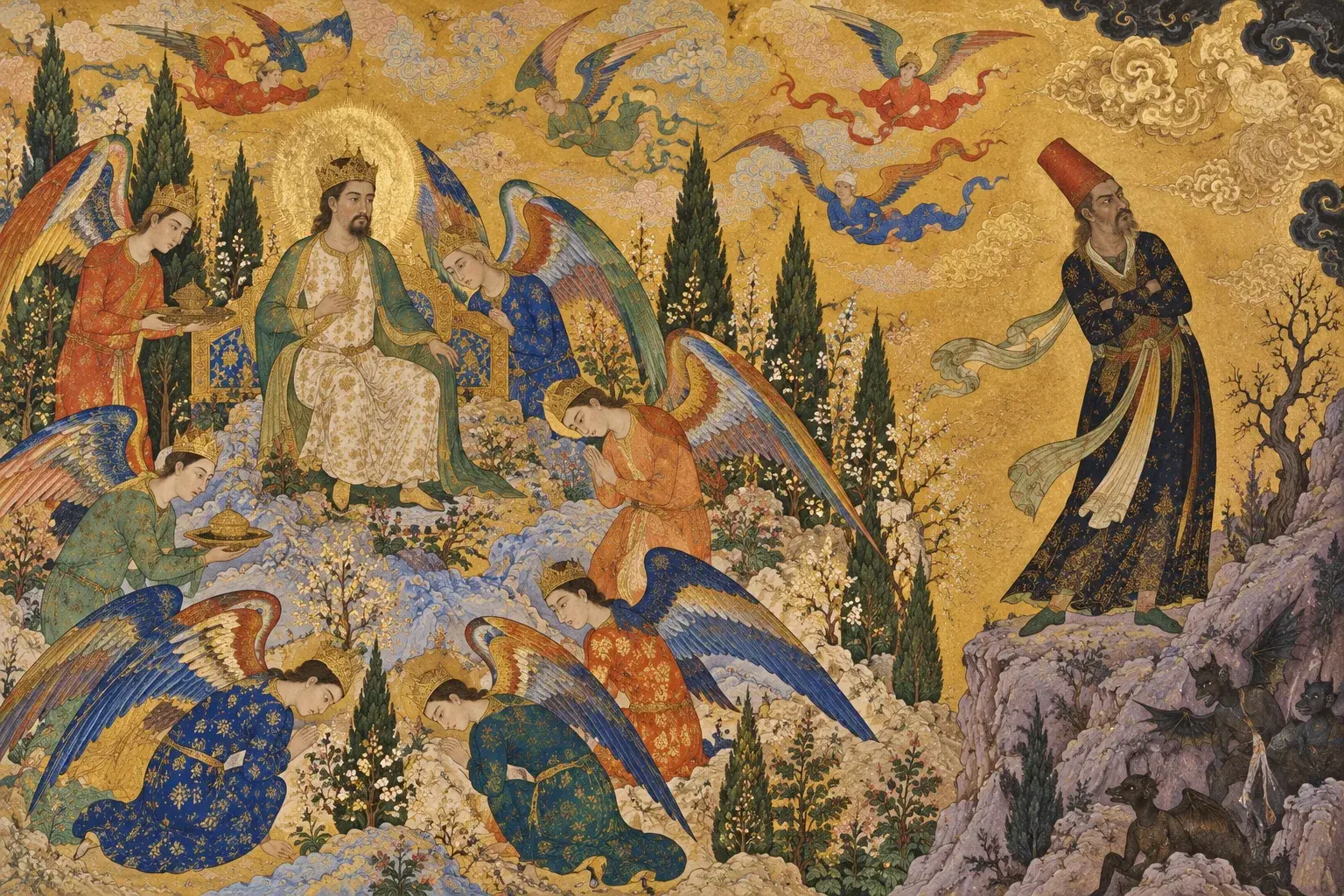
On Mount Ida near Troy there was a shepherd named Paris, and he had a history he didn't know about. He was a prince — a son of King Priam and Queen Hecuba of Troy. But when he was born, an oracle had said he would be the death of his family and the ruin of his country, so, like Oedipus, he was left on a mountain to die. And, like Oedipus, he was found and raised by herdsmen, and lived to fulfil the prophecy exactly. He grew up handsome, tended sheep, and married the mountain nymph Oenone. The three goddesses came to him, and each made an offer. Hera came first, in full state, attended by peacocks, and offered him power: wealth and kingship over men. Athena came next, grey-eyed under a golden helmet, and offered wisdom that would last forever, glory among men, and victory in war. Aphrodite came last, and she was wearing the cestus — her girdle, a piece of enchantment nobody can resist. Peabody notes that she could have won without offering anything at all, and she's right. But she made an offer anyway: he would have for a wife the most beautiful woman in the world. Paris knelt and handed her the apple. And that decision, made by a shepherd on a hillside, decides everything else in this article. Two goddesses walked away in a cloud that boded storm, and they would spend the next ten years on the other side.
Offered power by Hera and wisdom by Athena, the shepherd prince chose the promise of the most beautiful woman in the world.
Part Two: Paris Takes Helen
Aphrodite told Paris who he really was. He went down to Troy, entered an athletic contest Priam happened to be holding, won it, revealed his parentage — and the royal family, who had been warned about precisely this by an oracle, welcomed him back as a long-lost prince and forgot the whole thing. One person didn't. Cassandra, his sister. Cassandra had turned Apollo down, and his revenge was elegant and total: she would see the future accurately, and nobody would ever believe her. On the day Paris was recognised, she saw the whole thing — the war, the burning, all of it — and started screaming, and her family put it down to another of her fits. She was right every single time and it never once helped anybody. Cassandra complex is now a term used in psychology and organisational studies for exactly that predicament.
Sparta
Paris, on Aphrodite's instructions and under a cover story about searching for a lost aunt, sailed for Greece and landed at Sparta. There he was received with full hospitality by King Menelaus and his wife, Helen — the most beautiful woman in the world, daughter of Leda and (in some versions) of Zeus in the shape of a swan. Helen had been courted by every hero in Greece before her marriage. Her father, seeing the danger, had made all the suitors swear an oath: they would accept her choice, and if she was ever stolen, they would all come to her husband's aid. That oath is why this becomes a world war and not a raid. Menelaus went to Crete on business. Paris, in his host's house, eating his host's food, persuaded Helen to leave with him and sailed for Troy. Peabody's line for the homecoming is the best in her chapter: King Menelaus returned to find the nest empty of the swan.
An oath sworn years earlier by every one of Helen's former suitors turned a private betrayal into a ten-year war.
Part Three: Gathering the Heroes
Greece caught fire. The oath was invoked and, notably, most of the anger went at Paris rather than Helen — the general view being that she had been enchanted rather than persuaded, which conveniently avoided the harder question. Two heroes had to be dragged in, and both stories are famous.
Odysseus and the Plough
Odysseus, king of Ithaca, had a wife he loved, an infant son, and a small kingdom that suited him. He did not want to go. So he faked insanity. When the recruiters arrived he was down on the beach ploughing the sand and sowing salt in the furrows, apparently not recognising anyone. Palamedes, who had come with the summons, didn't believe a word of it. He picked up the baby Telemachus and laid him in the sand directly in front of the plough. Odysseus swerved. Peabody's comment is perfect: for once the wise man's craft deserted him, and his fatherly wits were manifest. He couldn't play madman after that. He took leave of Penelope and went, with no idea he wouldn't see her again for twenty years. He never forgave Palamedes, and later engineered his death. That part tends to be left out of children's editions.
Achilles in a Dress
Achilles was the son of Thetis — the boy prophesied to be greater than his father, whose potential birth Prometheus had used to blackmail Zeus. Thetis knew he would die at Troy. So she'd taken two precautions. First, she'd dipped him as a baby in the river Styx to make him invulnerable — holding him by one heel, which stayed dry. Second, when war came, she hid him. She sent him to the court of King Lycomedes of Scyros dressed as a girl, to live among the king's daughters where nobody would look for him. Odysseus found him anyway, and the method was pure Odysseus. He arrived at the palace disguised as a travelling merchant and laid out his goods for the royal household — jewellery, ivory, fine cloth, and, among them, weapons. The king's daughters picked out veils and belts and jewellery. One of them picked up the weapons and handled them with obvious pleasure. That was that.
Hidden by his mother among the daughters of King Lycomedes, Achilles gave himself away the moment he saw a weapon.
Aulis
The Greeks — who called themselves Achaeans — chose Agamemnon, king of Mycenae and Menelaus's brother, as commander-in-chief. Under him: Achilles, the greatest fighter; Ajax, the giant; Diomedes; Odysseus; and old Nestor, kept around for his judgement. After two years of shipbuilding they gathered at the port of Aulis — and couldn't leave. Agamemnon had killed a stag sacred to Artemis, and she pinned the fleet in harbour with a dead calm and sent plague through the camp. The oracle named the price: Agamemnon's own daughter, Iphigenia. He agreed. She was brought to the altar under the pretence of a marriage to Achilles. In the version Peabody follows, Artemis snatched her away in a cloud at the last second, left a white hind in her place, and carried her to Tauris in Scythia to serve as a priestess. Her family never knew, and mourned her as dead. Hold on to that, because it comes back in the story of Agamemnon's house. The winds returned. The fleet sailed.
Part Four: Nine Years, and the Tenth
The Greeks landed and made camp on the plain. Odysseus and Menelaus went into the city and formally demanded Helen back. Troy refused. The siege began. And it went on for nine years without resolution. Troy was a real fortified city with walls, farmland behind it and allies. The Greeks couldn't get in, so they raided the surrounding towns instead. There were single combats between champions with both armies watching, and the old men and women of Troy watching from the walls — Priam, Hecuba, Cassandra with her useless foreknowledge, and Andromache, Hector's young wife, with their little son whom the people had nicknamed The City King. Sometimes Helen came and looked out across the plain at the countrymen she'd left. And Peabody records the detail that has always struck me hardest: although she was the cause of the entire war, the Trojans half forgave her when she walked past, because her beauty worked like a spell and warmed hard hearts the way sunshine ripens apples. There were good men on the Trojan side who deserved none of it: Aeneas, Sarpedon, Glaucus, Deiphobus, and above all Hector, Priam's eldest son and commander of the Trojan forces — the most decent character in the entire war on either side. The gods took sides, openly. Hera and Athena backed the Greeks, still furious about the apple. Poseidon backed the Greeks too. Aphrodite backed Troy and brought Ares with her. Zeus and Apollo tried to stay neutral and repeatedly failed.
What the Iliad Actually Covers
Worth knowing: the Iliad is not the story of the Trojan War. It covers about fifty days in the tenth year, and it ends before the city falls. Its subject is announced in the first word — menis, the rage of Achilles. Agamemnon takes a captive woman, Briseis, from Achilles. Achilles, publicly humiliated, withdraws from the fighting and sits in his tent while the Greeks are pushed back to their ships and slaughtered. He will not return for anything: not appeals, not gifts, not the deaths of his friends. Then Patroclus, his closest companion, borrows his armour to rally the Greeks, and Hector kills him. Achilles comes back, and what comes back is not a soldier. It's grief in the shape of one. He goes out in new armour forged by Hephaestus at Thetis's request, drives the Trojans back to the walls, and meets Hector alone by the river Scamander. Hector runs. They go round the walls of Troy three times, in front of his own family, before he turns and faces him. Achilles kills him, ties the body to his chariot, and drags it round the city in front of Hector's wife and parents, and keeps doing it for days. And then the Iliad does the thing that makes it the Iliad. Priam, an old man, goes alone at night, unarmed, across the plain into the camp of the man who killed his son, and kneels, and kisses the hands that did it, and asks for the body back. And Achilles — who has been inhuman for the entire poem — looks at him and thinks about his own father, and the two of them sit and weep together, and then eat a meal. He gives the body back and grants a truce for the funeral. The poem ends with Hector's burial. No horse, no fall, no victory. Just a funeral.
The Iliad ends not with the fall of Troy but with two enemies weeping together over what the war has taken from them.
Part Five: The Deaths of Achilles and Paris
Hector was dead, and Troy's protection with him. But Achilles didn't outlive him long, and he didn't die well. Paris killed him — Paris, who had spent the entire war letting other men fight the disaster he'd caused, and who would never have faced Achilles in the open field. He waited in a temple of Apollo and shot a poisoned arrow from cover. It hit Achilles in the ankle, at the one point the water of the Styx hadn't touched. The Achilles heel as we use the phrase — a single fatal weakness in something otherwise invulnerable — comes from this. Though it's worth knowing that Homer never mentions it. The Styx-dipping and the vulnerable heel appear much later, most fully in Statius's Achilleid in the 1st century CE. In the Iliad, Achilles is simply the best fighter alive and mortal like everyone else. Paris was killed shortly afterwards by another poisoned arrow. Peabody's verdict on this is the most satisfying sentence in her book: but that was no long grief to anybody.
Part Six: The Wooden Horse
Ten years in, Troy still stood. So the Greeks stopped trying to take it by force. The plan — Odysseus's, of course — had three parts. One: a portion of the fleet broke camp and sailed away, in full view. Once out of sight of the city they anchored behind the nearby island of Tenedos. Two: the rest of the army built a horse. Wooden, carved, enormous, with a door so well fitted that you couldn't find the seams. Hollow inside, and big enough to hold a squad of armed men. Odysseus, Menelaus and the other chiefs got in, fully armed, and the door was shut on them. The remaining Greeks burned their camp and sailed. Three: they left one man behind.
The Morning After
Troy woke up and the plain was empty. Ten years of tents, gone. The camp burnt out. No ships on the horizon. It was over. The city went completely, uncontrollably mad with relief. The gates were thrown open for the first time in a decade and the entire population — men, women, children — poured out across the plain to walk through the abandoned camp. And there was the horse. Nobody knew what it was. They gathered round it the way children gather round a live horse, marvelling at the size of it, and started talking about dragging it into the city as a trophy.
Laocoön
One man spoke against it: Laocoön, a priest of Poseidon. His warning is the famous one, and Virgil gives him the line everyone still quotes in some form: beware of Greeks bearing gifts. Peabody's rendering: have you fought them for ten years without learning their tricks? This is treachery. He threw a spear at the horse's flank and it rang hollow, and nobody noticed.
Sinon
At that moment a crowd dragged forward a Greek they'd found hiding — Sinon, who was there entirely on purpose. His story: he'd been abandoned by the Greeks out of Odysseus's spite. The horse was an offering to Athena. And it had been made deliberately enormous so that the Trojans couldn't get it through their own gates — because whoever possessed it would win. Which turns the horse from a curiosity into a challenge. Now they had to get it in.
The Serpents
While they were working out the logistics, two vast sea-serpents came out of the water and up the beach. They went straight through the crowd, seized Laocoön and his two sons, wrapped all three in coils, killed them, and slid back into the sea leaving no trace. The Trojans drew the obvious conclusion and it was exactly the wrong one. Laocoön had spoken against the horse and been destroyed in front of everybody. Clearly the horse was sacred and he had blasphemed. They put garlands on it and dragged it into the city. (The Laocoön group — the marble sculpture of the priest and his sons in the serpents' coils — was dug up in Rome in 1506 and is one of the most famous ancient sculptures in existence. It's in the Vatican Museums.)
The one man who warned against the horse was killed in front of the crowd — and the Trojans read his death as proof the horse was holy.
That Night
The whole city was at a feast. Not one guard on the walls. Sinon opened the door in the horse's side. Odysseus, Menelaus and the rest came down into the dark and signalled. The fleet had already sailed back from behind the island. The gates were opened from inside. Priam and his men were killed. The city was stripped — women, children, treasure. Then it was burned to the ground. Cassandra, who had said all of this out loud repeatedly for ten years, was taken as a prize by Agamemnon.
Aftermath
Helen went home. She'd woken from Aphrodite's enchantment before Paris even died and had been quietly homesick for a long time. She sailed back to Sparta with Menelaus after a long, storm-battered voyage, and lived there as his queen and died the most beautiful woman in the world. If that seems like a light sentence for the woman the war was fought over — it is, and that's more or less the ancient tradition's position on her. Aeneas escaped the burning city with a band of survivors and, after years of wandering, founded the line that led to Rome. That's Virgil's Aeneid, and it exists partly to give Rome a Trojan rather than a Greek ancestry. Odysseus started a ten-year journey home that is its own epic. Agamemnon sailed home in triumph to Mycenae, where his wife was waiting for him with a plan. And Troy itself became grass. Peabody's closing image is the best writing in her book: under the foundations of later towns built and burned in the wars of a thousand years afterwards, the ruins of ancient Troy lie hidden, like mouldered leaves deep under the new grass. And there, she wrote in 1897, men who love the story are digging after the dead city as you might search for buried treasure. She was writing about Heinrich Schliemann, who excavated at Hisarlik in north-west Turkey from 1870 and found not one city but a stack of them, one on top of another. Excavation there continues today. Whether any layer corresponds to Homer's Troy is still argued over — but the site is real, it was destroyed by fire more than once, and the argument is now about which burning, not whether.