The Anunnaki are, depending on which section of a bookstore one happens to be standing in, two rather different subjects. In the archaeological and historical record, they are a category of deities named across four thousand years of Sumerian, Akkadian, Babylonian, and Assyrian writing, a designation applied to major gods such as An, Enlil, and Enki rather than one fixed pantheon with a settled membership list. In the alternative history and paranormal sections, they are something else altogether: an advanced extraterrestrial species from a hypothetical world called Nibiru, said to have arrived on Earth hundreds of thousands of years ago to mine gold and, in the process, to have genetically engineered the first humans as a labor force. Almost the entire modern version of this story traces back to one writer, Zecharia Sitchin (1920-2010), whose Earth Chronicles book series has sold in the millions since its first volume appeared in 1976, despite being dismissed by nearly every Sumerologist, Assyriologist, and geneticist who has examined its claims in detail. This piece looks at both Anunnaki: the modest gods of the cuneiform tablets, and the towering ancient astronauts built on top of them by twentieth-century pseudohistory.
The Anunnaki of Sumer, Akkad, and Babylon
In the cuneiform sources themselves, the word Anunnaki (also spelled Anunna, and rendered Anunnaki or Anunnaku in Akkadian) is generally understood to mean something like royal or divine offspring, tied to Anu, the Sumerian god of the sky. It names a category of gods rather than one fixed group, and the number and identity of its members shift from text to text; among the deities counted among them at various points are Enlil, Enki, Ninhursag, Nanna, Utu, and Inanna, with Enlil usually treated as the most senior. No single, complete roster of the Anunnaki has ever turned up in the archaeological record, and the group tends to appear together mainly in literary compositions rather than temple inventories, which helps explain why no evidence has surfaced of the Anunnaki being worshipped collectively - each god who might be counted among them had an individual cult and a city that regarded that god as its patron. The Assyriologist Thorkild Jacobsen, whose Treasures of Darkness remains a standard academic account of Mesopotamian religion, described the wider assembly of the gods as too large to characterize in full, noting that only a handful of its members can be described with any precision. One of the clearer functions the texts assign the Anunnaki is judicial: in compositions such as Enki and the World Order they honor Enki and help order the affairs of Sumer, and elsewhere they are described as deciding the fates of human beings, a role that later Hittite sources continued to associate with a set of retired 'former gods' consigned to the underworld.
Cylinder seals like this one, carved more than four thousand years ago, are among the main sources for how Mesopotamians pictured their gods; none shows the Anunnaki as a single unified group.
Zecharia Sitchin and the Earth Chronicles
The modern, extraterrestrial version of the Anunnaki comes from Zecharia Sitchin, who was born in Russia in 1920, raised in what was then British Mandatory Palestine, and trained in economic history at the University of London before working for years as a journalist and editor in Israel. In 1976 he published The 12th Planet, the first of what became a seven-volume main sequence known as the Earth Chronicles, later expanded with several companion titles. Sitchin's publishers described him as one of a small number of people able to read Sumerian and Akkadian cuneiform directly from the original tablets, and marketed his books as documentary history rather than speculation; the books themselves went on to sell millions of copies in more than two dozen languages, a commercial run matched by very few other authors writing about the ancient world. His core claim was that a technologically advanced, human-like species he called the Anunnaki came from a planet he named Nibiru, which he placed on a roughly 3,600-year elliptical orbit carrying it from the outer solar system into the vicinity of Earth and back out again.
Sitchin framed the Earth Chronicles as a reinterpretation of genuine Sumerian, Akkadian, and biblical sources rather than an invented mythology of his own, arguing that ancient scribes were recording real historical events involving real visitors rather than composing religious fiction. Later volumes expanded the timeline into a running account of Anunnaki politics, wars, and returns to Earth, and tied it to subjects ranging from the biblical Nephilim to the construction of the pyramids. His sixth volume, The Cosmic Code, pushed the genetic argument further still, proposing that DNA, the Hebrew alphabet, and a system of sacred numbers were all connected pieces of a single code left behind by the Anunnaki, a claim that drew even sharper criticism from working geneticists than his earlier books had. The series became one of the most commercially successful works of what is usually called ancient astronaut theory, a genre pioneered a few years earlier by the Swiss writer Erich von Daniken, and it went on to directly shape later popular treatments of the same idea, including the History Channel series Ancient Aliens.
Gold, Genetic Engineering, and the Making of Man
According to Sitchin's account, the Anunnaki first came to Earth in search of gold, which he said their home planet needed to repair a failing atmosphere; early mining took place in the Persian Gulf region and then, at larger scale, in southern Africa. He wrote that the rank-and-file Anunnaki miners eventually rebelled against the conditions of the work, and that this mutiny is what pushed the god Enki, working alongside a fellow deity Sitchin identifies as Ninhursag, to engineer a new laborer by combining Anunnaki genetic material with that of a hominid population already present on Earth - the result, in Sitchin's telling, was Homo sapiens. He treated the composite or mismatched figures found in Mesopotamian art, including creatures with extra heads or faces, as depictions of failed early attempts at this genetic engineering, and read the Sumerian composition Enki and Ninmah, in which the goddess Ninmah experiments with shaping various bodies, as a literal record of trial and error rather than a myth about craftsmanship and creation. From there, Sitchin extended the same interpretive method to a wide range of other material: the biblical flood, the succession customs of Egyptian pharaohs, and the practice of half-sibling marriage among royal families in the ancient Near East and the Andes, all of which he treated as distorted memories of Anunnaki genetics and Anunnaki inheritance rules.
Sitchin's DNA Argument
The most frequently repeated piece of Sitchin's genetic argument concerns Gilgamesh, the king of Uruk who is described in the genuine, much-translated Epic of Gilgamesh as two-thirds divine and one-third human, because his mother was said to be the goddess Ninsun. Sitchin connected this ancient claim to a real and significant discovery in modern genetics: mitochondrial DNA, a small amount of genetic material located outside the cell nucleus that passes down almost entirely from mother to child. That discovery became well known outside genetics in 1987, when the biologists Rebecca Cann, Mark Stoneking, and the late Allan Wilson published an analysis in the journal Nature tracing all living humans' mitochondrial DNA back to a common maternal ancestor who lived in Africa roughly two hundred thousand years ago, a figure the press nicknamed 'Mitochondrial Eve.' Sitchin argued that if Gilgamesh's mother really had been a goddess, he would have inherited both a full share of her nuclear DNA and her distinct mitochondrial DNA, which would make the ancient description of him as 'two-thirds divine' technically accurate rather than poetic exaggeration. The argument is a good example of how Sitchin's method worked throughout the Earth Chronicles: take a real, well-documented scientific finding, pair it with a genuine detail from ancient literature, and treat the resulting resemblance as proof of an underlying extraterrestrial narrative, rather than as the kind of coincidence that turns up whenever two very different bodies of knowledge are placed next to each other.
The claim that Gilgamesh was two-thirds divine appears in the genuine ancient epic; the mitochondrial-DNA explanation for it is Sitchin's own twentieth-century addition.
How Historians, Linguists, and Geneticists Have Responded
Outside of Sitchin's own readership, the reception of his work has been almost uniformly negative among the specialists best positioned to evaluate it. Sumerologists, Assyriologists, and other historians of the ancient Near East have generally treated the Earth Chronicles as pseudohistory rather than an alternative but defensible reading of the evidence, and their central objection is not to the idea of ancient astronauts in the abstract but to the specific claim that Sitchin's translations of Sumerian and Akkadian accurately represent what the tablets say. Michael S. Heiser, a scholar of Hebrew Bible and ancient Semitic languages who has published detailed critiques of Sitchin's work, examined the cuneiform evidence for the term Nibiru directly and found that it is used only to refer to the planet Jupiter, occasionally Mercury, the god Marduk, or a star, never to a hidden planet beyond Pluto. The historian Ronald H. Fritze, whose book Invented Knowledge surveys several major strands of pseudohistory including ancient astronaut theory, likewise concluded that Sitchin's central claims about the Anunnaki are not supported by the texts he cites as evidence.
Part of the disagreement traces back to Sitchin's own training. His publishers frequently described him as a scholar capable of reading Sumerian and Akkadian directly from clay tablets, but his formal education was in economic history, and he worked for most of his career as a journalist rather than as a philologist. Critics have argued that a number of his translations reflect this gap, pointing to instances where Sitchin appears to have taken words with well-established meanings in reference works such as the Chicago Assyrian Dictionary and assigned them new, more convenient definitions to fit his larger argument. None of this has stopped the theory from spreading: it has been invoked, among other places, by a government official in Iraq discussing ancient sites, and it continues to circulate widely across documentaries, podcasts, and online communities built around alternative history.
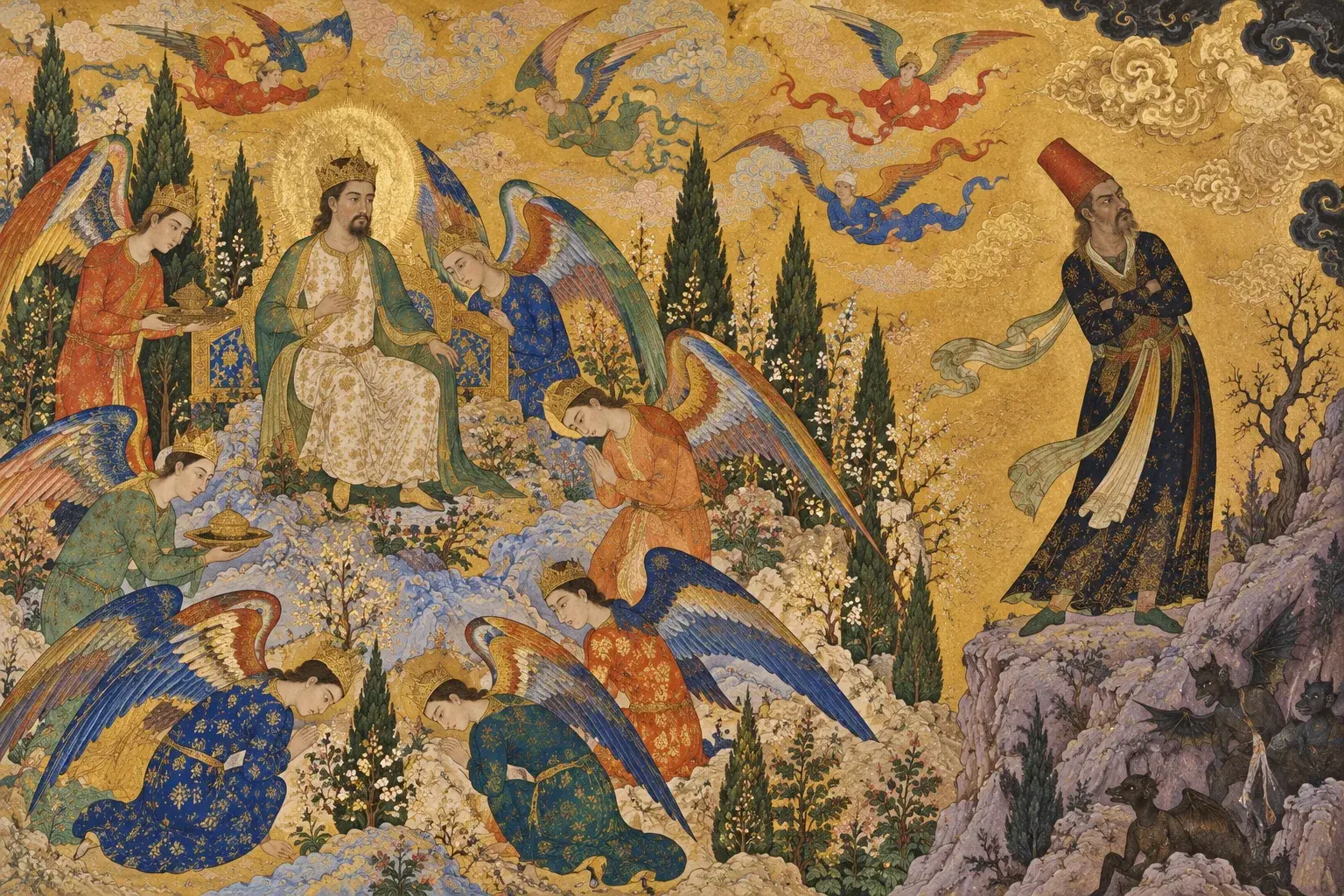
Popular treatments of the Anunnaki theory, from documentaries to novels, tend to visually merge real Mesopotamian art with modern science-fiction imagery.
Why the Anunnaki Keep Coming Back
Part of the durability of Sitchin's version of the Anunnaki is structural: it offers one tidy explanation for an enormous range of separate mysteries, from the biblical flood to the pyramids to the origin of religion itself, at a moment when many readers are drawn to narratives that promise to connect everything at once. It also arrived a few years after Erich von Daniken's Chariots of the Gods had already made ancient astronaut theory commercially viable, giving Sitchin's denser, more source-heavy version of the same basic idea a ready audience. The theory's afterlife has extended well past Sitchin's death in 2010: it forms much of the intellectual backbone of the History Channel's long-running Ancient Aliens, it shows up filtered through other belief systems such as the Raelian movement, and it continues to inspire new books, novels, and documentaries built on the same Nibiru-and-Anunnaki framework. None of that popularity settles the underlying factual question, which is really a question about translation and evidence rather than imagination: what the Sumerians, Akkadians, and Babylonians actually wrote, in their own language, about the gods they called the Anunnaki. On that narrower question, the specialists who can read the tablets directly have reached a fairly settled answer, even where the wider popular conversation has not. Whatever one makes of Sitchin's theory, the mythology underneath it has not gone anywhere: the real Anunnaki, inconsistent and thinly documented as they are, remain part of one of the oldest literate civilizations on record, and are worth reading about on their own terms, gold-mining aliens or not.