Zecharia Sitchin spent his career arguing that ancient astronauts built the pyramids, engineered humanity, and inspired every god people have ever worshipped. That alone made him one of the most widely read fringe authors of the twentieth century. But in his final book, Divine Encounters, he pushed the idea further than any pyramid or spaceport claim. In the book's closing chapter, titled 'God the Extraterrestrial,' Sitchin asked a question few writers would put in print: was Yahweh, the God of the Hebrew Bible, actually one of the Anunnaki? It's worth saying plainly, right up front: no biblical scholar, Sumerologist, rabbi, or theologian accepts this idea. But understanding what Sitchin actually argued, and where it breaks down, says a lot about how his whole body of work operates.
Where the Claim Comes From
Sitchin's argument starts from a real feature of Hebrew grammar. One of the Bible's most common words for God, Elohim, is technically a plural noun. In Hebrew, adding the ending '-im' to a word normally makes it plural, similar to adding an 's' in English. Sitchin took that literally: if Elohim is plural, he reasoned, the word can't describe just one god. It must describe a group, the same group the ancient Sumerians called the Anunnaki. From there, he treated the entire Hebrew Bible as an edited, condensed retelling of older Sumerian myths, with the actions of several different Anunnaki leaders folded together into a single figure called Yahweh.
Sitchin's entire theory hinges on a single Hebrew word for God, Elohim, and how it should be read.
Testing the Candidates
Having set up that premise, Sitchin worked through the Sumerian pantheon almost like a detective running down suspects, comparing each major god's personality and life story to what the Bible says about Yahweh. Enlil, the Anunnaki's commander on Earth in Sumerian mythology, was an early candidate. He warns a chosen follower about a coming flood, much like Yahweh does with Noah, and both figures are strict, order-focused rulers who preside over councils of lesser gods. But Sitchin found the match incomplete. Marduk, the Babylonian ruler-god, seemed to fit for a while too, since ancient texts describe him as a supreme, sky-traveling figure, until Sitchin pointed out that Hebrew prophets describe Marduk's downfall as an enemy of Yahweh, not as Yahweh himself. Anu, the distant, mostly unseen ruler of the Anunnaki who stayed on their home planet rather than living on Earth, came closest of all. Like Yahweh, Anu was rarely shown in ancient art and stayed mostly out of sight. But even that match wasn't perfect.
A God Above the Gods
Unable to land on one clean match, Sitchin's argument shifts by the end of the book. Instead of settling on a single Anunnaki ruler, he proposes that Yahweh came before the Anunnaki and created them, reading the Hebrew word Olam, usually translated 'eternity' or 'forever,' as a reference to a distant, cyclical world. He also draws a connection between an old rabbinic teaching about a 3,500-year journey between Heaven and Earth and the 3,600-year orbit he had already assigned to Nibiru earlier in his book series. In this final version of the theory, Yahweh isn't simply one of the Anunnaki. He becomes their maker, an idea Sitchin ties, somewhat awkwardly, back to the Bible's own insistence that there is only one God.
Sitchin tested several Sumerian gods, including Enlil, Marduk, and Anu, as possible identities for the biblical Yahweh.
What 'Elohim' Actually Means to Hebrew Scholars
The grammar Sitchin starts with is real, and it isn't even controversial. Elohim genuinely is a plural noun. What's controversial is what that plural means, and Hebrew scholars explain it very differently than Sitchin does.
Through nearly all of the Hebrew Bible, Elohim pairs with singular verbs and adjectives, a strong grammatical clue that it functions as a singular word despite its plural shape. Scholars usually explain this using a pattern called the plural of majesty, or an abstract plural: the same pattern shows up in other Hebrew words, like the ones for old age or compassion, which also take plural endings to express an intensified single idea rather than an actual group.
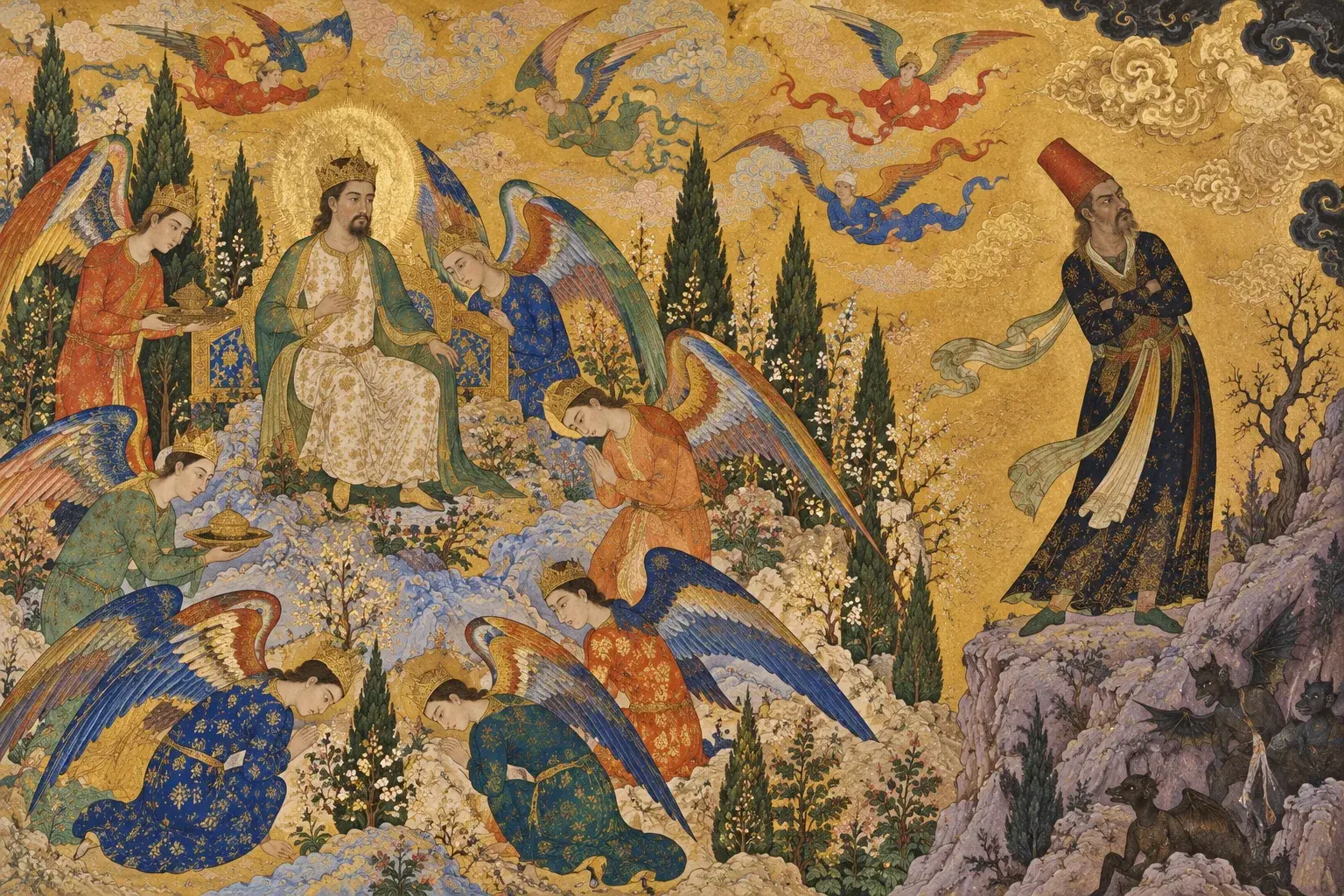
There is one genuinely debated exception. In a handful of passages, most famously Psalm 82, Elohim does seem to describe a real assembly of beings gathered around Yahweh, an idea scholars call the divine council. But scholars who take this council seriously are careful about one detail: they describe it as a group of created, lesser spirit-beings, closer to angels than to equals. That's a very different claim than physical alien astronauts from another planet, and it's the detail Sitchin's argument tends to skip past.
Why Sumerologists and Theologians Both Reject It
Beyond the Elohim question, Sitchin's specific matchups run into the same problem his pyramid claims do. Experts trained in Sumerian and Akkadian, working from the original cuneiform texts (the wedge-shaped writing used across ancient Mesopotamia), don't find his translations or his parallels holding up. Flood stories, storm gods, and councils of divine beings show up across many ancient Near Eastern religions, which shared borders, trade routes, and centuries of cultural contact. Two ancient religions sharing a flood myth or a mountain-dwelling god doesn't mean one is secretly a disguised version of the other.
For religious readers, there's a more basic issue than translation. Judaism and Christianity are both built on the idea that God isn't a physical being who can be sorted into a lineup of alien rulers, however powerful those rulers might be. Turning Yahweh into one member, or even the ancestor, of a family of extraterrestrial gods isn't just an unproven claim to people who hold those beliefs. It runs against the very point the text is making.
Sitchin located many of his most dramatic claims, including the spaceport and Yahweh's first appearances to Moses, in this region.
Why Sitchin Went There
It's worth asking why a writer already known for aliens and pyramids would take the riskier step of bringing God into the theory. Part of the answer is structural. Sitchin's entire project depended on readers accepting the Bible as disguised history rather than scripture, so a chapter connecting Yahweh directly to the Anunnaki was, in a sense, where the argument had been heading all along. Divine Encounters came out in 1995, near the end of Sitchin's writing life, after almost twenty years spent building the same case book by book. By that point, following the logic all the way through, wherever it led, fit naturally with everything he had already written.
Sitchin never lacked confidence, and 'God the Extraterrestrial' shows that as clearly as anything else he wrote. He walked up to one of the biggest questions a person can ask and offered an answer instead of leaving it a mystery. Hebrew grammarians, Sumerologists, and theologians from several different faiths have all taken a close look at that answer since. None of them have found it standing on solid ground.