If you speak Spanish, French, Turkish, or Arabic, you probably know the name of one of the most exotic ancient tribal confederations that nobody has heard of. Say "Germany" in any of these languages, and you will not actually be saying the name of the country that the modern-day Germans live in. Alemania, Allemagne, Almanya, the ancient word for Germany was the name of one confederation of tribes that once stood along the Upper Rhine and considered itself to be something else entirely. The region of their former dominance was a long way from being called Germany at the time, because that name never officially existed before the 10th century AD. The tribes themselves were long gone before that time, however, leaving behind the name of mystery. The name was Alemanni, and it was quite a journey that the Alemanni and their legacy made from the first obscure mentions of them in ancient chronicles to the current use of their old name in the tongues of languages as distant from each other as Spanish and Arabic.
A People Nobody Had Written About Yet
When the Roman historian Tacitus delivered his famous description of the German tribes in around 98 AD, he described dozens of tribes living beyond the rivers Danube and Rhine, but not the Alemanni. If the Alemanni had existed and been known to Roman historians at that time, it is highly probable that they would have been mentioned, as Tacitus did describe many other tribes. The Alemanni were apparently not familiar to the Romans in the first century AD. The earliest surviving references to them were made in 213 AD by the Roman senator Cassius Dio, who wrote about the campaigns of the Roman Emperor Caracalla. By this time, they are thought to have formed a tribal confederation, the likes of which the Romans rarely encountered. This is probably why the name Alemanni, meaning "all men," became the label for all of these tribes. Alemanni does not actually refer to one specific tribe but rather a combination of Germanic tribes that had formed an alliance. Interestingly enough, the Alemanni themselves did not appear to refer to themselves as Alemanni. As noted by Walafrid Strabo, a medieval scholar, and monk, the Alemanni were called Suebi by their own people. The exact etymology of the name is unclear to scholars to this day, and it has been speculated, most notably by the sixteenth-century humanist Johannes Trithemius, that the name Alemanni may have actually been derived from Hebrew. Most of the theories about the name's origin had since been ruled out, and the prevailing thinking was that the name Alemanni was a Roman invention. The name became firmly attached to the tribes, but whether the tribes liked it or not, it was up to the Romans to decide.
A Curse, a Sick Emperor, and a New Enemy
According to Cassius Dio, the Alemanni were first mentioned in relation to a request for aid from none other than the Emperor Caracalla. The Alemanni apparently sent an envoy to the Emperor, begging for his intervention in a conflict of their own making. They were rebuffed by the Emperor, who promptly proceeded to conquer their lands and kill their warriors. It appears that the Alemanni, at least for the first century after they acquired the dubious honor of being labeled by the Romans, had little to no influence on Roman policy. Caracalla, who suffered from numerous health problems, claimed that the Alemanni had cursed him, and he later launched another attack on their territory. It is unclear whether or not Caracalla actually believed this, but he managed to rally the support of his troops and even earned the honorific title Germanica for the campaign. It is also notable that Alemanni's reputation in the Roman Empire was largely based on the propaganda that was created by them. It appears that the Alemanni were a proud foe in battle, but the image of Alemanni as barbarians who had to be conquered by Rome was most often manufactured by the Romans. Emperor Caracalla and his subsequent policies towards the Alemanni would set the trend for the two hundred years of the Alemanni's subsequent history. His actions were a part of a pattern that would lead to the Alemanni engaging in several military campaigns with the Romans, both as adversaries and allies.
Emperor Caracalla's policies toward the Alemanni served as a model for the two centuries of Alemanni's history spent in military engagement with the Roman Empire.
More Roman Than Rome Would Like to Admit
Despite the Romans' attempts to label the Alemanni as barbarians, the Alemanni had more in common with the Romans to be called anything else. Excavated Alemannic settlements contain numerous finds of Roman origin. The domesticated Roman-style buildings were the homes of Alemanni living according to Roman fashion and using Roman tools. Even in their clothing, the Alemanni showed their preference for the Romans. It was the Roman-style tunic that was favored by Alemannic women, and not long after, the men adopted the distinctive clothing for themselves. It is clear from these cultural borrowings that the Alemanni had a degree of Roman cultural sophistication, which was considerably higher than what the Roman writers were accustomed to encountering among the "barbarian" tribes. The Alemanni, living at the edge of the Empire, had access to Roman goods. They used them in their homes and even in their clothes. However, the Alemanni were not as uncivilized as their Roman neighbors insisted them to be. The Alemanni were one of the most civilized tribes in the area, which had been demonstrated by their interactions with the Roman Empire. Despite the Romans' attempts to dismiss the Alemanni as simply barbarians, the Alemanni lived much closer to Roman customs than either the Romans or the Alemanni themselves cared to admit.
Raids, Reprisals, and a Long Roman Standoff
At the end of the third century, the Alemanni began their campaign of expansion and aggression against the Roman Empire. Their forces were able to penetrate into Gaul and even northern Italy, dealing the Roman Empire with a number of setbacks on its frontiers. The Alemanni's raids were notoriously violent, and the Roman sources hold that the Alemanni destroyed numerous Gallic settlements and temples. Although the reports of the Alemanni's atrocities committed against the Roman Empire should be taken with a grain of salt, it is evident that not even the Romans were entirely prepared for the aggression shown by the Alemanni. The Romans responded in kind, but it took several rulers to repel the Alemanni from Italy. Emperor Gallienus managed to keep them back, and several years later, Emperor Claudius Gothicus was able to deliver a decisive blow to the Alemanni at the Lake Benacus. It took another emperor, Constantius II, to finish off the Alemanni, but in 357, the general Julian the Caesar won a significant victory over them at the Battle of Strasbourg, known also as the Battle of Argentoratum. The Roman forces led by Julian were able to inflict heavy casualties on the Alemanni and even to take their king Chnodomarius captive. The Alemanni would continue their aggressive expansionist policies and, in 366, managed to cross the frozen Rhine and invade the Roman Empire once again. However, the efforts of Emperor Valentinian were enough to drive them back. It would take another attempt from the Alemanni to get past the Rhine in 406 before they finally gave up attempting to conquer the Roman Empire and settled down in Alsace and part of Switzerland as the loyal vassals of the Roman Empire.
Julian's forces defeated the Alemanni in an important battle near Strasbourg. It marked the high point of Roman efforts to subdue the Alemanni.
A King Prays to a Foreign God
The independent kingdom of the Alemanni, loosely ruled from Strasbourg and stretching to Augsburg, lasted another century and a half, until it was invaded and defeated by the Frankish King Clovis in 496 AD. According to Gregory of Tours, a Frankish bishop and contemporary chronicler, the battle was nearly lost by the Franks, but Clovis, the leader of the Franks, prayed to his wife's God, promising to convert to Christianity if he won the battle. Gregory notes that the Alemanni were overcome and began to retreat shortly after that, and the Alemannic king was killed in the fighting. It is unclear whether this story is true or not, but the conversion to Christianity by Clovis was a fait accompli several years later and would have lasting repercussions on the fortunes of the Alemanni and, consequently, the Franks. It has been suggested that Clovis's prayer did not actually happen or that he never intended to convert, but his public and ostensible conversion to Christianity undermined the reputation of the pagan Frankish nobility and elevated Clovis to new heights of popularity with the Frankish Christians. It may have even served to undermine the position of the Alemanni in the region. After being conquered by the Franks, the Alemanni were given an opportunity to preserve their autonomy as a Frankish vassal state. However, not all of the Alemanni were willing to accept Frankish rule, and those who refused to pay taxes and provide troops to King Clovis sought refuge in Italy with Theodoric, the ruler of the Ostrogoths. However, after the death of Theodoric, the Franks re-established their authority in Italy in 536 AD, and the Alemanni were eventually incorporated back into the Frankish kingdom as a territorial province with their own Frankish Duke.
According to legend, the prayer that Frankish King Clovis inserted during the Battle of Tolbiac was the turning point in the battle and marked the beginning of the Alemanni's conversion to Christianity.
A Revolt, a Blood Court, and Frankish Dukes
Until the eighth century, Alemanni nobility retained much autonomy, only nominally answerable to Frankish kings, who had at that point already broken up the administrative unity of the ancient Frankish kingdom. That autonomy was severely curtailed in 746 AD, when the Frankish King Carloman suppressed an Alemanni noble revolt. At Cannstatt, Carloman presided over the mass execution of thousands of Alemanni nobles and free citizens of the realm. It has been called the blood court by subsequent chroniclers. The executions served as a stark warning to other Alemanni nobles who might have thought of revolt. The Frankish kings replaced Alemanni's local nobility with new Duke of Alemanni loyal to the Frankish crown. Thus, the informal independence of the Alemanni was finally crushed. In the 760s, Charles Martel's son merged the former kingdom of the Alemanni back into the Frankish kingdom.
From Sacred Rivers to Church Law
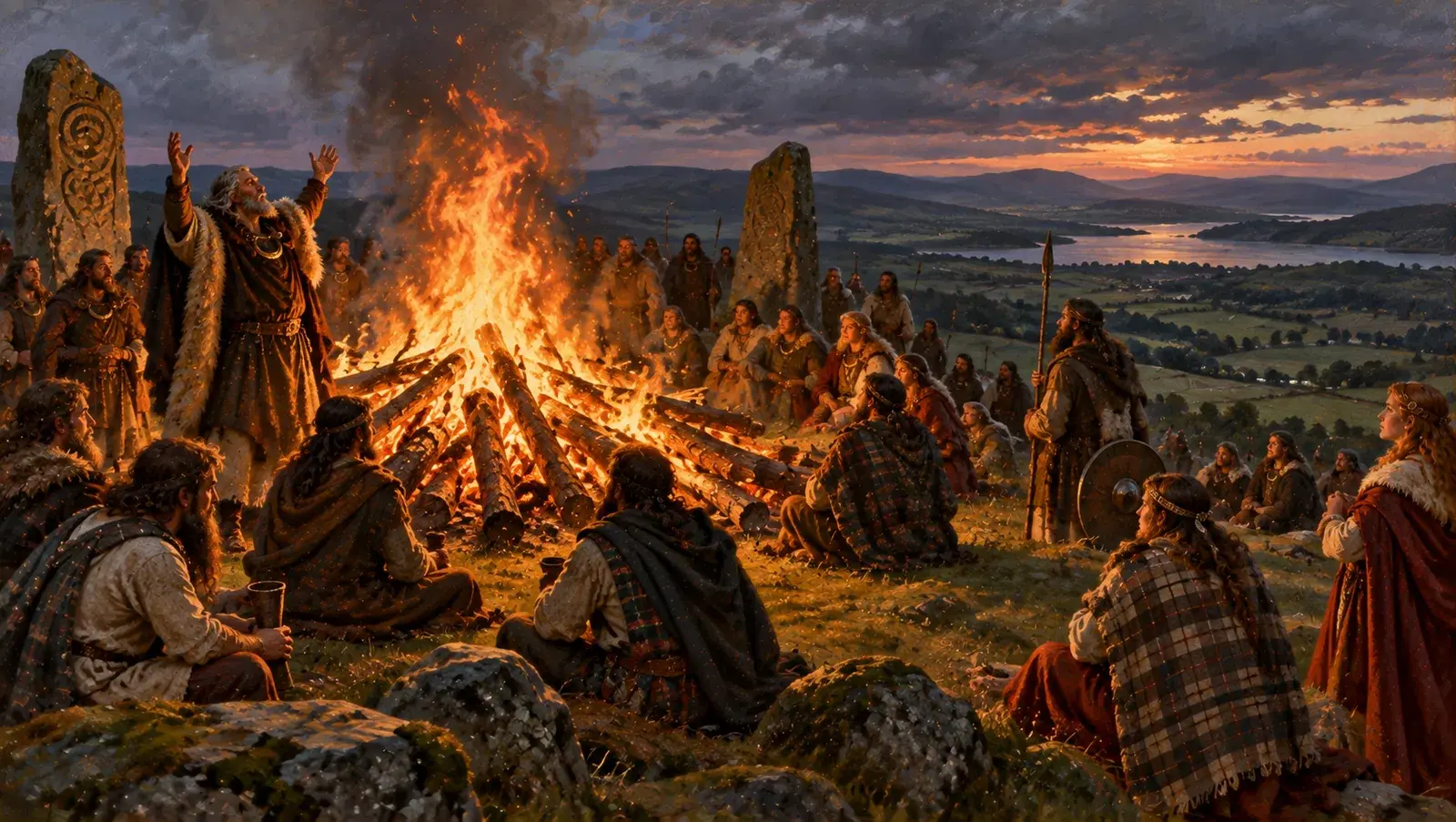
The process of the Alemanni's Christianization was much slower than their political transition from an independent kingdom to a Frankish vassal state. In the sixth century AD, most Alemanni still adhered to the old Germanic paganism that worshiped sacred groves and waters and held animal sacrifices. By the eighth century, the majority of the Alemanni had converted to Christianity, and the seventh century seems to have been a period of transition and cultural synthesis. Missionaries such as Columbanus actively promoted conversion to Christianity in the region, but there was certainly resistance to it. Columbanus, for example, famously clashed with local pagan Alemanni over public drunkenness and sacrificial rituals that used beer offered to the god Wodan. These are just some of the clues to the cultural transition that can be identified in written sources. Written sources, however, are not the only way to determine the cultural background of the Alemanni. Researchers have also examined various artifacts found on Alemanni territory. Of these are the runestones, on which Old High German was recorded in runes between the sixth and eighth centuries AD. They are seen as evidence of the local Alemanni culture. Between the 520s and the 620s AD, there was a peak in the production of runestones in the Alemanni region. The Pforzen buckle, first discovered in Bavaria in 1992, was one of the most remarkable runes stones. On it was the oldest surviving example of Old High German poetry. Such artifacts, however, eventually ceased to be used as Germanic culture converted to Christianity. A fibula from Bad Ems, dated between the sixth and the ninth century, contains Christian symbols and runes, serving as a reminder of Alemanni's pre-Christian culture. Another sign of the times was when, in the 620s AD, Bishop Werinfrid was assigned to Constance to oversee the organization of the regional church. In the eighth century, the Alemanni's local law code, the Lex Alamannorum was finalized for the first time, containing several sections concerning the church.
A Name that Outlasted Its Kingdom
The territorial integrity of the Frankish Empire continued to be dismantled, which allowed for another period of Alemanni independence for certain nobles. It was during this time that the Duke of Swabia and the Alemanni nobleman Burchard II, who ruled over the former Alemanni kingdom, gained his independence. In 919, the German king Henry the Fowler formally invested the territory of the former Alemanni kingdom with the title of Duke of Swabia, and Duke Burchard II, the Swabia Duke, became a vital part of the Holy Roman Empire. The title of Swabia Duke continued to be passed from one noble family to another until the Hohenstaufen dynasty was overthrown in 1268, and the title of Duke of Swabia became extinct for the second time. The region eventually became known as Swabia, and the local population spoke in Alemannic. The Alemannic dialects survived to this day and are still used by the people of Swabia, Baden in Germany, Alsace in France, Switzerland, Liechtenstein, and Austria's Vorarlberg region on the eastern border of Switzerland. The name and the title of Alemanni, however, continued to live on and were carried to the modern world. The word was eventually adapted by different languages, including French Allemagne, Spaniards Alemania, and Turks Almanya. None of these countries actually call Germany Germany. The name Germany, in fact, is the only one in existence that is not the official name of the country to whose inhabitants it refers.