Thermopylae is the most famous defeat in history. That's worth saying plainly at the start, because most people carry a version of it in their heads where the Spartans somehow win. They don't. The pass falls. The Persians walk through, burn Athens to the ground, and go on doing what they came to do. Leonidas dies, his body is decapitated and crucified, and every man who stayed with him is killed. And it still mattered enormously — just not for the reasons the films give you.
What Xerxes Was Doing There
Persia had tried this before. In 490 BCE, Darius sent a force to punish Athens for supporting a rebellion in Ionia, and the Athenians beat it at Marathon. That was a humiliation an empire couldn't leave standing. Darius died before he could go back. His son Xerxes spent four years preparing on a scale nobody in Greece had imagined possible. He cut a canal through the Athos peninsula so his fleet wouldn't have to round the headland where an earlier one had been wrecked. He built two pontoon bridges across the Hellespont — and when a storm broke the first pair, Herodotus says he had the sea whipped and the engineers beheaded. He also had a grudge list. When Persian heralds came demanding earth and water — the formal tokens of submission — most Greek states handed them over. Athens and Sparta did not. Athens put the envoys on trial and executed them; Sparta threw them down a well and told them to collect their earth and water from there. Both cities were marked for destruction.
The Numbers Problem
Here's where you should be careful with everything you've read. Herodotus gives Xerxes 1.7 million infantry and a total force of 5,283,220. That number is not possible, and it hasn't been taken seriously for a century. The classic demolition is Sir Frederick Maurice's 1930 study, written after he'd walked the actual ground: given the water available along the route and the width of the roads, he calculated an absolute ceiling of roughly 150,000 soldiers plus 60,000 non-combatants. Later scholars have gone lower. Modern estimates cluster between 80,000 and 300,000, and the low end has been gaining ground. The Persians vastly outnumbered the Greeks. They did not outnumber them by five thousand to one. Ancient writers inflated enemy numbers as a matter of routine, and Herodotus was working from oral testimony fifty years after the fact. Greek force at the pass: about 7,000 men. Not 300. That number matters and I'll come back to it.
Why This Pass
Greece is cut across by mountain ranges running down to the sea, which means an invading army from the north has to use a handful of narrow passes. Block the pass, and numbers stop mattering — you can only fight across the width of the road. The name Thermopylae means "hot gates," after the sulphur springs there. In 480 BCE it was a road about fifteen metres wide at its narrowest, squeezed between cliffs and the sea, with an old defensive wall across it that the Greeks rebuilt. Alongside it ran the strait of Artemisium, where the Greek fleet could hold off the Persian ships and stop them landing in the rear. The two positions only worked together. Thermopylae without Artemisium was pointless. That's the part almost every retelling drops, and it's why the naval battle at Artemisium — fought at the same time, and effectively a bloody draw — belongs in this story. (A note for anyone visiting: the coastline has silted up enormously in 2,500 years. The sea is now several kilometres from the pass. The monument stands in what looks like an ordinary flat field, which is disorienting until you know why.)
Why Only 300 Spartans
Sparta was in the middle of the Carneia, a nine-day religious festival during which Spartan armies did not march. The Olympic Games were also on. Both created a religious prohibition against a full call-up. So Sparta sent an advance guard: 300 hand-picked men under one of its two kings, Leonidas, with the full army to follow after the festival. There's a further detail Herodotus records that is genuinely chilling. Every one of the 300 was selected on the condition that he had a living son. The Spartans picked men whose bloodlines would survive them. They knew what they were sending them to do. And they weren't 300 men alone. Each Spartiate travelled with helots — the enslaved Messenian population who fought and died in numbers nobody bothered to record. The rest of the 7,000 were Thespians, Thebans, Corinthians, Arcadians, Phocians, Mycenaeans and others.
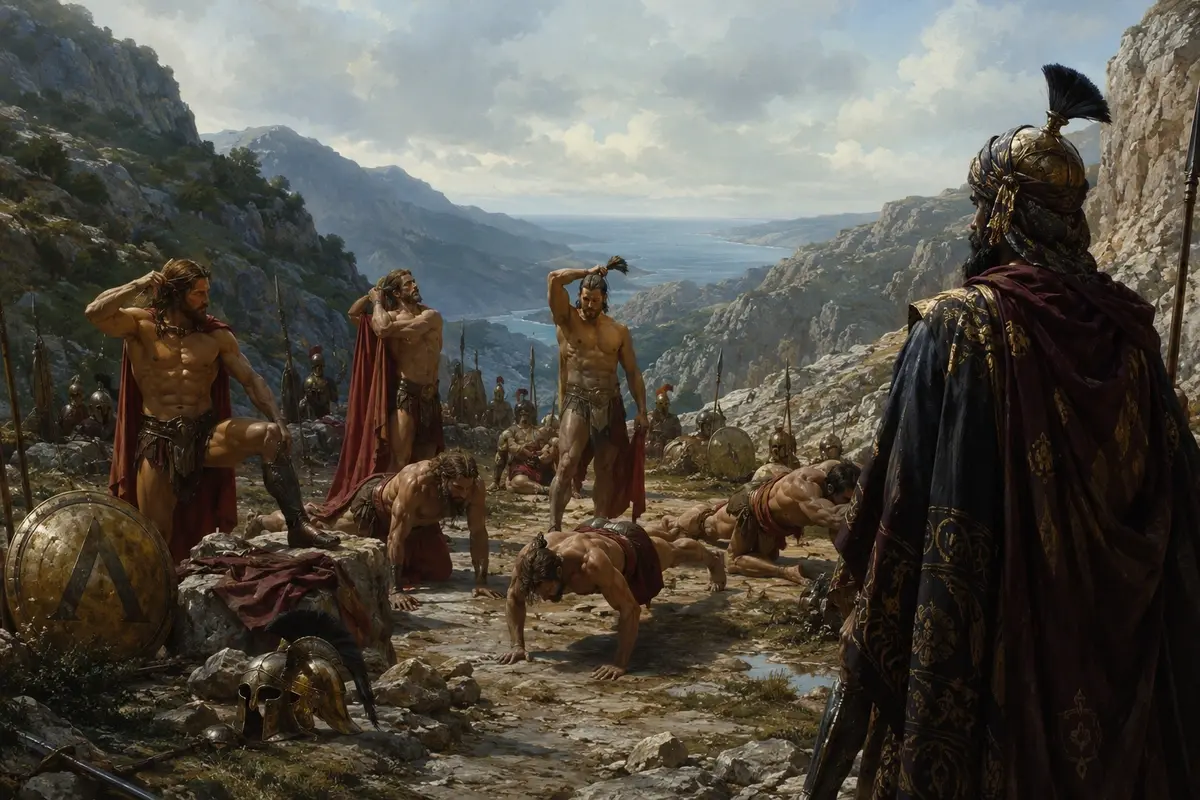
Xerxes sent a scout, who came back reporting that the Spartans were doing gymnastic exercises and combing their hair. He couldn't make sense of it. Demaratus told him: this is what Spartans do before they intend to die.
Three Days
Day one. Xerxes waited four days, expecting the Greeks to disperse. When they didn't he sent in the Medes and Cissians with orders to take the Greeks alive. They were destroyed. Long Greek spears, heavy shields, bronze armour, and a frontage too narrow for numbers to tell. He then sent the Immortals, his elite guard. They did no better. Day two. Same assaults, same result. Day three. A local Greek named Ephialtes went to Xerxes and told him about the Anopaea path — a mountain track that ran around the pass and came out behind it. The Greeks knew about the path. Leonidas had posted a thousand Phocians on it. When the Immortals came up through the oak woods at dawn, the Phocians assumed they were the target, pulled back to higher ground, and the Persians simply walked past them and kept going.
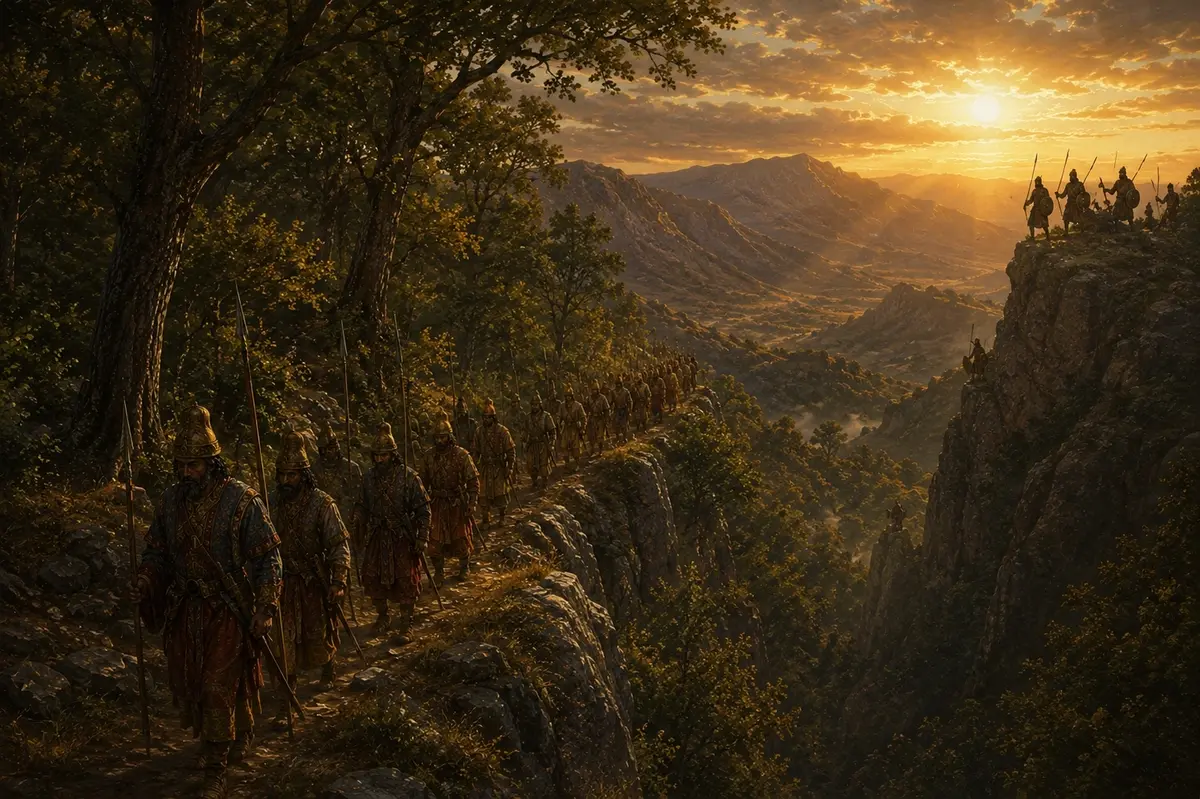
The Phocians assumed they were the target and pulled back to higher ground to make a stand. The Persians simply walked past them and kept going.
The Last Stand
Leonidas found out at first light that the pass was being turned and dismissed the army. Most of the Greek contingents were sent home — not ordered into a mass suicide, but preserved as a force that could fight again. A rearguard stayed to cover the retreat. Who stayed: 300 Spartans; 700 Thespians, who volunteered and refused to leave — the least-remembered and arguably most remarkable thing about the whole battle, since Thespiae was a small town giving up its entire fighting strength for nothing but the principle; 400 Thebans, whose motives Herodotus is suspicious about; and the helots, uncounted. They moved out beyond the wall into the wider part of the pass to take as many with them as possible. Herodotus says the Persians had to be driven forward with whips. Spears broke and the Greeks fought with swords; swords broke and they fought with hands and teeth. Leonidas fell, and there was a prolonged fight over his body — the Greeks drove the Persians off four times and dragged him back. Then the Immortals arrived from behind and it ended. The last of them made a stand on a small hillock and were shot down with arrows. Xerxes had Leonidas's head cut off and the body crucified. Herodotus notes this as evidence of unusual rage, since Persians normally honoured brave enemies.
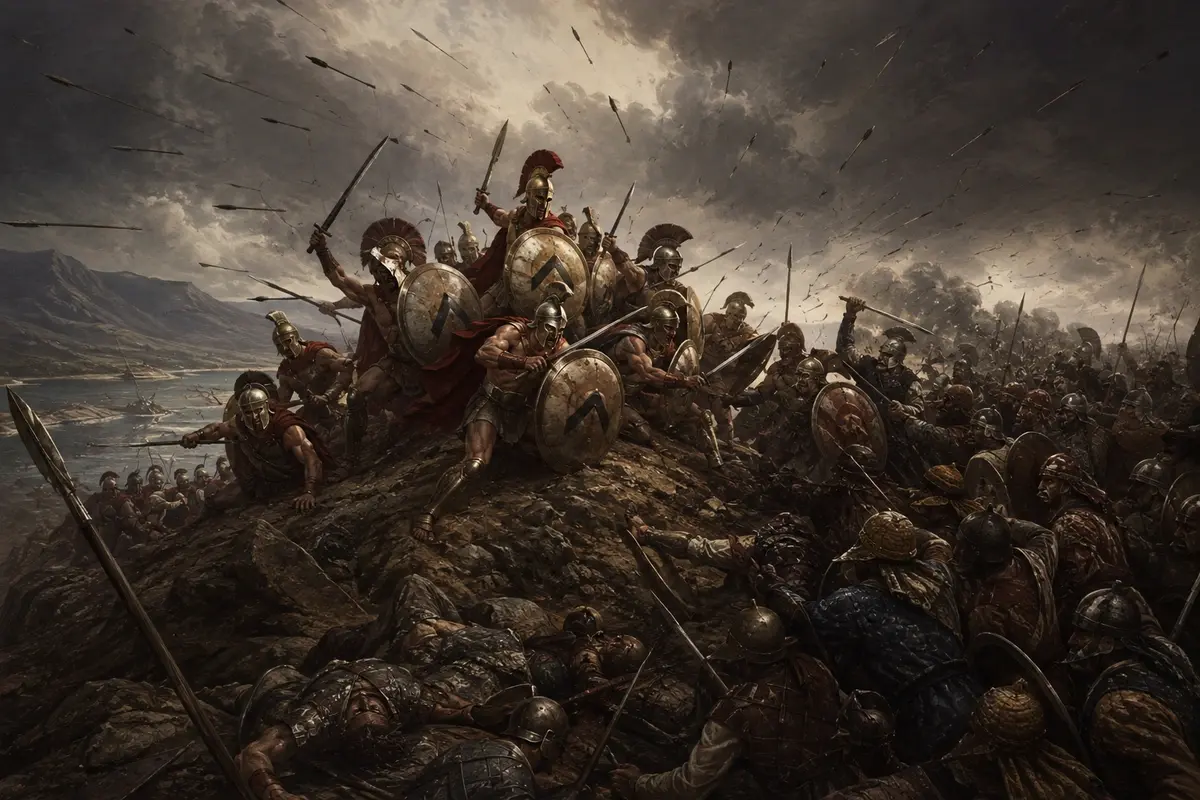
Spears broke and they fought with swords; swords broke and they fought with hands and teeth. Then the Immortals arrived from behind, and it ended.
The Famous Lines
Three of them, and their pedigrees vary. "Come and take them" — molon labe, Leonidas's reply when told to surrender his weapons. This comes from Plutarch's Sayings of the Spartans, written around 500 years later. It's a good line. Whether he said it is unknowable. "Then we will fight in the shade." A Spartan called Dienekes was told the Persian archers were so numerous their arrows would blot out the sun. This one is in Herodotus, and he clearly loved it. The epitaph. Simonides wrote it, and Herodotus records it at the site. Rendered in English it says roughly: go tell the Spartans that we lie here, obedient to their orders. Every translation is a compromise; the Greek is flatter and harder than any English version manages, and that flatness is the point.
What 300 Got Wrong
The 2006 film is a stylised adaptation of a comic book, not a documentary. Since it's how most people know the story, the corrections are worth having. The other 6,700 Greeks are erased almost entirely, along with the Thespians who stayed to the end. The armour is wrong — hoplites fought in bronze breastplates or layered linen, not bare-chested; the shield and the armour are the entire reason the tactic worked. The helots don't appear. Xerxes is presented as a nine-foot golden god-figure. Sparta is cast as the champion of freedom, when it was in fact a rigidly hierarchical slave state. And Artemisium, the simultaneous naval battle without which the land position was meaningless, is gone entirely. There's also a real problem in the film's visual treatment of the Persians as monstrous and deformed against the idealised Greeks.
So Did It Matter?
Yes, but be precise about how. Militarily, the delay was small — two or three days. Xerxes went straight on to Athens and burned it. Strategically, it bought time for the evacuation of Athens and kept the allied fleet in position at Artemisium — and the fleet went on to win at Salamis a few weeks later, which was the battle that actually decided the war. Politically, it proved that Persian troops could be beaten by Greek ones in a straight fight, and gave a fractious, mutually hostile set of city-states a shared story. Sparta had been wavering about defending anything north of the Isthmus of Corinth. After Thermopylae it was committed. And there's a fourth thing, which is why we're still talking about it. Thermopylae established a template — the outnumbered defenders who choose not to leave — that has been reached for from Byron to the Alamo. The Greeks understood the value of that immediately, which is why the epitaph went up almost at once. The Persians won the battle. The Greeks won the story, and then won the war.
Sources
Herodotus, Histories, Books 7–8 (around 430 BCE) is the source for essentially everything above. He interviewed survivors and people who'd talked to survivors, and on narrative detail he's remarkably good. On numbers he is not reliable, and modern historians treat his Persian figures as literary rather than statistical. Diodorus Siculus and Plutarch add material centuries later, including most of the famous quotations. For current scholarship, start with Paul Cartledge's Thermopylae (2006) and Tom Holland's Persian Fire (2005).