Let's deal with the runner first, because it's the thing everybody knows and it isn't true. There was no run from Marathon to Athens. Nobody gasped out news of the victory and dropped dead. Herodotus doesn't mention it — and Herodotus is our main source, he interviewed people who were there, and he is not a man who leaves out a good story. The real Pheidippides did something considerably more impressive, and I'll get to it. But first, the battle, because it deserves better than being remembered as the backdrop to a running anecdote.
Why Persia Came
In 499 BCE the Greek cities of Ionia revolted against Persian rule. Athens sent twenty ships to help. Eretria sent five. It wasn't much — the revolt was crushed and Miletus was destroyed. But those ships had taken part in the burning of Sardis, a Persian regional capital, and Darius I did not forget it. Herodotus tells a story that's probably too neat to be true and is memorable anyway: Darius had a servant instructed to say to him three times at every meal, master, remember the Athenians. A first expedition in 492 BCE lost its fleet in a storm off Athos. In 490 BCE he sent a second force sailing directly across the Aegean. They took Naxos. They took Eretria after six days, burned its temples and enslaved the population — which was a deliberate advertisement of what was coming. Then they landed on the plain of Marathon, about 42 km from Athens. They had a reason for choosing it. It was good cavalry ground, and they had an elderly passenger: Hippias, the former tyrant of Athens, expelled twenty years earlier and now around eighty, who had suggested the landing site and expected to be reinstalled as a Persian puppet. That's the real danger Athens faced. Not just an army on the plain, but the possibility that someone would open the gates.
The March Out
The Athenians did something unexpected. Instead of waiting behind their walls, they marched out and blocked the two roads off the plain. Their force: around 9,000–10,000 hoplites, plus 1,000 Plataeans who turned up in full — a small town committing everything it had, which the Athenians never forgot. Persian numbers aren't given by Herodotus for the land force. Modern estimates land around 25,000, with a fleet of 600 ships. So the Greeks were outnumbered roughly two to one, with no cavalry and effectively no archers against an enemy built around both.
Sparta Doesn't Come
Athens sent for Sparta, and this is where the real Pheidippides appears. Pheidippides was a professional long-distance runner. He was sent from Athens to Sparta with the appeal for help. The distance is about 246 km over mountain roads. He covered it in roughly 36 hours, arriving the day after he set out. Herodotus adds a detail that most people skip past: crossing Mount Parthenion in Arcadia, Pheidippides met Pan, who asked why the Athenians ignored him when he'd always been well disposed towards them. The Athenians took this seriously enough to build Pan a shrine below the Acropolis afterwards. The Spartans said yes — and said they couldn't march yet. They were in the middle of the Carneia, and religious law forbade them to take the field before the full moon. They would come after. (Twenty thousand people run this route every September in the modern Spartathlon, a 246 km ultramarathon with a 36-hour cut-off. Runners regularly finish it. Herodotus was telling the truth about the distance and the time.)
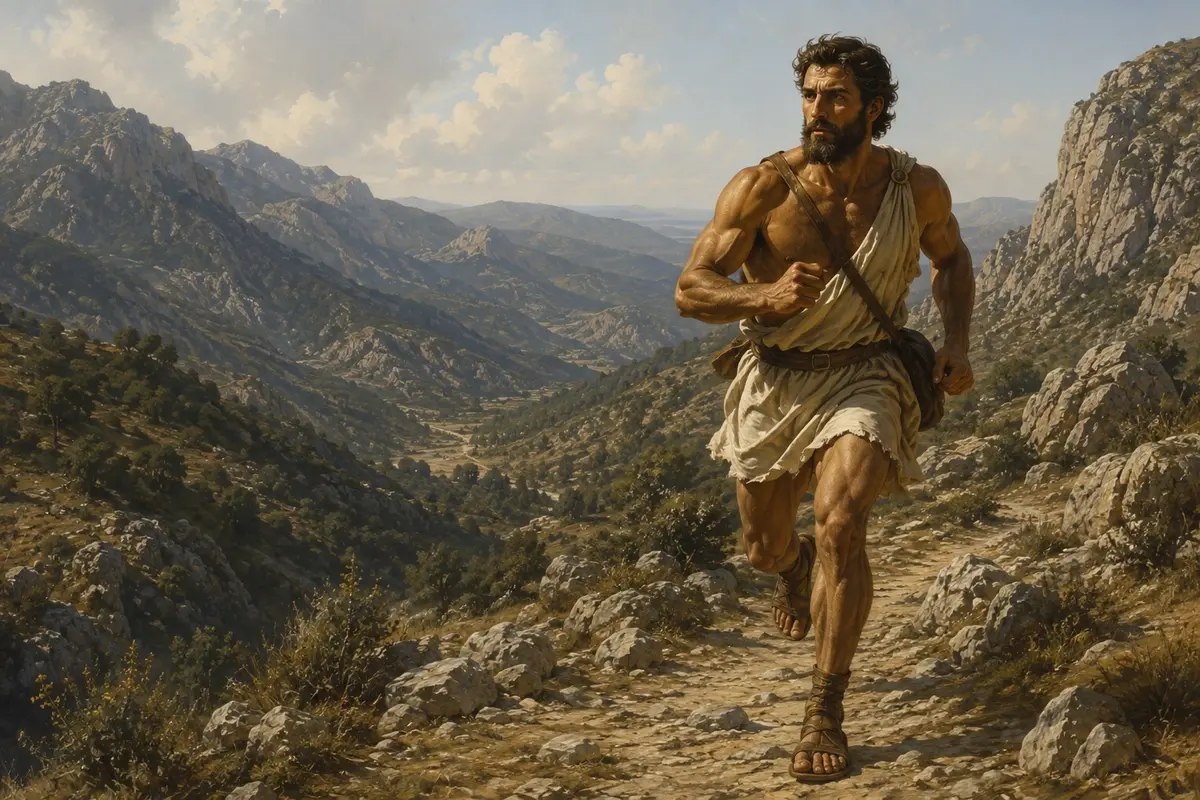
246 km of mountain road in roughly 36 hours. This is what the real Pheidippides did — not the run to Athens that appears in no ancient source until 600 years later.
The Battle
The two armies faced each other for several days. Neither moved. The Athenian command was split — ten generals, one from each tribe, with the war-archon Callimachus holding a casting vote. Five wanted to wait. Five, led by Miltiades, wanted to attack. Miltiades had spent years under Persian rule and had fought in Darius's Scythian campaign; he knew how Persian armies worked. He talked Callimachus round. Something else may have forced the decision. Herodotus is oddly silent about the Persian cavalry during the battle, and a later source says the Greeks attacked on hearing that the horse were away — possibly re-embarking for a run at Athens by sea. Historians have argued about this for two centuries.
The Tactic
Miltiades did something that shouldn't have worked. He had to match the Persian frontage or be outflanked, and didn't have the men for it. So he thinned his centre to four ranks deep and loaded the two wings at full strength. Then he attacked, and Herodotus says the Athenians came across the last stretch at a run — roughly 1,500 metres of open ground, in bronze armour, into archery. What happened next was exactly what the deployment invited. The Persian centre — Persians and Sacae, the best troops — broke through the thin Greek middle and drove it back. And the Greek wings, which were strong, crushed the weaker Persian flanks. Then instead of chasing them, the wings turned inwards and closed on the Persian centre from both sides. It's a double envelopment, and it's the earliest clear one in recorded history. The Persian army disintegrated and ran for the ships across marshy ground, where large numbers drowned. Callimachus was killed at the shoreline.
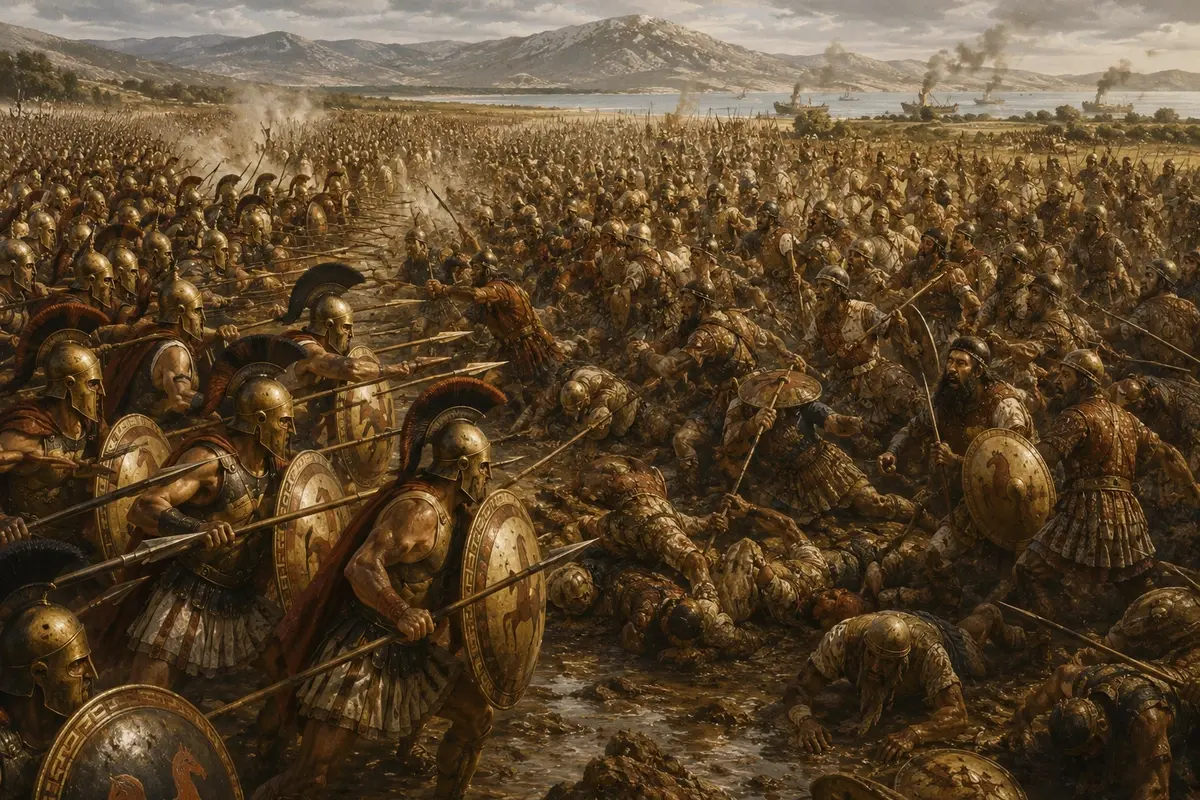
The wings turned inward and closed — the earliest recorded double envelopment. The Persian army broke and ran for the ships across marshy ground, where large numbers drowned.
The Casualties
Herodotus gives 192 Athenian dead and 6,400 Persian. The Athenian figure is almost certainly accurate — the dead were named, honoured and buried on the field under a mound. The Soros is still there, ten metres high, and you can walk up to it. The Persian number is a round figure that should make you suspicious, though the ratio isn't implausible. Heavily armoured infantry in formation, fighting lightly armoured troops who have broken, produce lopsided casualty counts. The Plataean dead were buried separately. So were the slaves who fought, which was not a small gesture in 490 BCE.
The Second Race — the Real One
The Persians got back to their ships and sailed for Athens, which was now undefended. So the Athenian army, having just fought a battle in armour, marched the 42 km back to Athens the same day and was standing in position at Phalerum when the Persian fleet arrived. The Persians looked at the shore, saw the army they had just left at Marathon somehow already there, and sailed home. That march is the astonishing part of the story and it has been almost entirely eclipsed by a fictional runner. Nine thousand men did it, carrying their equipment, on the day of the battle.
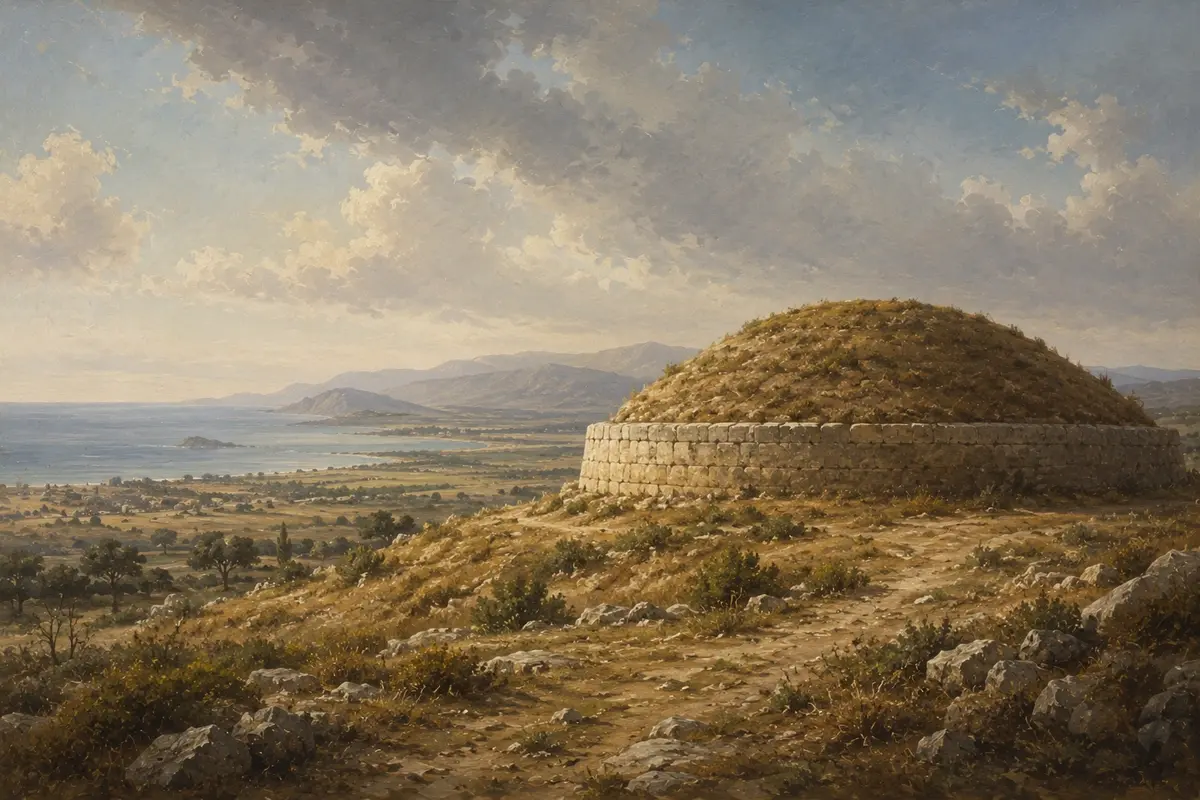
The dead were named and buried here. The Soros is still there, ten metres high, and you can walk up to it. The 192 Athenian figure is one of the most trusted numbers in ancient history.
So Where Does the Marathon Come From?
The chain is traceable. Herodotus (c. 430 BCE): Pheidippides runs to Sparta. No run to Athens. No death. Plutarch (c. 100 CE): a runner does bring news from Marathon and dies, but Plutarch calls him Thersippus, or says most historians call him Eucles. Lucian (c. 170 CE): first writer to combine everything — the messenger from Marathon, the collapse, the dying announcement — and he names him Philippides. So the story everybody knows was assembled about 600 years after the battle out of two unrelated traditions. Then in the 1890s, Michel Bréal — a French classicist — suggested a long-distance race for the first modern Olympics in Athens, 1896. A Greek water-carrier named Spyridon Louis won it. And the 26.2 miles? It isn't a Greek distance at all. The figure of 42.195 km was fixed at the 1908 London Olympics, where the course ran from Windsor Castle to the royal box in the stadium — the extra distance added so the race could start beneath a particular window. It was standardised in 1921. Every marathon in the world is that length because of the position of a window in an English royal residence in 1908.
Why Marathon Mattered
It proved Persia could be beaten. Before 490 BCE the Persian Empire had absorbed everything it went after. Afterwards, every Greek knew it could lose. It made Athens. The city had become a democracy barely twenty years earlier, and Marathon was its first great collective act. Athenians were still boasting about it a century later. Aeschylus fought there and lost a brother in the fighting at the ships; his epitaph mentions Marathon and doesn't mention that he wrote plays. And it guaranteed the next war. Darius spent the rest of his life planning to come back. His son Xerxes did it, on a scale that made 490 BCE look like a raid — which is how you get to Thermopylae and Salamis ten years later.
One footnote worth having. Miltiades, hero of Marathon, was ruined within a year. He talked Athens into giving him a fleet for a secret expedition, attacked the island of Paros, failed, came home with a leg wound, was prosecuted and fined fifty talents. He died of gangrene before he could pay it. Athenian democracy did not do gratitude. That pattern repeats for Themistocles, for Aristides, for almost everyone in this period.
Sources
Herodotus, Histories, Book 6 (around 430 BCE) is the primary account and everything else derives from it. He's excellent on narrative, unreliable on numbers, and refreshingly willing to tell you when he doesn't believe something. Cornelius Nepos, Pausanias and Plutarch add later material of varying reliability. For modern treatments: Peter Krentz, The Battle of Marathon (2010), and Richard Billows, Marathon (2010).