Ask who invented democracy and most people will say Pericles, or shrug and say the Greeks. The specific answer is Cleisthenes, in Athens, in 508/507 BCE. He designed it, pushed it through, and then disappears from the historical record so completely that we don't know how or when he died. What he actually did was stranger and more radical than the textbook summary suggests. He didn't extend voting rights to more people, exactly. He took an existing society organised around clan and family and deliberately broke it up and reassembled it on artificial lines, so that the old loyalties would stop working. It's one of the boldest pieces of social engineering anyone has ever attempted, and it held for nearly two hundred years.
The Family Money
Cleisthenes came from the Alcmaeonids, and Herodotus tells a story about where their money came from that is worth having because it sets the tone. His great-grandfather Alcmaeon helped some messengers Croesus had sent to Delphi. Croesus, grateful, invited him to Sardis and offered him as much gold as he could carry out of the treasury in one go. Alcmaeon arrived wearing the loosest tunic he could find and enormous wide boots. He filled the boots. He filled the tunic. He packed his hair with gold dust and then filled his mouth with it, and waddled out barely able to move, unable to speak. Croesus laughed so hard that he let him keep it all and doubled it. Alcmaeon's son Megacles then won the hand of Agariste of Sicyon in a marriage contest, and their son was Cleisthenes. So the man who invented democracy was from one of the two or three richest aristocratic families in Athens. That's not a contradiction — it's the whole story.
Getting Rid of the Tyrants
Athens had been under the tyranny of Peisistratus and then his sons for most of the 6th century. Peisistratus himself governed reasonably and kept Solon's laws. His son Hippias got progressively worse after his brother Hipparchus was assassinated in 514 BCE. The Alcmaeonids, in exile, engineered the tyranny's fall — partly, Herodotus says, by rebuilding the temple at Delphi more lavishly than the contract required, after which the oracle told every Spartan delegation that came asking about anything that they should free Athens. Sparta eventually did, in 510 BCE. Then Athens had a power vacuum, and the two men left standing were Cleisthenes and an aristocrat named Isagoras who had Spartan backing. Isagoras won the first round and got himself elected archon. So Cleisthenes did something no Athenian aristocrat had done before. Herodotus's phrase for it is deliberately blunt: he took the people into his party. He went over the heads of the aristocratic factions and appealed directly to the mass of ordinary citizens, offering them a share in running the state. It was almost certainly opportunism. It worked completely.
Isagoras called in the Spartans, who marched in, expelled 700 families and tried to dissolve the Council. And then the ordinary citizens of Athens — with no leader, since Cleisthenes had withdrawn — rose on their own and besieged Isagoras and the Spartan garrison on the Acropolis for two days until they surrendered and left. That's the founding moment, and it's important that it happened without Cleisthenes present. The Athenians had already decided they wanted this before he came back to build it.
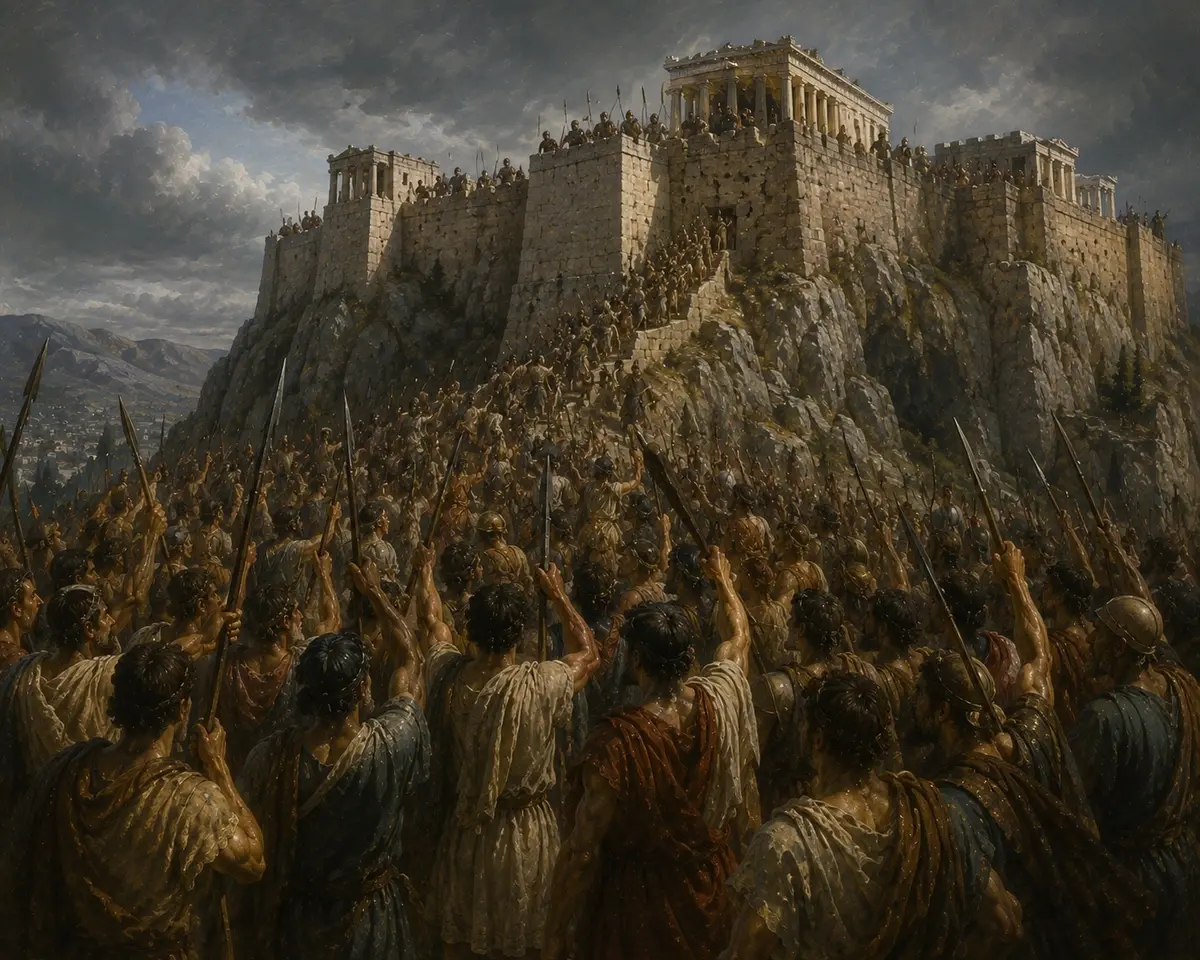
Cleisthenes had withdrawn. The citizens rose anyway and held the Acropolis under siege for two days. They had already decided they wanted this before he came back to build it.
The Reform: Breaking the Clans
Here's the problem Cleisthenes had to solve. Athenian society ran on kinship. Everyone belonged to a clan claiming descent from a common ancestor, often a god or hero. There were four traditional tribes, all built on these bloodlines, and each was dominated by a few aristocratic families. Political loyalty followed blood and locality — and since the three main geographical regions of Attica each had different economic interests, politics was a permanent three-way faction fight between aristocratic patrons and their dependants. You cannot build a democracy on that. The clan chief will always deliver his bloc. So Cleisthenes abolished the four old tribes and invented ten new ones, and the method is the clever part.
The demes. He divided Attica into around 139 demes — local units, villages or urban neighbourhoods. Every citizen was registered in his deme and, from now on, was officially identified by deme name rather than father's name. Not "son of Megacles" but "of Alopece." A man's political identity became a place instead of a family. The trittyes. He then grouped the demes into thirty trittyes — thirds — with ten drawn from the coast, ten from the inland plain and ten from the city. The tribes. Each new tribe was made of exactly three trittyes: one coastal, one inland, one urban. Which means every tribe contained men from all three regions with all three sets of economic interests, scattered across Attica and unable to be dominated by any single family or locality. The regional faction blocs simply stopped existing as political units. Then he made the tribes the basis of everything. Each tribe supplied one regiment to the army with its own elected general — ten generals of equal rank, which is how Miltiades came to be one of ten at Marathon. Each tribe supplied fifty men to the new Council of Five Hundred. He named the ten tribes after ten Athenian heroes chosen by the Delphic oracle from a shortlist of a hundred, which gave the artificial units instant religious legitimacy. Aristotle's summary of the intention is dry and exact: he mixed everybody up in order to give more people a share in the running of the state.
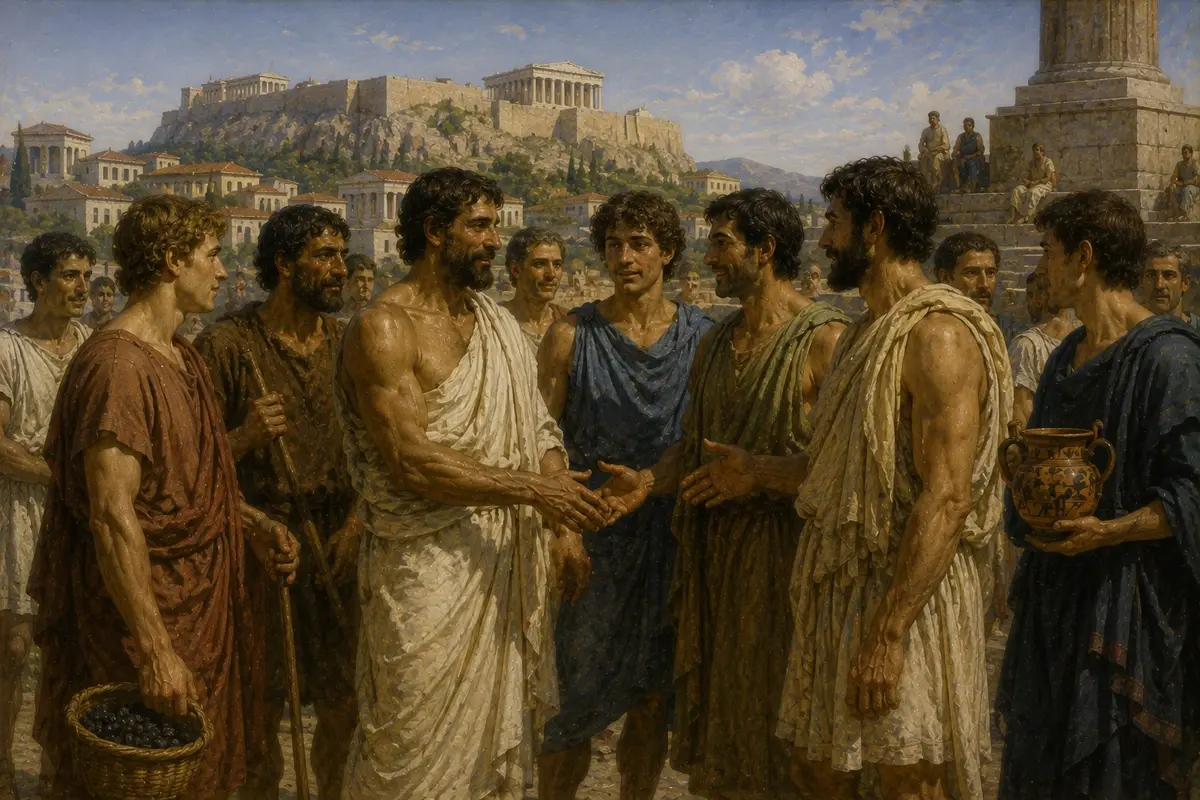
Each new tribe was built from one coastal, one inland and one urban third. Every tribe contained all three sets of economic interests — which meant the regional faction blocs simply stopped existing.
How It Worked Day to Day
The Council of Five Hundred (boule) prepared everything the Assembly voted on. Fifty men from each tribe, chosen by lot, serving one year, with a maximum of two terms in a lifetime. Selection by lot rather than election is the detail that separates Athenian democracy from anything modern. Elections favour the rich, the well-connected and the good-looking, and the Athenians knew it. Lot means an ordinary farmer sits on the council that sets the agenda for the state. The mathematics are startling. With a citizen body of perhaps 30,000 and 500 places a year, a very large proportion of Athenian men served on the Council at some point in their lives. Somewhere around one in three would also serve a day as chairman. The Assembly met on the Pnyx, several thousand at a time, and decided everything — war, treaties, laws, public spending — by show of hands. Any citizen could speak. The courts were juries of hundreds, chosen by lot, with no judge and no appeal. The limits should be stated plainly. Citizenship meant free adult males of Athenian parentage — so women, slaves and resident foreigners were excluded entirely, which is most of the population. It was a direct democracy for a minority. It was also, for that minority, more genuinely participatory than any system that has existed since.
Ostracism
Cleisthenes' strangest invention, and the one that says most about what he was afraid of. Once a year the Assembly was asked a single question: should we hold an ostracism this year? If yes, a date was set. On that day citizens came to the Agora and each scratched a name on a piece of broken pottery — an ostrakon, which was the ancient world's scrap paper, free and everywhere — and dropped it in. If at least 6,000 votes were cast, the man named on the most went into exile for ten years. The details matter. There was no charge, no trial, no defence — nobody had to accuse him of anything. He kept his property, and his family stayed. He came back after ten years with full citizenship restored. And it could be cut short, and often was — most famously in 480 BCE, when Athens recalled everyone in the face of the Persian invasion. It sounds monstrous and it was designed for one purpose: preventing another tyranny. Cleisthenes had watched a popular aristocrat turn a following into permanent personal rule, and built a tool to remove anyone who started to look like it, before he could act. Whether it worked is arguable. In practice it was mostly used to settle factional deadlock — when two leaders were pulling the city apart, one got sent away and policy could proceed.
Aristides the Just
The best ostracism story is Plutarch's. Aristides, nicknamed the Just for his conspicuous honesty over public money, was up for ostracism in 482 BCE against Themistocles, in an argument about whether Athens should build a fleet. On the day, an illiterate rural citizen who didn't recognise him handed him a piece of pottery and asked him to write a name on it. Aristides asked which name. Aristides, the man said. Aristides asked whether Aristides had ever done him any harm. No, said the man — I don't even know him. I'm just sick of hearing him called "the Just" everywhere I go. Aristides wrote his own name on the ostrakon and handed it back. He was exiled, recalled two years later when the Persians came, and fought at Salamis and commanded at Plataea. The archaeology backs the practice up nicely. Thousands of ostraka have been dug up in the Athenian Agora and Kerameikos with real names scratched on them — Themistocles, Aristides, Cimon, Pericles' father Xanthippus. One cache of about 190 was found together, all bearing Themistocles' name in only a handful of different hands: someone was mass-producing pre-written ballots to hand out. Ancient voter fraud, physically preserved.
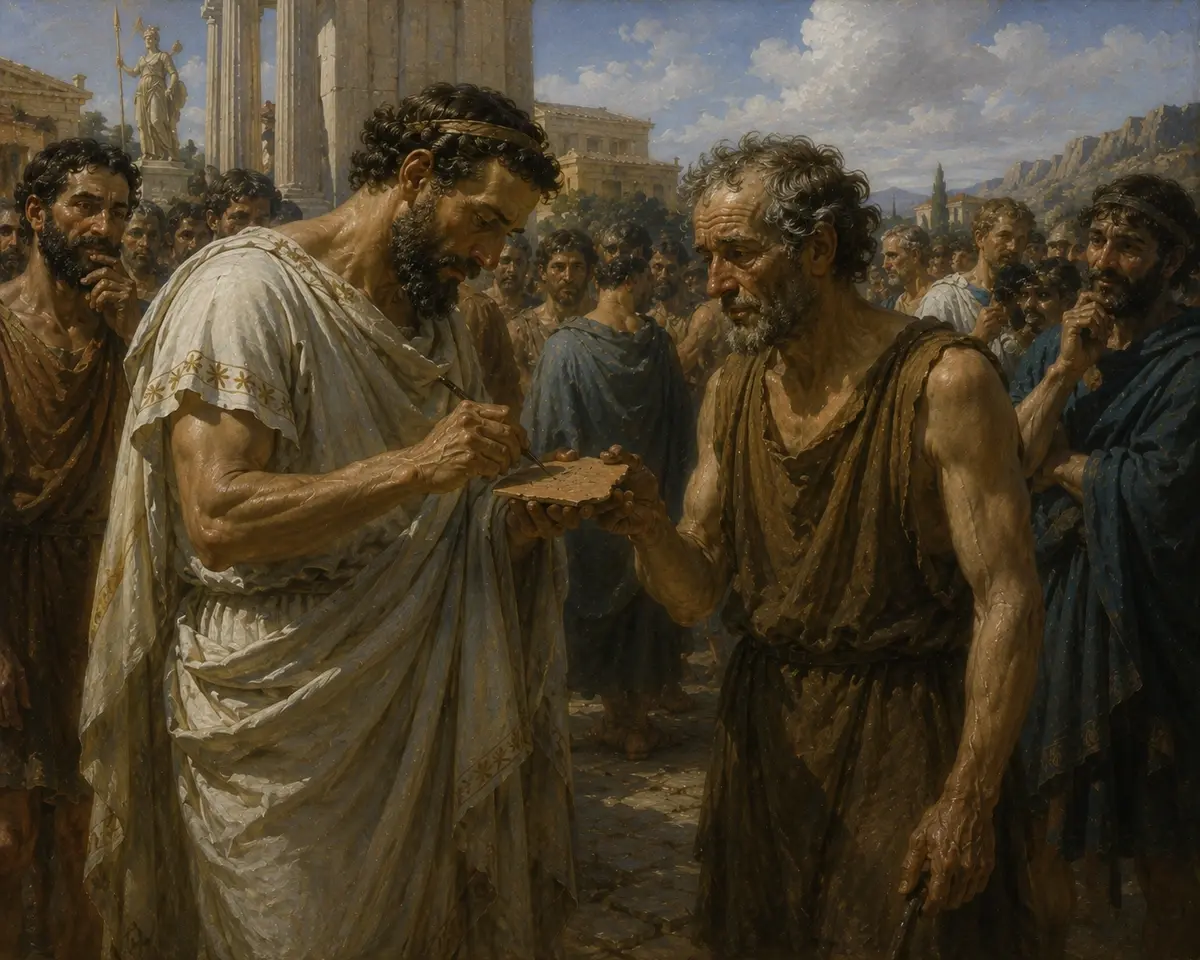
I don't even know him, said the man. I'm just sick of hearing him called "the Just" everywhere I go. Aristides wrote his own name and handed it back.
Then He Disappears
And that's it for Cleisthenes. He pushes through the most consequential constitutional reform in European history around 508/507 BCE, and then he is simply not mentioned again. No death date, no tomb we can identify, no later career. Herodotus, who tells us about the reforms, tells us nothing about what became of him. One theory is that he was ostracised himself under his own law, which would be a fine irony but has no evidence behind it. More likely he was elderly and died shortly afterwards. He built a system that ran for nearly two centuries and produced Aeschylus, Sophocles, Euripides, Thucydides, Socrates, Plato, the Parthenon and the idea that ordinary people can govern themselves — and we don't know how his own life ended.