Here's the uncomfortable thing about Jason. He's the hero of one of the great quest myths and he doesn't personally achieve very much. He assembles a spectacular crew and is repeatedly overshadowed by them. He gets to Colchis and is set three impossible tasks — and every one is solved by a seventeen-year-old princess with a chest of drugs. He gets home, loses the throne he went for, breaks his word to the woman who won it for him, and dies alone under a rotting boat. Which is why the myth has lasted. It's a heroic quest with a hero who isn't quite up to it, and the ancient poets knew that and wrote it deliberately.
Where the Fleece Came From
The fleece has its own backstory and it's grim. Phrixus and Helle were the children of a king, threatened by a scheming stepmother who engineered a false oracle demanding Phrixus be sacrificed. At the altar, a golden ram sent by Zeus came out of the sky and carried them both away east. Helle fell off partway and drowned in the strait that took her name — the Hellespont, the modern Dardanelles. Phrixus reached Colchis at the far eastern end of the Black Sea, in modern Georgia. He was taken in by King Aeëtes, and then sacrificed the ram that had saved his life to Zeus. The fleece was hung in a sacred grove and guarded by a dragon that never slept.
One Sandal
Meanwhile in Iolcus in Thessaly, Pelias had taken the throne from his half-brother. An oracle warned him to beware a man wearing one sandal. The rightful heir's son, Jason, was smuggled out as an infant and raised in the mountains by Chiron — the centaur who tutored half the heroes of Greece. At twenty, Jason came down to claim his inheritance. On the way he carried an old woman across a swollen river and lost a sandal in the mud. The old woman was Hera, who loathed Pelias, and from that moment she was on Jason's side. He walked into Iolcus wearing one sandal. Pelias, who could hardly murder him publicly, asked a question: what would you do with a man you knew was destined to kill you? Jason — either naive or set up by Hera — said he'd send him after the Golden Fleece. So that's what Pelias told him to do. It was meant to be a death sentence dressed as a quest.
The Argo and the Crew
The ship was built by a man named Argus with help from Athena, who set into the prow a beam of oak from the sacred grove at Dodona — and that beam could speak. A boat that gives advice is a genuinely strange piece of equipment and Apollonius uses it well. The crew is the appeal. It's a Bronze Age all-star team, and half of them are more famous than Jason: Heracles, at the height of his strength; Orpheus, the greatest musician alive; Castor and Pollux; Peleus, who would father Achilles, and Telamon, who would father Ajax; Atalanta, in some accounts; Zetes and Calais, sons of the North Wind, who could fly; Lynceus, whose eyesight could see through the ground; and two seers, Idmon and Mopsus, who both knew they wouldn't come back and came anyway. Notably, the crew offered the command to Heracles first. He turned it down and said it should be Jason's.
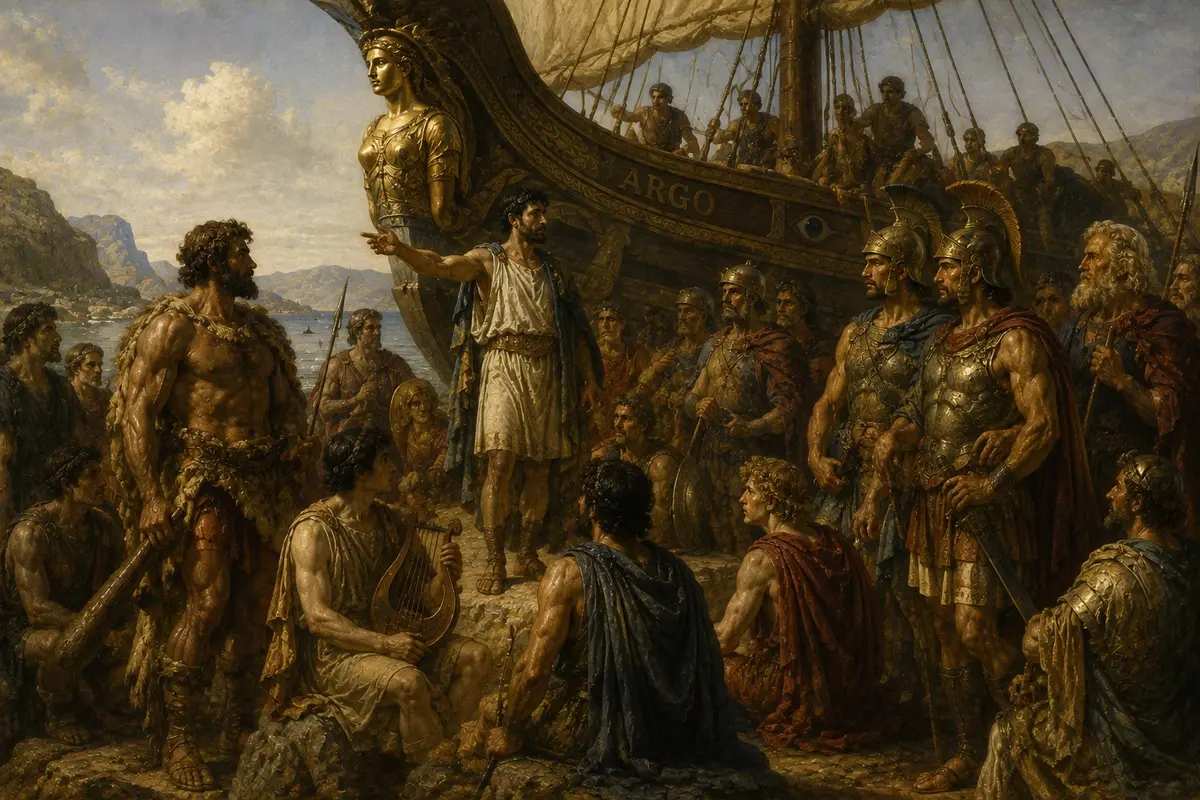
The crew offered the command to Heracles first. He turned it down and said it should be Jason's. Then they went on to repeatedly outperform the man they'd deferred to.
The Voyage Out
The outward journey is a sequence of episodes, and the good ones are very good. Lemnos: an island populated entirely by women, who had — some years earlier — murdered every man on it. The Argonauts stayed rather longer than the mission required. Heracles, who had stayed with the ship, eventually came and shouted at them until they left. Cyzicus: they were hosted generously by a young king, sailed at night, were blown back onto the same coast in the dark, and fought a battle in which Jason killed his own host, neither side recognising the other. In the morning they held funeral games for the man they'd murdered. Hylas: Heracles' young companion went to fetch water and was pulled into a spring by the nymphs. Heracles went mad looking for him, tore up trees, and refused to leave — and the Argo sailed without him. Losing the strongest man in Greece a third of the way in is a deliberate structural choice: the story wants Jason to have to manage. Phineus and the Harpies: a blind prophet punished with a curse — whenever food was set in front of him, the Harpies swooped down and either snatched it or fouled what they left. He had been starving for years, in sight of food. Zetes and Calais, being winged themselves, drove them off permanently. In return Phineus told them how to get through what was coming.
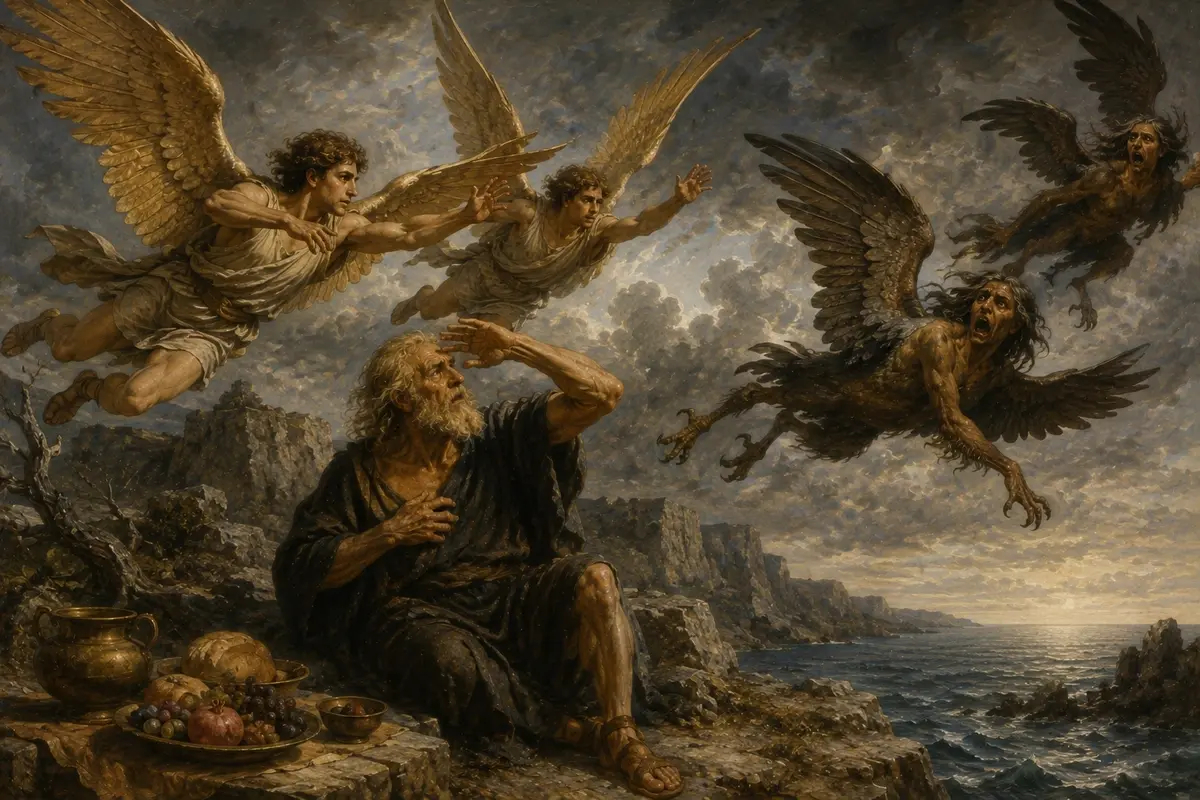
Phineus had been starving for years, in sight of food. The sons of the North Wind drove off the Harpies — and he told the Argonauts how to get through the Clashing Rocks.
The Clashing Rocks
The Symplegades were two cliffs at the entrance to the Black Sea that floated apart and slammed together, crushing anything trying to pass. Phineus's instruction was to release a dove and watch. The dove went through and the rocks closed and clipped its tail feathers as it cleared. So they knew two things: that a passage was possible, and exactly how much margin they had. They went in on the rebound, rowing flat out, and Athena put a hand on the stern and pushed. The rocks closed behind them and took the ornament off the sternpost. And then the Symplegades stopped moving. They had been fated to stand still forever once a ship got through. Nobody after the Argo ever had to face them.
Colchis, and Medea
King Aeëtes received them, heard the request, and had no intention of handing over anything. So he set conditions: yoke the khalkotauroi — two bulls with bronze hooves that breathed fire — plough a field with them, sow the field with dragon's teeth, and deal with what came up. All in one day. Jason had no answer to any of it. What he had was Hera and Aphrodite, watching from above and deciding the most efficient solution was to make the king's daughter fall in love with him. Eros was sent down to shoot her. Medea was a priestess of Hecate and a pharmakis — a woman who knew drugs and spells. She was also, in Apollonius's telling, very young, and the third book of the Argonautica is largely her internal argument with herself: knowing that helping this stranger means betraying her father and destroying her own life, and doing it anyway. It is the best sustained piece of psychological writing in Greek epic, and it's about a teenager deciding to ruin herself. She gave him an ointment made from a flower grown from Prometheus's spilt blood, which made him fireproof and unwoundable for a day. She told him what to do about the dragon's teeth. So: he yoked the bulls, ploughed the field, sowed the teeth — and armed men grew out of the ground. On Medea's instruction he threw a rock into the middle of them. Unable to see who had thrown it, they turned on each other, and he killed the survivors while they fought. Then Medea took Jason to the grove at night, drugged the sleepless dragon, and he took the fleece off the branch. Jason's total independent contribution to the quest is carrying it back to the ship.
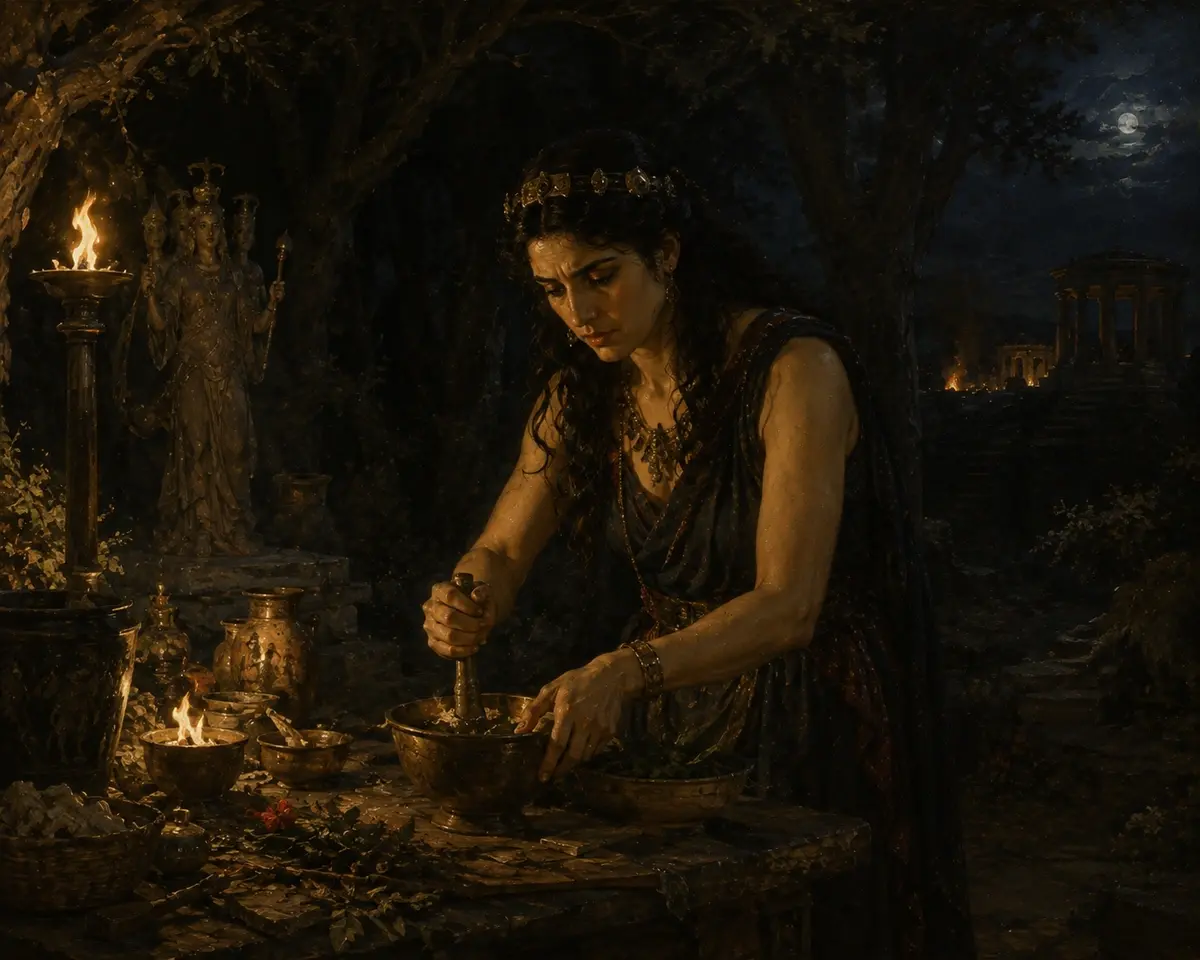
She was a priestess of Hecate and a woman who knew drugs. Apollonius's third book is her internal argument with herself: knowing that helping him means destroying her own life, and doing it anyway.
The Return
They ran, and Aeëtes pursued, and what happens next is the thing that shadows the rest of Medea's story. Her young brother Apsyrtus was killed. In the oldest and ugliest version she takes him aboard, kills him herself and drops the pieces into the sea one at a time so that her father has to stop and collect them. In Apollonius, Jason kills him in an ambush Medea arranges. Either way, both of them are complicit in murdering a child, and both know it. The way home is a long, strange circuit through the western Mediterranean — including a stop with the sorceress Circe for ritual purification, which she performs and then throws them out. Two more set pieces: the Sirens, where Orpheus simply picked up his lyre and played louder and better until the crew couldn't hear them — the same problem Odysseus solves with wax and rope a generation later, and Orpheus solves it with a better song; and Talos, the bronze automaton that ran round Crete three times a day throwing rocks at ships, defeated by Medea working out how to remove the pin that sealed its single vein.
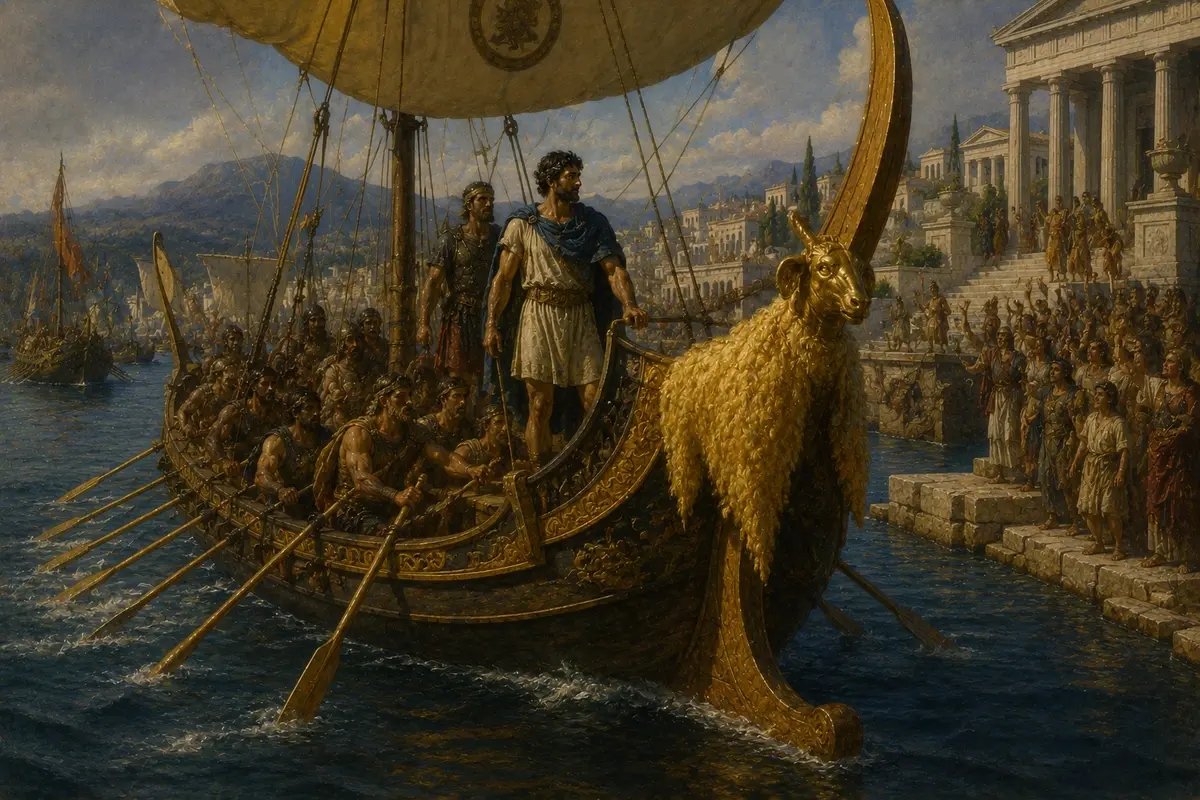
They got home. Pelias refused to give up the throne. Medea handled it. The rest of the story belongs to her.
The Ending Nobody Puts on the Poster
They got home to Iolcus with the fleece, and Pelias refused to give up the throne. So Medea handled it. She went to Pelias's daughters and demonstrated a rejuvenation spell — cut up an old ram, boiled it with herbs, and produced a lamb. Then she persuaded them that they could do the same for their aged father. They cut their father up. She left out the herbs. It worked, in the sense that Pelias was dead. It also made Jason and Medea unrulable, and they were driven out and went into exile in Corinth. They lived there for years and had two sons. Then Jason arranged to marry Glauce, the daughter of the king of Corinth, on the practical grounds that it would give him a throne — and had the nerve to explain to Medea that he was doing it for the family's benefit and that she ought to be grateful, since she'd got to live in Greece instead of a barbarian country. Euripides' Medea (431 BCE) is what happens next, and it is still one of the most frightening plays ever written. She sends a poisoned robe and crown that kill Glauce and her father. Then, deliberately, and after an agonising scene in which she changes her mind twice, she kills her own two children — because they are Jason's, and because the one thing she can do to him that he cannot undo is take his line away. Then she leaves in a chariot drawn by dragons, with the bodies, and Jason is left on the ground with nothing.
What the Myth Is Doing
Jason is not a warrior hero and isn't meant to be. He doesn't win by strength — he has Heracles for that and loses him early. He wins by persuading people to help him: the crew, Phineus, Medea, the gods. Apollonius calls him amechanos — at a loss — over and over. He's a leader of a difficult coalition, which is a much more modern kind of protagonist. And his one real flaw is fatal. He is dependent on other people, and then he doesn't honour what he owes them. Medea gives up her family, her country and her name for a promise. Breaking it is what destroys him, and the Greeks were clear that oath-breaking was the offence. Euripides has the chorus of Corinthian women, who have every reason to side with the Greek, side with the foreign witch instead. Medea is the real subject. She has outlived him by a wide margin in the culture, and she's been rewritten more than any other Greek figure — as monster, as victim, as coloniser's discarded wife, as an argument about what happens to women who make themselves useful to ambitious men.
Is There Anything Behind It?
Possibly, in a general way. Colchis is a real place — western Georgia, on the Black Sea — and it was famous in antiquity for gold. There's a well-attested local method of extracting alluvial gold by pegging sheepskins into a stream so the fleece catches the heavy particles, and pulling out a skin glittering with gold dust. Strabo mentions it. What the voyage does clearly reflect is a real Greek expansion — colonists pushing up the Black Sea coast into unfamiliar waters from the 8th century BCE. Homer already refers to the Argonauts in the Odyssey as a tale everyone knows.